
Judge, 1918-06-08 · page 19 of 36
Judge — June 8, 1918 — page 19: what you’re looking at
What you’re looking at
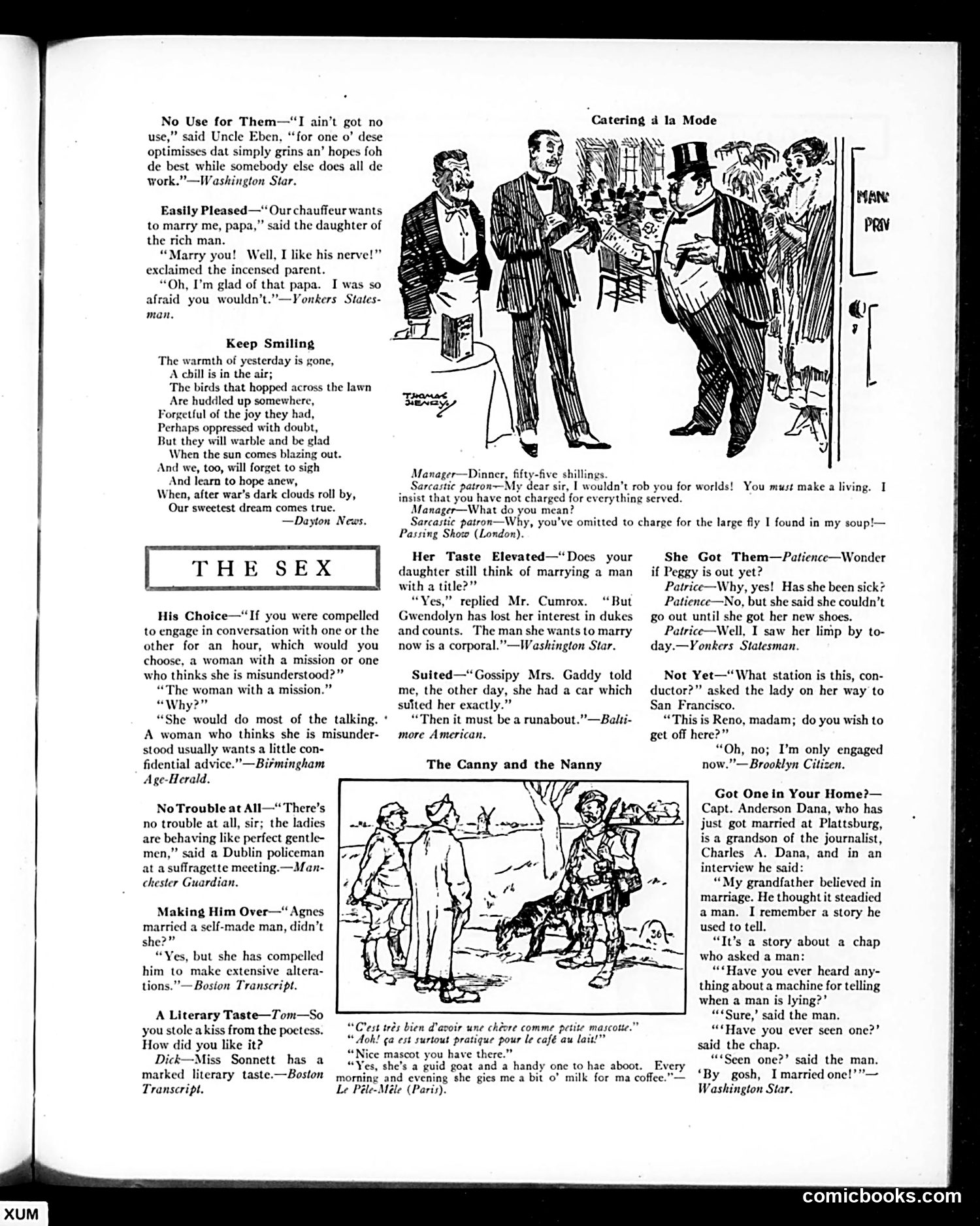
This page collects brief humorous anecdotes and satirical cartoons typical of early 20th-century American humor. **Key content:** The cartoons mock social pretensions and gender dynamics. "Catering à la Mode" satirizes both pretentious diners and struggling restaurants through a sarcastic patron who demands compensation for a fly in his soup—commenting on the economic struggles of service workers. "The Canny and the Nanny" shows a woman limping despite claiming she couldn't go out without new shoes, mocking female materialism and vanity. "His Choice" presents misogynistic stereotypes about women—those with "missions" being talkative busybodies, while those feeling "misunderstood" seek male attention and advice. References include "suffragette meeting," reflecting contemporary tensions over women's voting rights. The "Reno" joke alludes to Reno, Nevada as a divorce destination—significant because divorce was scandalous and location-dependent. Overall, the page reflects period attitudes: skepticism toward women's education/activism, workplace class dynamics, and marital/romantic anxieties. The humor relies on stereotypes now recognized as dated or offensive.
📄 Transcribed text from this page (OCR, searchable)
Machine-transcribed from the original scan — historical spelling and the odd misread are preserved.
XUM No Use for Them—“I ain’t got no use,” said Uncle Eben, ‘“‘for one 0’ dese optimisses dat simply grins an’ hopes foh de best while somebody else does all de work.”—Washington Star. Easily Pleased—‘‘ Our chauffeur wants to marry me, papa,” said the daughter of the rich man. “Marry you! Well, I like his nerve!” exclaimed the incensed parent. “Oh, I’m glad of that papa. I was so afraid you wouldn’t.”—Yonkers States- man. Keep Smiling The warmth of yesterday is gone, A chill is in the air; The birds that hopped across the lawn Are huddled up somewhere, Forgetful of the joy they had, Perhaps oppressed with doubt, But they will warble and be glad When the sun comes blazing out. And we, too, will forget to sigh And learn to hope anew, When, after war’s dark clouds roll by, Our sweetest dream comes true. —Dayton News. HE SEX | His Choice—‘“If you were compelled to engage in conversation with one or the other for an hour, which would you choose, a woman with a mission or one who thinks she is misunderstood?” “The woman with a mission.” “Why?” “She would do most of the talking. * A woman who thinks she is misunder- stood usually wants a little con- fidential advice.” —Birmingham Age-Herald. ‘Catering d la Mode Manager—Dinner, fifty-five shillings. Sarcastic patron 'y dear sir, I wouldn’t rob you for worlds! You must make a living. I insist that you have not charged for everything served. Manager—What do you mean? Sarcastic patron—Why, you've omitted to charge for the large fly I found in my soup!— Passing Show (London). Her Taste Elevated—“Docs your daughter still think of marrying a man with a title?” “Yes,” replied Mr. Cumrox. “But Gwendolyn has lost her interest in dukes and counts. The man she wants to marry now is a corporal.” —Washington Star. Suited—“Gossipy Mrs. Gaddy told me, the other day, she had a car which sulted her exactly.” “Then it must be a runabout.”—Balti- more American. The Canny and the Nanny She Got Them—Patience—Wonder if Peggy is out yet? Patrice—Why, yes! Has she been sick? Patience—No, but she said she couldn’t go out until she got her new shoes. Patrice—Well, I saw her limp by to- day.—Yonkers Statesman. Not Yet—“ What station is this, con- ductor?” asked the lady on her way to San Francisco. “This is Reno, madam; do you wish to get off here?” now.”—Brooklyn Citizen. “Oh, no; I’m only engaged Got One in Your Home?— No Trouble at All—“ There’s no trouble at all, sir; the ladies are behaving like perfect gentle- men,” said a Dublin policeman at a suffragette meeting.—Man- chester Guardian. Making Him Over—‘ Agnes married a self-made man, didn’t she?” “Yes, but she has compelled him to make extensive altera- tions.” — Boston Transcript. A Literary Taste—Tom—So you stole a kiss from the poetess. How did you like it? “Crest trés bien d'avoir une chéore comme petite mascotte.” “ Aoh! ¢a est surtout pratique pour le café au lait!” ¢ mascot you have there.” Capt. Anderson Dana, who has just got married at Plattsburg, is a grandson of the journalist, Charles A. Dana, and in an interview he said: “My grandfather believed in marriage. He thought it steadied aman. I remember a story he used to tell. “It’s a story about a chap who asked a man: “*Have you ever heard any- thing about a machine for telling when a man is lying?’ “ ‘Sure,’ said the man. “*Have you ever seen one?’ said the chap. “*Seen one?’ said the man. Dick—Miss Sonnett has a marked literary taste.—Boston Transcript. she’s a guid goat and a handy one to hae aboot. Every morning and evening she gies me a bit o° milk for ma coffee.”— Le Péle-Méle (Paris). “By gosh, I married one!?”"— Washington Star. comicbooks.com