
Judge, 1918-06-08 · page 16 of 36
Judge — June 8, 1918 — page 16: what you’re looking at
What you’re looking at
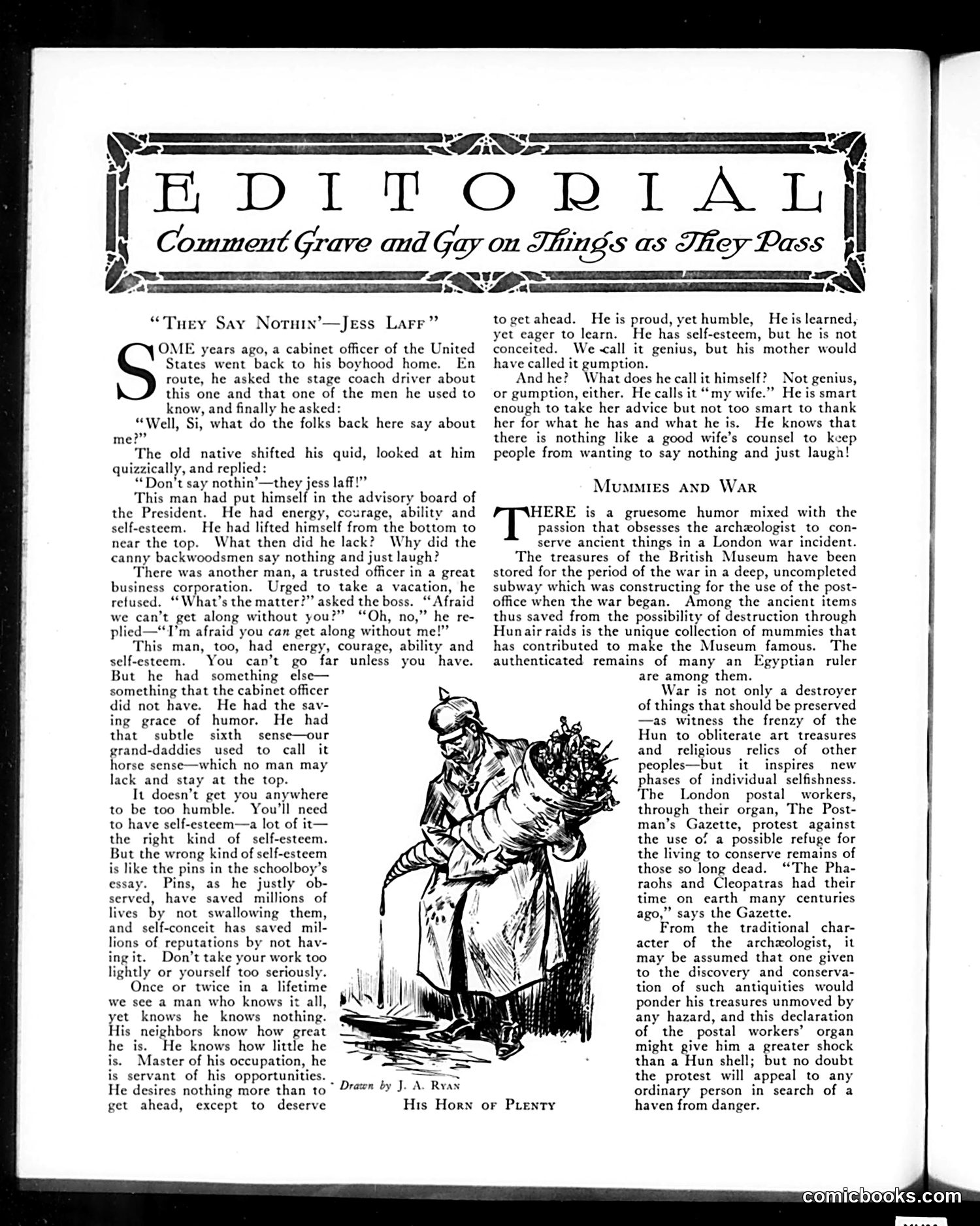
This page contains two separate satirical pieces: **"They Say Nothin'—Jess Laff"** (left column with illustration): A moral essay contrasting two successful men. One cabinet officer lacks humor and self-awareness, prompting backwoods people to laugh at him. A second, more successful businessman possesses "saving grace of humor"—that "horse sense" allowing him to recognize his own limitations. The satire targets excessive self-importance and lack of humility among ambitious men, suggesting that true success requires not just self-esteem, but humble self-awareness and the wisdom of listening to one's wife. **"Mummies and War"** (right column): Commentary on a real conflict during World War I. London postal workers protested using an underground subway (built for the post office) to store British Museum treasures, including Egyptian mummies. The satire criticizes workers' prioritizing comfort over cultural preservation during wartime, while also condemning German destruction of art. The piece suggests war reveals both noble preservation efforts and petty selfishness. Both pieces use humor to critique human vanity and priorities.
📄 Transcribed text from this page (OCR, searchable)
Machine-transcribed from the original scan — historical spelling and the odd misread are preserved.
OS Comment Grave and Gay 4 t> “THEY OME years ago, a cabinet officer of the United States went back to his boyhood home. En route, he asked the stage coach driver about this one and that one of the men he used to know, and finally he asked: “Well, Si, what do the folks back here say about me?” The old native shifted his quid, quizzically, and replied: “Don’t say nothin’—they jess laff!” This man had put himself in the advisory board of the President. He had energy, courage, ability and self-esteem. He had lifted himself from the bottom to near the top. What then did he lack? Why did the canny backwoodsmen say nothing and just laugh? There was another man, a trusted officer in a great business corporation. Urged to take a vacation, he refused. “What’s the matter?” asked the boss. “Afraid we can’t get along without you?” “Oh, no,” he re- plied—“I’m afraid you can get along without me!” This man, too, had energy, courage, ability and self-esteem. You can’t go far unless you have. But he had something else— something that the cabinet officer did not have. He had the sav- ing grace of humor. He had that subtle sixth sense—our grand-daddies used to call it horse sense—which no man may lack and stay at the top. It doesn’t get you anywhere to be too humble. You'll need to have self-esteem—a lot of it— the right kind of self-esteem. But the wrong kind of self-esteem is like the pins in the schoolboy’s essay. Pins, as he justly ob- served, have saved millions of lives by not swallowing them, and self-conceit has saved mil- lions of reputations by not hav- ingit. Don’t take your work too lightly or yourself too seriously Once or twice in a lifetime we see a man who knows it all, yet knows he knows nothing. His neighbors know how great he is. He knows how little he is. Master of his occupation, he is servant of his opportunities. He desires nothing more than to get ahead, except to deserve Say Noruin’—Jess Larr” looked at him > Drawen by J. A. Ryan iH DITORIALS His Horn oF Pienty =a on Things as They Pass 5 Q= togetahead. He is proud, yethumble, He is learned, yet eager to learn. He has self-esteem, but he is not conceited. We «all it genius, but his mother would have called it gumption. And he? What does he call it himself? Not genius, or gumption, either. He calls it “my wife.”” He is smart enough to take her advice but not too smart to thank her for what he has and what he is. He knows that there is nothing like a good wife’s counsel to keep people from wanting to say nothing and just laugh! | passion that obsesses the archxologist to con- serve ancient things in a London war incident. The treasures of the British Museum have been stored for the period of the war in a deep, uncompleted subway which was constructing for the use of the post- office when the war began. Among the ancient items thus saved from the possibility of destruction through Hunair raids is the unique collection of mummies that has contributed to make the Museum famous. The authenticated remains of many an Egyptian ruler are among them. War is not only a destroyer of things that should be preserved —as witness the frenzy of the Hun to obliterate art treasures and religious relics of other peoples—but it inspires new phases of individual selfishness. The London postal workers, through their organ, The Post- man’s Gazette, protest against the use of a possible refuge for the living to conserve remains of those so long dead. ‘The Pha- raohs and Cleopatras had their time on earth many centuries ago,” says the Gazette. From the traditional char- acter of the archzologist, it may be assumed that one given to the discovery and conserva- tion of such antiquities would ponder his treasures unmoved by any hazard, and this declaration of the postal workers’ organ might give him a greater shock than a Hun shell; but no doubt the protest will appeal to any ordinary person in search of a haven from danger. Mummies anp War HERE is a gruesome humor mixed with the icbooks.com