
Judge, 1918-06-08 · page 7 of 36
Judge — June 8, 1918 — page 7: what you’re looking at
What you’re looking at
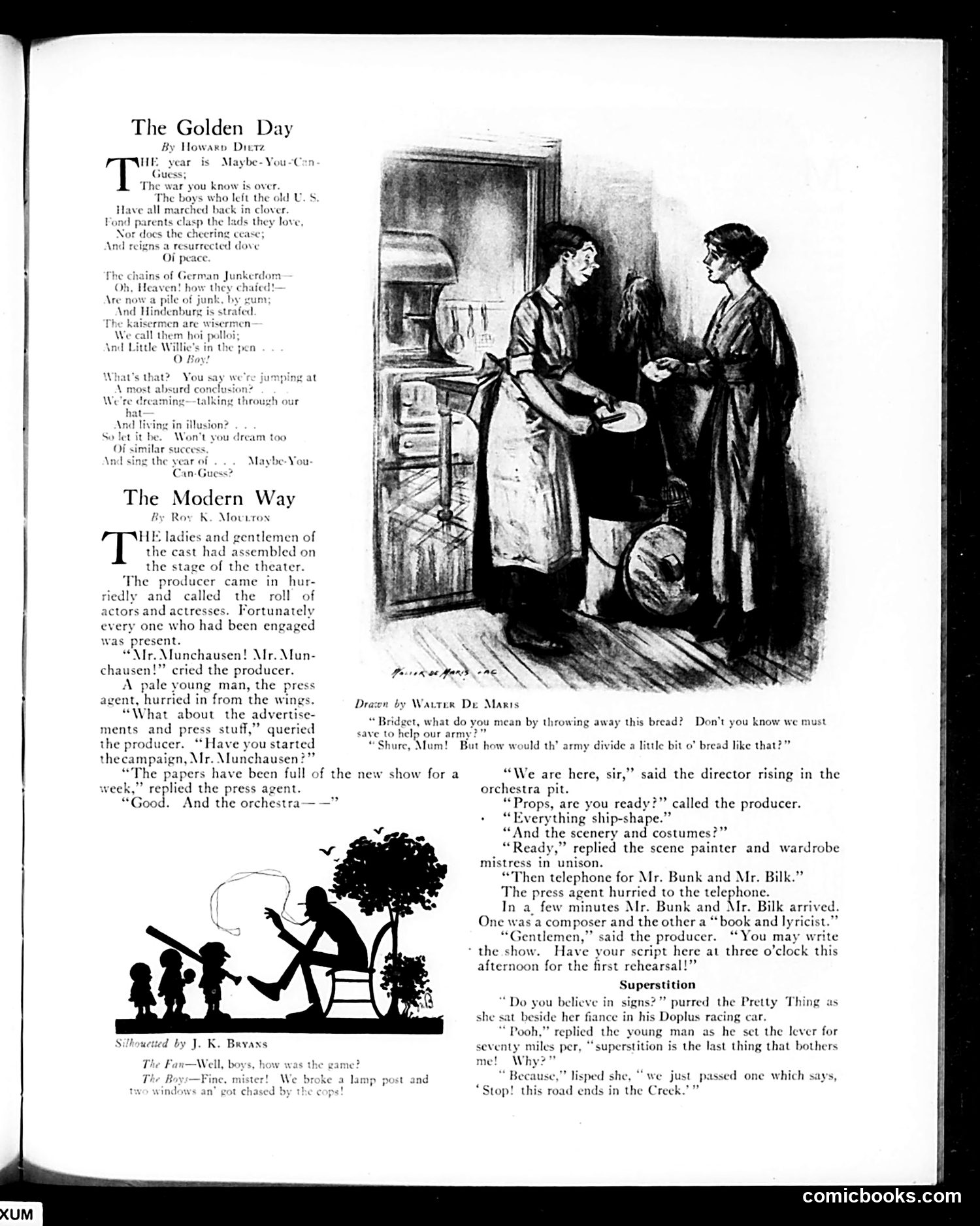
**"The Golden Day"** by Howard Dietz is a post-WWI poem imagining a peaceful future ("Maybe-You-Can-Guess") where American soldiers have returned home victorious and war has ceased. It's optimistic wartime propaganda, encouraging readers to dream of peaceful prosperity after the conflict. **"The Modern Way"** satirizes theatrical production. A producer assembles a cast and hires composers/lyricist "Mr. Bunk and Mr. Bilk" to write an entire show by 3 p.m.—mocking the rushed, commercialized nature of modern theater where shows are churned out quickly for profit rather than artistic merit. The names suggest "bunk" (nonsense) and "bilk" (swindle). **"Superstition"** jokes about a reckless young couple in a racing car. The woman warns about superstitions while her boyfriend dismissively speeds ahead, ignoring a road sign warning "this road ends in the Creek"—dark humor about overconfidence meeting consequences. All three pieces reflect post-WWI American attitudes: optimism about peace, cynicism about commercial entertainment, and satirical commentary on modern behavior.
📄 Transcribed text from this page (OCR, searchable)
Machine-transcribed from the original scan — historical spelling and the odd misread are preserved.
The Golden Day By Howarn Dietz HE. year is Maybe-YousCon Guess; he war you know is over The boys who left the old U.S Have all marched back in clover. s they love heerii igns a resurrected dove OF peace n Junkerdor y chaiec by gum strafed. “We call them t's that? You say we t absurd conc talking living in illusion? So let it be. Won't you dream too OF similar succe And sing the year of Maybe-You Can-Guess? The Modern Way B: Roy K. Movuros HE la s and gentlemen of the cast had assembled on the stage of the theater. The producer came in_hur- riedly and called the roll of actors and actresses. Fortunately every one who had been engaged was present. “Mr. Munchausen! Mr. Mun- chausen!” cried the producer. A pale young man, the press agent, hurried in from the wings. Dracon:'by Warren “What about the advertise- ments and press stuff,” queried the producer. ‘Have you started thecampaign, Mr. Munchausen?” “The papers have been full of the new show for a week,” replied the press agent. “Good. And the orchestra—— “Shure, Mum! Pirie oe Hard SA De Maris “ Bridget, what do you mean by throwing away this bread? Don't you know we must save to help our army?” But how would th’ army divide a little bit 0° bread like that?” “We are here, sir,” said the director rising in the orchestra pit. “Props, are you ready?” called the producer. + “Everything ship-shape.” “And the scenery and costumes?” “Ready,” replied the scene painter and wardrobe mistress in unison. “Then telephone for Mr. Bunk and Mr. Bilk.” The press agent hurried to the telephone. In a, few minutes Mr. Bunk and Mr. Bilk arrived. One was a composer and the other a “book and lyricist.” “Gentlemen,” said the producer. ‘You may write * the show. Have your script here at three o’clock this afternoon for the first rehearsal!” Superstition signs?” purred the Pretty Thing as she sat beside her f n his Doplus racing car. “Pooh,” replied the young man as he set the lever for seventy miles per, “superstition is the last thing that bothers me! Why?” as “Stop! this road ends in the Creck.’” “Do you believe i se,” lisped she, “we just: passed one which says, comicbooks.com