
Judge, 1918-06-08 · page 20 of 36
Judge — June 8, 1918 — page 20: what you’re looking at
What you’re looking at
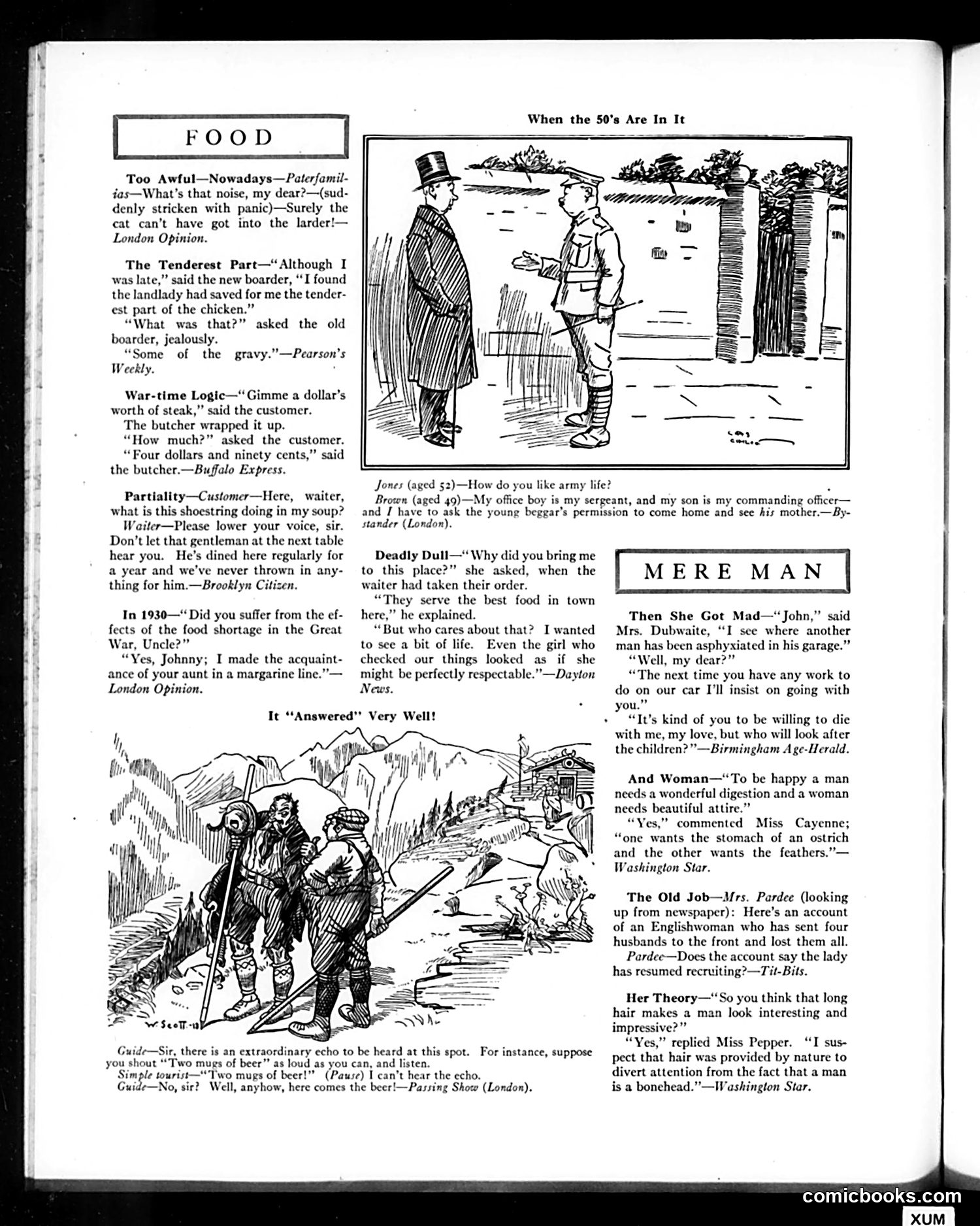
This page collects brief humorous anecdotes reflecting **wartime rationing and social disruption during World War I**. Key satirical points: **Food shortage jokes**: Multiple items mock scarcity—a butcher charging exorbitant prices, waiter serving "gravy" as chicken, someone meeting their spouse in a "margarine line" (rationed margarine queues). **Military hierarchy inversion**: "When the 50's Are In It" depicts an older man whose son is his commanding officer and office boy his sergeant—inverting normal age-based authority, likely mocking how WWI conscription displaced traditional social order. **Gender dynamics**: "Then She Got Mad" satirizes a woman insisting on accompanying her husband during car repairs, fearing he'll die in his garage (likely referencing carbon monoxide suicide, a period concern). **The echo cartoon** shows a guide deliberately tricking a tourist—shouting "Two mugs of beer" produces actual beer rather than an echo, mocking gullibility. The overall tone is **cynical about wartime hardship** while maintaining light, domestic humor typical of 1910s-20s satirical magazines.
📄 Transcribed text from this page (OCR, searchable)
Machine-transcribed from the original scan — historical spelling and the odd misread are preserved.
Too Awful—Nowadays—Paterfamil- tas—What’s that noise, my dear?—(sud- denly stricken with panic)—Surely the cat can’t have got into the larder!— London Opinion. The Tenderest Part—“ Although I was late,” said the new boarder, “I found the landlady had saved for me the tender- est part of the chicken.” “What was that?” boarder, jealously. “Some of the gravy.”—Pearson’s Weekly. asked the old War-time Logic—“ Gimme a dollar’s worth of steak,” said the customer. The butcher wrapped it up. “How much?” asked the customer. “Four dollars and ninety cents,” said the butcher.—Buffalo Express. Partiality—Customer—Here, waiter, what is this shoestring doing in my soup? Waiter—Please lower your voice, sir. Don’t let that gentleman at the next table hear you. He’s dined here regularly for a year and we've never thrown in any- thing for him.—Brooklyn Citizen. In 1930—“ Did you suffer from the ef- fects of the food shortage in the Great War, Uncle?” “Yes, Johnny; I made the acquaint- ance of your aunt in a margarine line.”— London Opinion. When the 50's Are In It Jones (aged 52)—How do you like army life? Brown (aged 49)—My office boy is my sergeant, and my son is my commanding officer— and J have to ask the young beggar’s permission to come home and see his mother.—By- stander (London). Deadly Dull—‘ Why did you bring me to this place?” she asked, when the waiter had taken their order. “They serve the best food in town here,” he explained. “But who cares about that? I wanted to see a bit of life. Even the girl who checked our things looked as if she might be perfectly respectable.” —Dayton News. It “Answered” Very Well! Sir, there is an extraordinary echo to be heard at this spot. For instance, suppose you shout “Two mugs of beer” as loud as you can, and listen. Simple tourist Guide—No, sir? “Two mugs of beer!"” (Pause) I can’t hear the echo. Well, anyhow, here comes the beer!—Passing Show (London). Then She Got Mad—“ John,” said Mrs. Dubwaite, ‘I see where another man has been asphyxiated in his garage.” “Well, my dear?” “The next time you have any work to do on our car I'll insist on going with you.” “It's kind of you to be willing to die with me, my | but who will look after the children?” —Birmingham A ge-Herald. And Woman—“To be happy a man needs a wonderful digestion and a woman needs beautiful attire.” “Yes,” commented Miss Cayenne; “one wants the stomach of an ostrich and the other wants the feathers.”— Washington Star. The Old Job—Mrs. Pardee (looking up from newspaper): Here’s an account of an Englishwoman who has sent four husbands to the front and lost them all. Pardee—Does the account say the lady has resumed recruiting?—Tit-Bits. Her Theory—‘‘So you think that long hair makes a man look interesting and impressive?” “Yes,” replied Miss Pepper. “I sus- pect that hair was provided by nature to divert attention from the fact that a man is a bonehead.” —IWashington Star. comicbooks.com