
Judge, 1918-06-08 · page 25 of 36
Judge — June 8, 1918 — page 25: what you’re looking at
What you’re looking at
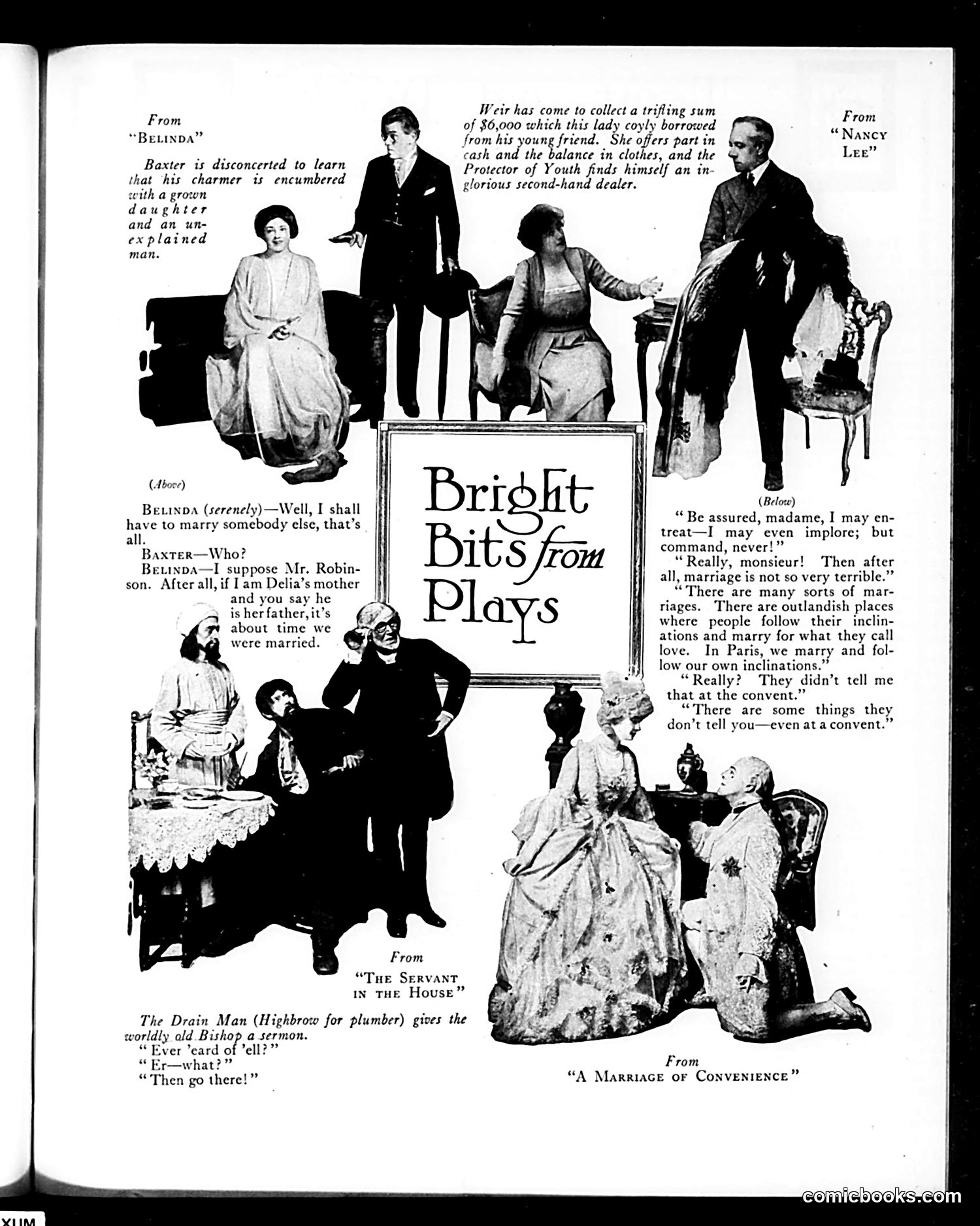
This page excerpts comedic dialogue from theatrical productions, satirizing marriage customs and social hypocrisy of the early 20th century. **"Belinda"** scene mocks opportunistic romance: a woman casually agrees to marry Mr. Robinson merely because they share a daughter and an "unexplained man"—suggesting unmarried cohabitation was socially scandalous enough to require hastily arranging matrimony. **"A Marriage of Convenience"** portrays a cynical Parisian marriage negotiation where a woman admits Paris allows marriages based on "inclinations" rather than love—implying this contrasts with supposedly more moral English/American practice. The joke criticizes French moral laxity. **"The Servant in the House"** features a working-class plumber lecturing a Bishop about hell—a reversal of expected social hierarchy that exposes the clergyman's worldliness. The overall satirical thrust: Judge mocks the gap between claimed respectability and actual behavior across classes and cultures, presenting marriage as transactional and religious authority as compromised.
📄 Transcribed text from this page (OCR, searchable)
Machine-transcribed from the original scan — historical spelling and the odd misread are preserved.
From “BeLinDa” Baxter is disconcerted to learn that his charmer is encumbered with a grown daughter and an un- ex plained man. (Above) Bewinpa (serenely) —Well, I shall have to marry somebody else, that’s all. Baxter—Who? Betinpa—I suppose Mr. Robin- son. After all, if Iam Delia’s mother and you say he A is her father, it’s about time we were married. Weir has come to collect a trifling sum of $6,000 which this lady coyly borrowed from his young friend. She offers part in cash and the balance in clothes, and the Protector of Youth finds himself an in- glorious second-hand dealer. (Belowe) “ Be assured, madame, I may en- treat—I_ may even implore; but command, never!” “Really, monsieur! Then after all, marriage is not so very terrible.” “There are many sorts of mar- riages. There are outlandish places where people follow their inclin- ations and marry for what they call love. In Paris, we marry and fol- low our own inclinations.” “Really? They didn’t tell me that at the convent.” “There are some things they don’t tell you—even ata convent.” “Tue SERVANT In THE House” The Drain Man (Highbrow for plumber) gives the worldly ald. Bishop a sermon. “ Ever ’eard of ’ell?” “ Er—what?” “Then go there!” From “A Marriace or CoNnvENIENCE”