
Judge, 1918-06-08 · page 22 of 36
Judge — June 8, 1918 — page 22: what you’re looking at
What you’re looking at
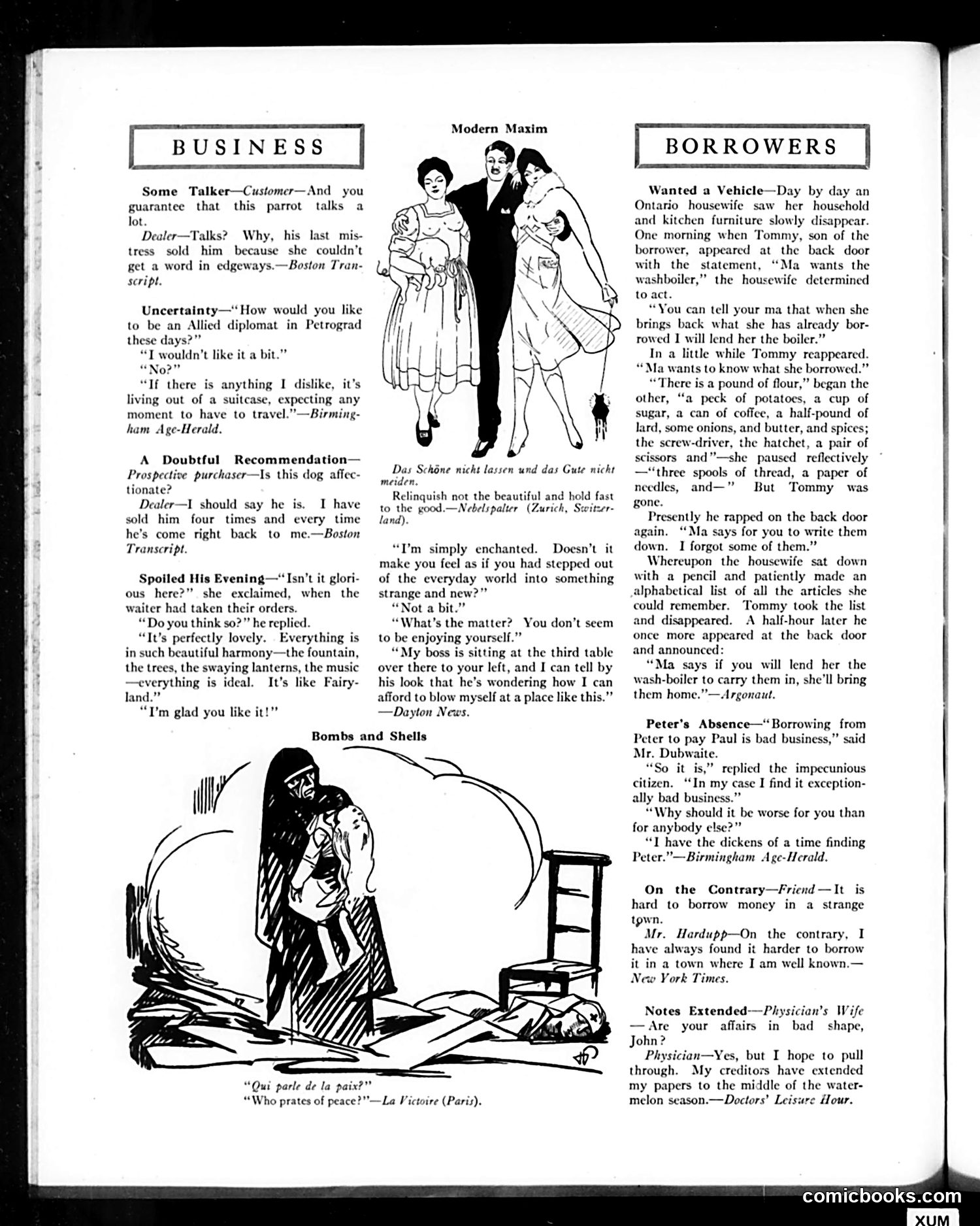
This page collects humorous anecdotes and cartoons reflecting early 20th-century American life and wartime concerns. **The Business section** includes jokes about everyday transactions: a talkative parrot, diplomatic uncertainty (likely referencing WWI-era Petrograd/Russian Revolution instability), and a dog repeatedly returned to its seller—satirizing consumer behavior and trust. **The "Modern Maxim"** presents a German aphorism about balancing beauty and goodness, alongside a cartoon labeled "Bombs and Shells" depicting a distressed woman amid war devastation, captioned in French asking "Who speaks of peace?"—reflecting contemporary anxiety about ongoing WWI. **The Borrowers section** satirizes a widespread social problem: chronic borrowing. Stories depict neighbors endlessly requesting household items without returning them, and financial desperation (borrowing from Peter to pay Paul). The humor targets both shameless borrowers and the social awkwardness of debt collection among acquaintances—a relatable concern during economically uncertain times.
📄 Transcribed text from this page (OCR, searchable)
Machine-transcribed from the original scan — historical spelling and the odd misread are preserved.
BUSINESS Some Talker—Customer—And you guarantee that this parrot talks a lot. Dealer—Talks? Why, his last mis- tress sold him because she couldn’t get a word in edgeways.—Boston Tran- script. Uncertainty—“ How would you like to be an Allied diplomat in Petrograd these days?” “T wouldn't like it a bit.” “If there is anything I dislike, it’s living out of a suitcase, expecting any moment to have to travel.”—Birming- ham Age-Herald. A Doubtful Recommendation— Prospective purchaser—Is this dog affec- tionate? Dealer—I should say he is. I have sold him four times and every time he’s come right back to me.—Boston Transcript. Spoiled His Evening—“Isn’t it glori- ous here?” she exclaimed, when the waiter had taken their ordet “Do you think so?” he replied. “It’s perfectly lovely. Everything is in such beautiful harmony—the fountain, the trees, the swaying lanterns, the music —everything is ideal. It's like Fairy- land.” “T’'m glad you like it!” Modern Maxim Das Schone nicht lassen und das Gute nicht meiden. Relinquish not the beautiful and hold fast to the good.—Nebelspalter (Zurich, Stwitzer- land). “I’m simply enchanted. Doesn't it make you feel as if you had stepped out of the everyday world into something strange and new?” “Not a bit.” “What's the matter? to be enjoying yourself.” “My boss is sitting at the third table over there to your left, and I can tell by his look that he’s wondering how I can afford to blow myself at a place like this.” —Dayton News. You don’t seem Bombs and Shells i” “Qui parle de la paix?” “Who prates of peace?""—La Victoire (Paris). | BORROWERS Wanted a Vehicle—Day by day an Ontario housewife saw her household and kitchen furniture slowly disappear. One morning when Tommy, son of the borrower, appeared at the back door with the statement, fa wants the hboiler,” the housewife determined to act. “You can tell your ma that when she brings back what she has already bor- rowed I will lend her the boiler.” In a little while Tommy reappeared. “Ma wants to know what she borrowed.” “There is a pound of flour,” began the other, “a peck of potatoes, a cup of sugar, a can of cofice, a half-pound of lard, some onions, and butter, and s ; the screw-driver, the hatchet, a pair of scissors and”—she paused _reflectively —‘three spools of thread, a paper of needles, and—" But Tommy was gone. Presently he rapped on the back door again. ‘‘Ma says for you to write them down. I forgot some of them.” Whereupon the housewife sat down with a pencil and patiently made an alphabetical list of all the articles she could remember. Tommy took the list and disappeared. A half-hour later he once more appeared at the back door and announced: “Ma says if you will lend her the wash-boiler to carry them in, she'll bring them home.”—Argonaut. Peter's Absence—‘ Borrowing from Peter to pay Paul is bad business,” said Mr. Dubwaite. “So it is,” replied the impecunious citizen. ‘In my case I find it exception- ally bad business.” “Why should it be worse for you than for anybody else?” “T have the dickens of a time finding Peter.”—Birmingham Age-Herald. On the Contrary—Friend—It is hard to borrow money in a strange Hardupp—On the contrary, I have always found it harder to borrow it in a town where I am well known.— New York Times. Notes Extended-——Physician’s Wife —Are your affairs in bad shape, John? Physician—Yes, but I hope to pull through. My creditors have extended my papers to the middle of the water- melon season.—Doctors’ Leisure Hour. comicbooks.com