
A complete issue · 36 pages · 1918
Judge — April 20, 1918
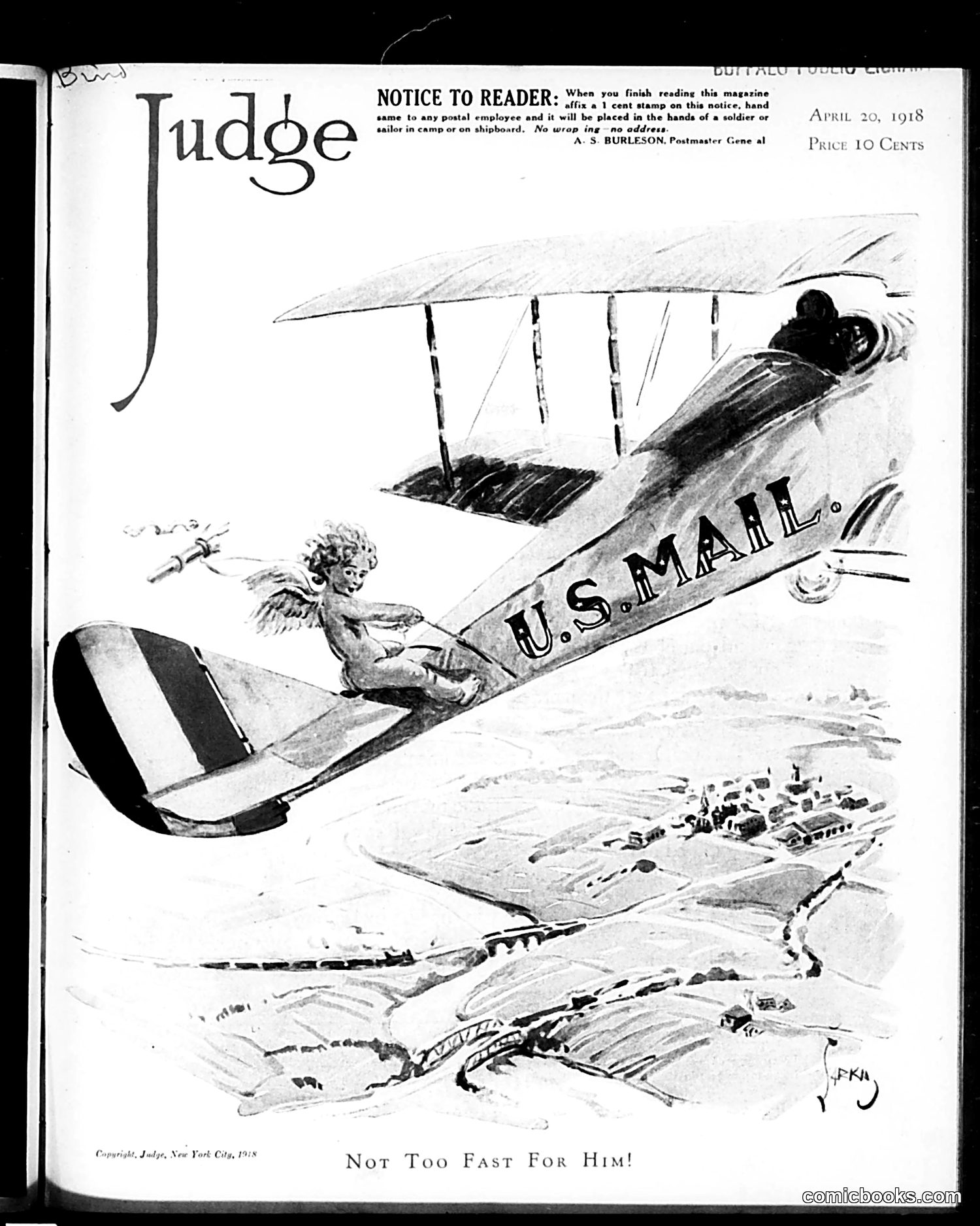
This cover depicts an allegorical figure (likely representing America or Liberty, with wings) piloting a U.S. Mail airplane marked "U.S. MAIL" during World War I. Below, a German military installation or fortification is visible on the landscape. The title "Not Too Fast For Him!" suggests the cartoon celebrates America's airmail delivery service as impressively rapid—so efficient that even enemy forces cannot intercept it. The caption implies confidence in American military-industrial capability during WWI. The winged figure represents American ideals or patriotic virtue, framing the mailservice as both a practical wartime asset and a symbol of national superiority. This reflects 1918 wartime propaganda celebrating American technological and organizational prowess.
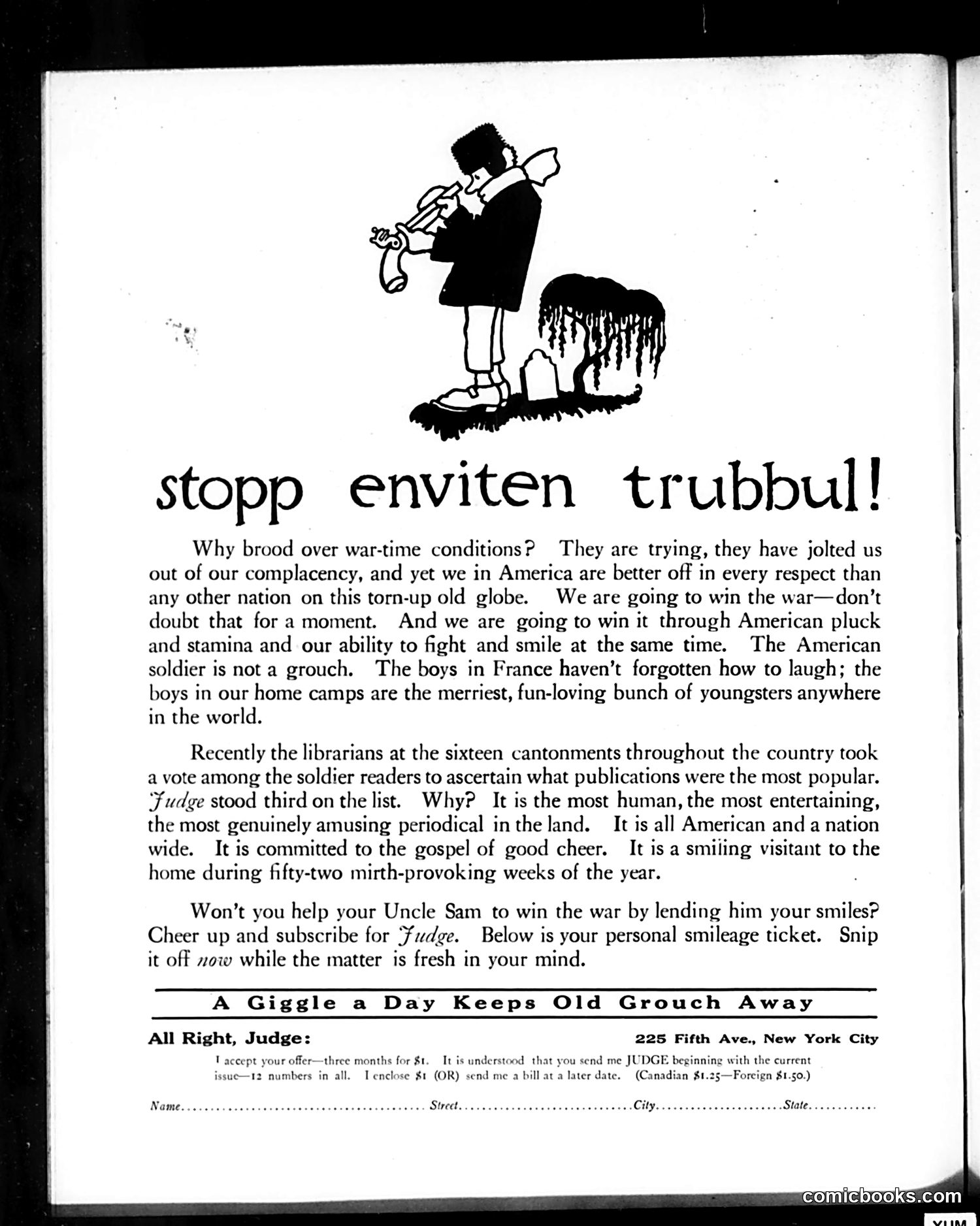
This is a WWI-era recruitment advertisement urging Americans to maintain morale during wartime. The cartoon shows a dejected soldier writing home, illustrating the text's message: "stop enviten trubbul!" (stop inviting trouble). The ad argues Americans should avoid complaining about wartime hardships because the U.S. is "better off in every respect than any other nation." It positions the American soldier as cheerful and resilient—"not a grouch"—and claims troops in France remain lighthearted. The piece then promotes *Judge* magazine as a morale-booster, noting librarians ranked it third among soldiers' favorite publications for its "human," "entertaining," and "genuinely amusing" content. The subscription ticket below functions as a patriotic appeal: readers can support the war effort by spreading humor and good cheer.
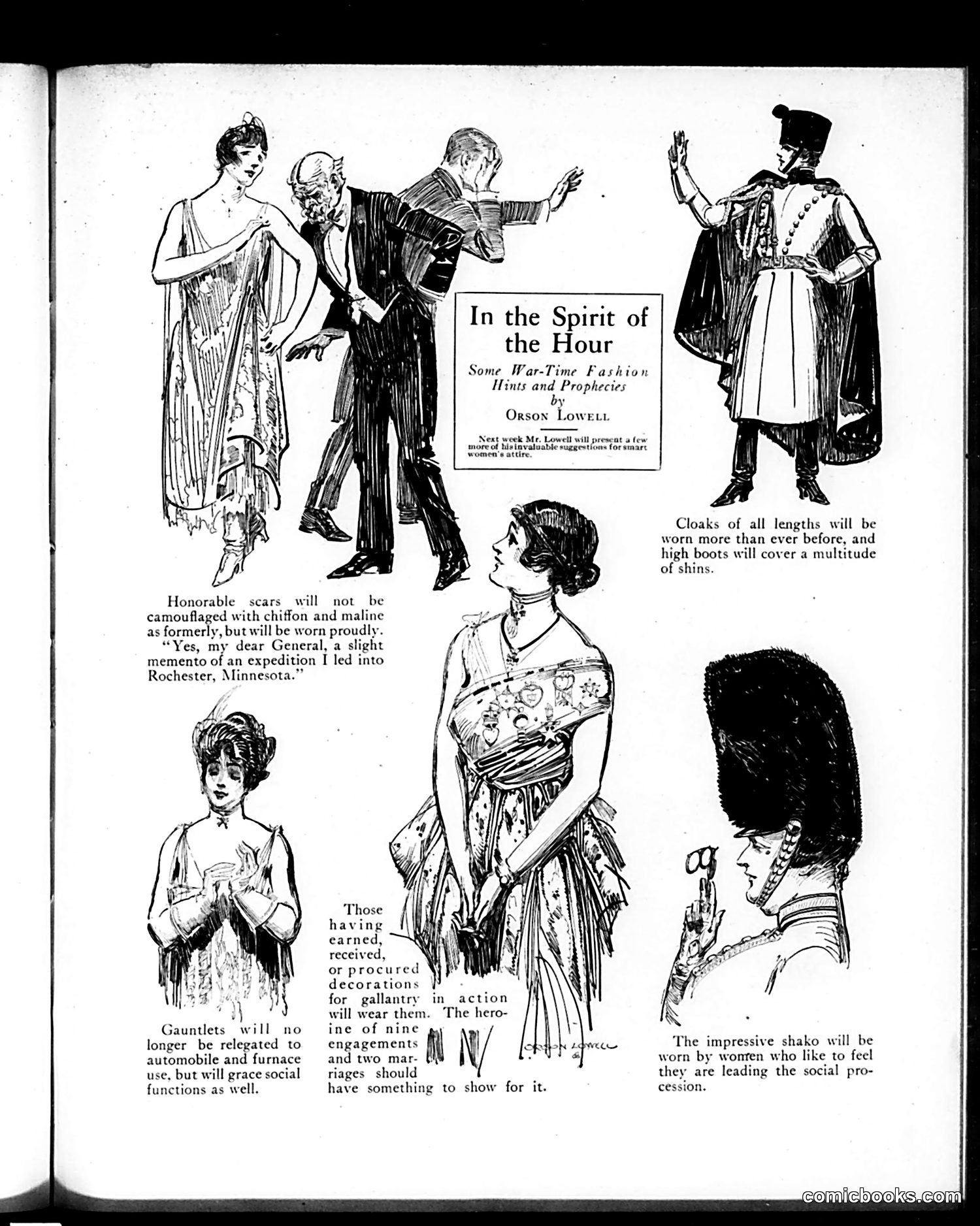
This Judge magazine page satirizes women's fashion during wartime (likely WWI era, given references to military decoration and "General"). The cartoonist mocks patriotic fashion trends emerging among society women. The satire targets wealthy women adopting military-inspired accessories—decorations, scarves, and tall boots—as status symbols while claiming patriotic sentiment. One caption quotes a woman mentioning a "General" and "Rochester, Minnesota," suggesting pretentious name-dropping of military connections. The piece ridicules the contradiction: women who previously avoided such garments now wear them "proudly," and those with military honors display decorations "to show for it." The joke is that fashionable women are co-opting wartime aesthetics for social prestige rather than genuine patriotic commitment, reducing military sacrifice to mere costume.
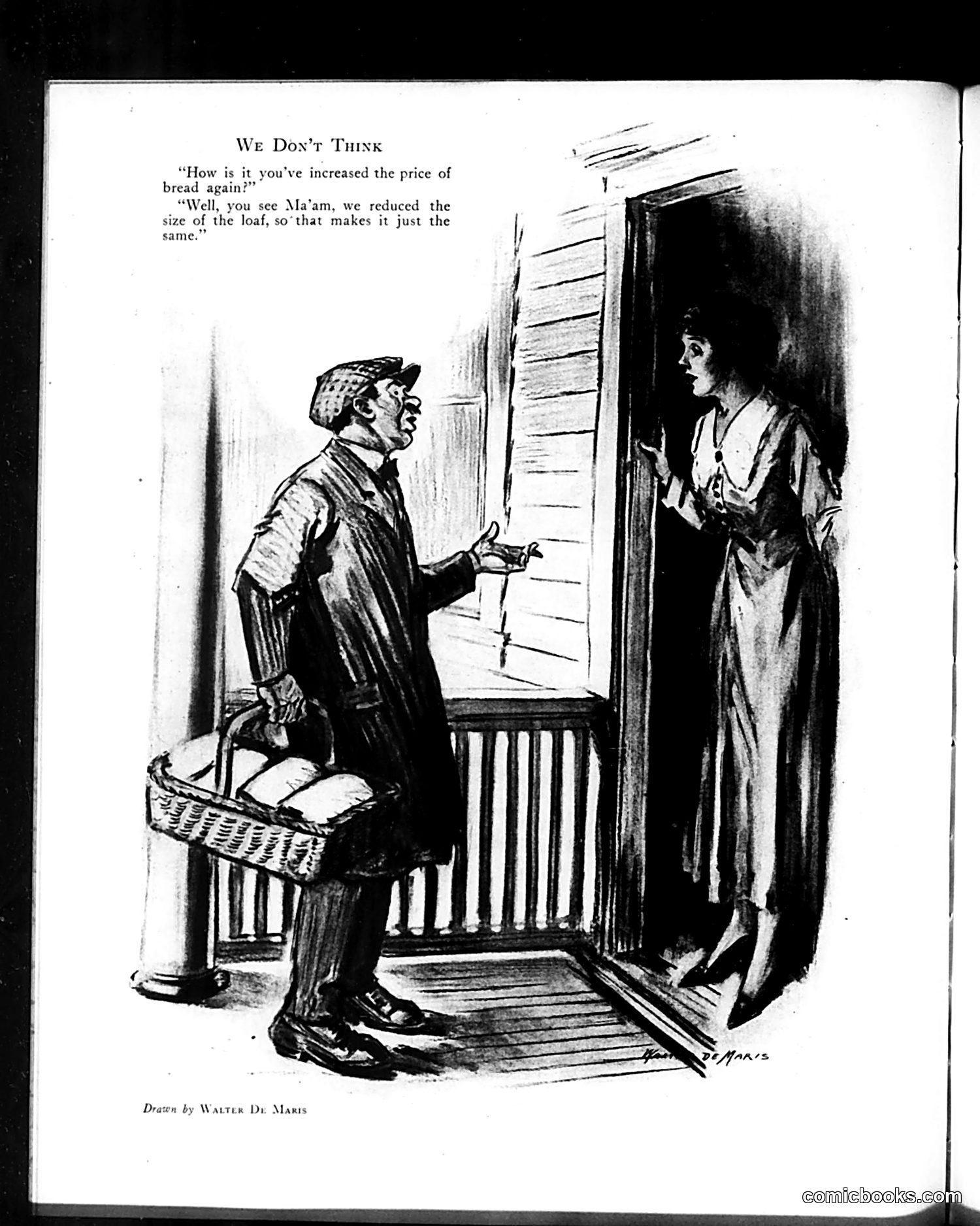
This cartoon satirizes a baker's deceptive pricing practice. A customer questions why bread prices have increased, and the baker responds that he's actually reduced the loaf's size while keeping the price the same—so technically, no price increase occurred. The satire targets consumer deception during what appears to be a period of inflation or food cost concerns. The title "We Don't Think" suggests the baker assumes customers won't notice or calculate the true cost per unit. The joke critiques both the merchant's dishonest practice and, implicitly, the public's supposed gullibility in accepting such transparent trickery. The cartoon likely reflects real wartime or post-war economic anxieties about food prices and merchant manipulation.
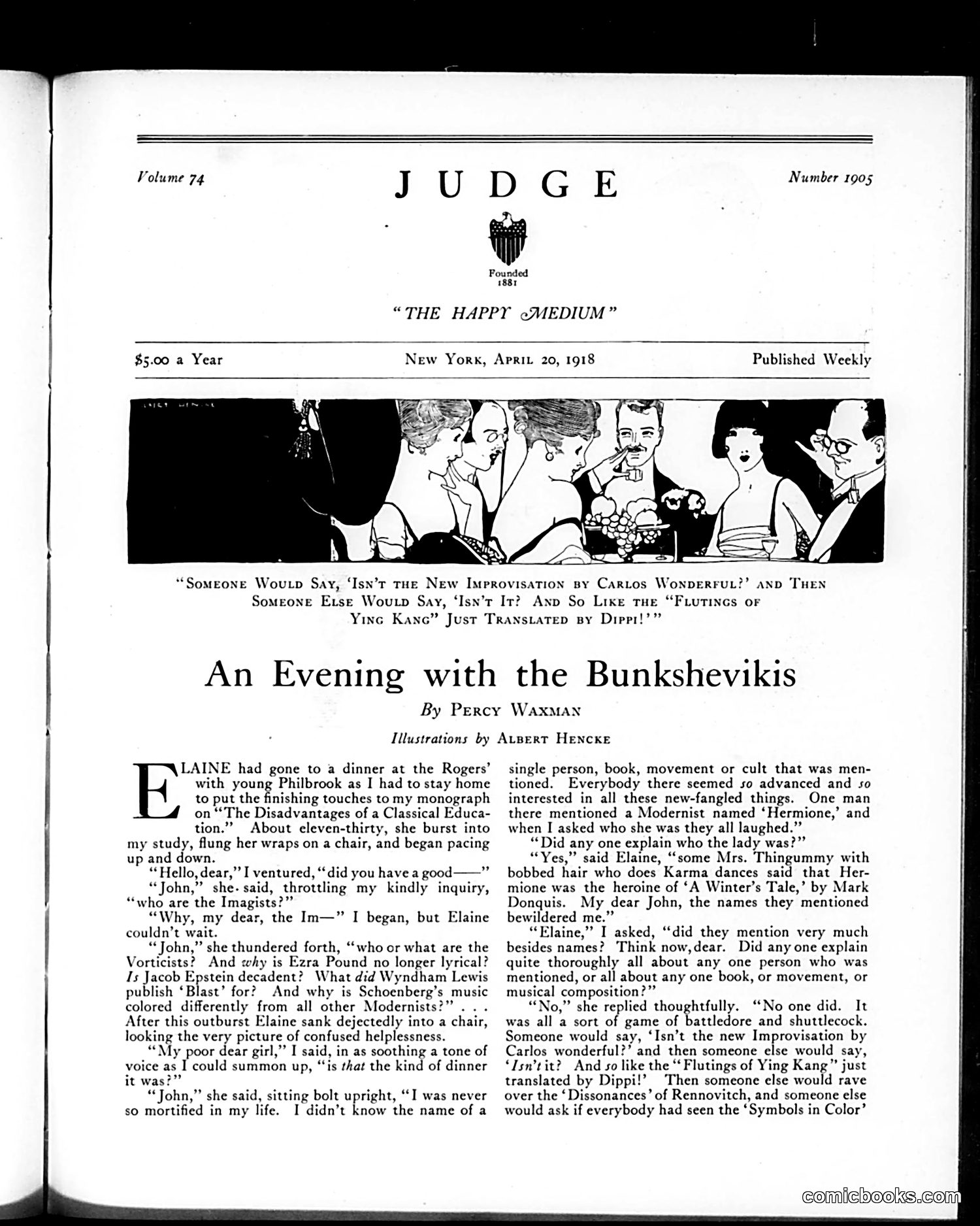
This satirical story by Percy Waxman mocks the Russian Bolshevik Revolution and American intellectuals who embraced modernist culture. The headline image shows stylized figures representing avant-garde society. The narrative depicts a dinner conversation where the narrator encounters fashionable New York elites discussing obscure modernist figures—Carlos Wonderful's "improvisation," Wyndham Lewis's publications, and Schoenberg's atonal music. The satire suggests these intellectuals mindlessly celebrate incomprehensible avant-garde art without understanding it. "Bunkshevikis" is a pun combining "Bolsheviks" with "bunk"—implying the revolutionary attitudes and artistic experimentation are pretentious nonsense. The 1918 date places this amid anti-Bolshevik sentiment following the Russian Revolution (1917).
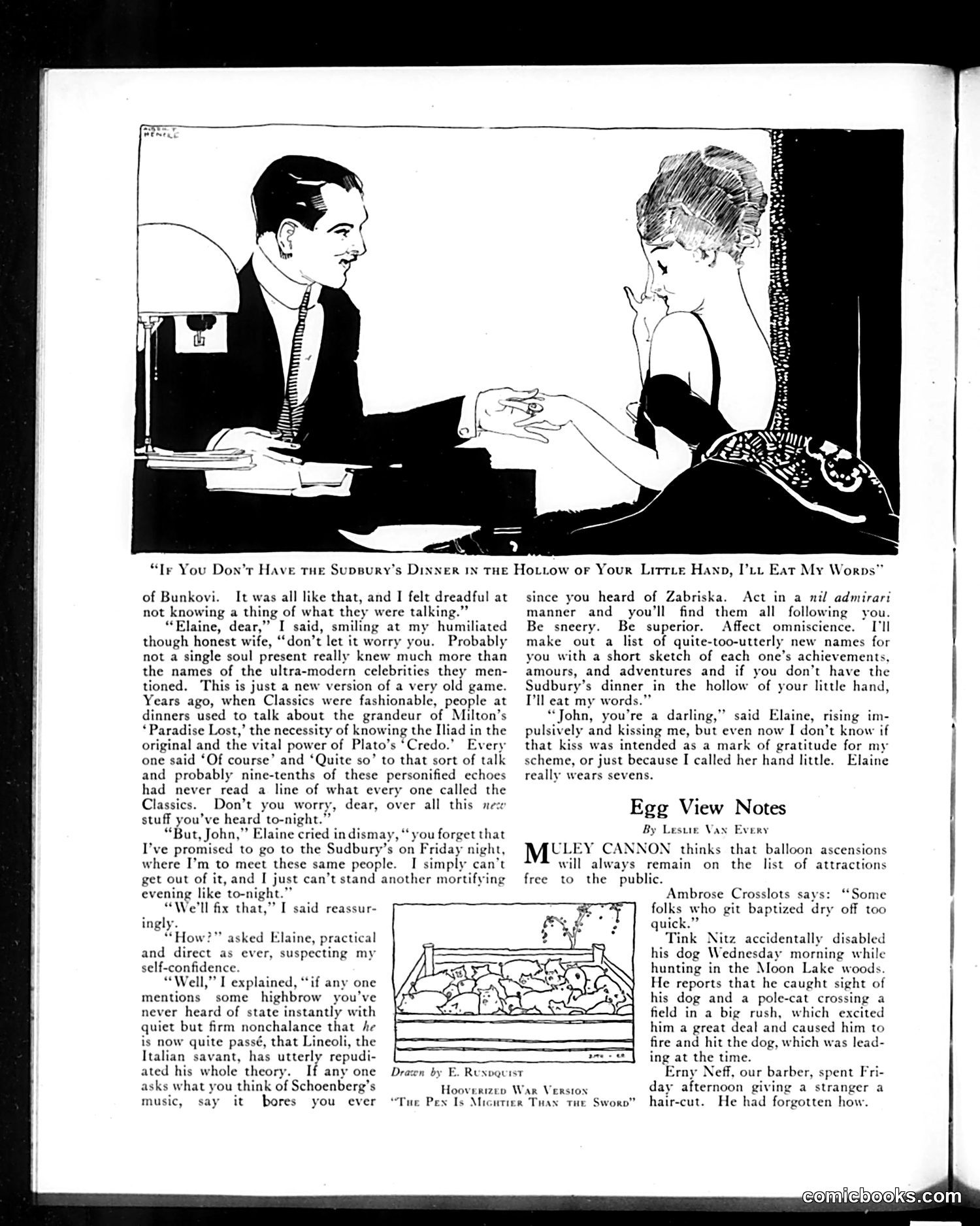
**Main Cartoon:** The illustration shows a man at a desk confronting a woman, with the caption "If You Don't Have the Sudbury's Dinner in the Hollow of Your Little Hand, I'll Eat My Words." This depicts a domestic dispute about social obligations—specifically attending a dinner party at the Sudbury residence. The satire targets the pretensions of upper-class social climbing and dinner-party culture, where missing such events carried social consequences. **"Egg View Notes" Section:** This gossip column includes brief anecdotes about local personalities, including references to balloon ascensions, an accidental dog injury, and a barber's mishap. These are light satirical jabs at everyday suburban life and minor celebrities. The page satirizes early 20th-century American social anxiety around maintaining proper social standing through fashionable dinner attendance.
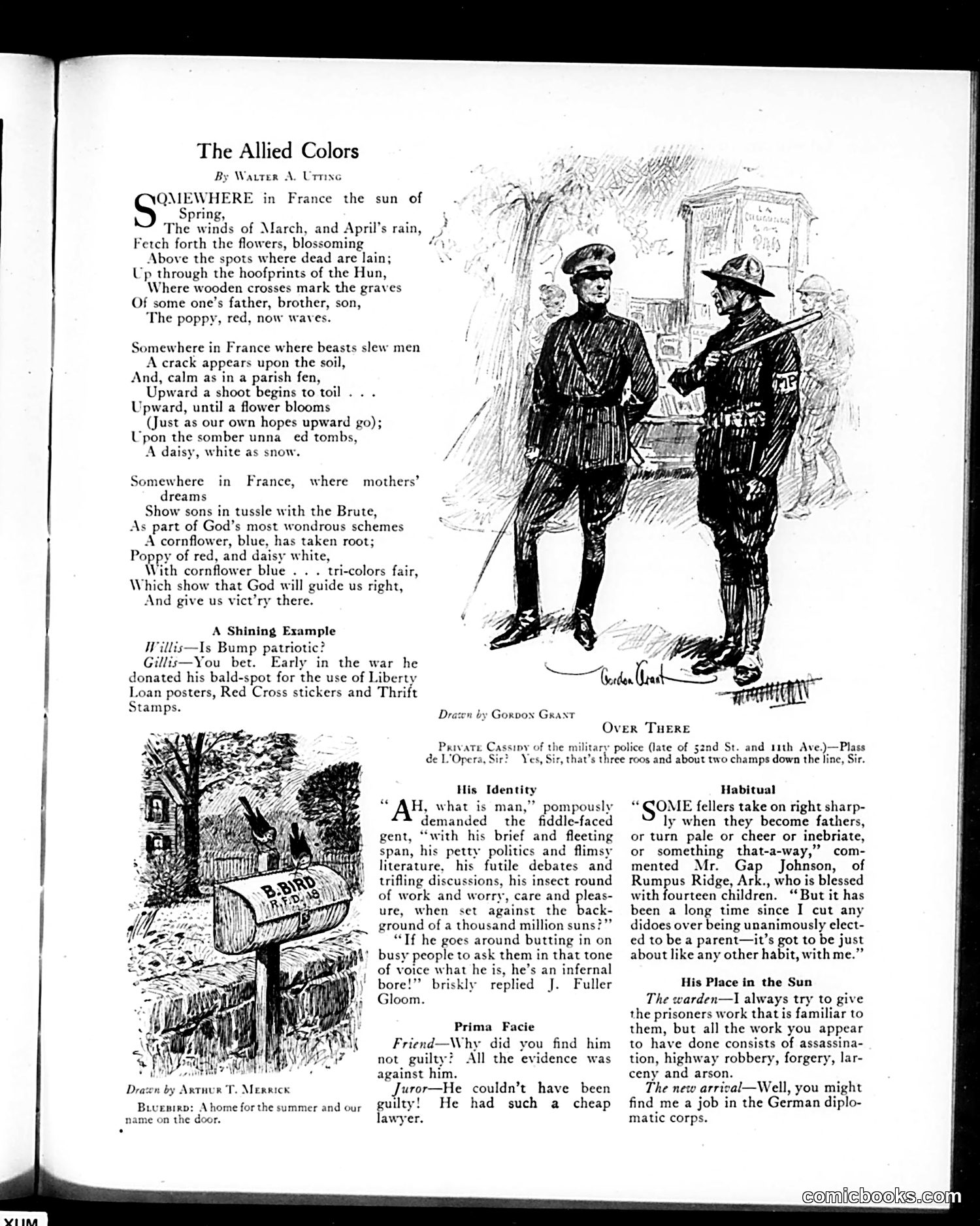
This *Judge* page contains WWI-era American satire (likely 1917-1918). **"The Allied Colors"** poem uses wildflowers blooming over French battlefields—red poppies, white daisies, blue cornflowers—as metaphors for the Allied nations (France, Britain, America) united against Germany ("the Brute"). It's patriotic wartime verse celebrating sacrifice and divine providence in victory. **"A Shining Example"** mocks wealthy businessman "Bump" for donating only his bald head as space for Liberty Loan posters—satirizing superficial patriotism and minimal personal sacrifice during wartime fundraising. **"Over There"** jokes about a military policeman's accent (suggesting an immigrant from New York's immigrant neighborhoods), using French phrases phonetically mangled—a casual ethnic stereotype common to the era. **"His Place in the Sun"** darkly jokes that a prisoner's criminal résumé (assassination, robbery, forgery, arson) qualifies him perfectly for the German diplomatic corps—biting anti-German wartime propaganda suggesting German diplomacy itself was criminally dishonest. All reflect American home-front attitudes circa WWI.
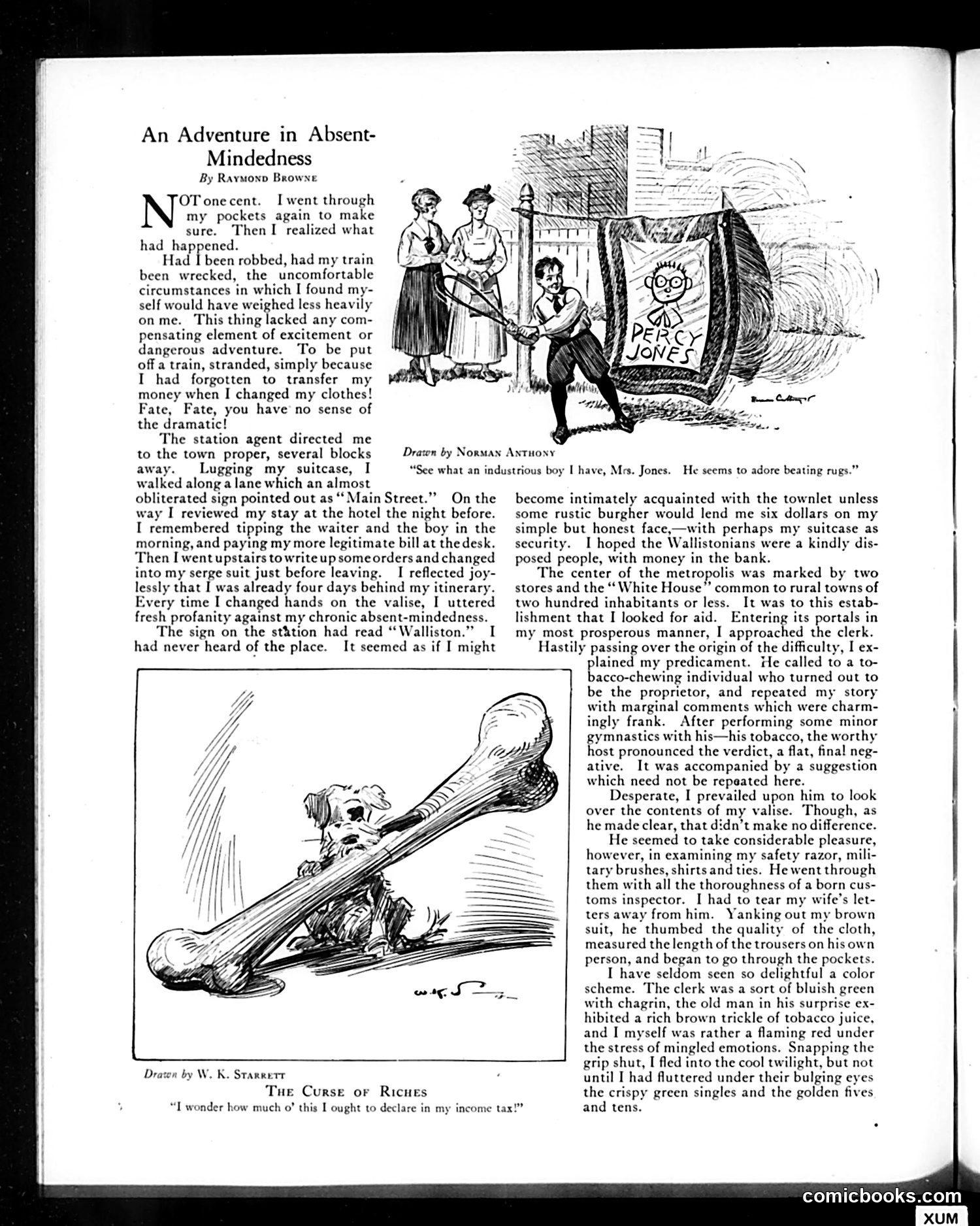
This humorous story concerns a traveling salesman who absent-mindedly forgot to transfer money when changing clothes, leaving him stranded in a small town called Walliston. The narrative satirizes both the protagonist's chronic forgetfulness and rural small-town attitudes. The two cartoons illustrate supporting jokes: the top one shows a woman praising her industrious boy for "beating rugs" (likely a servant child), mocking domestic pretension. The bottom cartoon, "The Curse of Riches," depicts a wealthy man worried about income tax declarations—satirizing the newly-taxed wealthy classes' anxiety over the (then-recent) income tax. The story's humor derives from the salesman's humiliation when the crude country proprietor scrutinizes his belongings, ultimately discovering the money hidden in his suit—reversing the expected outcome. The satire targets both the absent-minded gentleman and provincial rural skepticism toward outsiders.
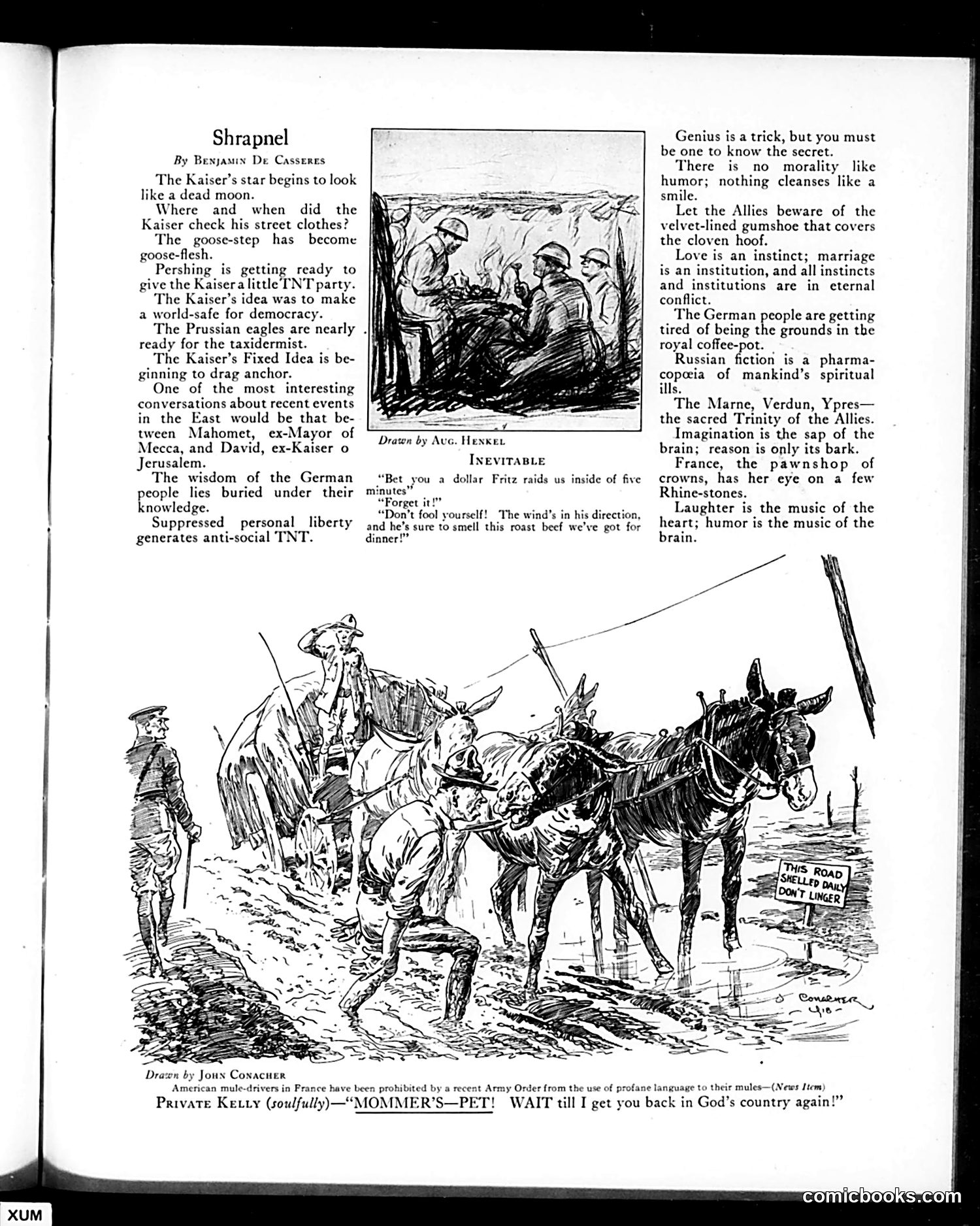
This WWI-era page contains two distinct pieces satirizing the conflict. **"Shrapnel"** consists of aphoristic commentary by Benjamin De Casseres mocking Germany's defeat. It references General Pershing preparing "TNT" for the Kaiser, predicts the Prussian eagle will soon be "taxidermied," and compares the Kaiser to deposed biblical figures. The tone is celebratory of Allied victory. **"Inevitable"** is a cartoon (drawn by John Cosacher) depicting American soldiers discussing a German air raid. The joke plays on a news item about U.S. Army prohibition against profane language directed at mules. The caption shows a frustrated mule-driver yearning to return home and curse freely—satirizing military censorship and the absurdity of regulating speech toward animals during wartime. Both pieces reflect American confidence in Allied victory and use humor to mock German defeat and military bureaucracy.
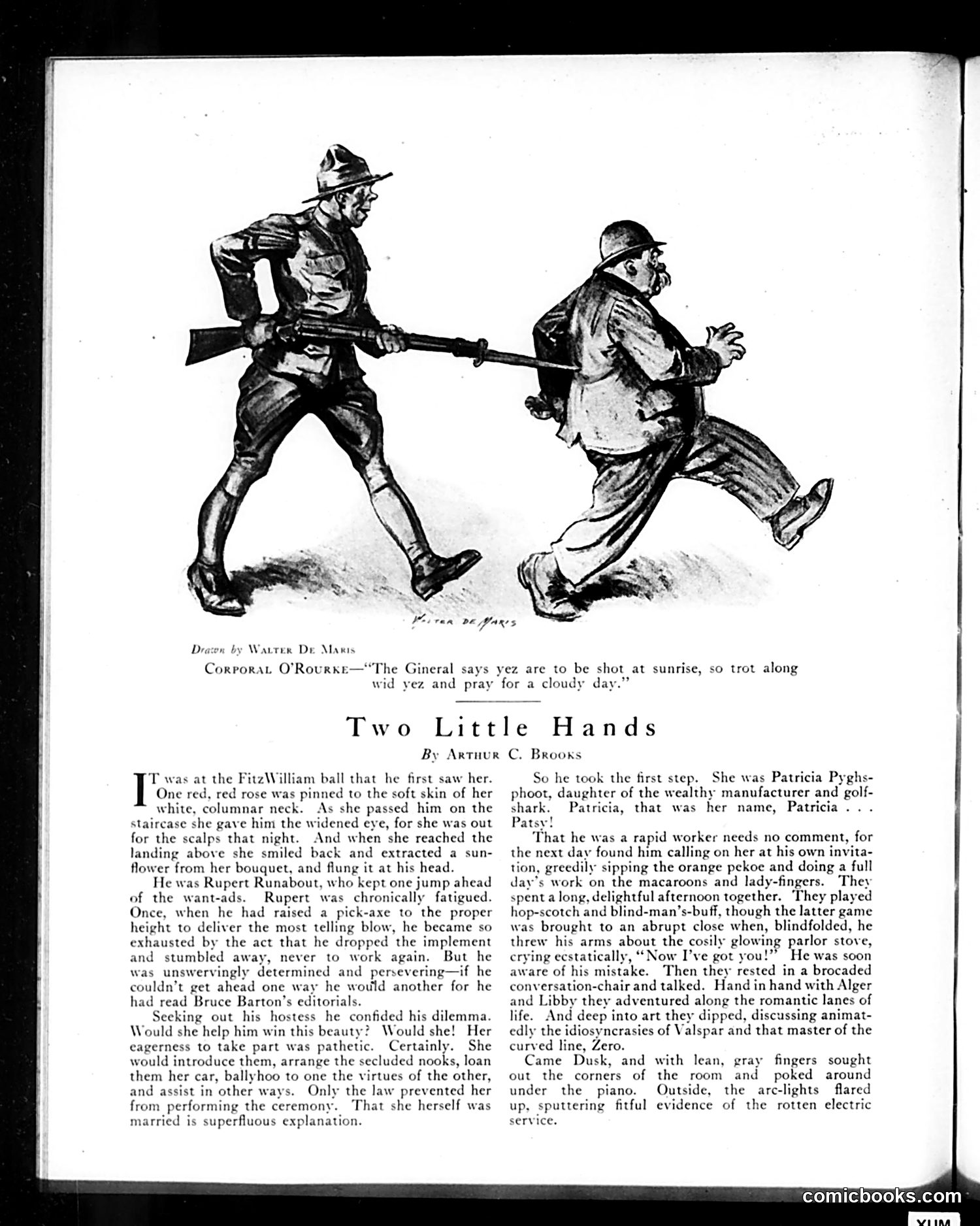
**The Cartoon (top):** Drawn by Walter De Maris, this depicts "Corporal O'Rourke" (identifiable by the Irish dialect caption) as a military officer bayoneting a fleeing civilian. The caption's dark joke—the General orders execution at sunrise, so O'Rourke advises the victim to "pray for a cloudy day"—appears to satirize either military brutality or Irish soldiers' roles in conflict, likely referencing World War I-era violence or British-Irish military dynamics. **The Story:** "Two Little Hands" by Arthur C. Brooks is a romantic satire about Rupert Runabout (a lazy fortune-hunter) pursuing wealthy heiress Patricia Pyghsphoot. The humor mocks shallow upper-class courtship rituals, social-climbing, and the protagonist's shameless opportunism. References to "Bruce Barton's editorials" (a 1920s advertising/business figure) and casual mentions of servants and wealth highlight class-based satire typical of Judge magazine's audience.
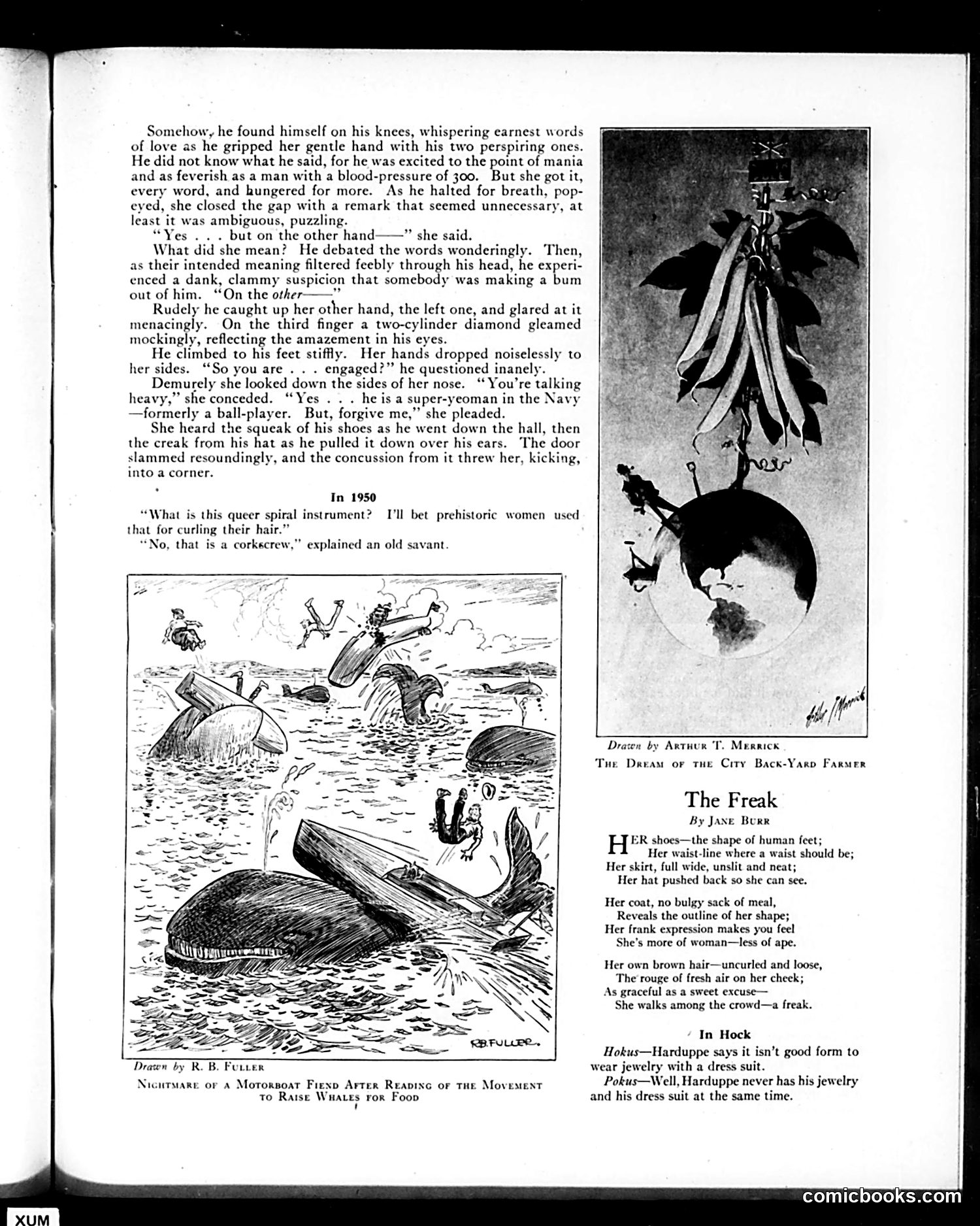
This page contains two distinct pieces of satire: **Top narrative & cartoons:** A romantic comedy about a man proposing to a woman, only to discover she's already engaged (evidenced by her diamond ring). The joke hinges on his obliviousness and her deliberately ambiguous response ("Yes... but on the other hand"). The humor satirizes male presumption in courtship and female duplicity. **"The Freak" poem (by Jane Burr):** This satirizes early 1950s fashion and gender standards. The "freak" is a woman who dresses practically and modestly—with a neat skirt, uncurled hair, and natural complexion—rather than conforming to contemporary glamorous styling. The poem's tone suggests society views natural, functional femininity as aberrant, mocking both the woman's practicality and the era's beauty obsession. **"In Hock" joke:** A brief quip about poverty: a man can't afford to wear jewelry and a dress suit simultaneously, implying financial desperation. The page satirizes courtship pretense, gendered beauty standards, and economic inequality.
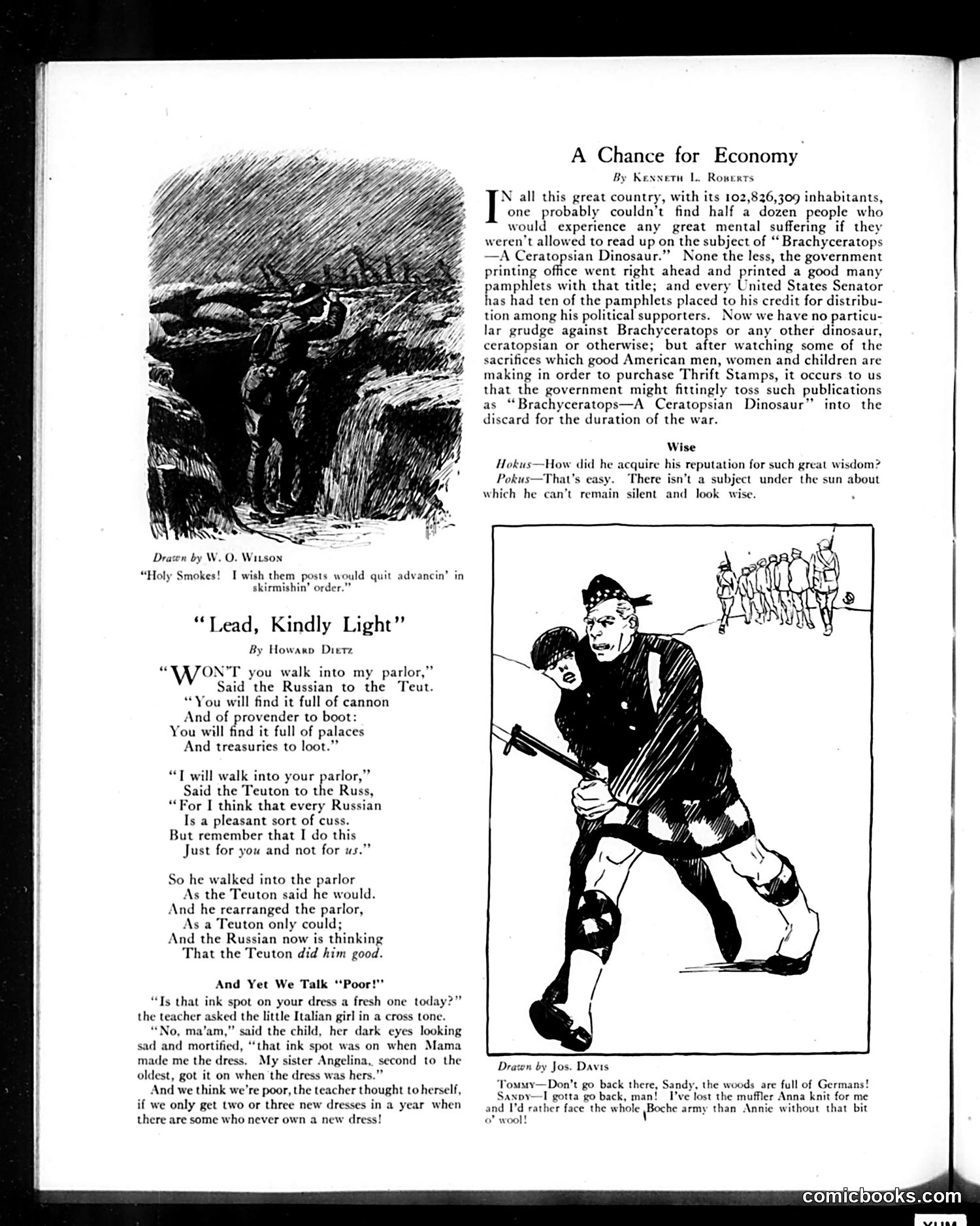
This WWI-era page contains several satirical pieces: **"Lead, Kindly Light"** (poem): A dark parody of the hymn "Lead, Kindly Light," depicting German-Russian conflict. The "Russian" invites the German ("Teuton") into his parlor with treasures to loot; the German accepts but "rearranges" it—a euphemism for invasion and destruction. The irony: the Russian considers this "good," suggesting he's been defeated and conquered. **"A Chance for Economy"**: Criticizes government waste—specifically the printing of thousands of pamphlets about obscure dinosaurs ("Brachyceratops") distributed by senators to constituents. During wartime rationing and sacrifice, the author argues this frivolous spending should stop. **"And Yet We Talk 'Poor!'"**: A sympathetic vignette showing an Italian immigrant child wearing an old dress with stains, contrasting poverty with American entitlement—likely addressing class consciousness during wartime. The cartoons and humor reflect 1917-18 American anxieties: wartime sacrifice, government efficiency, and immigrant experiences.
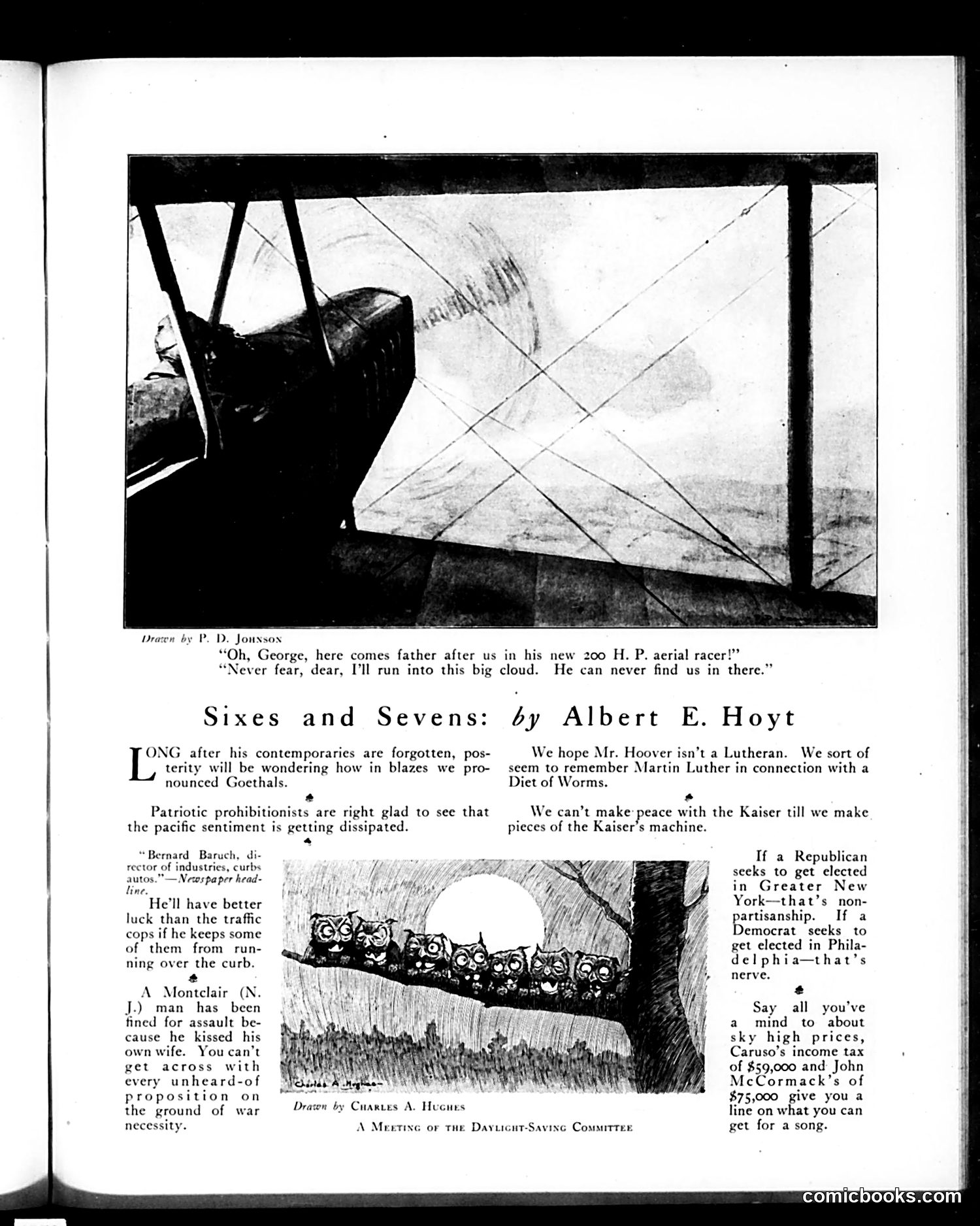
This page collects brief political and social commentary typical of Judge's satirical format during the WWI era. **Top cartoon** (by P.D. Jonsson): A couple in an airplane evades a pursuer by hiding in a cloud—likely satirizing aviation's novelty and unreliability, or wartime aviation developments. **Text commentary** includes: - A jab at **Goethals** (likely General George Goethals, canal/war materials official) and pronunciation debates - **Hoover/Lutheran reference**: unclear without fuller context, possibly mocking Herbert Hoover's background - **Baruch/prohibition satire**: Bernard Baruch (wartime industries director) attempting to curb automobile use while traffic laws fail - **Kissing wife assault fine**: mocking wartime "necessity" excuses for legal absurdities - **Republican/Democrat partisanship**: New York Republicans vs. Philadelphia Democrats portrayed as equally shameless - **Singer income taxes**: Caruso and McCormack's high wartime taxes ($59,000–$75,000) prove entertainers profit from war while others suffer The overall tone: cynical about wartime profiteering, government overreach, and partisan politics.
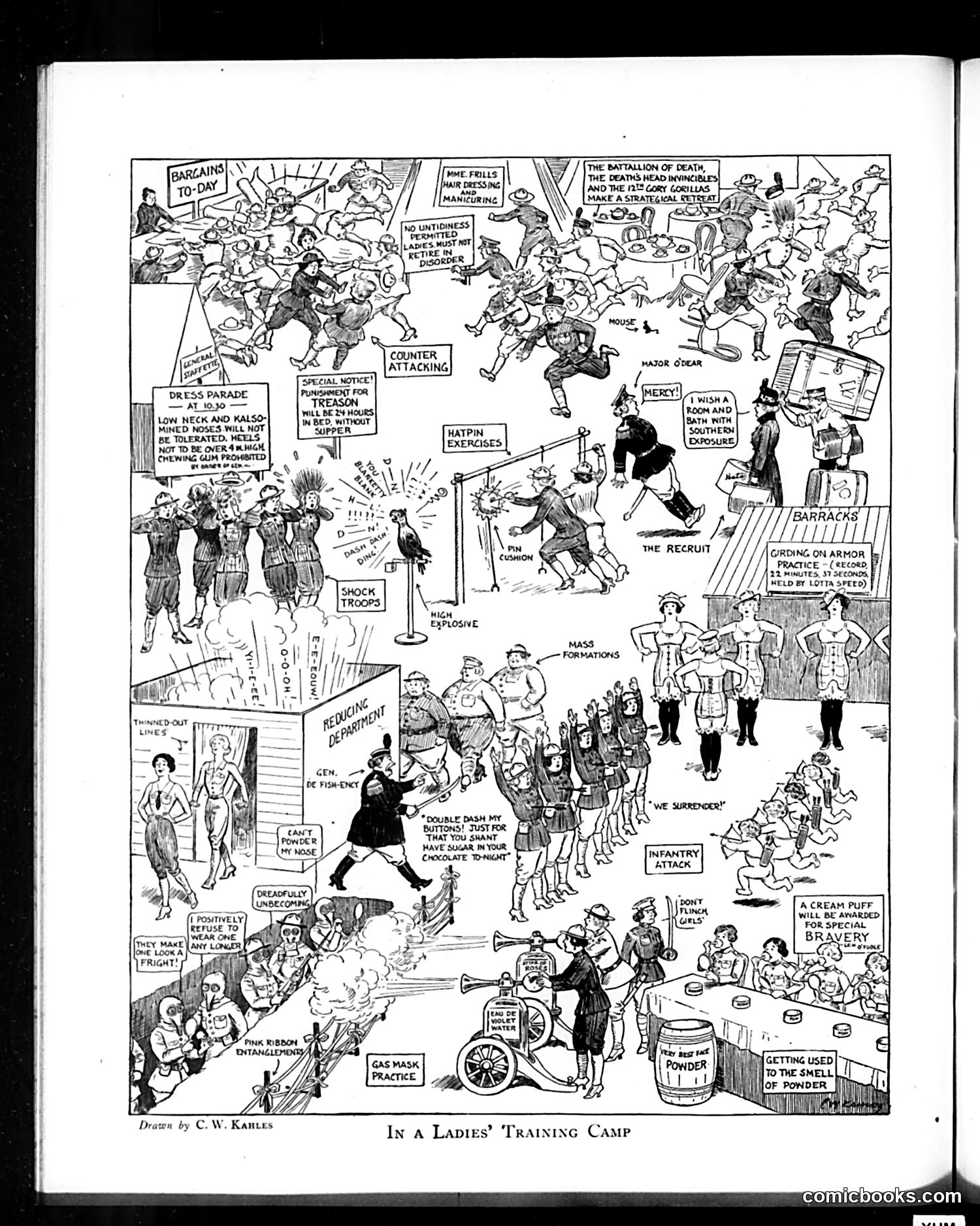
This satirical cartoon mocks women's military training during World War I. The drawing depicts various absurd training activities—"hatpin exercises," "gas mask practice," "shock troops," "infantry attack"—treating feminine accessories and stereotypes as weaponry. The satire targets both the novelty of women entering military service and anxieties about women abandoning traditional femininity. References to "dress parades," strict grooming rules ("low neck and rouged noses will not be tolerated"), and the offer of a "cream puff" as reward mock the contradiction between military discipline and contemporary expectations of ladylike behavior. The cartoon reflects early-20th-century skepticism about women's combat roles, presenting female soldiers as inherently comic rather than credible fighters. The tone is patronizing—simultaneously joking about women's military capability while acknowledging their actual participation in wartime efforts.
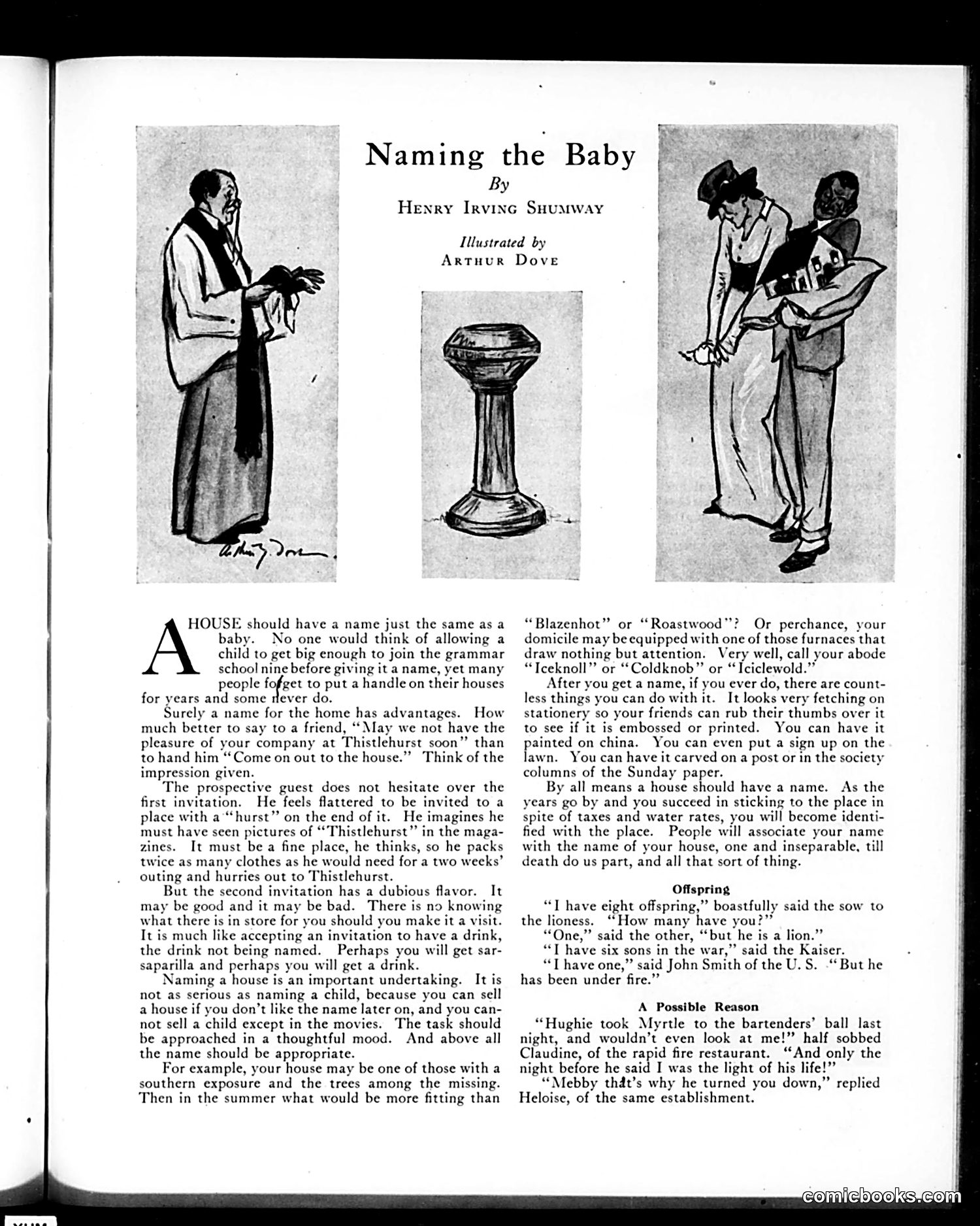
This is a humorous essay with three unrelated comic sketches about naming—houses, animal offspring, and romantic attention. **Main article**: Shumway satirizes Americans' pretentiousness about naming their homes. He mocks how a named house ("Thistlehurst") impresses guests more than an unnamed one ("the house"), despite being identical. The satire suggests social climbing and shallow status-consciousness—that names create false impressions of grandeur. He offers absurd heat-related names for poorly-situated homes ("Blazenhot," "Roastwood"), mocking the matching of names to actual conditions. **Three brief jokes below** offer quick punchlines: quality over quantity (a lion cub beats eight piglets); sacrifice matters more than numbers (one American soldier in combat beats the Kaiser's six sons); and a woman's romantic value diminishes after she becomes *too* available ("light of his life" loses appeal once she's clingy). The tone is lighthearted domestic humor typical of early 20th-century Judge magazine.
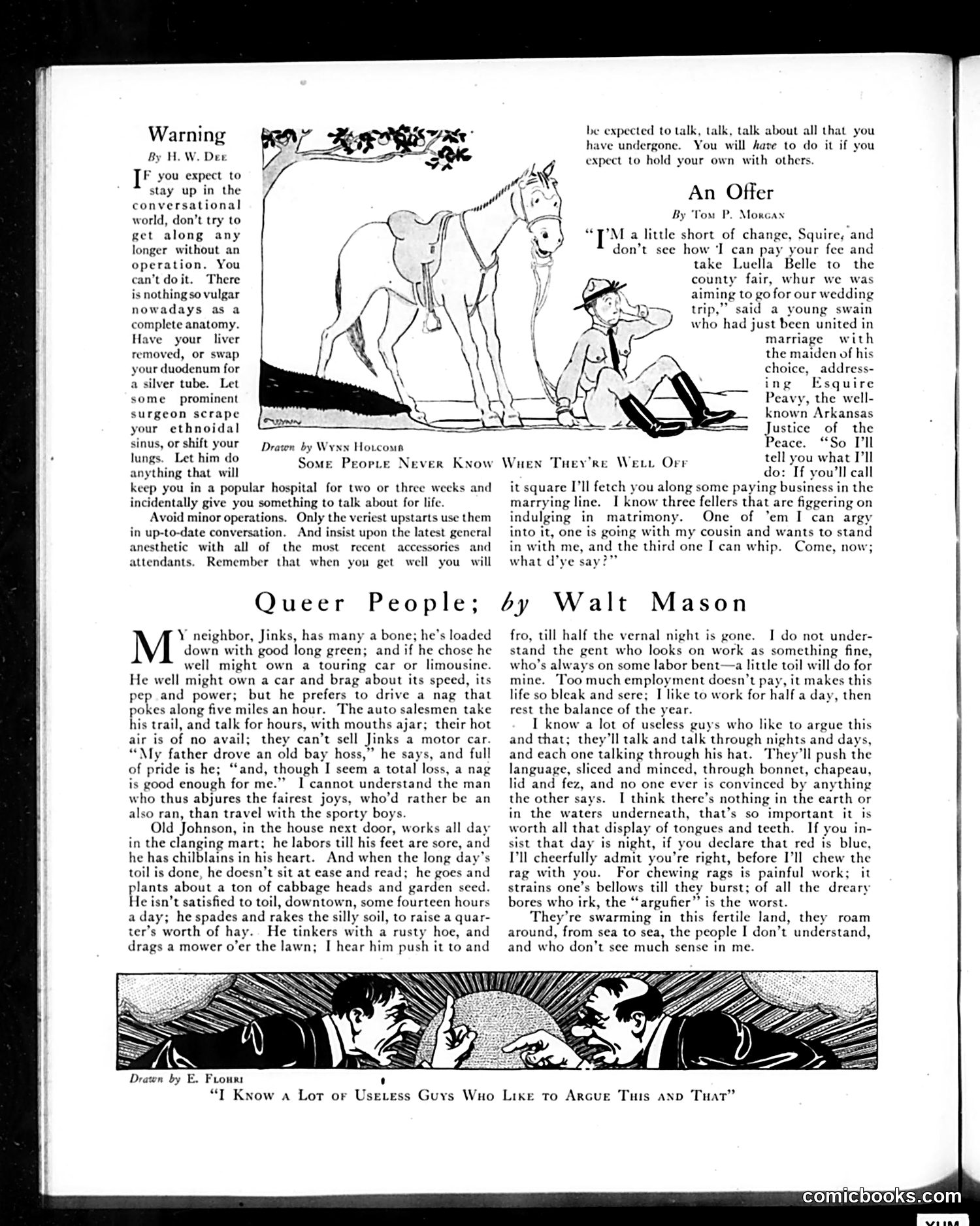
This *Judge* page contains three distinct satirical pieces: **"Warning" (top left):** Mocks 1920s society's obsession with cosmetic surgery as social currency. The joke: you must undergo unnecessary operations and discuss them constantly to remain conversationally relevant. It satirizes how people weaponize medical procedures for status. **"An Offer" (top right):** A rural Arkansas story where a poor newlywed offers a Justice of the Peace three potential solutions to pay his fee—including bribing, coercing, or fighting other suitors into marriages to generate business. It's gentle satire of rural desperation and opportunistic officials. **"Queer People" (bottom):** Walt Mason critiques three men who reject modern conveniences: Jinks refuses a car despite wealth (prefers horses), Johnson works obsessively on gardening after exhausting days, and argumentative men waste time debating pointlessly. "Queer" meant "strange/odd." Mason satirizes those who reject progress, overwork, and pointless arguers—suggesting these behaviors make no rational sense. The illustrations by Wyss Holcomb and E. Florher support each piece's themes.
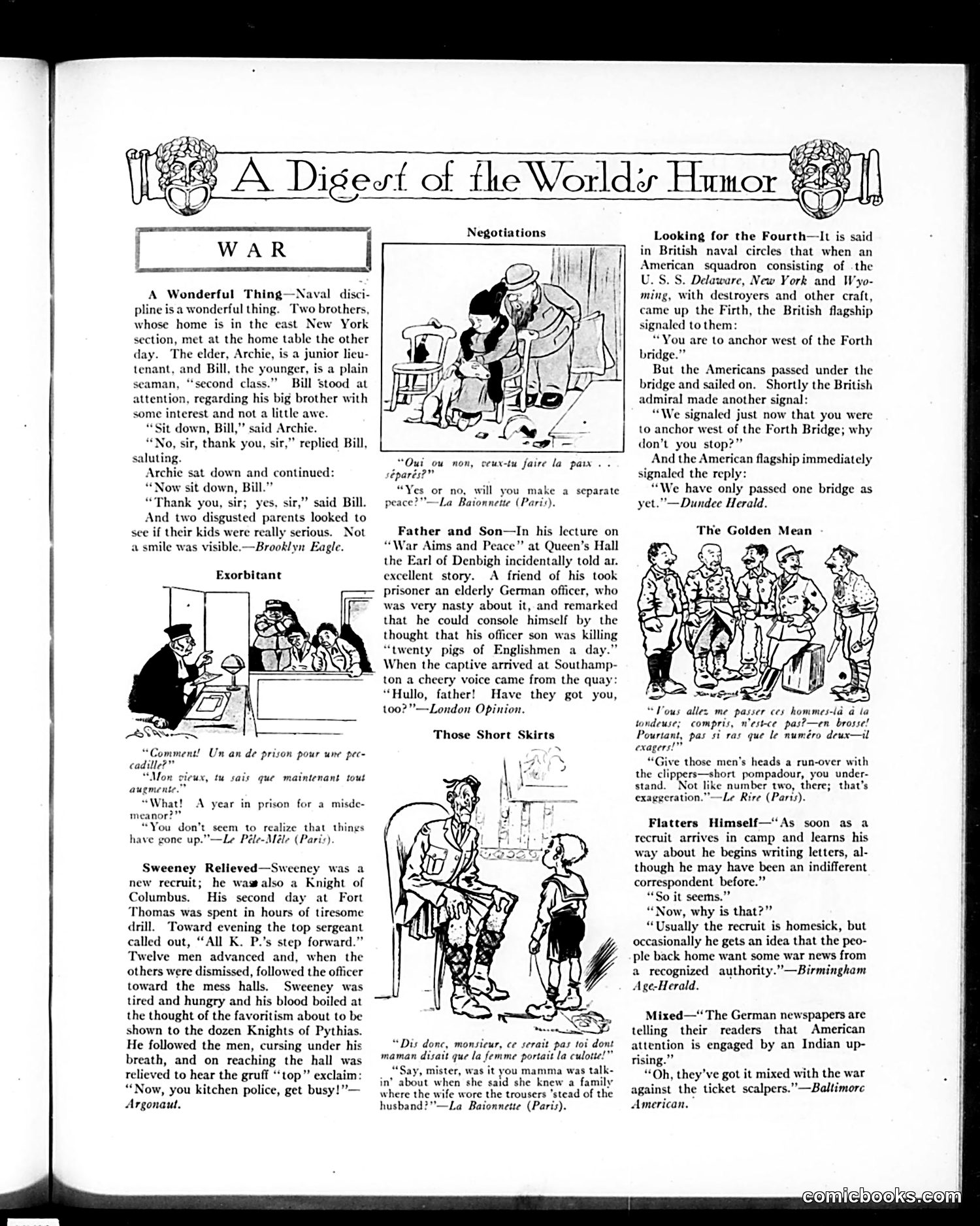
This page collects brief satirical anecdotes about WWI military life and international relations. Key items: **"A Wonderful Thing"** mocks rigid military discipline—two brothers meeting at home, where the younger automatically salutes and stands at attention for his officer brother, leaving parents bewildered. **"Sweeney Relieved"** plays on a recruit's assumption of favoritism: expecting Knights of Columbus to receive special treatment, Sweeney is relieved (disappointed) when all K.P. duty assignees are treated equally. **"Looking for the Fourth"** jokes about American naval confusion: British ships signal Americans to anchor west of the Forth Bridge, but Americans pass under it anyway, claiming they've "only passed one bridge." **"Those Short Skirts"** and **"The Golden Mean"** are European cartoons (translated) about wartime gender roles and military grooming standards. **"Father and Son"** presents dark humor: a captured German officer consoles himself that his son kills "twenty Englishmen daily"—only to encounter his son arriving as a prisoner too. The magazine collects international war-related humor, reflecting home-front anxieties and military absurdities.
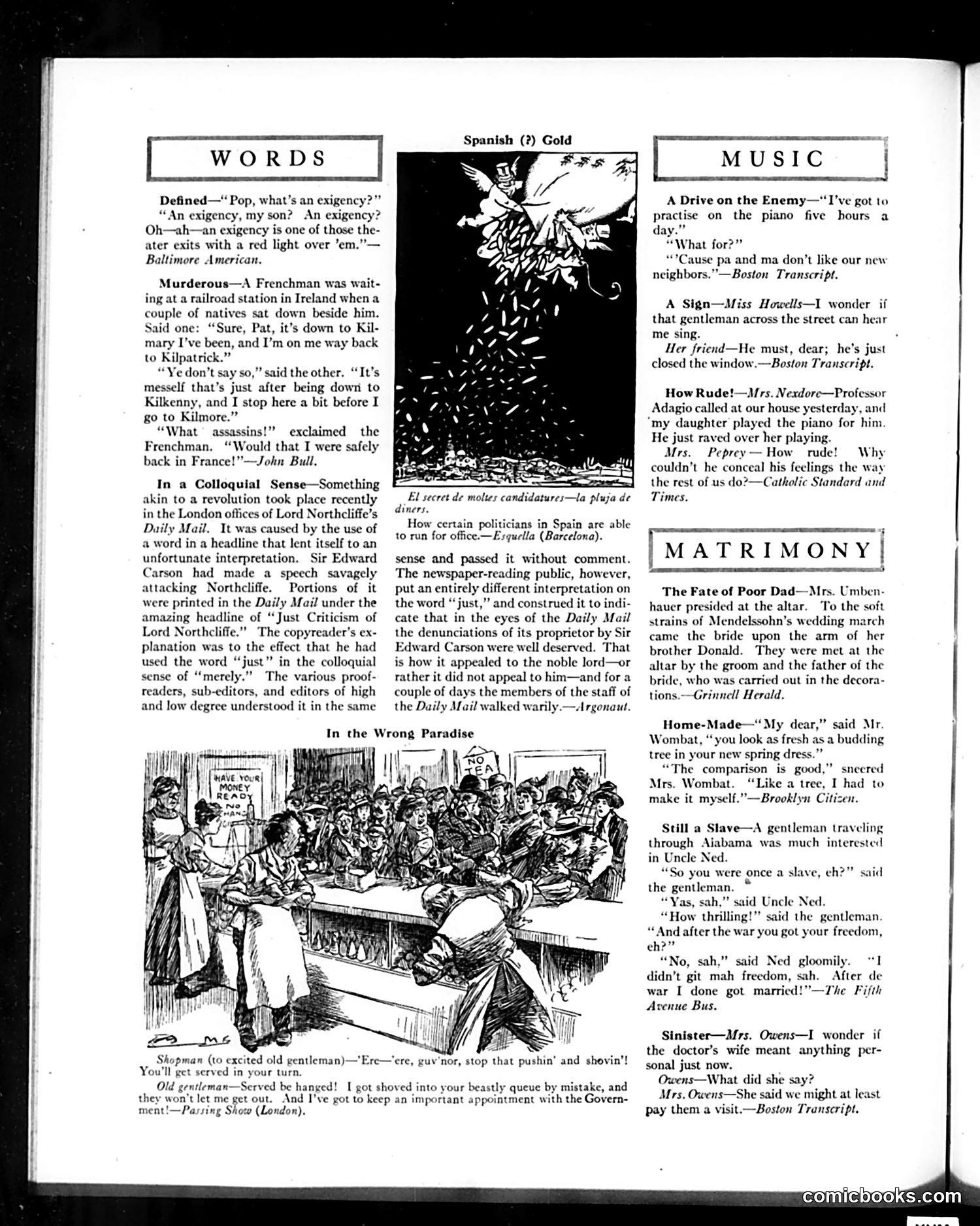
This page from Judge magazine contains several short humorous pieces and one political cartoon: **"In the Wrong Paradise"** (main cartoon): Depicts a crowded queue where an impatient older gentleman is pushing in line, complaining he has "an important appointment with the Government." A queue attendant protests he must wait his turn. The satire mocks British bureaucratic inefficiency and the common frustration of waiting in orderly lines—a particularly British cultural touchstone. **"Spanish (?) Gold"** caption references Spanish politicians financing campaigns through bribes ("la pluja de diners"—rain of money). This criticizes corruption in Spanish electoral politics. The remaining items are brief joke columns about miscellaneous topics: Irish place-names confusing a Frenchman, a Daily Mail headline ambiguity involving Lord Northcliffe, and various domestic humor pieces about music and marriage. The overall tone is light satire targeting bureaucratic inefficiency, political corruption abroad, and domestic absurdities—typical Judge magazine fare of the era.
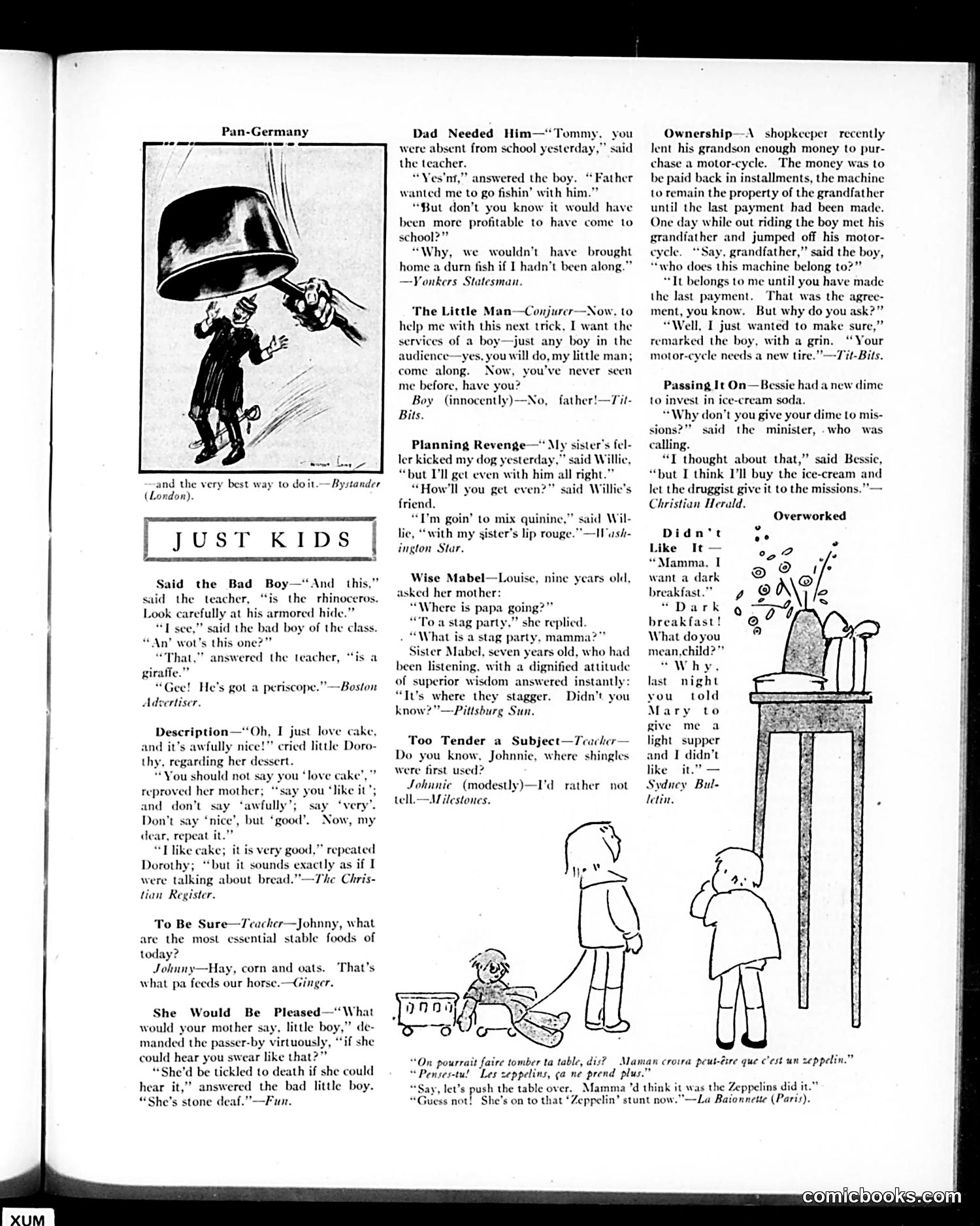
This page from Judge magazine contains a collection of short humorous anecdotes for children under the heading "JUST KIDS." The cartoons and jokes are primarily domestic and school-based humor with no apparent political commentary. The featured cartoon at top left—"Pan-Germany"—appears to show a German military figure (identifiable by the spiked Prussian helmet), likely satirizing German militarism. The caption attributes the image to "Rysländer (London)," suggesting British commentary on German aggression, possibly referencing pre-WWI tensions. The remaining content consists of brief jokes about children's misbehavior, linguistic corrections, and wordplay. These include a child's innocent misunderstanding of "shingles," confusion about "stag parties," and a child's reluctance to give pocket money to church missions. The page concludes with a French joke about children pushing over a table, joking that their mother will think it's a "Zeppelin" attack—a reference to German bombing raids during World War I. The overall tone is light, domestic satire aimed at amusing adults about children's logic and behavior.
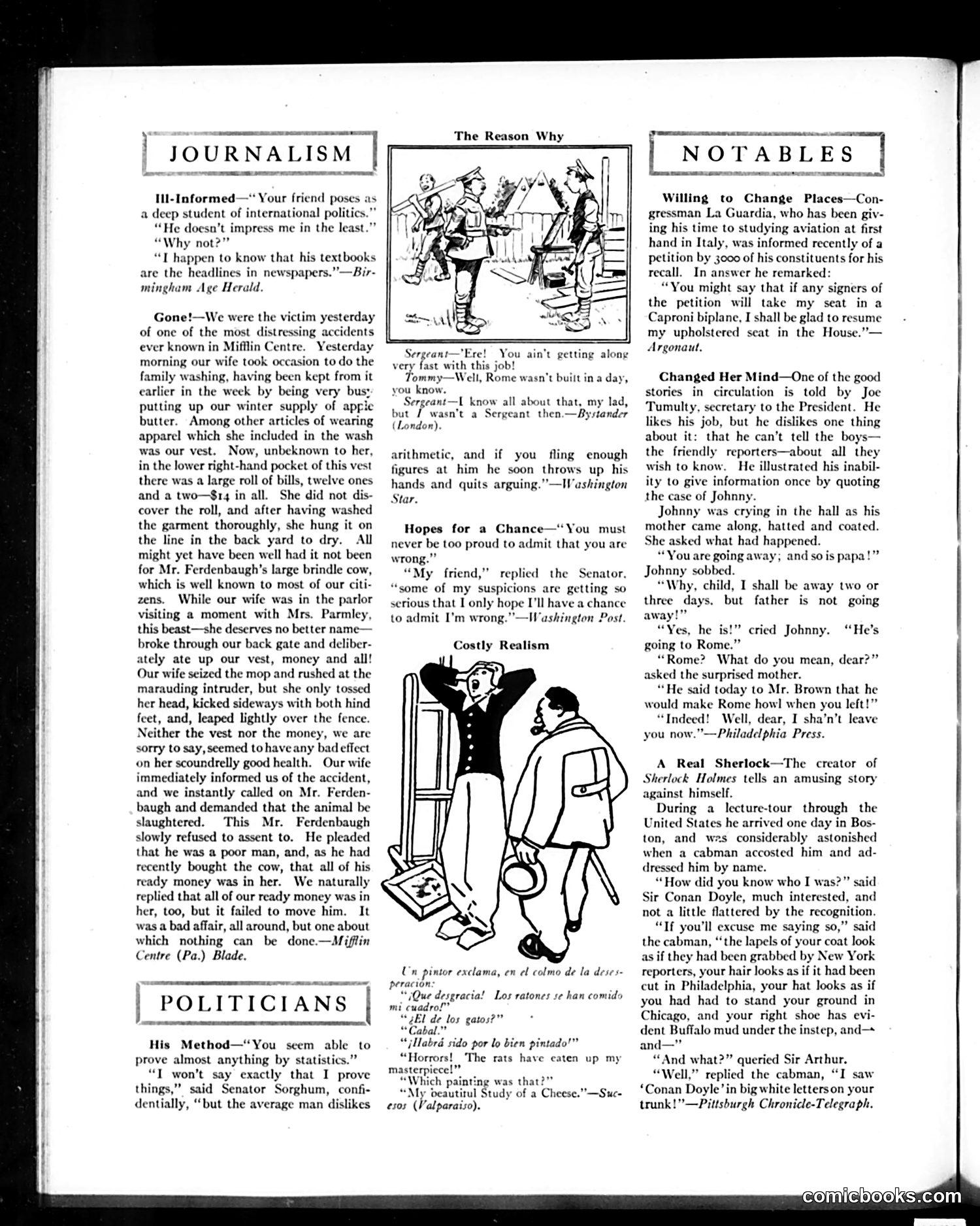
**The cartoons illustrate workplace frustrations through humor:** **"The Reason Why"** shows a sergeant and soldier discussing Rome's construction. The sergeant boasts he couldn't have built Rome faster because he wasn't even a sergeant then—satirizing military rank inflation and the sergeant's false importance. **"Costly Realism"** (in Spanish) features a painter lamenting that rats ate his painting of cheese. The joke: his artwork was *so realistic* the rats actually attacked it. This mocks overly literal, naturalistic art. **The text sections**—under "Journalism," "Politicians," and "Notables"—contain brief satirical anecdotes. Notable is the Fiorello LaGuardia reference: constituents petitioned his recall while he studied aviation in Italy. He jokingly offered to resign his House seat if they'd trade him their airplane seat instead—clever political humor about absent legislators. These pieces mock incompetent journalism, manipulative politicians, and institutional absurdities through witty, pointed commentary typical of Judge's satirical style.
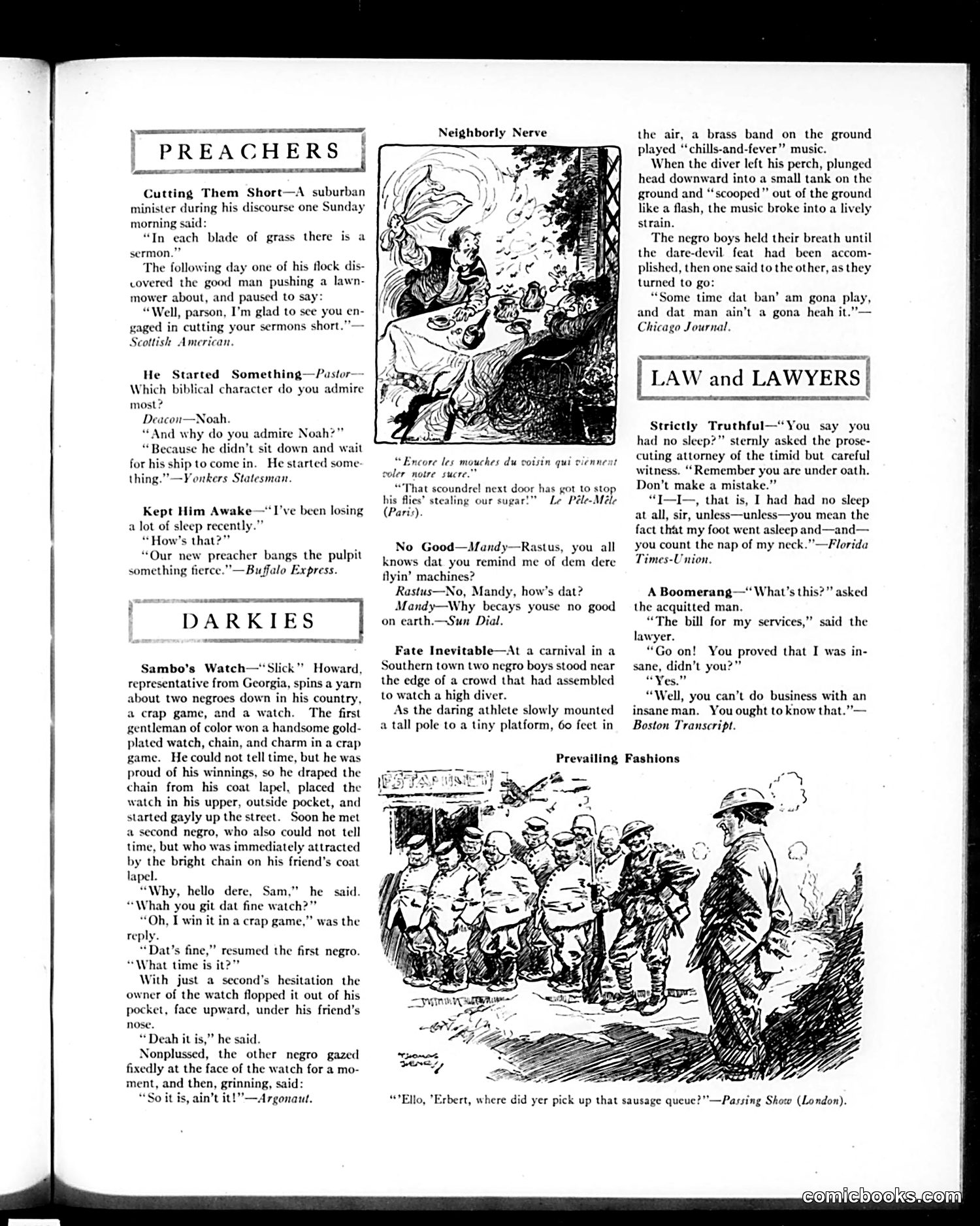
This page contains humorous anecdotes organized by topic. The "DARKIES" section presents racist dialect jokes portraying Black Americans as ignorant and simple-minded—a common feature of early 20th-century American humor magazines. These jokes rely on stereotypical speech patterns and situations designed to mock Black people's intelligence and behavior. The other sections mock clergy (for verbose sermons), lawyers (for billing absurd fees), and include a French cartoon about neighboring flies stealing sugar. A "Prevailing Fashions" cartoon shows what appears to be a working-class street scene. The racist content reflects the deeply embedded prejudices of the era. Judge magazine, while ostensibly satirizing various social groups, routinely published material that dehumanized Black Americans through caricature and stereotyping. This material is historically significant as evidence of normalized racism in mainstream American media, but the humor itself depends entirely on racial contempt.
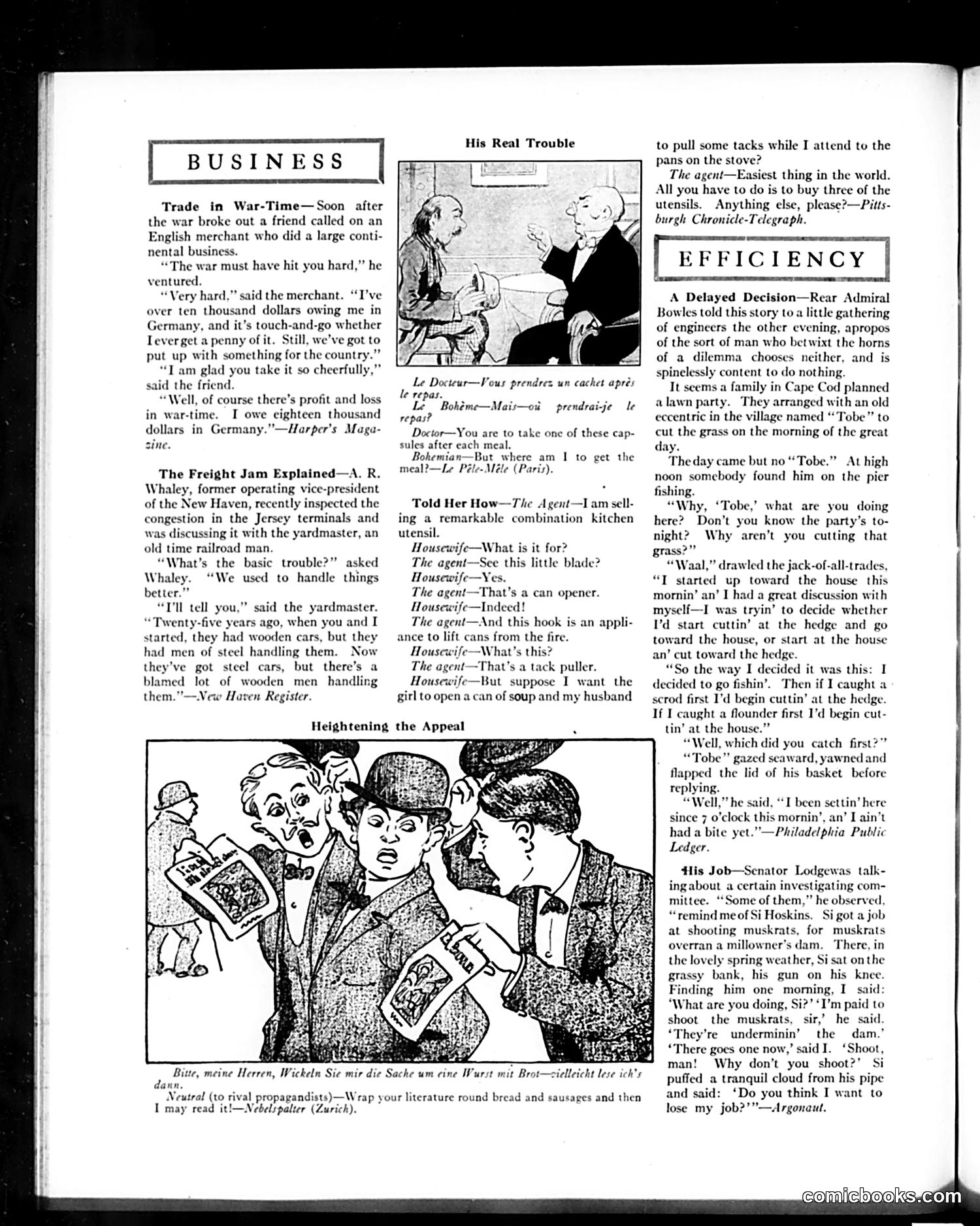
This page from Judge magazine contains several satirical business anecdotes typical of early 20th-century American humor. **"Trade in War-Time"** mocks wartime profiteering: an English merchant claims hardship from unpaid German debts while conveniently overlooking his larger debt owed *to* Germany—suggesting selective moral outrage serves business interests. **"The Freight Jam Explained"** contrasts past and present: railroads once had wooden cars but "men of steel" managing them; now they have steel cars but "wooden men"—satirizing how modern mechanization hasn't improved worker quality or efficiency. **"His Real Trouble"** features a Parisian bohemian too poor to eat, making the doctor's prescription for post-meal medication absurd. **"Efficiency"** section includes anecdotes mocking indecision and bureaucratic ineffectiveness—a Cape Cod villager avoids yard work through endless deliberation; Senator Lodge's investigator is presumably equally unproductive. The cartoon "Heightening the Appeal" (bottom) appears to show propagandists wrapping political literature around food—likely WWI-era satire about manipulative messaging tactics.
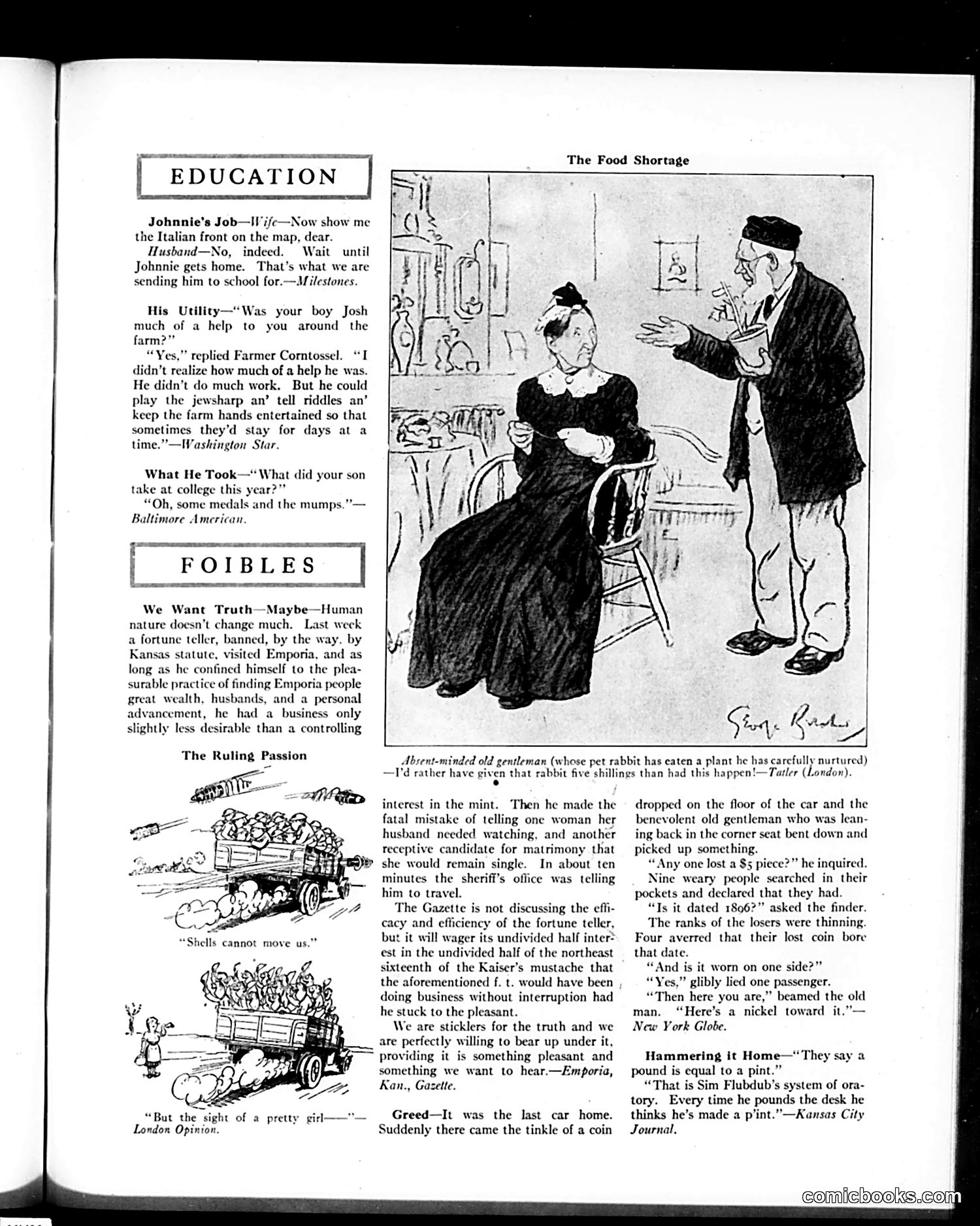
This Judge magazine page contains several short humorous anecdotes satirizing human nature and social foibles: **"The Food Shortage"** cartoon depicts an absent-minded gentleman upset that his pet rabbit ate a plant—he'd rather have given the rabbit five shillings (money) than suffered this loss. The joke mocks misplaced priorities and sentimentality. The **"EDUCATION"** section ridicules parents and schools: children learn little of practical value; a boy's main farm utility is entertainment rather than work; college teaches "medals and mumps" (diseases and trophies, not knowledge). **"FOIBLES"** includes three brief jokes: a fortune teller gets arrested for telling uncomfortable truths (people want pleasant lies); a con artist on a streetcar tricks nine people into claiming a lost nickel by asking specific questions, pocketing it himself; and a politician named Flubdub conflates pounding his desk with making persuasive arguments. The satire targets human gullibility, preference for comfortable illusions over truth, and the gap between education's promise and reality.
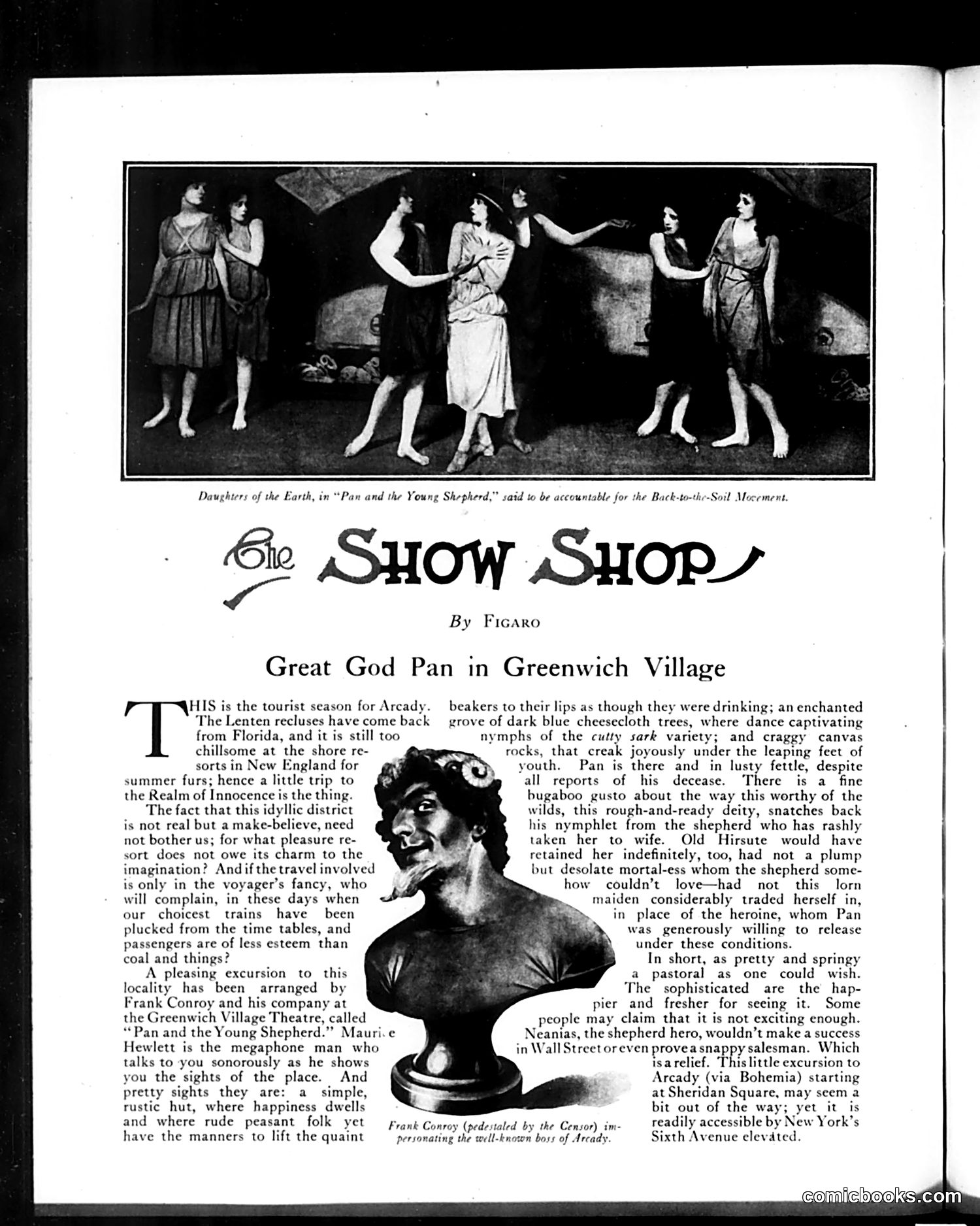
This is a theater review by Figaro (a Judge columnist) of a play at Greenwich Village Theatre. The satire targets both the play itself and the audience's nostalgia for "Arcady" — an imagined pastoral paradise. The joke: New Yorkers seeking escape from modern life (crowded trains, coal shortages post-WWI) attend this deliberately fake, cheaply-made production featuring "dark blue cheesecloth trees" and creaky canvas rocks. They pretend it transports them to an innocent, rustic world where Pan (the classical god of nature) and shepherds live simply. Figaro mocks this fantasy as pure imagination, yet acknowledges its appeal. He's especially sardonic about the plot: the shepherd can't keep the nymph he loves, so swaps for a "plump" mortal woman nobody else wants — hardly the romantic escape advertised. The real target: the Greenwich Village bohemian scene itself, which Figaro treats as artificial make-believe consumed by "sophisticated" urbanites desperate to believe in something genuine.
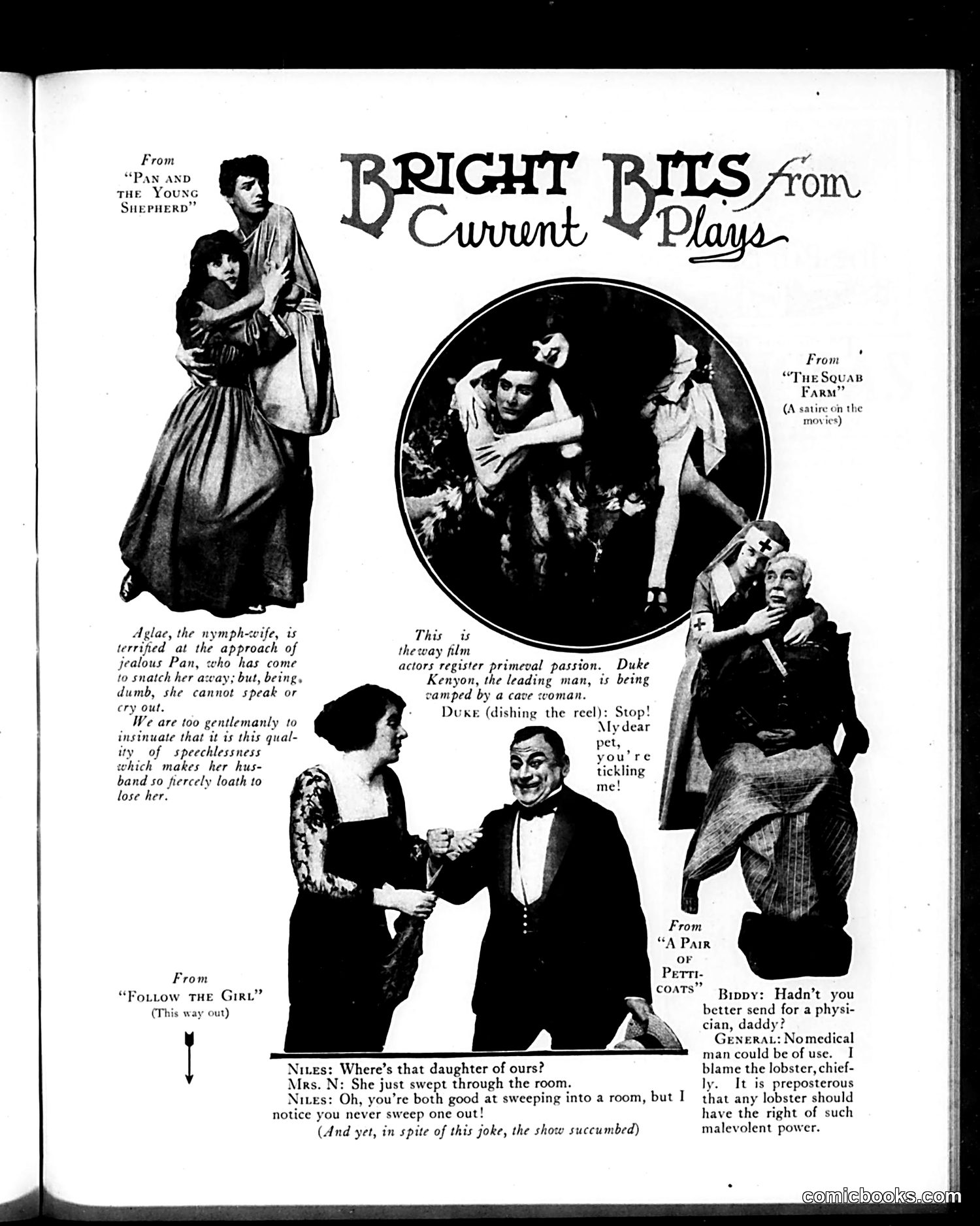
This page presents satirical sketches from four theatrical productions, mocking both stage drama and early cinema conventions. **"Pan and the Young Shepherd"** and **"The Squab Farm"** ridicule melodramatic acting styles—the first showing a woman rendered helpless by speechlessness (satirizing overwrought silent-film acting), the second depicting exaggerated "primeval passion" with a cave woman character. **"Follow the Girl"** jokes about domestic absurdity: a husband and wife are both skilled at *entering* rooms dramatically but never *exit* them—the show itself "succumbed" to this logical flaw. **"A Pair of Petticoats"** presents a comedic non-sequitur where a General blames a lobster for causing his daughter's illness, rejecting medical help. The humor lies in the ridiculous pseudo-logic that a lobster somehow possesses malevolent supernatural power. Overall, Judge mocks theatrical excess, weak plotting, and the nascent film industry's overwrought dramatic conventions.
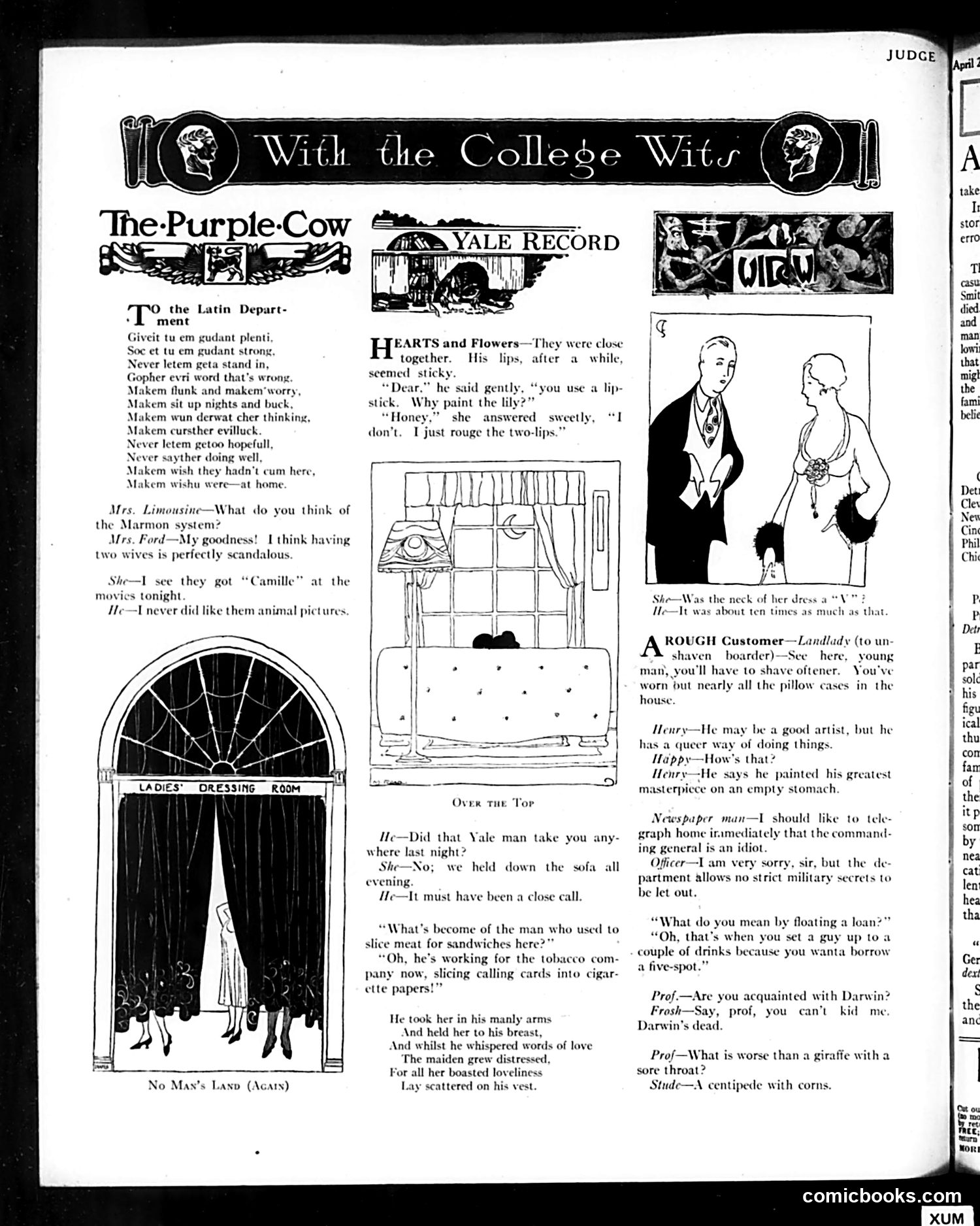
This page collects college-themed jokes and satirical cartoons typical of early 20th-century Judge magazine. The main sections include: **"The Purple Cow"** — A Latin Department satire mocking overly strict professors who torture students with grammar. **"Yale Record"** — College romance humor, including a lipstick joke ("rouge the two-lips") and a "close call" sofa scene implying unchaperoned dating. **"No Man's Land"** — A drawing of a crowded women's dressing room, satirizing gender separation in social spaces. The scattered jokes mock college types: wealthy socialites (Mrs. Limousine), dim freshmen ("Darwin's dead"), unshaven boarders, and student poverty. The humor is innocent by modern standards—mainly poking fun at class distinctions, courtship propriety, and academic absurdities rather than anything genuinely offensive. The overall tone celebrates collegiate life while gently mocking its pretensions.
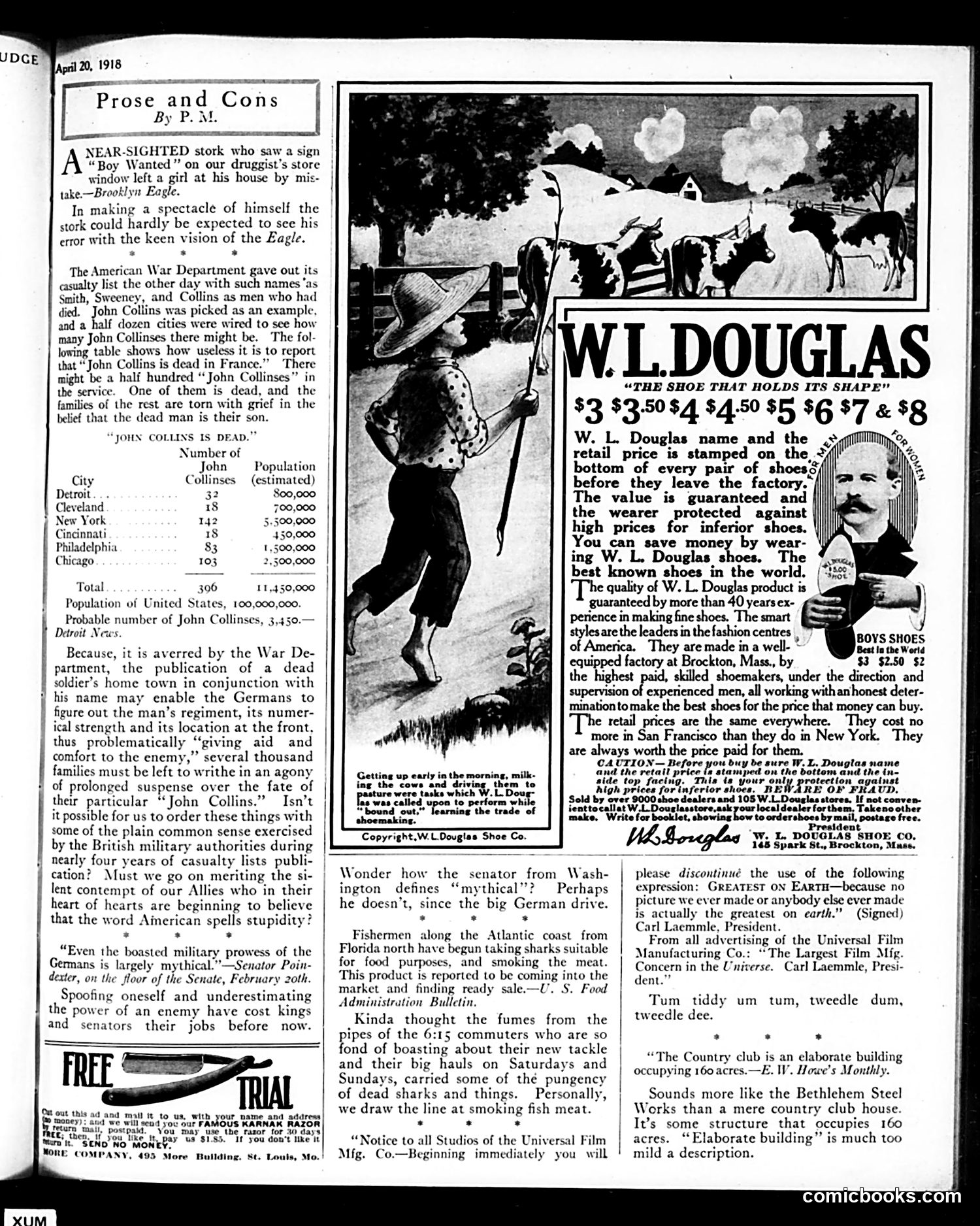
This page combines editorial commentary on WWI-era problems with shoe advertising. ## "Prose and Cons" Column The main satirical piece critiques U.S. War Department casualty reporting. When the Army announced "John Collins is dead in France," it triggered panic across multiple cities—the OCR text shows there were 396 John Collinses across major American cities. The columnist argues this practice is both cruel (leaving families in prolonged anguish) and stupid (potentially revealing regiment information to Germans, per department claims). He contrasts this unfavorably with British casualty procedures during "nearly four years" of their war experience, suggesting America is bungling basic military administration. The satire targets American military inefficiency and disregard for soldiers' families during WWI. ## Supporting Quotes A Senator Poindexter quote mocking German military prowess is undercut by the preceding example of American stupidity—the implicit joke being that America hardly has room to boast. The remainder is W.L. Douglas shoe advertising.
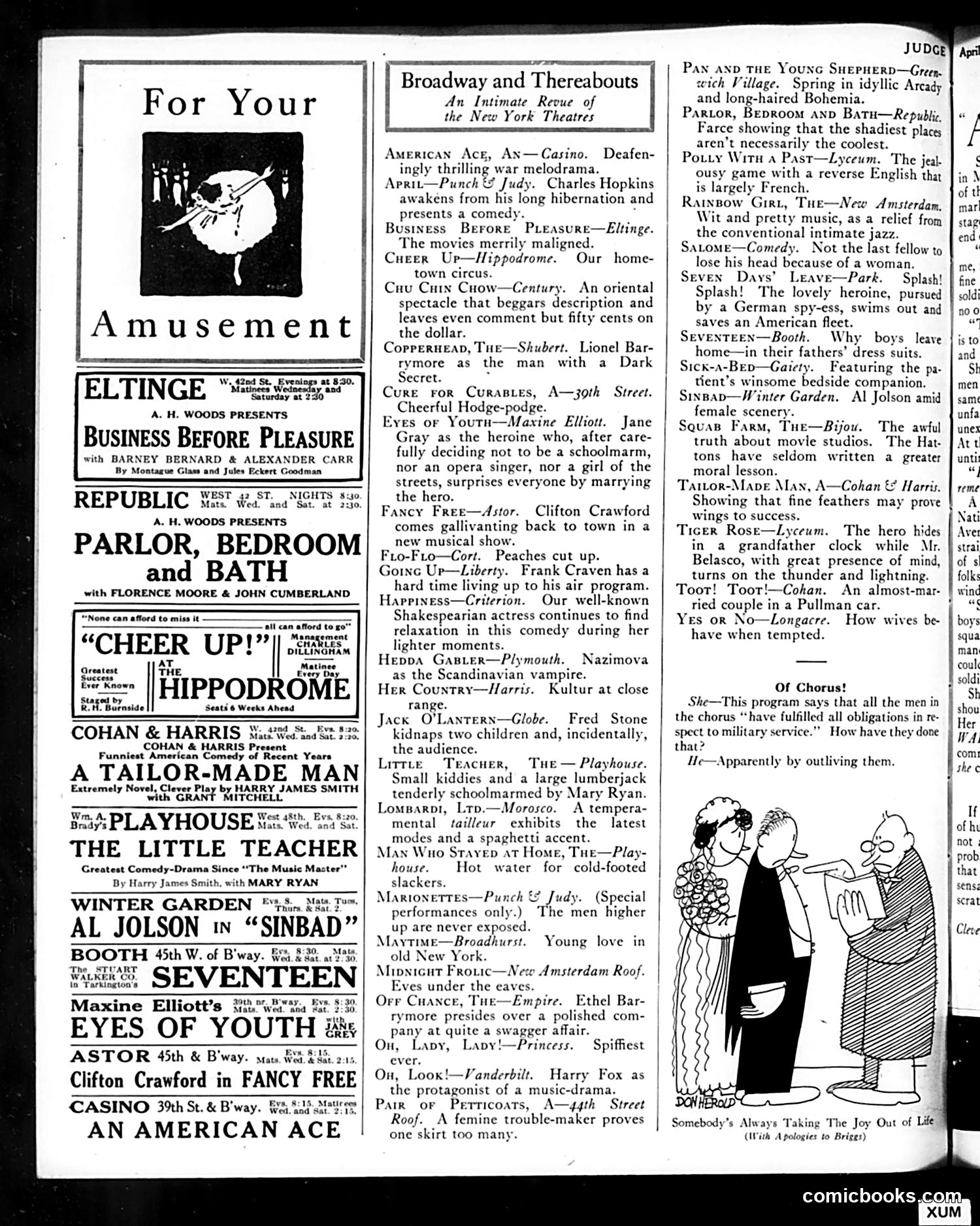
This page is primarily **theatrical advertising and reviews**, not political satire. It features Broadway theater listings and brief critical descriptions of current New York productions from approximately 1920. The small cartoon at bottom right—captioned "Somebody's Always Taking the Joy Out of Life"—shows a domestic scene where a woman appears to interrupt or scold a man, illustrating a mild marital comedy about spousal nagging. This is generic domestic humor rather than political satire. The theater reviews employ light, witty commentary: for example, *Chu Chin Chow* "leaves even comment but fifty cents on the dollar" (meaning it's so extravagant it exhausts description), and *The Man Who Stayed at Home* features "hot water for cold-footed slackers" (WWI-era jab at draft dodgers). The page's content reflects Judge's typical format: advertisements and entertainment coverage alongside satirical commentary, rather than focused political cartooning. The humor is theatrical and social rather than overtly political.
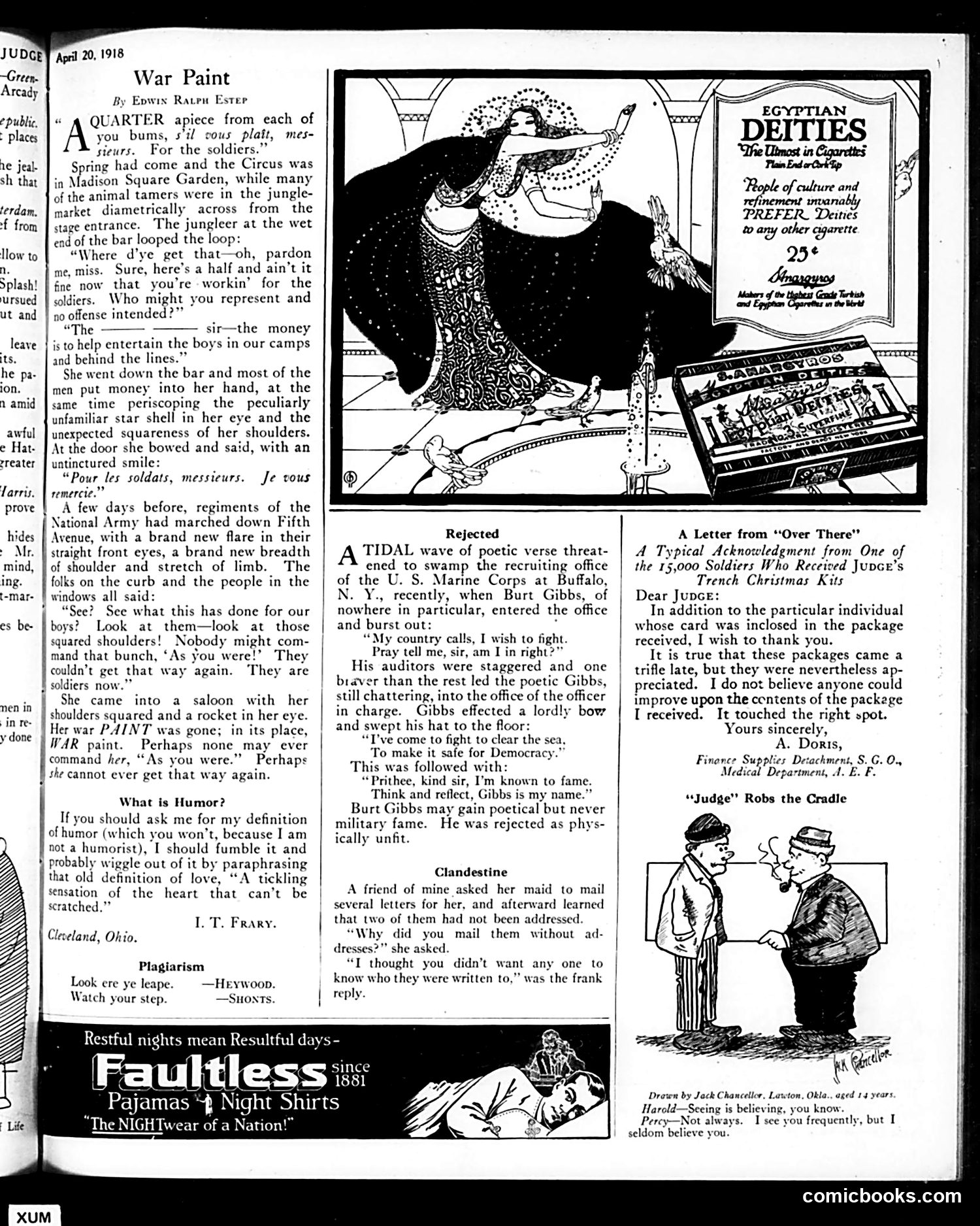
This story satirizes how military service transformed civilians into soldiers, then asks whether civilian women could achieve similar transformation. A woman fundraiser enters a saloon with "war paint" (makeup) removed, displaying the squared shoulders and military bearing of soldiers who'd recently marched down Fifth Avenue. The story's implicit point: while men gained permanent physical and moral strength from military service, the woman's transformation appears temporary—she "cannot ever get that way again." The accompanying anecdotes mock military bureaucracy (a poetic volunteer rejected as "physically unfit") and domestic foolishness (a maid mailing unaddressed letters to protect privacy). The page also advertises Egyptian Deities cigarettes and Faultless pajamas. Context: This appeared during America's WWI mobilization, when military service was reshaping national identity.
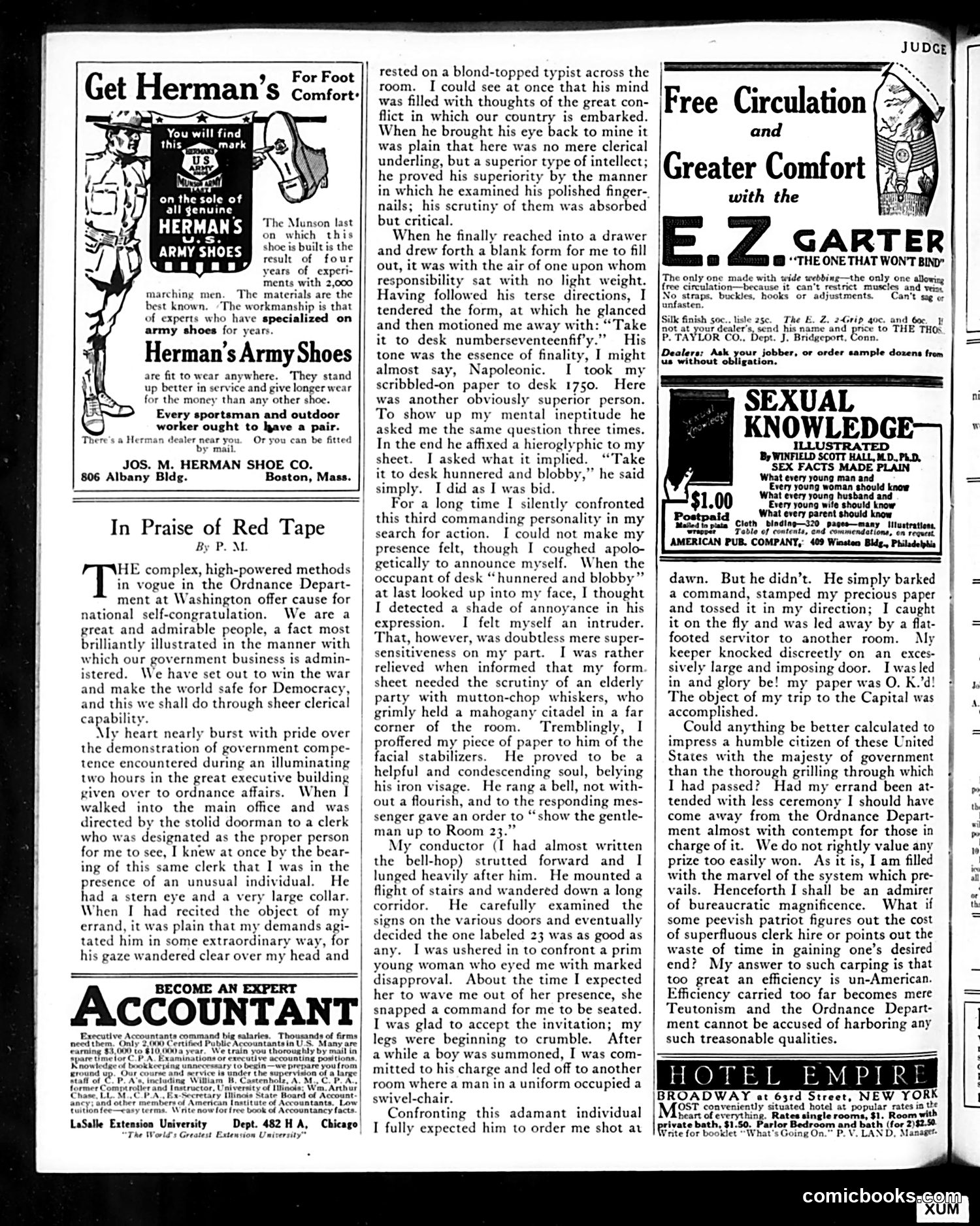
This page contains **satirical commentary on government bureaucracy** during World War I, titled "In Praise of Red Tape" (the title itself is ironic). **The Satire's Target:** The author describes visiting the Ordnance Department in Washington seeking action on an errand. He encounters a series of clerks who display exaggerated self-importance—examining fingernails with absorbed attention, giving terse Napoleonic commands, and shuffling him between desks numbered 1750 and "hunnered and blobby" without apparent purpose. **The Point:** The satire mocks the inefficiency of government wartime administration. While America claims to be fighting for Democracy with "sheer clerical capability," the actual machinery consists of pompous bureaucrats focused on procedures rather than results. Desk numbers become absurd, and the protagonist gets no closer to accomplishing anything. **Historical Context:** This likely reflects genuine frustrations Americans experienced with slow wartime government processes during WWI. The page also contains period advertisements (Herman's Army Shoes, accountancy courses) and another ad for sexual knowledge—typical Judge content.
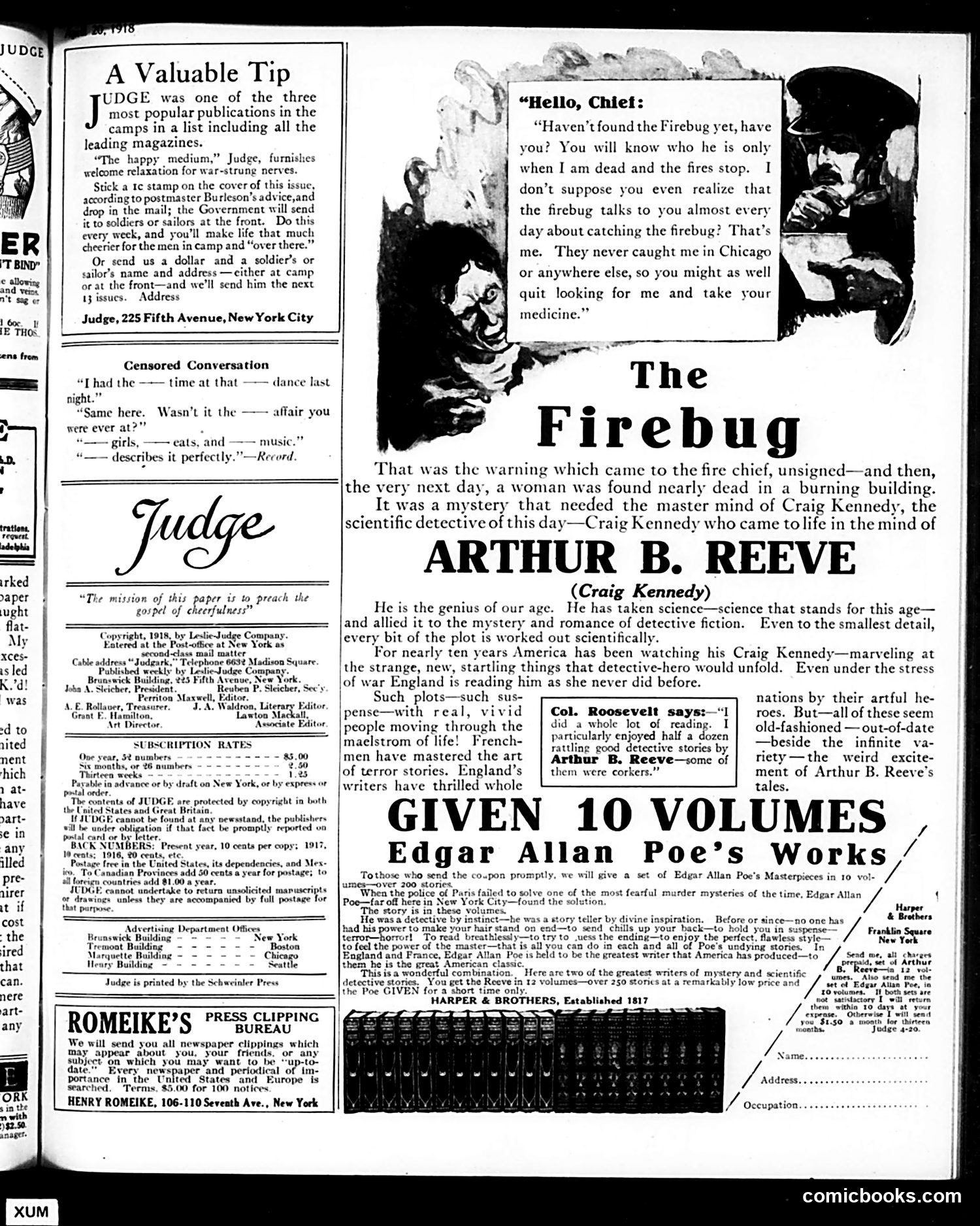
This page primarily advertises a serialized detective fiction story by Arthur B. Reeve featuring "Craig Kennedy," a famous "scientific detective" character popular in early 20th-century pulp magazines. The narrative hook shown depicts an anonymous arsonist taunting the fire chief, claiming responsibility for fires and boasting of eluding capture in Chicago. The story promises mystery and detection work. The surrounding content—including patriotic appeals to send Judge magazines to WWI soldiers, subscription information, and a "Censored Conversation" joke about wartime speech restrictions—reflects Judge's 1918 publication date during American involvement in World War I. Craig Kennedy stories were bestselling detective fiction of the era, emphasizing scientific investigation methods. The "Firebug" appears designed to capitalize on public fascination with both detective narratives and sensational crime stories. The illustration shows the anonymous criminal character.
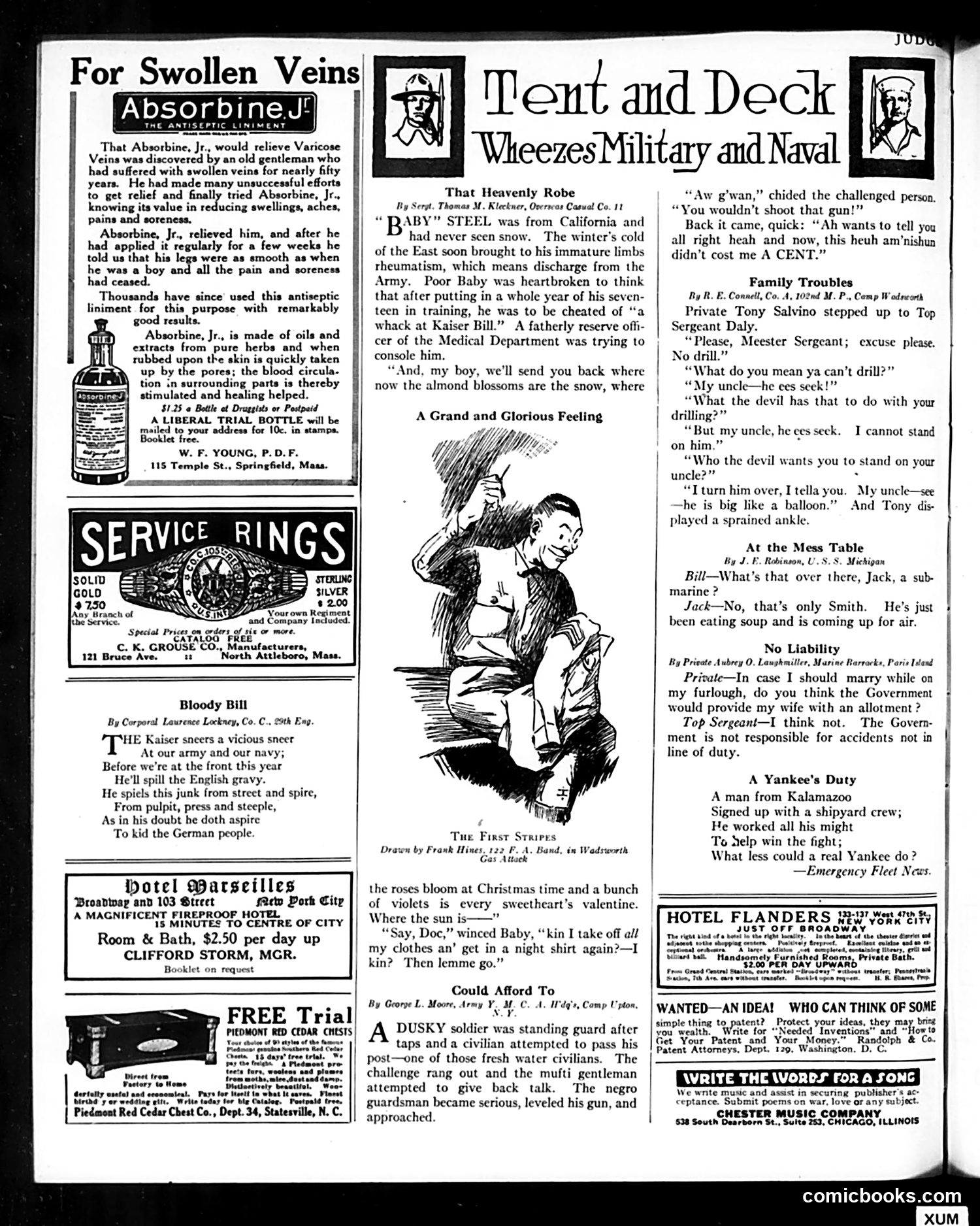
This page is primarily **advertisements and military humor** from Judge magazine, likely WWI-era based on references to "the Kaiser" and Army training. The main cartoon, "A Grand and Glorious Feeling," depicts a **homesick soldier** ("Baby Steel") from California suffering rheumatism in Eastern cold. An officer tries consoling him by describing warm climates and romantic imagery. Baby's response—asking to strip down to a night shirt and leave—is the joke: the soldier is so eager to escape (via medical discharge) that he's willing to abandon dignity. Secondary jokes include a **Black soldier** standing guard who threatens to shoot a civilian, joking his ammunition "didn't cost me A CENT" (implying the military provides it freely), and an Italian immigrant soldier requesting time off because his uncle is sick—a stereotyped ethnic humor bit. The ads (Absorbine liniment, hotel, service rings) fill remaining space. The "Bloody Bill" poem mocks German propaganda.
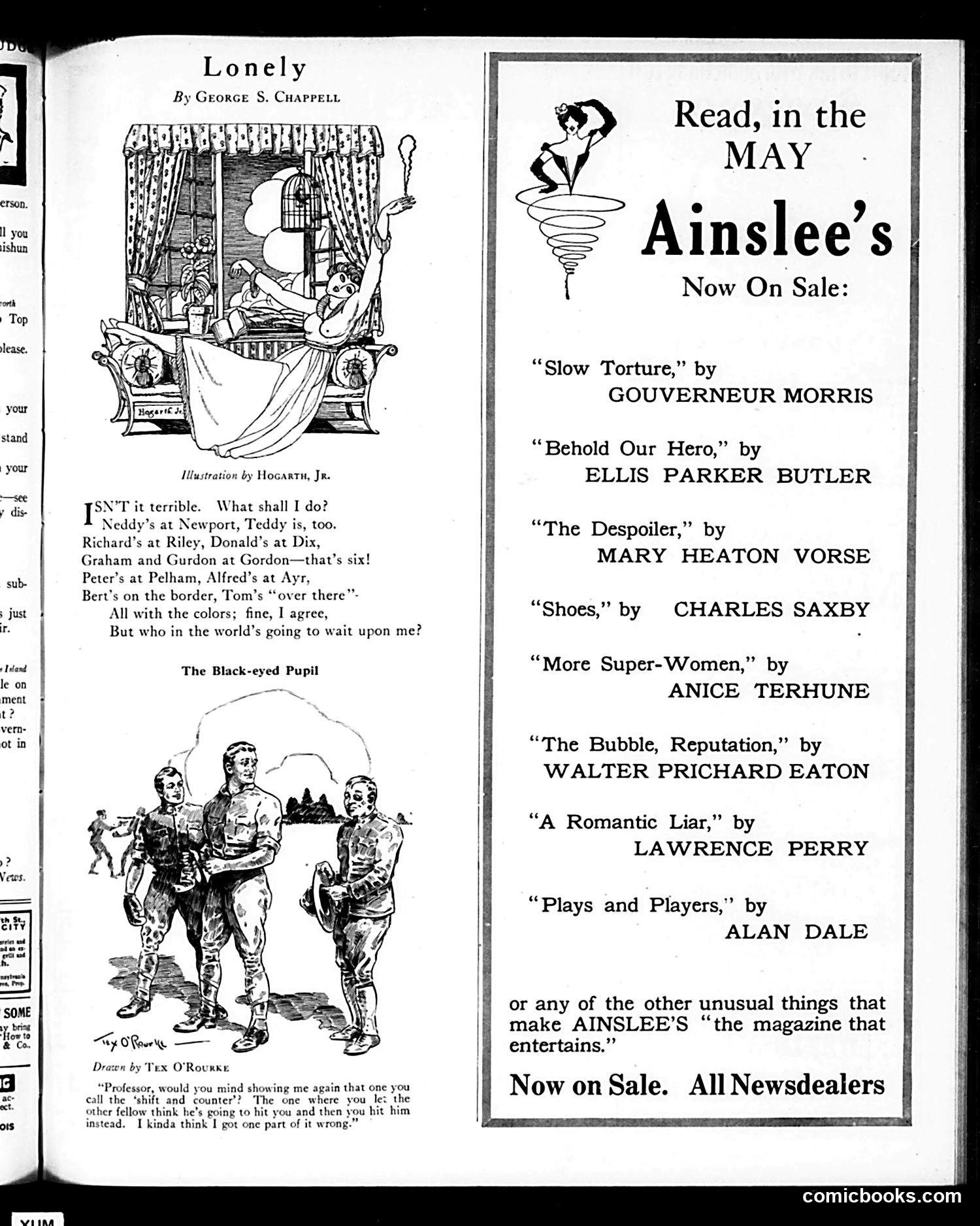
This page contains two distinct pieces: **Left side:** A satirical poem titled "Lonely" about a woman whose male companions have all enlisted for military service (references to "the colors" and "over there" indicate World War I). She lists six named men at various locations—Newport, Riley, Dix, Gordon, Pelham, and Ayr—plus others including "Bert's on the border" and "Tom's 'over there'"—all apparently soldiers. The poem's dark humor pivots on her final complaint: with all these men at war, "who in the world's going to wait upon me?" The secondary cartoon "The Black-eyed Pupil" (drawn by Tex O'Rourke) appears unrelated—a boxing joke about a fighter asking for technique clarification. **Right side:** An advertisement for Ainslee's magazine's May issue, listing fiction titles and authors. The satire mocks civilian women's self-centered concerns during wartime mobilization.
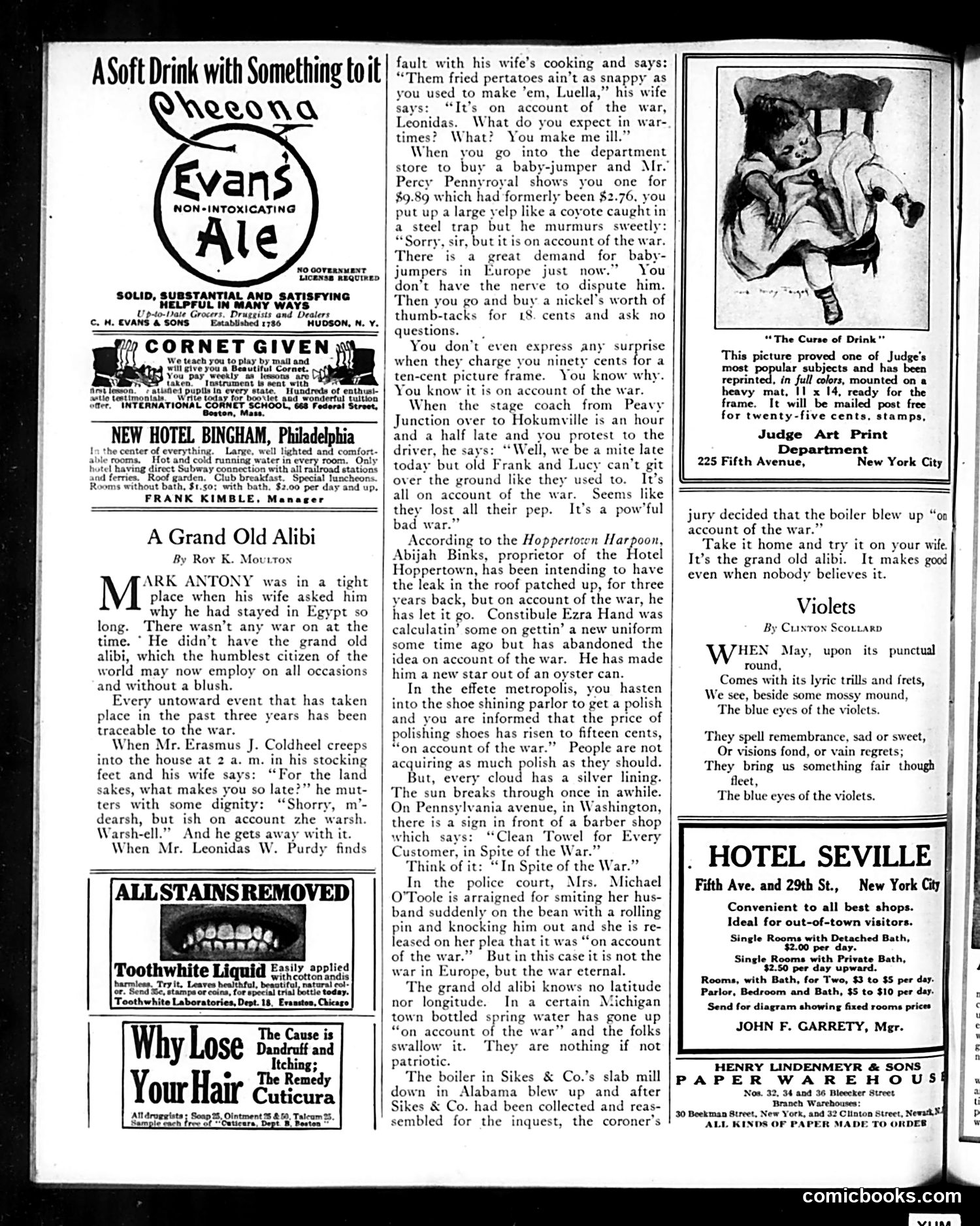
This satirical piece mocks how Americans invoked World War I as an all-purpose excuse for any inconvenience or failure. The article catalogs absurd examples: a husband arriving home at 2 a.m., a wife's poor cooking, inflated store prices (baby-jumpers, picture frames, shoe shines), late stagecoaches, and neglected home repairs—all blamed on "the war." The satire's point: citizens and merchants had become so accustomed to wartime disruptions that they accepted any explanation prefaced with "it's on account of the war" without question or complaint. The humor lies in the escalation from legitimate wartime hardships to ridiculous excuses—a leaky roof hasn't been fixed in *three years* because of the war. The piece concludes with gentle optimism: one barber shop advertises "Clean Towel for Every Customer, in Spite of the War"—suggesting some Americans still maintained standards despite wartime chaos.
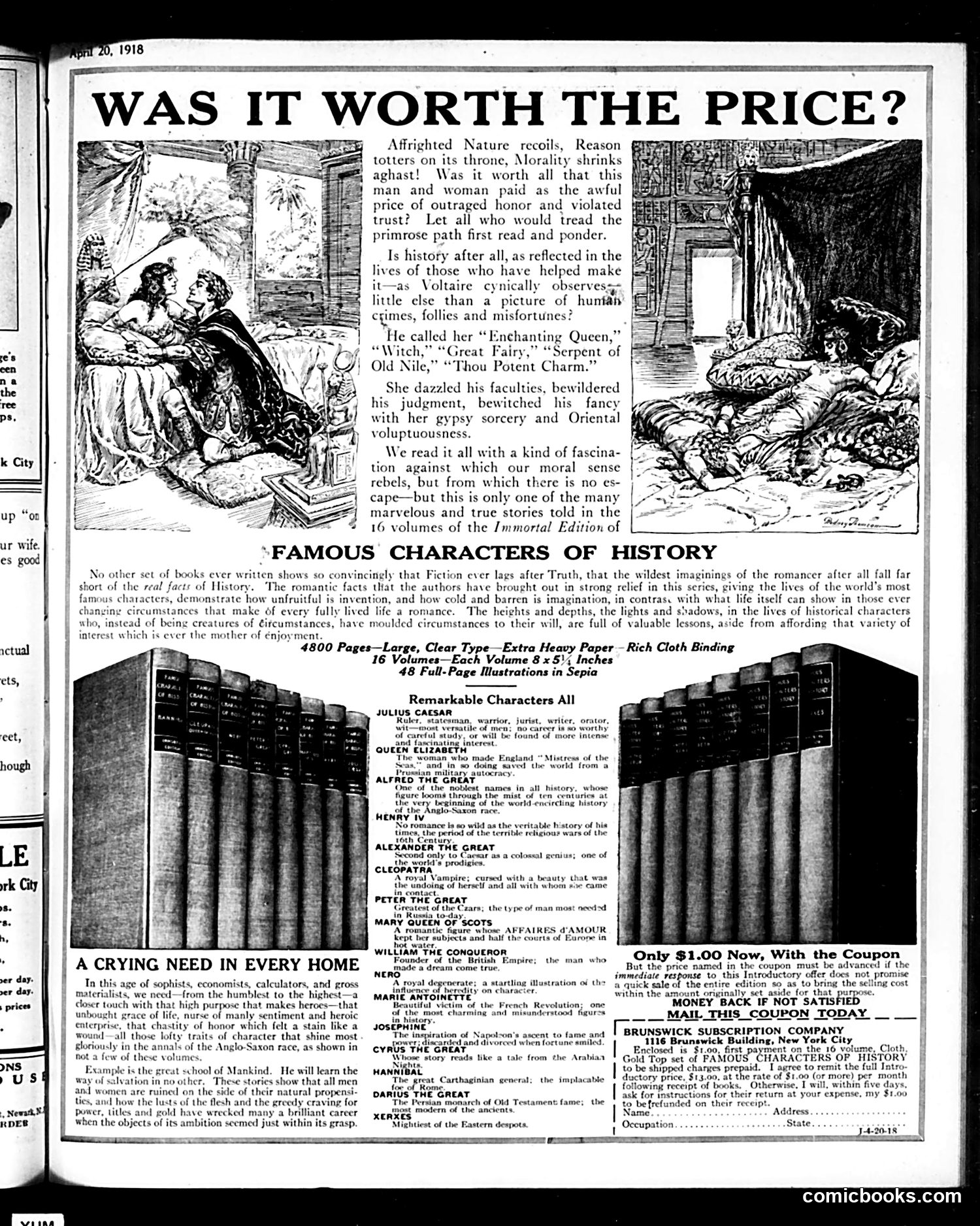
This page is primarily **advertising for a 16-volume book series called "Famous Characters of History,"** presented as educational literature. The decorative header illustration depicts a seduction scene—a man and woman in an intimate encounter—which serves as the hook for the pitch. The advertisement uses moral language ("Affrighted Nature," "outraged honor") to describe historical romance and scandal, then argues paradoxically that these true stories are more compelling than fiction. It appeals to readers' fascination with sensational historical figures (Cleopatra, Mary Queen of Scots, Nero) while framing the purchase as morally and intellectually worthwhile. The text quotes Voltaire cynically: history is largely "a picture of human crimes, follies and misfortunes"—yet readers should buy these volumes anyway. This is **marketing through moral ambiguity**: promising both edification and lurid entertainment. The $1.00 coupon offer at bottom indicates this was an affordable, mass-market product aimed at middle-class households seeking both culture and scandal.
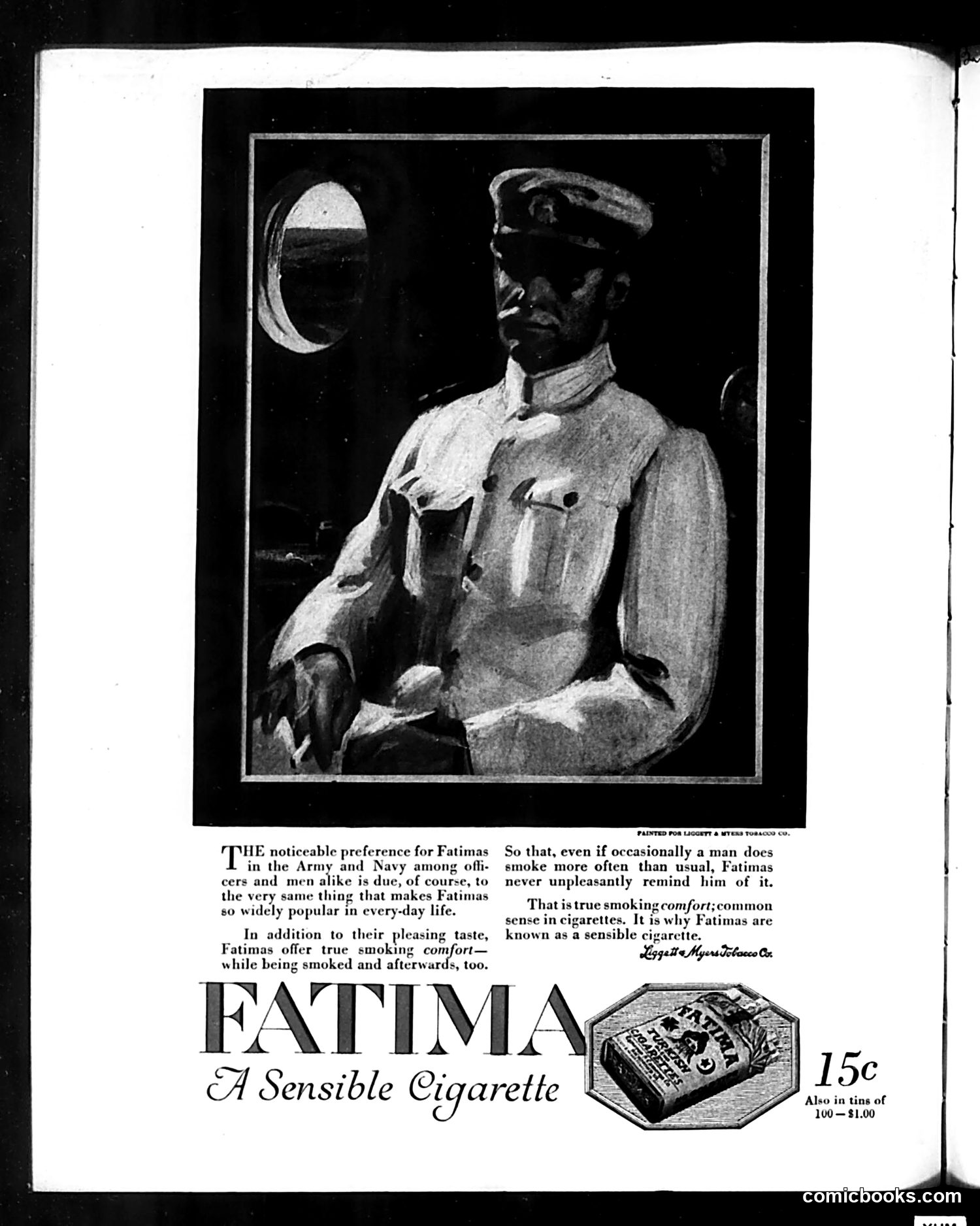
This is primarily a **cigarette advertisement**, not political satire. The image shows a military officer in what appears to be WWI-era uniform, gazing out a porthole, positioned to endorse Fatima brand cigarettes. The advertisement's pitch emphasizes "smoking comfort" and positions Fatimas as a "sensible cigarette" suitable for military personnel. The marketing strategy exploits military prestige—noting the brand's "noticeable preference...in the Army and Navy among officers and men"—to build civilian consumer appeal. The text claims Fatimas won't remind smokers unpleasantly of overindulgence, a selling point to health-conscious buyers of the era. The price (15¢) and bulk option (100 for $1.00) are shown. This reflects early 20th-century advertising's unregulated approach: using military figures and comfort claims to market tobacco without health disclaimers. Judge magazine published such advertisements alongside satirical content.