
Judge, 1918-04-20 · page 21 of 36
Judge — April 20, 1918 — page 21: what you’re looking at
What you’re looking at
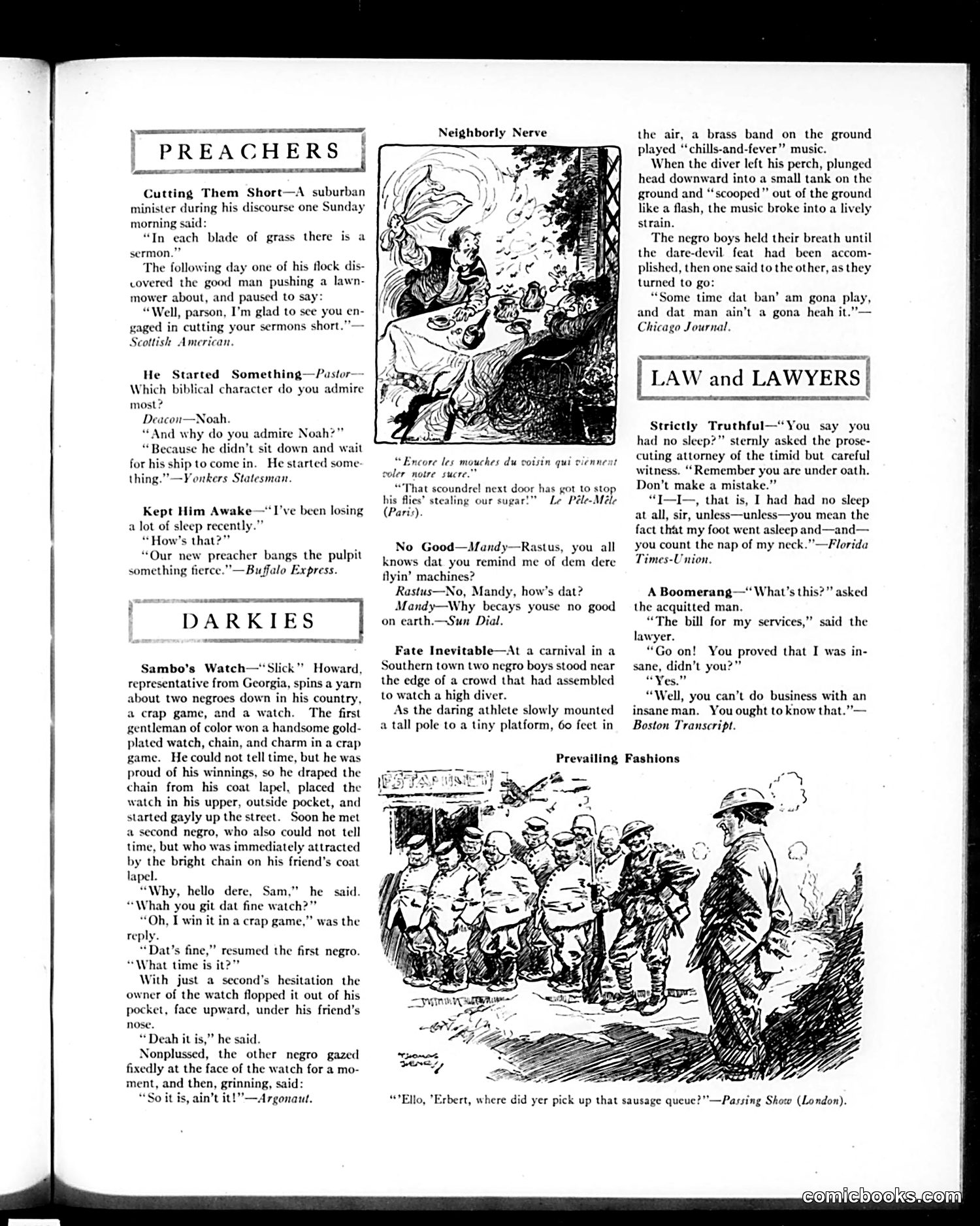
This page contains humorous anecdotes organized by topic. The "DARKIES" section presents racist dialect jokes portraying Black Americans as ignorant and simple-minded—a common feature of early 20th-century American humor magazines. These jokes rely on stereotypical speech patterns and situations designed to mock Black people's intelligence and behavior. The other sections mock clergy (for verbose sermons), lawyers (for billing absurd fees), and include a French cartoon about neighboring flies stealing sugar. A "Prevailing Fashions" cartoon shows what appears to be a working-class street scene. The racist content reflects the deeply embedded prejudices of the era. Judge magazine, while ostensibly satirizing various social groups, routinely published material that dehumanized Black Americans through caricature and stereotyping. This material is historically significant as evidence of normalized racism in mainstream American media, but the humor itself depends entirely on racial contempt.
📄 Transcribed text from this page (OCR, searchable)
Machine-transcribed from the original scan — historical spelling and the odd misread are preserved.
| CSS oe PREACHERS } a (satis > arena Cutting Them Short—A suburban minister during his discourse one Sunday morning said: “In each blade of grass there is a sermon.” The following day one of his flock dis- covered the good man pushing a lawn- mower about, and paused to sa; “Well, parson, I’m glad to sce you en- gaged in cutting your sermons short.” Scottish American. He Started Something—Pastor- Which biblical character do you admire most? Deacon—Noah. “And why do you admire Noah?” “Because he didn’t sit down and wait for his ship to come in. He started some: thing.” —Yonkers Statesman. Kept Him Awake—‘“I've been losing a lot of sleep recently.” “How’s that?” “Our new preacher bangs the pulpit something fierce.” —Buffalo Express. DARKIES Sambo’s Watch—" Slick’? Howard, representative from Georgia, spins a yarn about two negroes down in his country, a crap game, and a watch. The first gentleman of color won a handsome gold- plated watch, chain, and charm in a crap game. He could not tell time, but he was proud of his winnings, so he draped the chain from his coat lapel, placed the watch in his upper, outside pocket, and started gayly up the street. Soon he met a second negro, who also could not tell time, but who was immediately attracted by the bright chain on his friend’s coat lapel. “Why, hello dere, Sam,” he said. “Whah you git dat fine watch?” “Oh, I win it in a crap game,” was the repl Dat’s fine,” resumed the first negro. “What time is it?” With just a second’s hesitation the owner of the watch flopped it out of his pocket, face upward, under his friend’s nose. “Deah it is,” he said. Nonplussed, the other negro gazed fixedly at the face of the watch for a mo- ment, and then, grinning, said: “So it is, ain’t it!”—Argonaut, Neighborly Nerve PSPS y4| Us neore les mouches du coisin qui viennent coler notre sucre.” hat scoundre! next door has got to stop his flies’ stealing our sugar!” Le Péle-Méle (Paris). No Good—Mandy—Rastus, you all knows dat you remind me of dem dere flyin’ machines? Rastus—No, Mandy, how's dat? Mandy—Why becays youse no good on earth.—Sun Dial. Fate Inevitable—At a carnival in a Southern town two negro boys stood near the edge of a crowd that had assembled to watch a high diver. As the daring athlete slowly mounted a tall pole to a tiny platform, 60 feet in Prevailing Fashions “Ello, ’Erbert, where did yer pick up that sausage queuc?""—Passing Show (London). the air, a brass band on the ground played ‘‘chills-and-fever” music. When the diver left his perch, plunged head downward into a small tank on the ground and “scooped” out of the ground like a flash, the music broke into a lively strain. The negro boys held their breath until the dare-devil feat had been accom- plished, then one said to the other, as they turned to go: “Some time dat ban’ am gona play, and dat man ain't a gona heah it.”— Chicago Journal. aa, LAW and LAWYERS | Strictly Truthful—‘You say you had no sleep?” sternly asked the prose- cuting attorney of the timid but careful witness. ‘Remember you are under oath. Don’t make a mistake.” “I—I-—, that is, I had had no sleep at all, sir, unless—unless—you mean the fact that my foot went asleep and—and— you count the nap of my neck.”"—Florida Times-Union. A Boomerang—“ What's this?” asked the acquitted man, “The bill for my services,” said the lawyer. “Go on! You proved that I was in- didn’t you?” “Well, you can’t do business with an insane man. You ought to know that.”— Boston Transcript.