
Judge, 1918-04-20 · page 23 of 36
Judge — April 20, 1918 — page 23: what you’re looking at
What you’re looking at
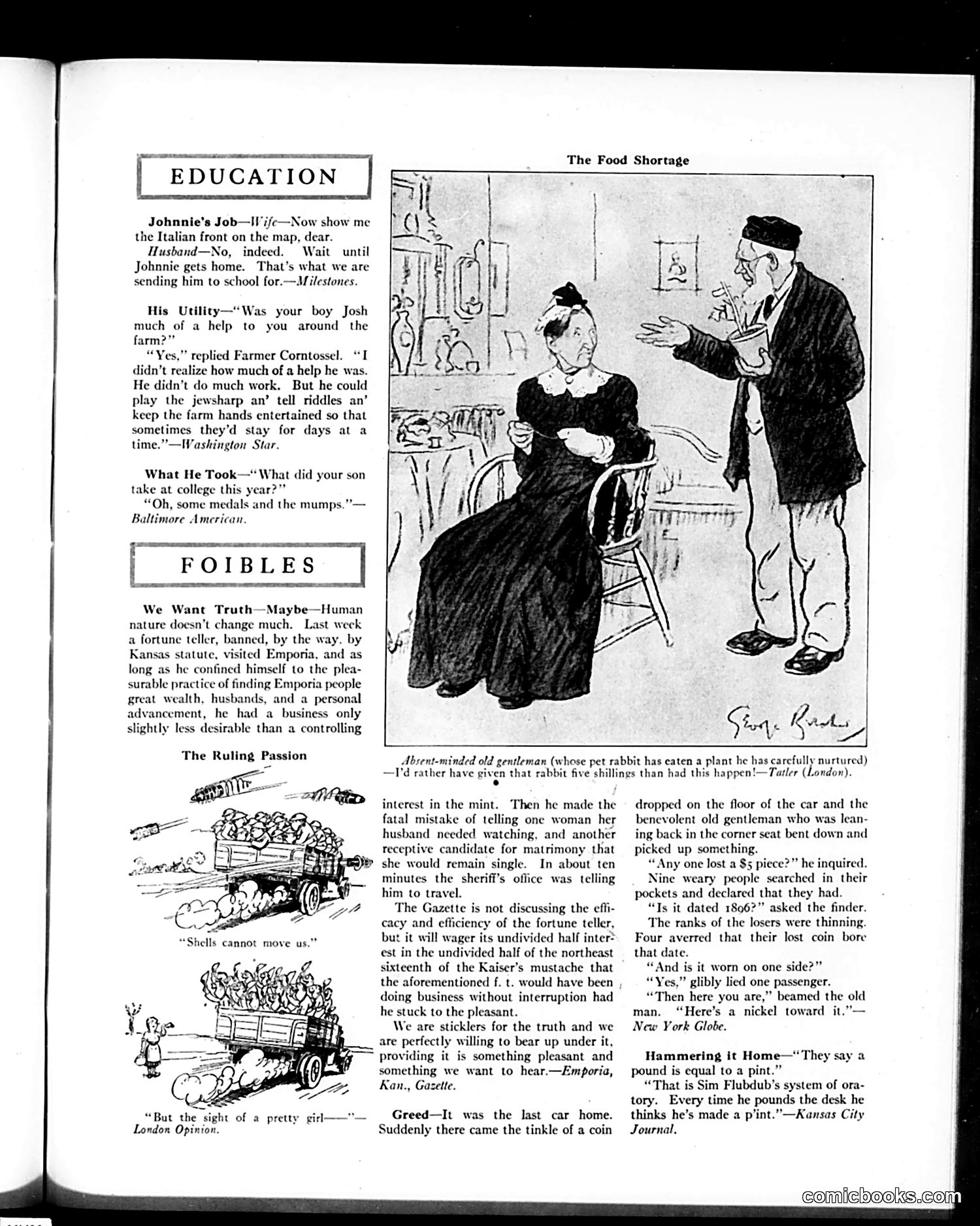
This Judge magazine page contains several short humorous anecdotes satirizing human nature and social foibles: **"The Food Shortage"** cartoon depicts an absent-minded gentleman upset that his pet rabbit ate a plant—he'd rather have given the rabbit five shillings (money) than suffered this loss. The joke mocks misplaced priorities and sentimentality. The **"EDUCATION"** section ridicules parents and schools: children learn little of practical value; a boy's main farm utility is entertainment rather than work; college teaches "medals and mumps" (diseases and trophies, not knowledge). **"FOIBLES"** includes three brief jokes: a fortune teller gets arrested for telling uncomfortable truths (people want pleasant lies); a con artist on a streetcar tricks nine people into claiming a lost nickel by asking specific questions, pocketing it himself; and a politician named Flubdub conflates pounding his desk with making persuasive arguments. The satire targets human gullibility, preference for comfortable illusions over truth, and the gap between education's promise and reality.
📄 Transcribed text from this page (OCR, searchable)
Machine-transcribed from the original scan — historical spelling and the odd misread are preserved.
| EDUCATION Johnnie's Job—Ilife—Now show me the Italian front on the map, dear. Husband—No, indeed. Wait until Johnnie gets home. That’s what we are sending him to school for.—M ilestones. His Utility—* your boy Josh much of a help to you around the farm?” “yi replied Farmer Corntossel. “I didn’t realize how much of a help he was. He didn’t do much work. But he could play the jewsharp an’ tell riddles an’ keep the farm hands entertained so that sometimes they'd stay for days at a time.”—IVashington Star. What He Took— take at college this ye “Oh, some medals and the mumps.”— Baltimore American. What did your son re? FOIBLES { We Want Truth—Maybe—Human nature doesn’t change much. Las! a fortune teller, banned, by the way. Kansas statute, visited Emporia, and as long as he confined himself to the plea- surable practice of finding Emporia people great wealth, husbands, and a personal advancement, he had a business only slightly less desirable than a controlling The Ruling Passion “But the sight of a pretty. gir—"— London Opinion. The Food Shortage e Absent-minded old gentleman (whose pet rabbit has caten a plant he has carefully nurtured) —I'd rather have given that rabbit five shillings than had this happen!—Tarler (London). e interest in the mint. Then he made the fatal mistake of telling one woman her husband needed watching, and another receptive candidate for matrimony that she would remain single. In about ten minutes the sheriff’s office was telling him to travel. The Gazette is not discussing the effi- cacy and efficiency of the fortune teller, but it will wager its undivided half inter est in the undivided half of the northeast sixteenth of the Kaiser’s mustache that the aforementioned f. t. would have been doing business without interruption had he stuck to the pleasant. We are sticklers for the truth and we are perfectly willing to bear up under it, providing it something pleasant and something we want to hear.—Emporia, Kan., Gazette. Greed—It was the last car home. Suddenly there came the tinkle of a coin dropped on the floor of the car and the benevolent old gentleman who was lean- ing back in the corner seat bent down and picked up something. “Any one lost a $5 pi he inquired. Nine weary people searched in their pockets and declared that they had. “Ts it dated 1806?” asked the finder. The ranks of the losers were thinning. Four averred that their lost coin bore that date. “And is it worn on one side?” “Yes,” glibly lied one passenger. “Then here you are,” beamed the old man. “Here’s a nickel toward it.”— New York Globe. Hammering it Home—" They say a pound is equal to a pint.” “That is Sim Flubdub’s system of ora- tory. Every time he pounds the desk he thinks he’s made a p’int.”—Kansas City Journal. comichooks.