
Judge, 1918-04-20 · page 15 of 36
Judge — April 20, 1918 — page 15: what you’re looking at
What you’re looking at
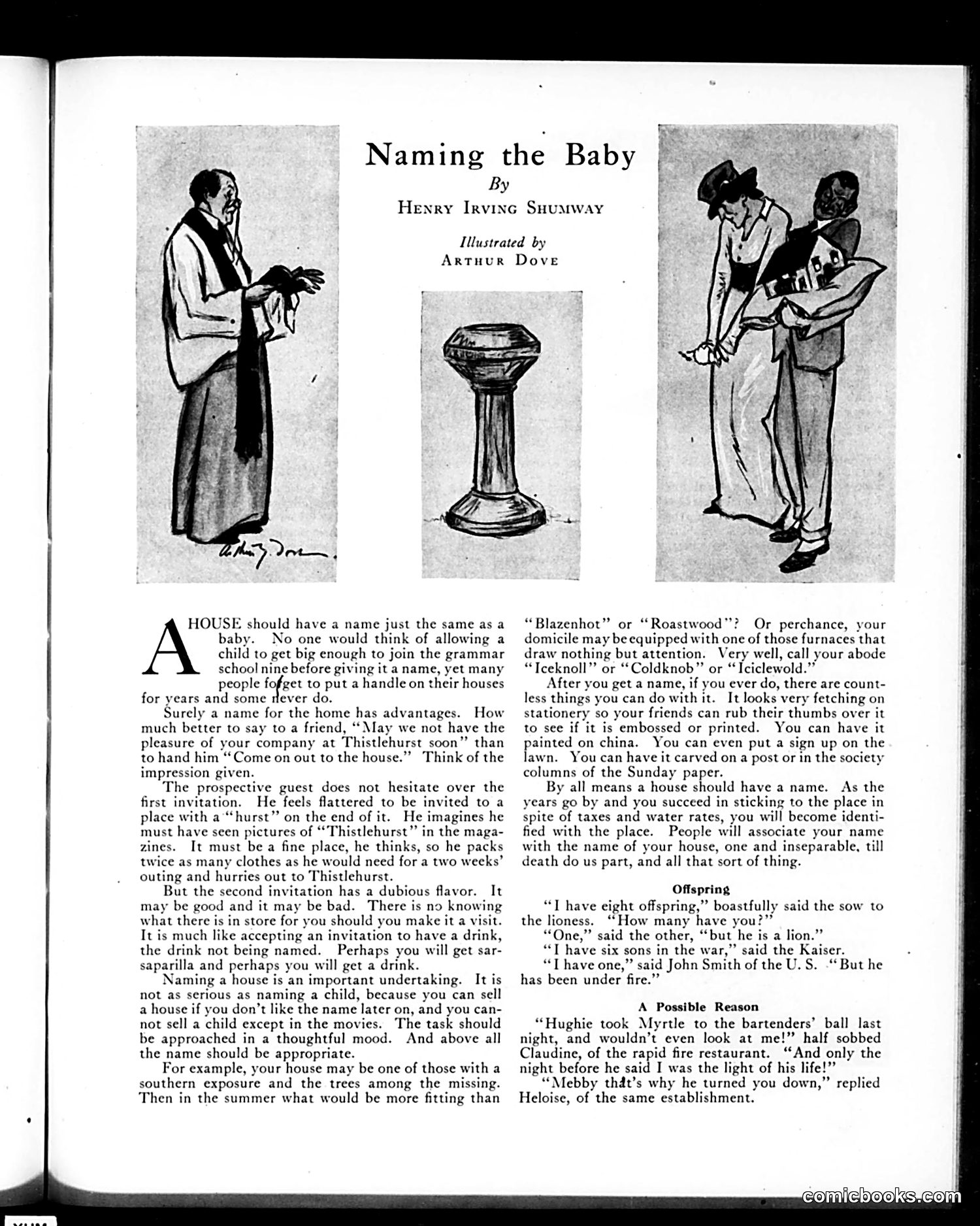
This is a humorous essay with three unrelated comic sketches about naming—houses, animal offspring, and romantic attention. **Main article**: Shumway satirizes Americans' pretentiousness about naming their homes. He mocks how a named house ("Thistlehurst") impresses guests more than an unnamed one ("the house"), despite being identical. The satire suggests social climbing and shallow status-consciousness—that names create false impressions of grandeur. He offers absurd heat-related names for poorly-situated homes ("Blazenhot," "Roastwood"), mocking the matching of names to actual conditions. **Three brief jokes below** offer quick punchlines: quality over quantity (a lion cub beats eight piglets); sacrifice matters more than numbers (one American soldier in combat beats the Kaiser's six sons); and a woman's romantic value diminishes after she becomes *too* available ("light of his life" loses appeal once she's clingy). The tone is lighthearted domestic humor typical of early 20th-century Judge magazine.
📄 Transcribed text from this page (OCR, searchable)
Machine-transcribed from the original scan — historical spelling and the odd misread are preserved.
Naming the Baby By Henry Irving Suumway Illustrated by Artuur Dove HOUSE baby. should have a name just the same as a No one would think of allowing a child to get big enough to join the grammar school nine before giving it a name, yet many people fofget to put a handle on their houses for years and some lever do. Surely a name for the home has advantages. How much better to say to a friend, “ May we not have the pleasure of your company at Thistlehurst soon” than to hand him “Come on out to the house.” Think of the impression given. The prospective guest does not hesitate over the first invitation. He feels flattered to be invited to a place with a’“hurst”’ on the end of it. He imagines he must have seen pictures of “Thistlehurst” in the maga- zines. It must bea fine place, he thinks, so he pac twice as many clothes as he would need for a two weeks. outing and hurries out to Thistlehurst. But the second invitation has a dubious flavor. It may be good and it may be bad. There is no knowing what there is in store for you should you make it a visit. It is much like accepting an invitation to have a drink, the drink not being named. Perhaps you will get sar- saparilla and perhaps you will get a drink. Naming a house is an important undertaking. It is not as serious as naming a child, because you can sell a house if you don’t like the name later on, and you can- not sell a child except in the movies. The task should be approached in a thoughtful mood. And above all the name should be appropriate. For example, your house may be one of those with a southern exposure and the trees among the missing. Then in the summer what would be more fitting than “Blazenhot” or “Roastwood"? Or perchance, your domicile may be equipped with one of those furnaces that draw nothing but attention. Very well, call your abode “Tceknoll” or “Coldknob” or “Iciclewold.” After you get a name, if you ever do, there are count- less things you can do with it. It looks very fetching on stationery so your friends can rub their thumbs over it to see if it is embossed or printed. You can have it painted on china. You can even put a sign up on the lawn. You can have it carved on a post or in the society columns of the Sunday paper. By all means a house should have a name. As the years go by and you succeed in sticking to the place in spite of taxes and water rates, you will become identi- fied with the place. People will associate your name with the name of your house, one and inseparable, till death do us part, and all that sort of thing. Offspring “T have eight offspring,” boastfully said the sow to the lioness. “How many have you?” “One,” said the other, “but he is a lion.” “T have six sons in the war,” said the Kaiser. “T have one,” said John Smith of the U.S. -“ But he has been under fire.” A Possible Reason “Hughie took Myrtle to the bartenders’ ball last night, and wouldn’t even look at me!” half sobbed Claudine, of the rapid fire restaurant. ‘And only the night before he said I was the light of his life!”’ “Mebby that’s why he turned you down,” replied Heloise, of the same establishment.