
Judge, 1918-04-20 · page 17 of 36
Judge — April 20, 1918 — page 17: what you’re looking at
What you’re looking at
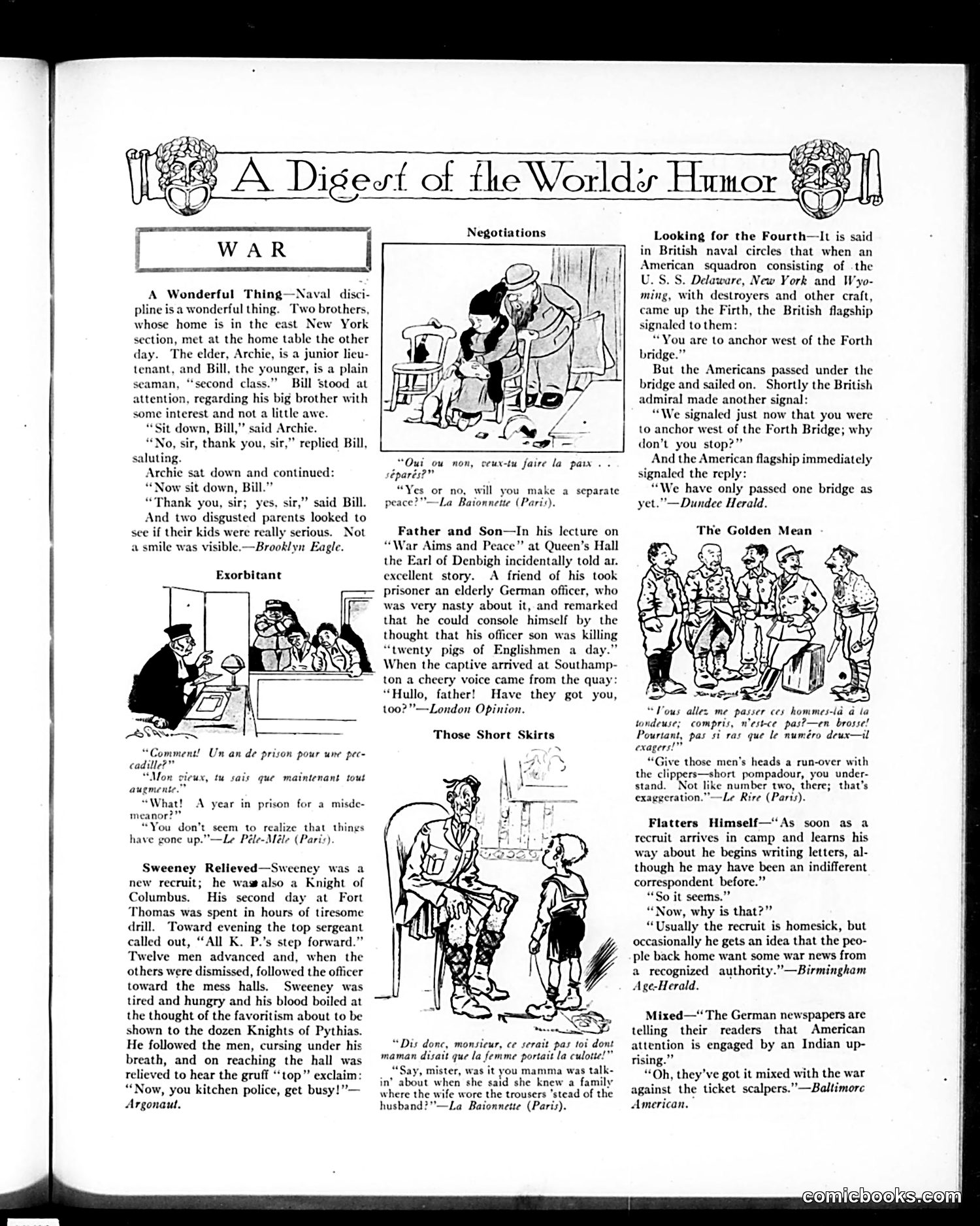
This page collects brief satirical anecdotes about WWI military life and international relations. Key items: **"A Wonderful Thing"** mocks rigid military discipline—two brothers meeting at home, where the younger automatically salutes and stands at attention for his officer brother, leaving parents bewildered. **"Sweeney Relieved"** plays on a recruit's assumption of favoritism: expecting Knights of Columbus to receive special treatment, Sweeney is relieved (disappointed) when all K.P. duty assignees are treated equally. **"Looking for the Fourth"** jokes about American naval confusion: British ships signal Americans to anchor west of the Forth Bridge, but Americans pass under it anyway, claiming they've "only passed one bridge." **"Those Short Skirts"** and **"The Golden Mean"** are European cartoons (translated) about wartime gender roles and military grooming standards. **"Father and Son"** presents dark humor: a captured German officer consoles himself that his son kills "twenty Englishmen daily"—only to encounter his son arriving as a prisoner too. The magazine collects international war-related humor, reflecting home-front anxieties and military absurdities.
📄 Transcribed text from this page (OCR, searchable)
Machine-transcribed from the original scan — historical spelling and the odd misread are preserved.
ZRUR) it: pare A Wonderful Thing. al disci- pline is a wonderful thing. Two brothers, whose home is in the east New York section, met at the home table the other day. The elder, Archi a junior lieu- tenant, and Bill, the younger, is a pla ‘ond ¢ Bill Stood at regarding his big brother with some interest and not a little awe. “Sit down, Bill,” said Archie. No, sir, thank you, sir,” replied Bill, saluting. Archie sat down and continue “Now sit down, Bill.” “Thank you, sir; yes, sir,” said Bill. And two disgusted parents looked to see if their kids were really serious. Not a smile was visible.—Brooklyn Eagle. Exorbitant “Comment! Un an de prison pour une pec~ cadille?” “Mon vieux, tu sais que maintenant tout meanor? “You don’t seem to realize that things have gone up.”—Le Péle-Méle (Paris) Sweeney Relieved—Sweeney was a new recruit; he wawalso a Knight of Columbus. His second day at Fort Thomas was spent in hours of tiresome drill. Toward evening the top sergeant called out, “All K. P.’s step forward.” Twelve men advanced and, when the others were dismissed, followed the officer toward the mess halls. Sweeney was tired and hungry and his blood boiled at the thought of the favoritism about to be shown to the dozen Knights of Pythias. He followed the men, cursing under his breath, and on reaching the hall was relieved to hear the gruff “top” exclaim: “Now, you kitchen police, get busy!”— Argonaut. < B& Digect of the Worldir Hitor Negotiations ui ou non, ceux-tu faire la paix . . séparés?” “y peace or no, will you make a separate La Baionnette (Paris). Father and Son—In his lecture on “War Aims and Peace” at Queen’s Hall the Earl of Denbigh incidentally told ar. excellent story. A friend of his took prisoner an elderly German officer, who was very nasty about it, and remarked that he could console himself by the thought that his officer son was killing “twenty pigs of Englishmen a day.” When the captive arrived at Southamp- ton a cheery voice came from the quay: “Hullo, father! Have they got you, too?"—London Opinion. Those Short Skirts a’ Mave “Dis donc, monsieur, ce serait pas toi dont maman disait que la femme portait la culotte!” “Say, mister, was it you mamma was talk- in’ about when she said she knew a family where the wife wore the trousers ‘stead of the husband?"—La Baionnette (Paris). Looking for the Fourth—It is said in British naval circles that when an American squadron consisting of the U.S. S. Delaware, New York and Wyo- ming, with destroyers and other craft, came up the Firth, the British flagship signaled to them: “You are to anchor west of the Forth bridge.” But the Americans passed under the bridge and sailed on. Shortly the British admiral made another signal: “We signaled just now that you were to anchor west of the Forth Bridge; why don’t you stop?” And the American flagship immediately signaled the reply: “We have only passed one bridge as yet.” —Dundee Herald. The Golden Mean la dla tondeuse; compris, n'estce pas?—en brosse! Pourtant, pas si ras que le numéro deux—il exagers!”” “Give those men’s heads a run-over with i short pompadour, you under- ke number two, there; that’s exaggeration.” —Le Rire (Paris). Flatters Himself—‘“As soon as a recruit arrives in camp and learns his way about he begins writing letters, al- though he may have been an indifferent correspondent before.” “So it seems.”” “Now, why is that?” “Usually the recruit is homesick, but occasionally he gets an idea that the peo- ple back home want some war news from a recognized authority.”—Birmingham Age-Herald. Mixed—“ The German newspapers are telling their readers that American attention is engaged by an Indian up- rising.” “Oh, they’ve got it mixed with the war against the ticket scalpers.”—Baltimorc American.”