
Judge, 1918-04-20 · page 10 of 36
Judge — April 20, 1918 — page 10: what you’re looking at
What you’re looking at
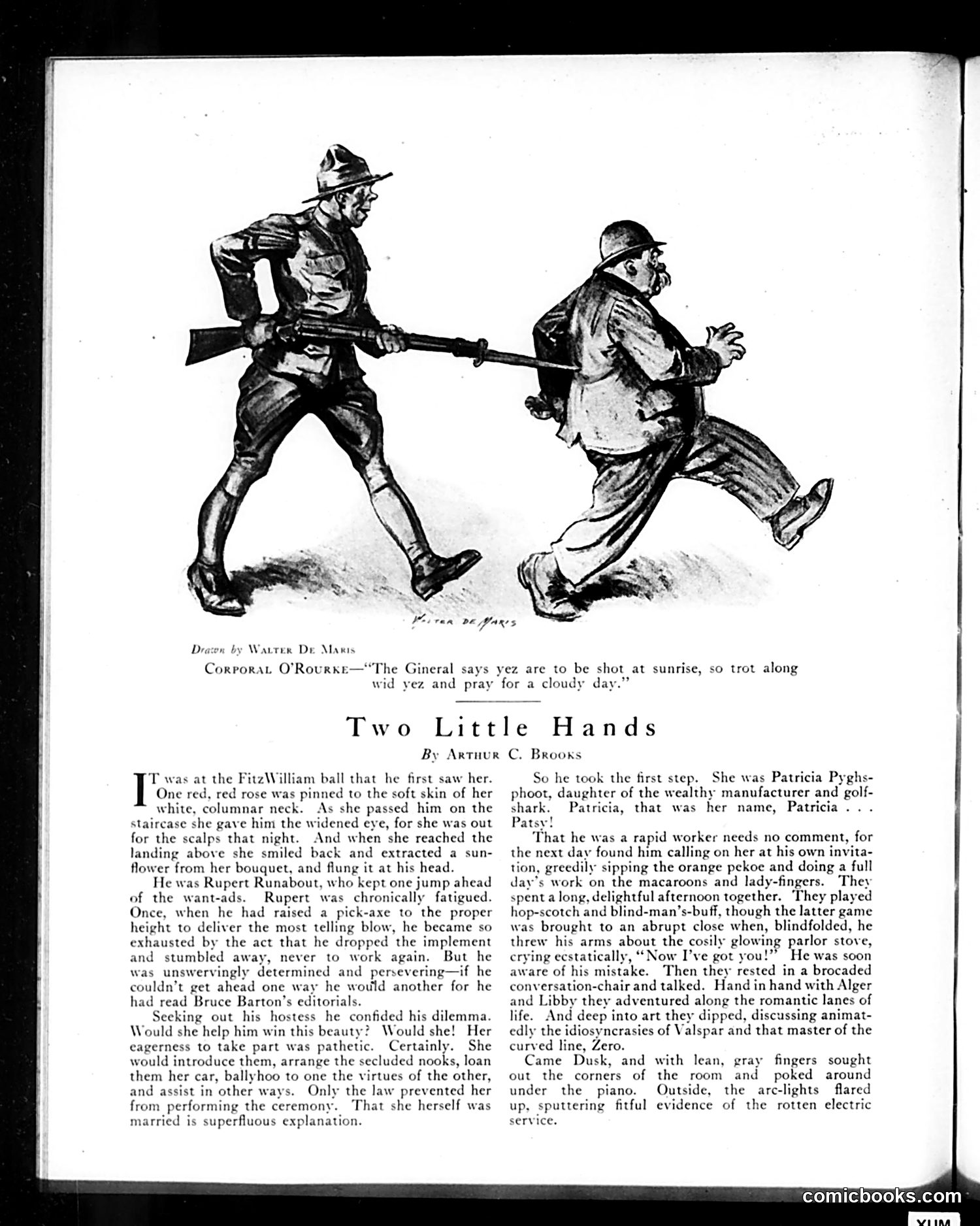
**The Cartoon (top):** Drawn by Walter De Maris, this depicts "Corporal O'Rourke" (identifiable by the Irish dialect caption) as a military officer bayoneting a fleeing civilian. The caption's dark joke—the General orders execution at sunrise, so O'Rourke advises the victim to "pray for a cloudy day"—appears to satirize either military brutality or Irish soldiers' roles in conflict, likely referencing World War I-era violence or British-Irish military dynamics. **The Story:** "Two Little Hands" by Arthur C. Brooks is a romantic satire about Rupert Runabout (a lazy fortune-hunter) pursuing wealthy heiress Patricia Pyghsphoot. The humor mocks shallow upper-class courtship rituals, social-climbing, and the protagonist's shameless opportunism. References to "Bruce Barton's editorials" (a 1920s advertising/business figure) and casual mentions of servants and wealth highlight class-based satire typical of Judge magazine's audience.
📄 Transcribed text from this page (OCR, searchable)
Machine-transcribed from the original scan — historical spelling and the odd misread are preserved.
y Watrer De Manis Corporat O’Rourke—“The Gineral says yez are to be shot at sunrise, so trot along wid yez and pray for a cloudy day.” Two Little Hands By Artuur C. Brooks T was at the FitzWilliam ball that he first saw her. One red, red rose was pinned to the soft skin of her white, columnar neck. As she passed him on the staircase she gave him the widened eye, for she was out for the scalps that night. And when she reached the landing above she smiled back and extracted a sun- flower from her bouquet, and flung it at his head. He was Rupert Runabout, who kept one jump ahead of the want-ads. Rupert was chronically fatigued. Once, when he had raised a pick-axe to the proper height to deliver the most telling blow, he became so exhausted by the act that he dropped the implement and stumbled away, never to work again. But he was unswervingly determined and persevering—if he couldn’t get ahead one way he would another for he had read Bruce Barton’s editorials. Seeking out his hostess he confided his dilemma. Would she help him win this beauty?) Would she! Her eagerness to take part was pathetic. Certainly. She would introduce them, arrange the secluded nooks, loan them her car, ballyhoo to one the virtues of the other, and assist in other ways. Only the law prevented her from performing the ceremony. That she herself was married is superfluous explanation. So he took the first step. She was Patricia Pyghs- phoot, daughter of the wealthy manufacturer and golf- shark. Patricia, that was her name, Patricia .. . Patsy! That he was a rapid worker needs no comment, for the next day found him calling on her at his own invita- tion, greedily sipping the orange pekoe and doing a full day’s work on the macaroons and lady-fingers. They spent a long, delightful afternoon together. ‘They played hop-scotch and blind-man’s-buff, though the latter game was brought to an abrupt close when, blindfolded, he threw his arms about the cosily glowing parlor stove, crying ecstatically, “Now I’ve got you!”” He was soon aware of his mistake. Then they rested in a brocaded conversation-chair and talked. Hand in hand with Alger and Libby they adventured along the romantic lanes of life. And deep into art they dipped, discussing animat- edly the idiosyncrasies of Valspar and that master of the curved line, Zero. Came Dusk, and with lean, gray fingers sought out the corners of the room and poked around under the piano. Outside, the arc-lights flared up, sputtering fitful evidence of the rotten electric service. comicbooks.com