
Judge, 1918-04-20 · page 16 of 36
Judge — April 20, 1918 — page 16: what you’re looking at
What you’re looking at
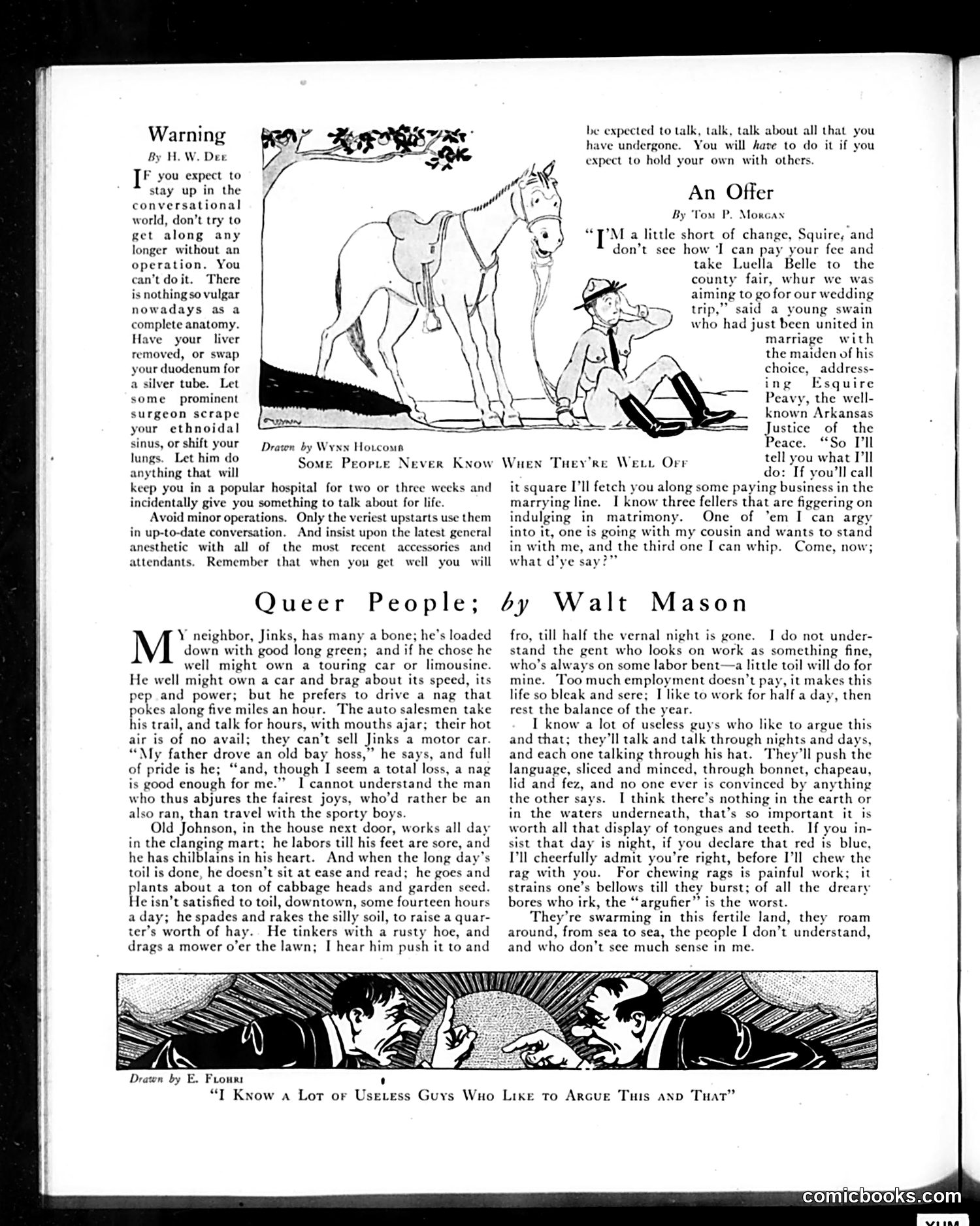
This *Judge* page contains three distinct satirical pieces: **"Warning" (top left):** Mocks 1920s society's obsession with cosmetic surgery as social currency. The joke: you must undergo unnecessary operations and discuss them constantly to remain conversationally relevant. It satirizes how people weaponize medical procedures for status. **"An Offer" (top right):** A rural Arkansas story where a poor newlywed offers a Justice of the Peace three potential solutions to pay his fee—including bribing, coercing, or fighting other suitors into marriages to generate business. It's gentle satire of rural desperation and opportunistic officials. **"Queer People" (bottom):** Walt Mason critiques three men who reject modern conveniences: Jinks refuses a car despite wealth (prefers horses), Johnson works obsessively on gardening after exhausting days, and argumentative men waste time debating pointlessly. "Queer" meant "strange/odd." Mason satirizes those who reject progress, overwork, and pointless arguers—suggesting these behaviors make no rational sense. The illustrations by Wyss Holcomb and E. Florher support each piece's themes.
📄 Transcribed text from this page (OCR, searchable)
Machine-transcribed from the original scan — historical spelling and the odd misread are preserved.
Warning By H.W. Dee you expect to stay up in the conversational world, don’t try to get along any longer without an operation. You can't doit. There is nothing so vulgar nowadays as a complete anatomy. Have your liver removed, or swap your duodenum for a silver tube. Let some prominent surgeon scrape be expected to talk, talk, talk about all that you have undergone. You will kate to do it if you expect to hold your own with others. An Offer By ‘Tou P. Moxcas “yM a little short of change, Squire, and don’t see how ‘I can pay your fee and take Luella Belle to the county fair, whur we was aiming to go for our wedding trip,” said a young swain who had just been united in marriage with the maiden of his choice, address- ing Esquire Peavy, the well- known Arkansas Justice of the your ethnoidal sinus, or shift your lungs. Let him do anything that will keep you in a popular hospital for two or three weeks and incidentally give you something to talk about for life. Avoid minor operations. Only the veriest upstarts use them in up-to-date conversation. And insist upon the latest gencral anesthetic with all of the most recent accessories and attendants. Remember that when you get well you will Drawn by Wyxx Horcoma Some Peopte Never Know Queer People; Y neighbor, Jinks, has many a bone; he’s loaded down with good long green; and if he chose he well might own a touring car or limousine. M He well might own a car and brag about its speed, its pep and power; but he prefers to drive a nag that pokes along five miles an hour. The auto salesmen take his trail, and talk for hours, with mouths ajar; their hot air is of no avail; they can’t sell Jinks a motor car. “My father drove an old bay hoss,” he says, and full of pride is he; “and, though I seem a total loss, a nag is good enough for me.” I cannot understand the man who thus abjures the fairest joys, who’d rather be an also ran, than travel with the sporty boys. Old Johnson, in the house next door, works all day in the clanging mart; he labors till his feet are sore, and he has chilblains in his heart. And when the long day’s toil is done, he doesn’t sit at ease and read; he goes and plants about a ton of cabbage heads and garden seed. He isn’t satisfied to toil, downtown, some fourteen hours aday; he spades and rakes the silly soil, to raise a quar- ter’s worth of hay. He tinkers with a rusty hoe, and drags a mower o’er the lawn; I hear him push it to and Drawn by E. Frow ' “I Know a Lot or Usetess Guys Wuo Peace. “So I'll tell you what I’ll do: If you'll call it square I'll fetch you along some paying business in the marrying line. I know three fellers that are figgering on indulging in matrimony. One of ‘em I can argy into it, one is going with my cousin and wants to stand in with me, and the third one I can whip. Come, now; what d’ye say? by Walt Mason fro, till half the vernal night is gone. I do not under- stand the gent who looks on work as something fine, who’s always on some labor bent—a little toil will do for mine. Too much employment doesn’t pay, it makes this life so bleak and sere; I like to work for half a day, then rest the balance of the year. I know a lot of useless guys who like to argue this and that; they'll talk and talk through nights and days, and each one talking through his hat. They'll push the language, sliced and minced, through bonnet, chapeau, lid and fez, and no one ever is convinced by anything the other I think there’s nothing in the earth or in the waters underneath, that’s so important it is worth all that display of tongues and teeth. If you in- sist that day is night, if you declare that red is blue, I'll cheerfully admit you're right, before I'll chew the rag with you. For chewing rags is painful work; it strains one’s bellows till they burst; of all the dreary bores who irk, the “‘argufier” is the worst. They’re swarming in this fertile land, they roam around, from sea to sea, the people I don’t understand, and who don’t see much sense in me. Wuen Tuey're Wert Orr Like to Arcue Tuis ano Tuat”