
Judge, 1918-04-20 · page 22 of 36
Judge — April 20, 1918 — page 22: what you’re looking at
What you’re looking at
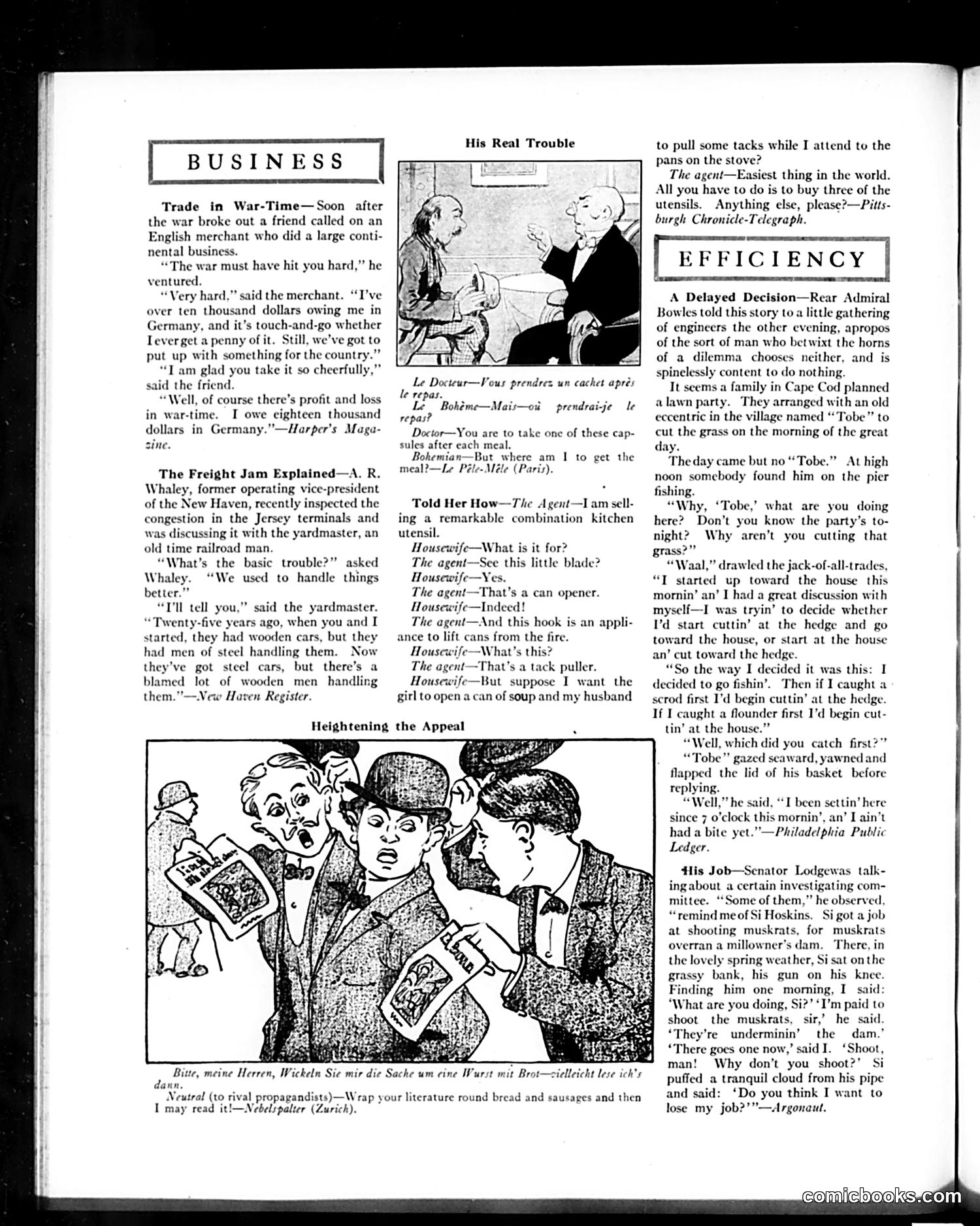
This page from Judge magazine contains several satirical business anecdotes typical of early 20th-century American humor. **"Trade in War-Time"** mocks wartime profiteering: an English merchant claims hardship from unpaid German debts while conveniently overlooking his larger debt owed *to* Germany—suggesting selective moral outrage serves business interests. **"The Freight Jam Explained"** contrasts past and present: railroads once had wooden cars but "men of steel" managing them; now they have steel cars but "wooden men"—satirizing how modern mechanization hasn't improved worker quality or efficiency. **"His Real Trouble"** features a Parisian bohemian too poor to eat, making the doctor's prescription for post-meal medication absurd. **"Efficiency"** section includes anecdotes mocking indecision and bureaucratic ineffectiveness—a Cape Cod villager avoids yard work through endless deliberation; Senator Lodge's investigator is presumably equally unproductive. The cartoon "Heightening the Appeal" (bottom) appears to show propagandists wrapping political literature around food—likely WWI-era satire about manipulative messaging tactics.
📄 Transcribed text from this page (OCR, searchable)
Machine-transcribed from the original scan — historical spelling and the odd misread are preserved.
BUSINESS Trade in War-Time—Soon after the war broke out a friend called on an English merchant who did a large conti- nental business. “The war must have hit you hard,” he ventured. Very hard.” said the merchant. “I’ve over ten thousand dollars owing me in Germany, and it’s touch-and-go whether Teverget a penny of it. Still, we’ve got to put up with something for the country.” “Tam glad you take it so cheerfully,” said the friend. “Well, of course there’s profit and loss in war-time. I owe eighteen thousand dollars in Germany.”—Harper’s Maga- si The Freight Jam Explained—A. R. Whaley, former operating vice-president of the New Haven, recently inspected the congestion in the Jersey terminals and was discussing it with the yardmaster, an old time railroad man. “What’s the basic trouble?” asked Whaley. “We used to handle things better.” “T'll tell you,” said the yardmaster. “Twenty- years ago, when you and I started, they had wooden cars, but they had men of steel handling them. Now they’ve got steel cars, but there’s a ed lot of wooden men_ handling —New Haven Register. ival propagandists) —Wrap your literature round bread and sausages and then —Nebelspalter (Zurich). His Real Trouble Le Docteur—Vous prendrez un cachet aprés le repas. Le Bohéme—Mais—oit repas? Doctor—You are to take one of these cap- sules after each meal. johemian—But where am I to get the meal?—Le Péle-Méle (Paris). prendrai-je le Told Her How— gent—I am sell- ing a remarkable combination kitchen utensil. Housewife—What is it for? The agent—Sec this little blade? Housewife The agent—That’s a can opener. Housewife—Indeed! The agent—And this hook is an appli- ance to lift cans from the fire. Housewife—What’s this? The agent—That’s a tack puller. Housewife—But suppose I want the girl to open a can of soup and my husband to pull some tacks while I attend to the pans on the stove? The agent—Easiest thing in the world. All you have to do is to buy three of the utensils. Anything else, please?—Pitts- burgh Chronicle-Telegraph. EFFICIENCY A Delayed Decision—Rear Admiral Bowles told this story to a little gathering of engineers the other ¢ ing, apropos of the sort of man who betwixt the horns of a dilemma chooses neither, and is spinelessly content to do nothing. It seem n Cape Cod planned a lawn party. arranged with an old eccentric in the village named “Tobe” to cut the grass on the morning of the great day. The day came but no “Tobe.” At high noon somebody found him on the pier fishing. “Why, ‘Tobe,’ what are you doing here? Don’t you know the party’s to- night? Why aren’t you cutting that grass?” “Waal,” drawled the jack-of-all-trades, “T started up toward the house this mornin’ an’ I had a great discussion with myself—I was tryin’ to decide whether I’d start cuttin’ at the hedge and go toward the house, or start at the house an’ cut toward the hedge. “So the way I decided it was this: I decided to go fishin’. Then if I caught a scrod first I'd begin cuttin’ at the hedge. If I caught a flounder first I'd begin cut- tin’ at the house.” “Well, which did you catch first?” Pobe”’ gazed seaward, yawned and flapped the lid of his basket before replying. “Well,” he said, “I been settin’ here since 7 o'clock this mornin’, an’ I ain't had a bite yet.” —Philadelphia Public Ledger. His Job—Senator Lodgewas talk- ingabout a certain investigating com- mittee. “Some of them,” he observed, “remind me of Si Hoskins. Si got a job at shooting muskrats, for muskrats overran a millowner’s dam. There, in the lovely spring weather, Si sat onthe gra: bank, his gun on his knee. Finding him one moming, I said: “What are you doing, Si?’ ‘I’m paid to shoot the muskrats, sir,’ he said. ‘They’re underminin’ the dam.” ‘There gocs one now,’ said I. ‘Shoot, man! Why don’t you shoot?’ Si puffed a tranquil cloud from his pipe and sai ‘Do you think I want to lose my job?’”—Argonaut.