
Judge, 1918-04-20 · page 7 of 36
Judge — April 20, 1918 — page 7: what you’re looking at
What you’re looking at
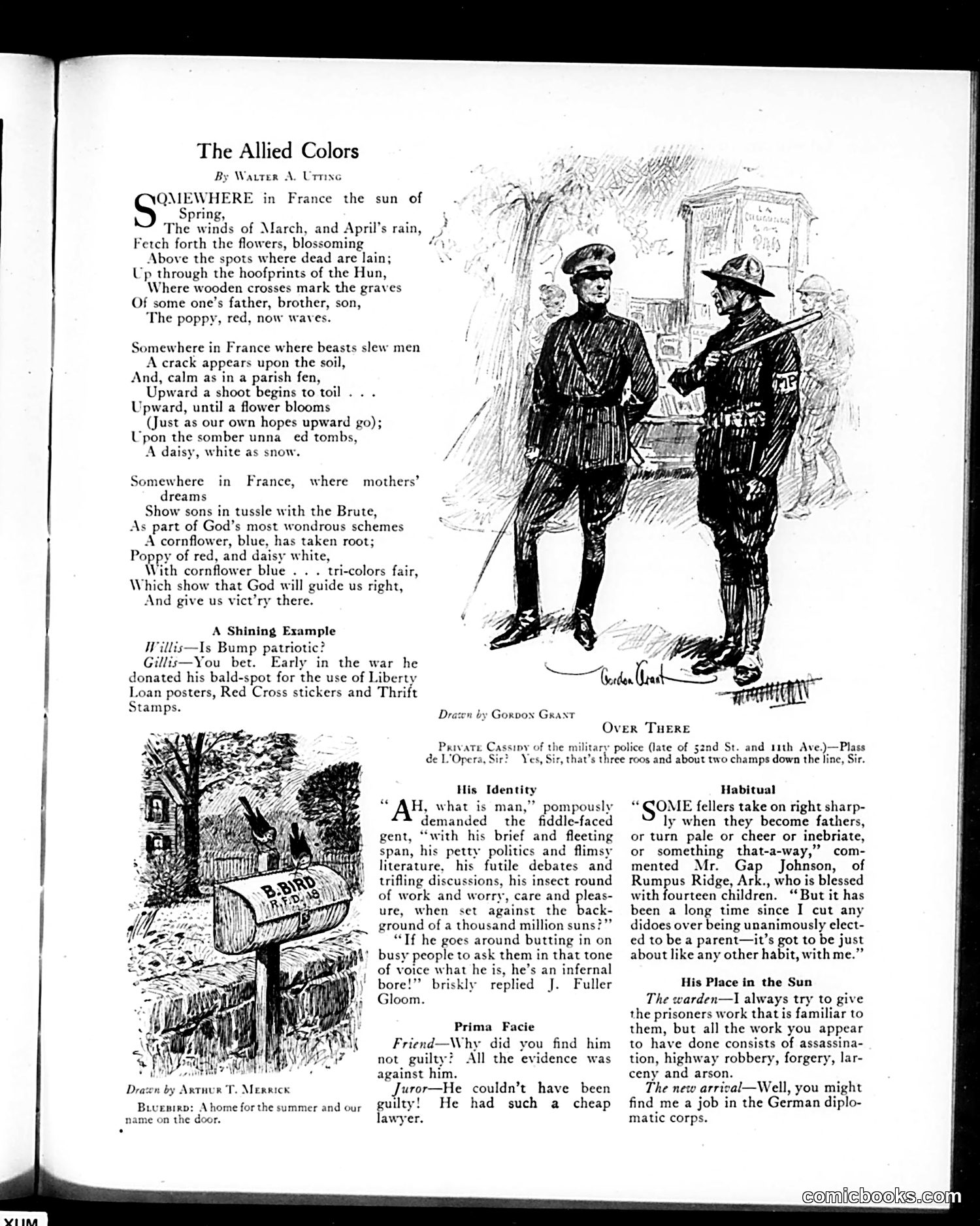
This *Judge* page contains WWI-era American satire (likely 1917-1918). **"The Allied Colors"** poem uses wildflowers blooming over French battlefields—red poppies, white daisies, blue cornflowers—as metaphors for the Allied nations (France, Britain, America) united against Germany ("the Brute"). It's patriotic wartime verse celebrating sacrifice and divine providence in victory. **"A Shining Example"** mocks wealthy businessman "Bump" for donating only his bald head as space for Liberty Loan posters—satirizing superficial patriotism and minimal personal sacrifice during wartime fundraising. **"Over There"** jokes about a military policeman's accent (suggesting an immigrant from New York's immigrant neighborhoods), using French phrases phonetically mangled—a casual ethnic stereotype common to the era. **"His Place in the Sun"** darkly jokes that a prisoner's criminal résumé (assassination, robbery, forgery, arson) qualifies him perfectly for the German diplomatic corps—biting anti-German wartime propaganda suggesting German diplomacy itself was criminally dishonest. All reflect American home-front attitudes circa WWI.
📄 Transcribed text from this page (OCR, searchable)
Machine-transcribed from the original scan — historical spelling and the odd misread are preserved.
The Allied Colors By Wauter A. Urnixe QMEWHERE in France the sun of S Spring, 7 The winds of March, and April’s rain, Fetch forth the flowers, blossoming “ey Above the spots where dead are lain; Up through the hoofprints of the Hun, Where wooden crosses mark the graves Of some one’s father, brother, son, The poppy, red, now waves. Somewhere in France where beasts slew men A crack appears upon the soil, And, calm as in a parish fen, Upward a shoot begins to toil . . . Upward, until a flower blooms Aj ANG | (Just as our own hopes upward go); j aa, pit i Upon the somber unna_ ed tombs, Hi fii A daisy, white as snow. Somewhere in France, where mothers’ dreams Show sons in tussle with the Brute, As part of God’s most wondrous schemes A cornflower, blue, has taken root; Poppy of red, and daisy white, With cornflower blue . . . tri-colors fair, Which show that God will guide us right, And give us vict’ry there. A Shining Exa le Willis—Is Bump patriotic? Gillis—You bet. Early in the war he donated his bald-spot for the use of Liberty Loan posters, Red Cross stickers and Thrift Stamps. D y Gorvox Grant Over THERE spy of the military police (late of 52nd St. and 11th Ave.)—Plass Yes, Sir, that’s three roos and about two champs down the line, Sir. Private de L’Opera His Identity “ AH, what is man,” pompously demanded the fiddle-faced gent, “with his brief and fleeting span, his petty politics and flimsy literature, his futile debates and trifling discussions, his insect round of work and worry, care and pleas- ure, when set against the back- ground of a thousand million suns?” “Tf he goes around butting in on * busy people to ask them in that tone of voice what he is, he’s an infernal bore!” briskly replied J. Fuller Gloom. Prima Facie hy did you find him All the evidence was Friend— not guil against him. uror—He couldn’t have been Buveniep: Ahome forthe summer and our guilty! He had such a cheap name on the door. lawyer. by Axtuur T. Merrick a Habitual fe: SOME fellers take on right sharp- ly when they become fathers, or turn pale or cheer or inebriate, or something that-a-way,” com- mented Mr. Gap Johnson, of Rumpus Ridge, Ark., who is blessed with fourteen children. “But it has been a long time since I cut any didoes over being unanimously elect- ed to be a parent—it’s got to be just about like any other habit, with me.” His Place in the Sun The warden—lI always try to give the prisoners work that is familiar to them, but all the work you appear to have done consists of assassina- tion, highway robbery, forgery, lar- ceny and arson. The new arrival—Well, you might find me a job in the German diplo- matic corps. comichooks.couy)