
Judge, 1918-04-20 · page 29 of 36
Judge — April 20, 1918 — page 29: what you’re looking at
What you’re looking at
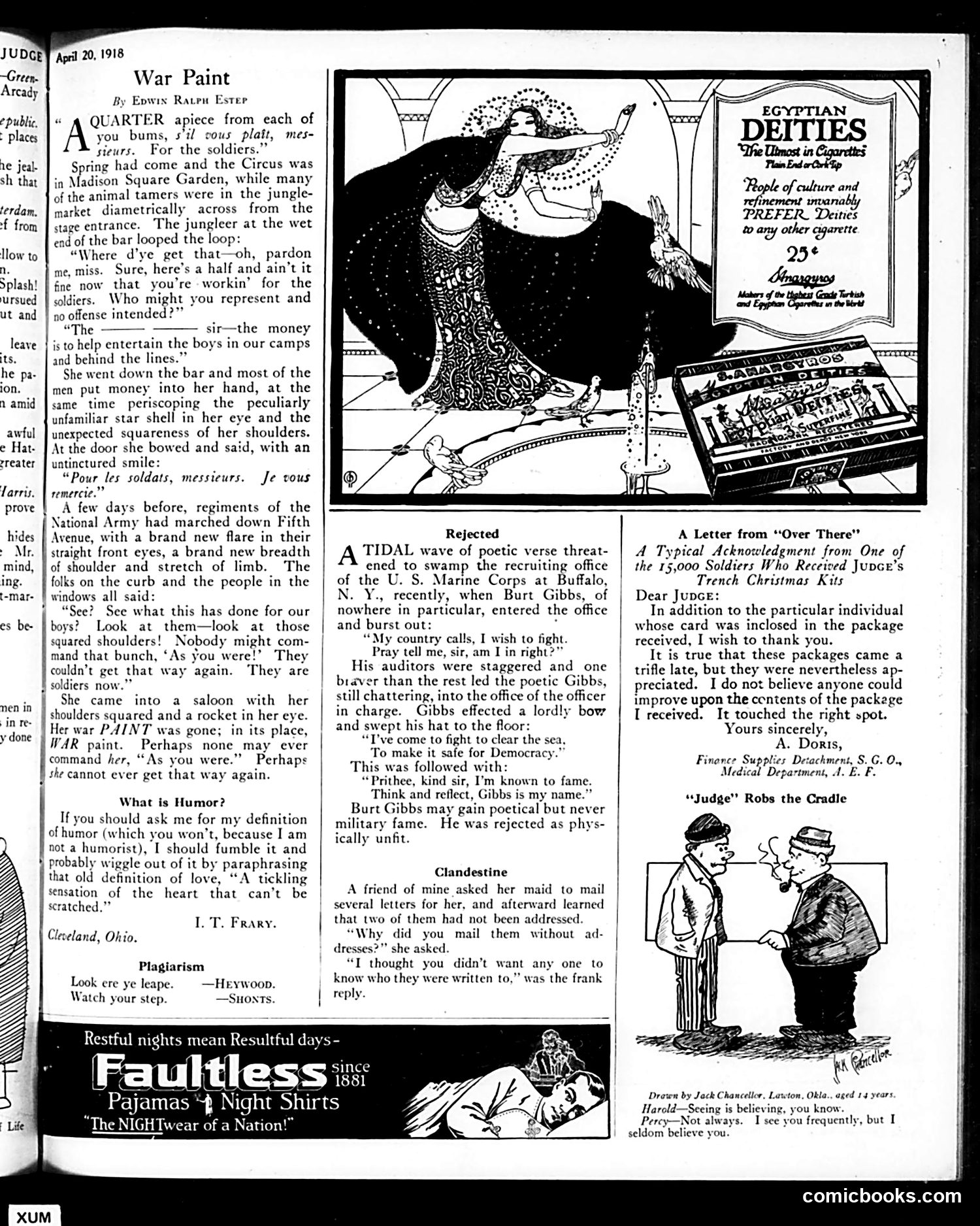
This story satirizes how military service transformed civilians into soldiers, then asks whether civilian women could achieve similar transformation. A woman fundraiser enters a saloon with "war paint" (makeup) removed, displaying the squared shoulders and military bearing of soldiers who'd recently marched down Fifth Avenue. The story's implicit point: while men gained permanent physical and moral strength from military service, the woman's transformation appears temporary—she "cannot ever get that way again." The accompanying anecdotes mock military bureaucracy (a poetic volunteer rejected as "physically unfit") and domestic foolishness (a maid mailing unaddressed letters to protect privacy). The page also advertises Egyptian Deities cigarettes and Faultless pajamas. Context: This appeared during America's WWI mobilization, when military service was reshaping national identity.
📄 Transcribed text from this page (OCR, searchable)
Machine-transcribed from the original scan — historical spelling and the odd misread are preserved.
n amid awful e Hat- rreater farris, prove hides Mr. mind, ing. [-mar- es be nen in in re- y done ., | Life = ‘ Apel 20, 1918 War Paint By Epwis Raveu Ester «“ @ QUARTER apiece from each of A you bums, s’i/ cous plait, mes- sieurs. For the soldiers.” Spring had come and the Circus was in Madison Square Garden, while many of the animal tamers were in the jungle- market diametrically across from the stage entrance. The jungleer at the wet end of the bar looped the loop: “Where d’ye get that—oh, pardon me, miss. Sure, here’s a half and ain’t it fine now that you’re workin’ for the soldiers. Who might you represent and no offense intended?” “The - sir—the money is to help entertain the boys in our camps and behind the lines.” She went down the bar and most of the men put money into her hand, at the same time periscoping the peculiarly unfamiliar star shell in her eye and the unexpected squareness of her shoulders. At the door she bowed and said, with an untinctured smile: “Pour les soldats, messieurs. remercie.”” A few days before, regiments of the National Army had marched down Fifth Avenue, with a brand new flare in their straight front eyes, a brand new breadth of shoulder and stretch of limb. The folks on the curb and the people in the windows all said: “See? See what this has done for our boys? Look at them—look at those squared shoulders! Nobody might com- mand that bunch, you were!’ They couldn’t get that way again. They are soldiers now.”” |) She came into a saloon with her | shoulders squared and a rocket in her eye. Her war PAINT was gone; in its place, | sn paint. Perhaps none may ever Je vous command her, “As you were.” Perhaps she cannot ever get that way again. What is Humor? If you should ask me for my definition of humor (which you won’t, because I am not a humorist), I should fumble it and probably wiggle out of it by paraphrasing that old definition of love, “A tickling sensation of the heart that can’t be ratched.”” . I. T. Frary. Cleceland, Ohio. Plagiarism Look ere ye leape. —HeEywoop. Watch your step. —Suonts. Restful nights mean Resultful dc The NIGHTwear of a Nation!” Faultless Pajamas “f Night Shirts Rejected A TIDAL wave of poetic verse threat- ened to swamp the recruiting office of the U. S. Marine Corps at Buffalo, N. Y., recently, when Burt Gibbs, of nowhere in particular, entered the office and burst out: . “My country calls, I wish to fight. Pray tell me, sir, am I in right?” His auditors were staggered and one braver than the rest led the poetic Gibbs, still chattering, into the office of the officer in charge. Gibbs effected a lordly bow and swept his hat to the floor: “T've come to fight to clear the sea, To make it safe for Democracy. This was followed with: “Prithee, kind sir, I’m known to fame. Think and reflect, Gibbs is my name.” Burt Gibbs may gain poetical but never military fame. He was rejected as phys- ically unfit. Clandestine A friend of mine asked her maid to mail several letters for her, and afterward learned that two of them had not been addressed. “Why did you mail them without ad- 2” she asked. “I thought you didn’t want any one to know who they were written to,” was the frank reply. di since 1881 finement iwnvanai PREFER_ Deities @ any other cigarette A Letter from ‘Over There’’ A Typical Acknowledgment from One of the 15,000 Soldiers Who Received Juvce’s Trench Christmas Kits Dear JupceE: In addition to the particular individual whose card was inclosed in the package received, I wish to thank you. It is true that these packages came a trifle late, but they were nevertheless ap- preciated. I do not believe anyone could improve upon the centents of the package I received. It touched the right spot. Yours sincerely, A. Doris, Finonce Supplies Detachment, S. G. On Medical Department, A. E. F. “Judge’’ Robs the Cradle Harold—Sceing is believing, you know. Percy—Not always. I see you frequently, but I seldom believe you. comicbooks.com