
Judge, 1918-04-20 · page 20 of 36
Judge — April 20, 1918 — page 20: what you’re looking at
What you’re looking at
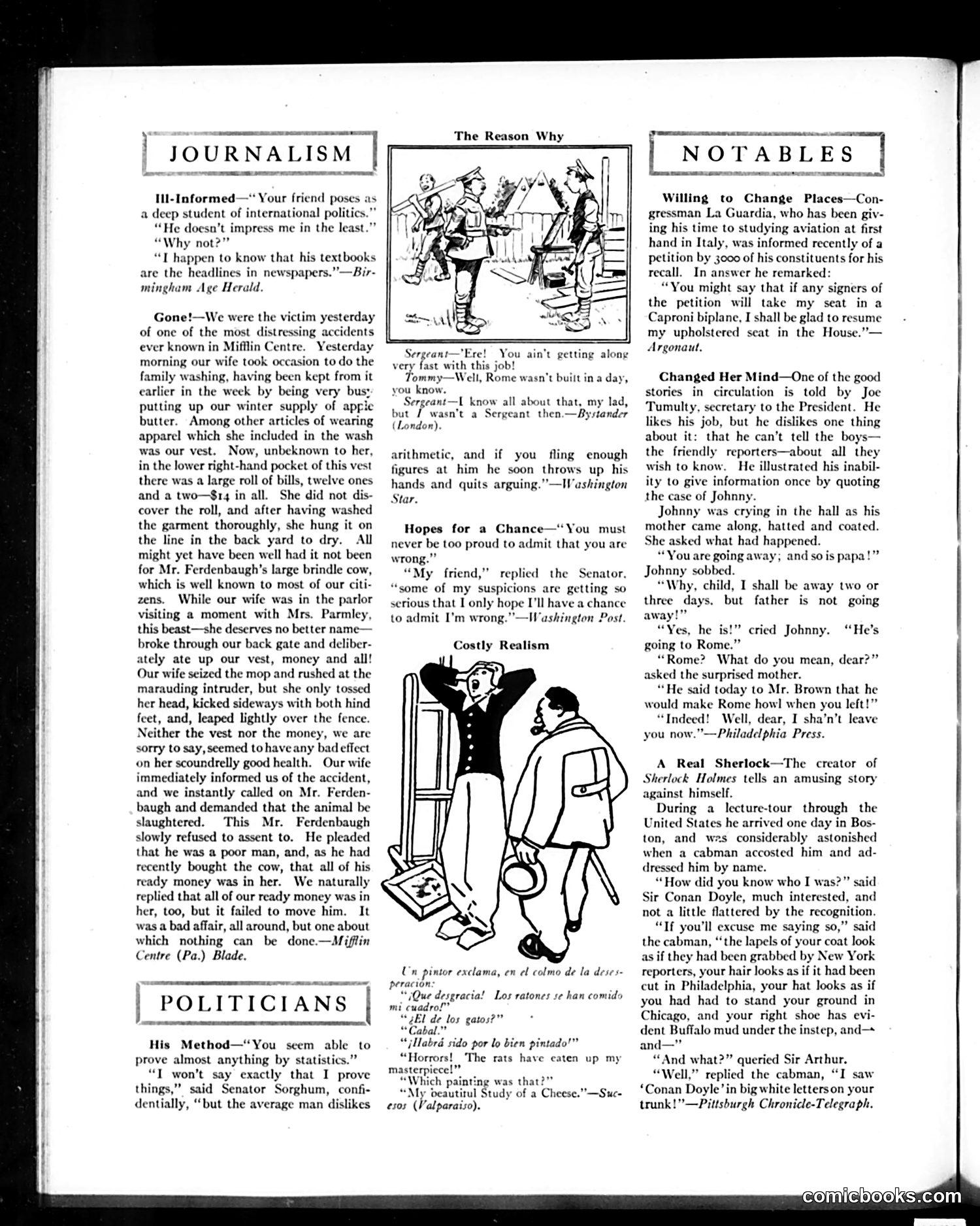
**The cartoons illustrate workplace frustrations through humor:** **"The Reason Why"** shows a sergeant and soldier discussing Rome's construction. The sergeant boasts he couldn't have built Rome faster because he wasn't even a sergeant then—satirizing military rank inflation and the sergeant's false importance. **"Costly Realism"** (in Spanish) features a painter lamenting that rats ate his painting of cheese. The joke: his artwork was *so realistic* the rats actually attacked it. This mocks overly literal, naturalistic art. **The text sections**—under "Journalism," "Politicians," and "Notables"—contain brief satirical anecdotes. Notable is the Fiorello LaGuardia reference: constituents petitioned his recall while he studied aviation in Italy. He jokingly offered to resign his House seat if they'd trade him their airplane seat instead—clever political humor about absent legislators. These pieces mock incompetent journalism, manipulative politicians, and institutional absurdities through witty, pointed commentary typical of Judge's satirical style.
📄 Transcribed text from this page (OCR, searchable)
Machine-transcribed from the original scan — historical spelling and the odd misread are preserved.
JOURNALISM Il-Informed—* Your friend pose: a deep student of international politics. “He doesn’t impress me in the least.” “Why not?” “T happen to know that his textbooks are the headlines in newspapers.”—Bir- mingham Age Herald. Gone!—We were the victim yesterday of one of the most distressing dents ever known in Mifflin Centre. Yesterday morning our wife took occasion to do the family washing, having been kept from it earlier in the week by being very bus; putting up our winter supply of appic butter. Among other articles of wearing apparel which she included in the wash was our vest. Now, unbeknown to her, in the lower right-hand pocket of this vest there was a large roll of bills, twelve ones and a two—$rq in all. She did not dis- cover the roll, and after having washed the garment thoroughly, she hung it on the line in the back yard to dry. All might yet have been well had it not been for Mr. Ferdenbaugh’s large brindle cow, which is well known to most of our citi- zens. While our wife was in the parlor visiting a moment with Mrs. Parmley, this beast—she deserves no better name— broke through our back gate and deliber- ately ate up our vest, money and all! Our wife seized the mop and rushed at the marauding intruder, but she only tossed her head, kicked sideways with both hind feet, and, leaped lightly over the fence. Neither the vest nor the money, we are sorry to say, seemed to have any bad effect on her scoundrelly good health. Our wife immediately informed us of the accident, and we instantly called on Mr. Ferden- baugh and demanded that the animal be slaughtered. This Mr. Ferdenbaugh slowly refused to assent to. He pleaded that he was a poor man, and, as he had recently bought the cow, that all of his ready money was in her. We naturally replied that all of our ready money was in her, too, but it failed to move him. It was a bad affair, all around, but one about which nothing can be done.—Mifiin Centre (Pa.) Blade. | POLITICIANS | His Method—‘You seem able to prove almost anything by statistics.” “T won't say exactly that I prove things,” said Senator Sorghum, confi- dentially, “but the average man dislikes The Reason Why Sergeant—Ere! You ain't getting along very fast with this job! Tommy—Well, Rome wasn’t built in a day, you know. Sergeant—L know all about that, my lad, but / wasn’t a Sergeant then.—Bystander (London). arithmetic, and if you fling enough figures at him he soon throws up his hands and quits arguing.” —IWashington Star. Hopes for a Chance—‘You must never be too proud to admit that you are wrong.” “My friend,’ replied the Senator, “some of my suspicions are getting so serious that I only hope I'll have a chance to admit I'm wrong.”"—IWashington Post. Costly Realism Un pintor exclama, en ef colmo de la deses- peracion “iQue desgracia! Los ratones se han comido mi cuadro!” “EI de los gatos?” bal.” “jHabrd sido por lo bien pintado “Horrors! ‘The rats have caten up my masterpiece!” “Which painting was that? “My bdeautitul Study of a Cheese.” —Suce esos (Valparaiso). (FR SN Ns CR | NOTABLES ne ea = eee Willing to Change Places—Con- gressman La Guardia, who has been giv- ing his time to studying aviation at first hand in Italy, was informed recently of a petition by 3000 of his constituents for his recall. In answer he remarked: “You might say that if any signers of the petition will take my seat in a Caproni biplane, I shall be glad to resume my upholstered seat in the House.”— Argonaut. Changed Her Mind—One of the good stories in circulation is told by Joe Tumulty, secretary to the President. He likes his job, but he dislikes one thing about it: that he can’t tell the boys— the friendly reporters—about all they wish to know. He illustrated his inabil- ity to give information once by quoting the case of Johnn, Johnny was crying in the hall as his mother came along, hatted and coated. She asked what had happened. “You are going away; and so is papa!” Johnny sobbed. “Why, child, I shall be away two or three days. but father is not going away!” “Yes, he is! going to Rome.” “Rome? What do you mean, dear?” asked the surprised mother. “He said today to Mr. Brown that he would make Rome how! when you left!” “Indeed! Well, dear, I sha’n't leave you now.”—Philadelphia Press. !” cried Johnny. “He's A Real Sherlock—The creator of Sherlock Holmes tells an amusing story against himself. During a lecture-tour through the United States he arrived one day in Bos- ton, and wes considerably astonished when a cabman accosted him and ad- dressed him by name. “How did you know who I was?” said Sir Conan Doyle, much interested, and not a little flattered by the recognition. “If you'll excuse me saying so,” said the cabman, “the lapels of your coat look as if they had been grabbed by New York reporters, your hair looks as if it had been cut in Philadelphia, your hat looks as if you had had to stand your ground in Chicago, and your right shoe has evi- dent Buffalo mud under the instep, and— and—" “And what?” queried Sir Arthur. “Well,” replied the cabman, “I saw ‘Conan Doyle’ in big white letters on your trunk!” —Pittsburgh Chronicle-Telegraph.