
Judge, 1918-04-20 · page 18 of 36
Judge — April 20, 1918 — page 18: what you’re looking at
What you’re looking at
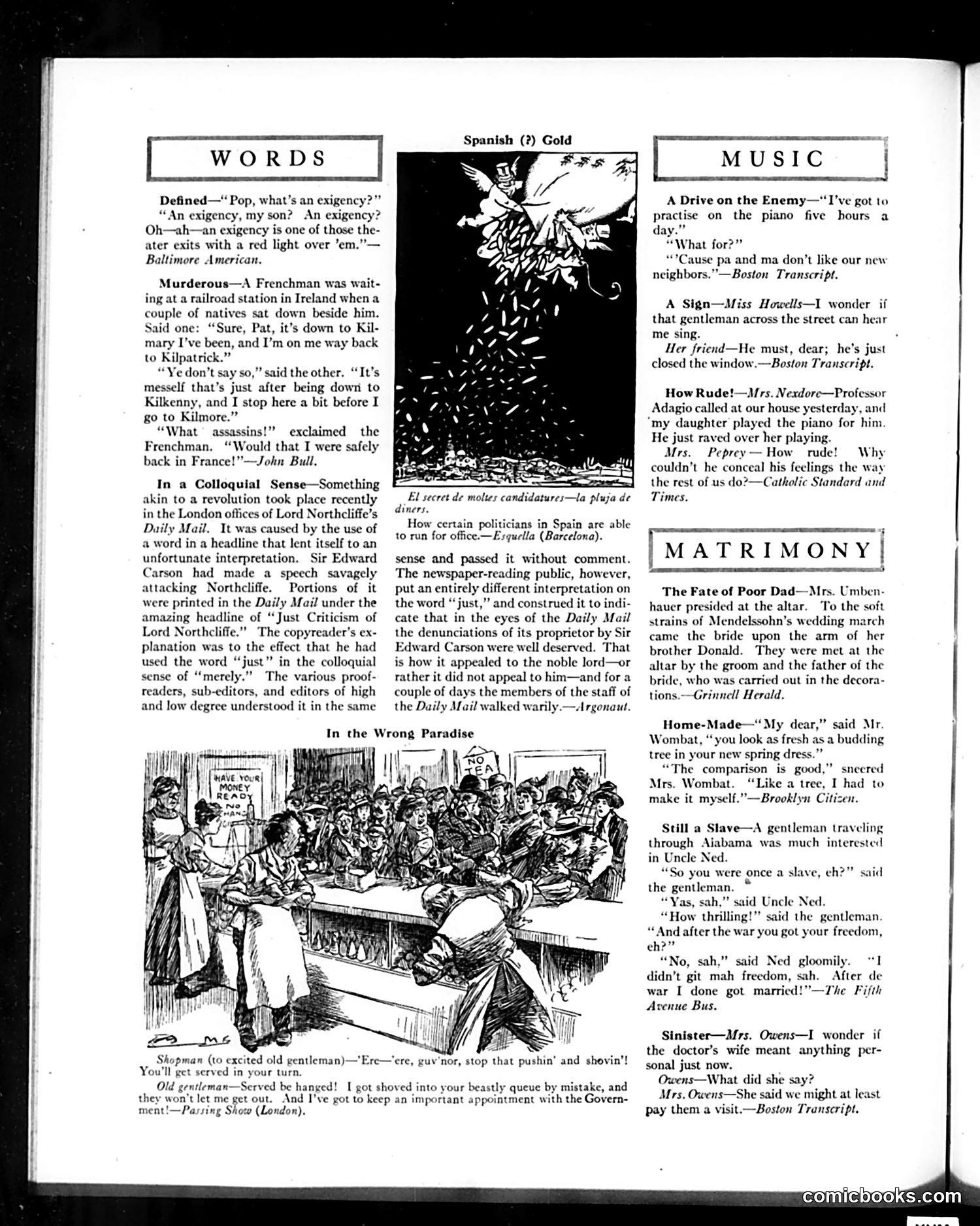
This page from Judge magazine contains several short humorous pieces and one political cartoon: **"In the Wrong Paradise"** (main cartoon): Depicts a crowded queue where an impatient older gentleman is pushing in line, complaining he has "an important appointment with the Government." A queue attendant protests he must wait his turn. The satire mocks British bureaucratic inefficiency and the common frustration of waiting in orderly lines—a particularly British cultural touchstone. **"Spanish (?) Gold"** caption references Spanish politicians financing campaigns through bribes ("la pluja de diners"—rain of money). This criticizes corruption in Spanish electoral politics. The remaining items are brief joke columns about miscellaneous topics: Irish place-names confusing a Frenchman, a Daily Mail headline ambiguity involving Lord Northcliffe, and various domestic humor pieces about music and marriage. The overall tone is light satire targeting bureaucratic inefficiency, political corruption abroad, and domestic absurdities—typical Judge magazine fare of the era.
📄 Transcribed text from this page (OCR, searchable)
Machine-transcribed from the original scan — historical spelling and the odd misread are preserved.
Defined—“ Pop, what’s an exigency?” “An exigency, my son? An exigency? Oh—ah—an exigency is one of those the- ater € with a red light over ’em.”— Baltimore American. Murderous—A Frenchman was wait- ing at a railroad station in Ireland when a couple of nat sat down beside him. Said one: “Sure, Pat, it’s down to Kil- mary I've been, and I’m on me way back to Kilpatrick.” “Ye don’t say so,” said the other. “It's mesself that’s after being down to Kilkenny, and I stop here a bit before I go to Kilmore.” “What assassins!” exclaimed the Frenchman, “Would that I were safely back in France!” —John Bull. In a Colloquial Sense—Something akin to a revolution took place recently in the London offices of Lord Northcliffe’s Daily Mail. It was caused by the use of a word in a headline that lent itself to an unfortunate interpretation. Sir Edward Carson had made a speech savagely attacking Northcliffe. Portions of it were printed in the Daily Mail under the amazing headline of “Just Criticism of Lord Northcliffe.” The copyreader’s ex- planation was to the effect that he had used the word “just” in the colloquial sense of “merely.” The various proof- readers, sub-editors, and editors of high and low degree understood it in the same Spanish (?) Gold El secret de moltes candidatures—la pluja de diners. How certain politicians in Spain are able to run for office.—Esquella (Barcelona). sense and passed it without comment. The newspaper-reading public, however, put an entirely different interpretation on the word “just,” and construed it to indi- cate that in the eyes of the Daily Mail the denunciations of its proprietor by Sir Edward Carson were well deserved. That is how it appealed to the noble lord—or rather it did not appeal to him—and for a couple of days the members of the staff of the Daily Mail walked warily.—Argonaut. In the Wrong Paradise (to excited old gentleman) —'Ere—'ere, guv’nor, stop that pushin’ and shovin’! erved in your turn. they won't let me ment!—Passing Show (London). ved be hanged! I got shoved into your beastly queue by mistake, and tout. .And I’ve got to keep an important appointment with the Govern- | USIC | A Drive on the Enemy—“‘I've got to practise on the piano five hours a day.” “What for?” “’Cause pa and ma don’t like our new neighbors.” —Boston Transcript. A Sign—Miss Howells—I wonder if that gentleman across the street can hear me sing. Her friend—He must, dear; he’s just closed the window.—Boston Transcript. How Rude!—Mrs. Nexdore—Professor Adagio called at our house yesterday, and ‘my daughter played the piano for him He just raved over her playing. Mrs. Peprey— How rude! Why couldn’t he conceal his feelings the way the rest of us do?—Catholic Standard and Times. <= | MATRIMONY | The Fate of Poor Dad—Mrs. Umben- hauer presided at the altar. To the soft strains of Mendelssohn's wedding march came the bride upon the arm of her brother Donald. They were met at the altar by the groom and the father of the bride, who was carried out in the decora- tions.—Grinnell Herald. Home-Made—“ My dear,” said Mr. Wombat, “you look as fresh as a budding tree in your new spring dress. “The comparison is good,” sneered Mrs. Wombat. “Like a tree, I had to make it myself.” —Brooklyn Cit Still a Slave—A gentleman traveling through Aiabama was much interested in Uncle Ned. “So you were once a slave, ch?” said the gentleman. “Yas, sah,” said Uncle Ned. “How thrilling!” said the gentleman. “And after the war you got your freedom, eh?” ‘0, sah,” said Ned gloomily. “1 didn’t git mah freedom, sah. After de war I done got married!”—The Fifth Avenue Bus. Sinister-—Mrs. Owens—I wonder if the doctor’s wife meant anything per- sonal just now. Owens—What did she say? Mrs. Owens—She said we might at least pay them a visit.—Boston Transcript.