
A complete issue · 36 pages · 1918
Judge — April 13, 1918
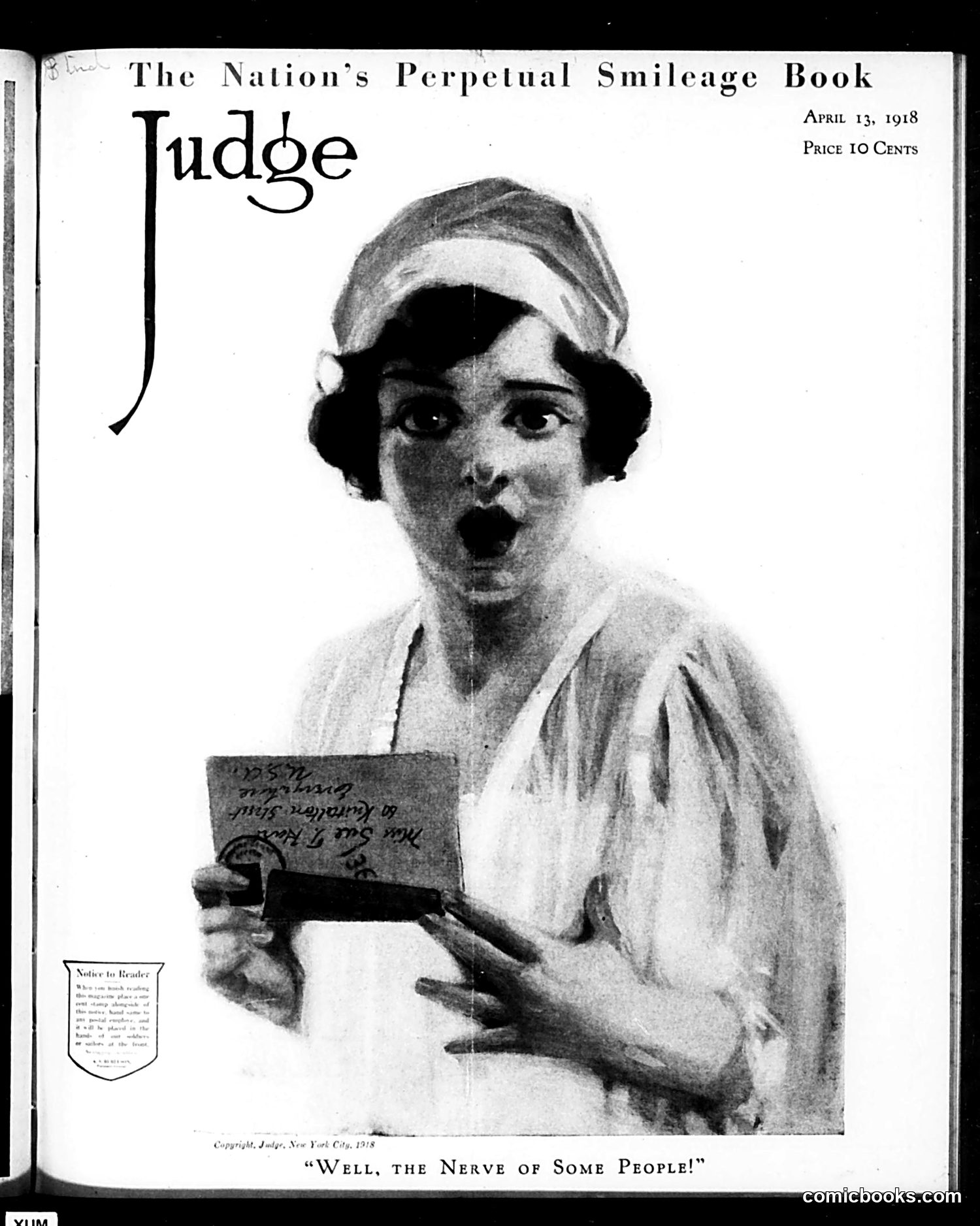
This satirical cover depicts a woman with an exaggerated shocked expression, holding what appears to be a letter or document. The caption reads "Well, the Nerve of Some People!" The image likely satirizes public reaction to audacious social behavior or correspondence during World War I era. The woman's theatrical surprise—wide mouth, raised eyebrows—suggests she's received something unexpected or impertinent. Without additional context identifying the specific letter's contents or the figure depicted, the exact target of satire remains unclear, though it appears to mock either bold social transgressions or the sanctimonious outrage they provoked among certain groups. The "Notice to Reader" box suggests additional explanatory content existed elsewhere in the magazine.
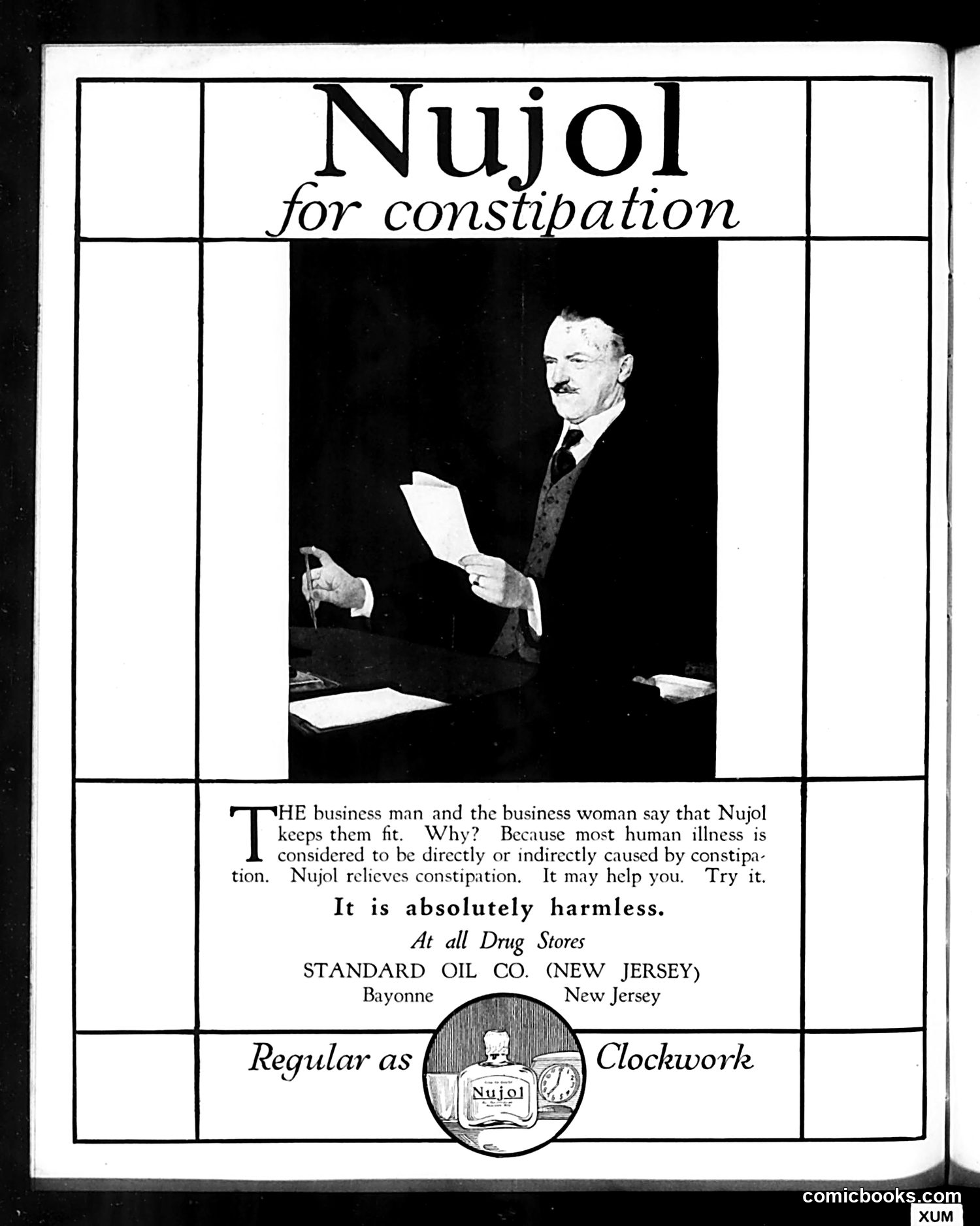
This is primarily a **product advertisement**, not political satire. It advertises Nujol, a laxative made by Standard Oil Company (New Jersey) in Bayonne. The image shows a well-dressed businessman reading at his desk, seemingly productive and fit. The ad's pitch claims that most human illness stems from constipation, and that Nujol provides relief. The tagline "Regular as Clockwork" emphasizes the product's reliability. The appeal to "business man and business woman" reflects early 20th-century marketing targeting working professionals. The claim that it's "absolutely harmless" was typical of patent medicine advertising from this era, before strict FDA regulations. This represents a period when laxatives were heavily marketed as cure-alls for general wellness.
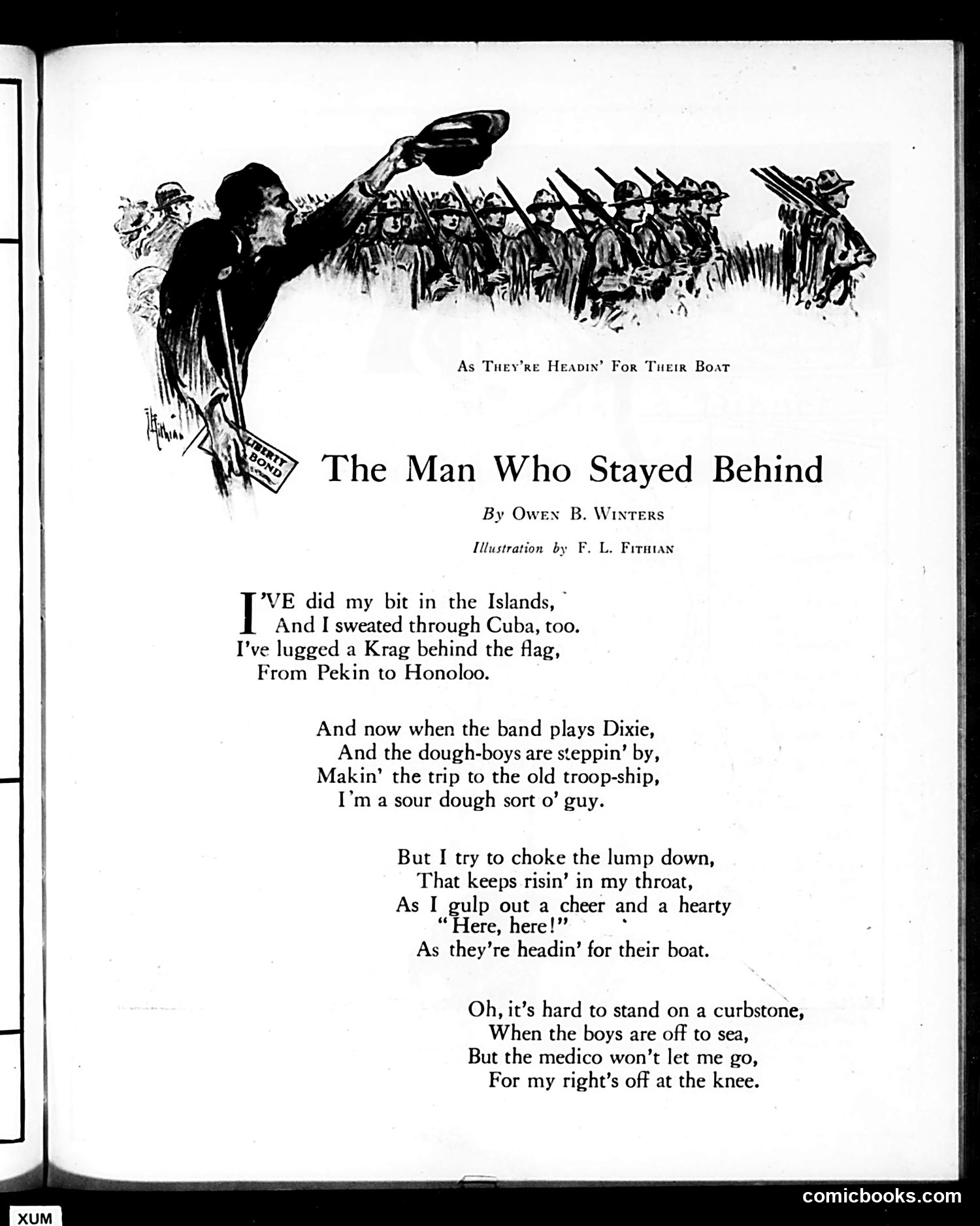
This poem satirizes a man left stateside while others deploy militarily. The illustration shows soldiers marching toward boats while a figure remains behind, gesturing futilely. The speaker boasts of military service ("Islands," "Cuba," "Pekin to Honolulu"), but now watches others depart while he's sidelined—apparently due to a knee injury ("medico won't let me go, / For my right's off at the knee"). The satire targets the emotional conflict: his embarrassment at staying behind while displaying patriotic enthusiasm ("cheer and a hearty / 'Here, here!'") masks frustration at missing action. The title and subtitle ("As They're Headin' For Their Boat") emphasize his exclusion from military service, likely referencing early-20th-century American military engagements.
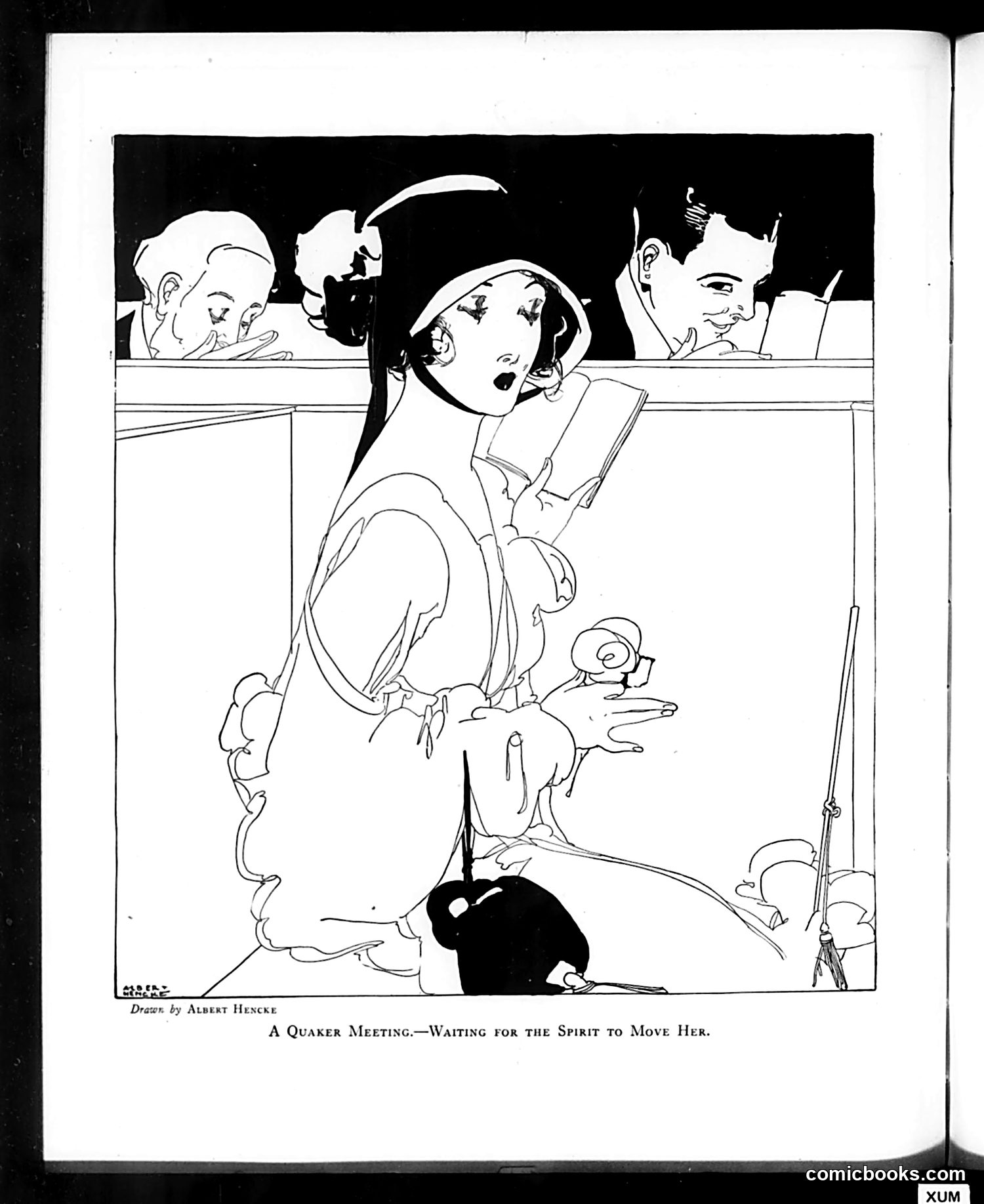
This cartoon by Albert Hencke satirizes Quaker religious practices through a gendered lens. The central figure is a woman at a Quaker meeting, a faith known for silent worship and waiting for divine inspiration ("the spirit to move her"). The three observers in the background—depicted with exaggerated features—appear skeptical or amused. The satire targets several elements: the earnestness of Quaker spiritual practice, gender dynamics in religious settings, and likely Victorian-era attitudes about women's religious authority. The title's phrasing ("move her") contains a double entendre, suggesting the cartoonist mocks both the religious practice itself and the woman's composure, positioning the humor around perceived ineffectiveness or absurdity of waiting passively for spiritual guidance.
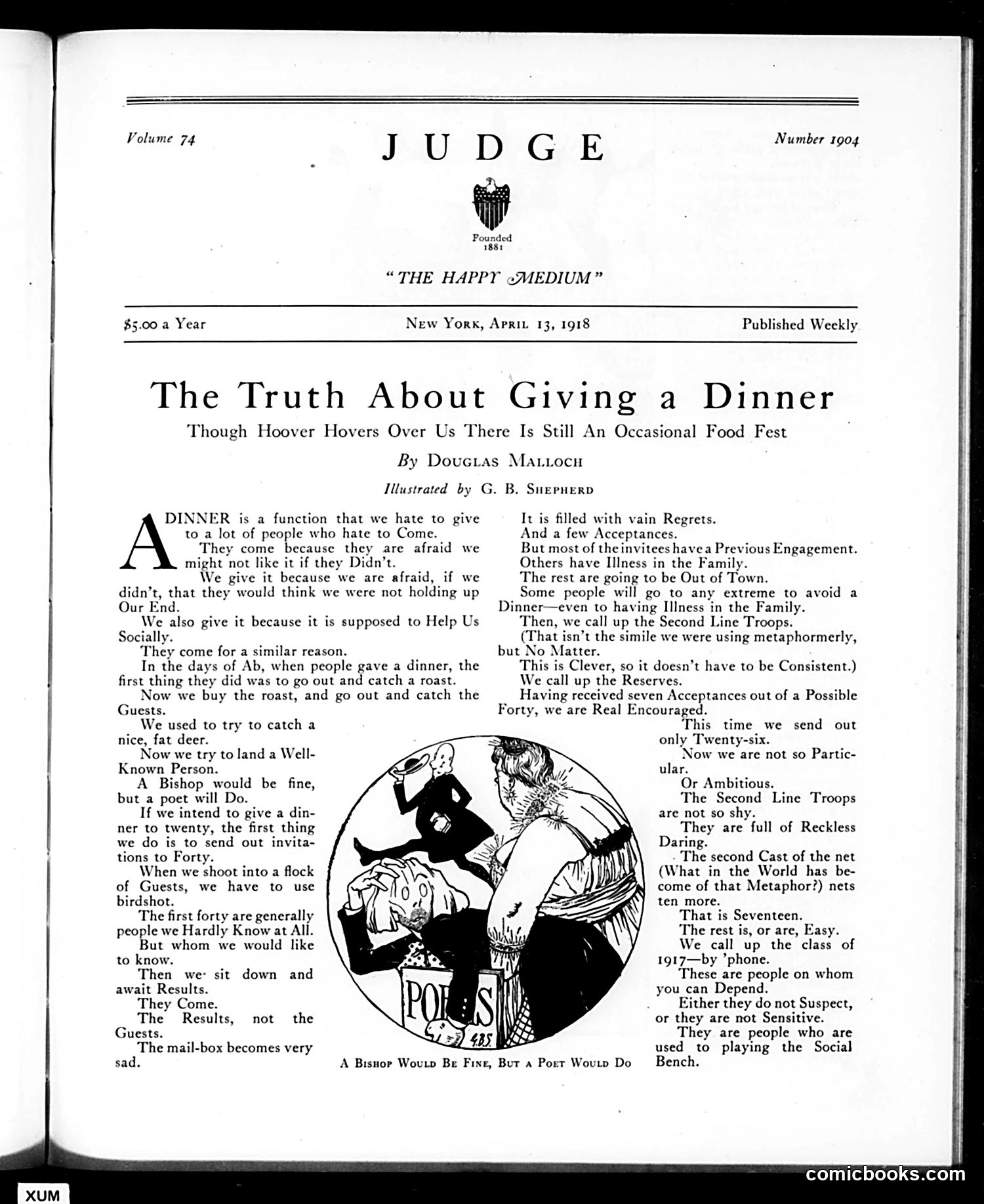
This satirical article by Douglas Malloch mocks the social obligation of hosting dinner parties. The accompanying cartoon depicts a chaotic dinner scene where guests appear disheveled and uncomfortable, illustrating the author's central point: that dinner parties are tedious social duties rather than genuine enjoyments. The text humorously catalogs why people actually attend dinners—obligation, fear of social judgment, illness excuses—rather than genuine enthusiasm. References to "Second Line Troops" and calling up "Reserves" suggest difficulty securing willing guests, using World War I military terminology for comic effect (published April 1918, during active U.S. involvement). The satire critiques upper-class social conventions that compel uncomfortable gatherings, presenting dinner hosting as an exhausting performance of civility rather than authentic hospitality.
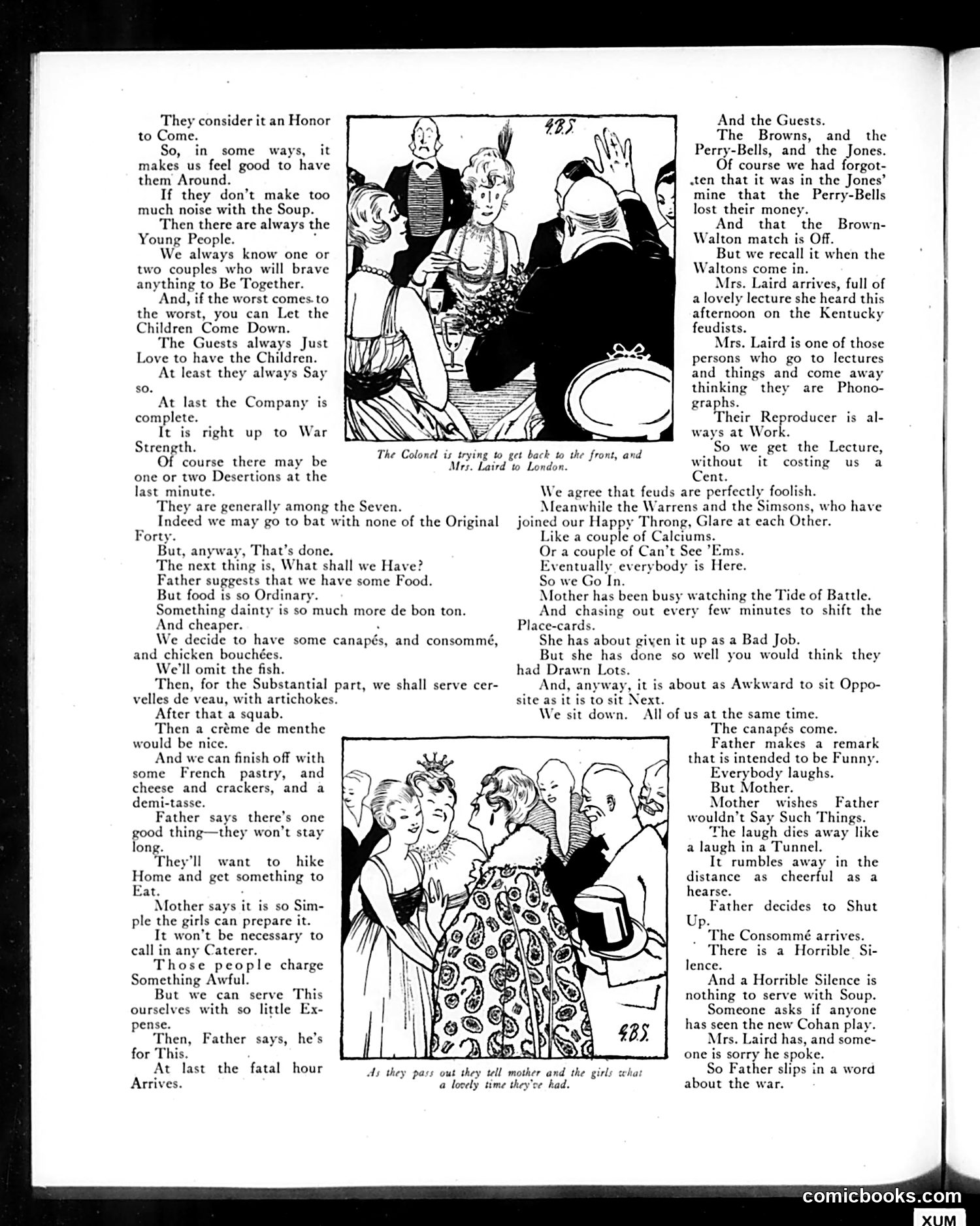
This page satirizes upper-class American social gatherings and dinner etiquette during the early 20th century. The two illustrations show society dinners where hosts nervously plan menus and navigate awkward social dynamics. The left cartoon depicts "The Colonel trying to get back to the front, and Mrs. Laird to London"—suggesting wartime context (likely WWI), where even social events are disrupted by military concerns. The text mocks how the wealthy obsess over appearing cultured through elaborate meals (cervelles de veau, crème de menthe, French pastries) while simultaneously worrying about appearing cheap. The satire targets the pretentiousness and anxiety of hosting formal dinners, including awkward moments like failed jokes and uncomfortable silences. The overall humor stems from exposing the artificial nature of high-society entertaining.
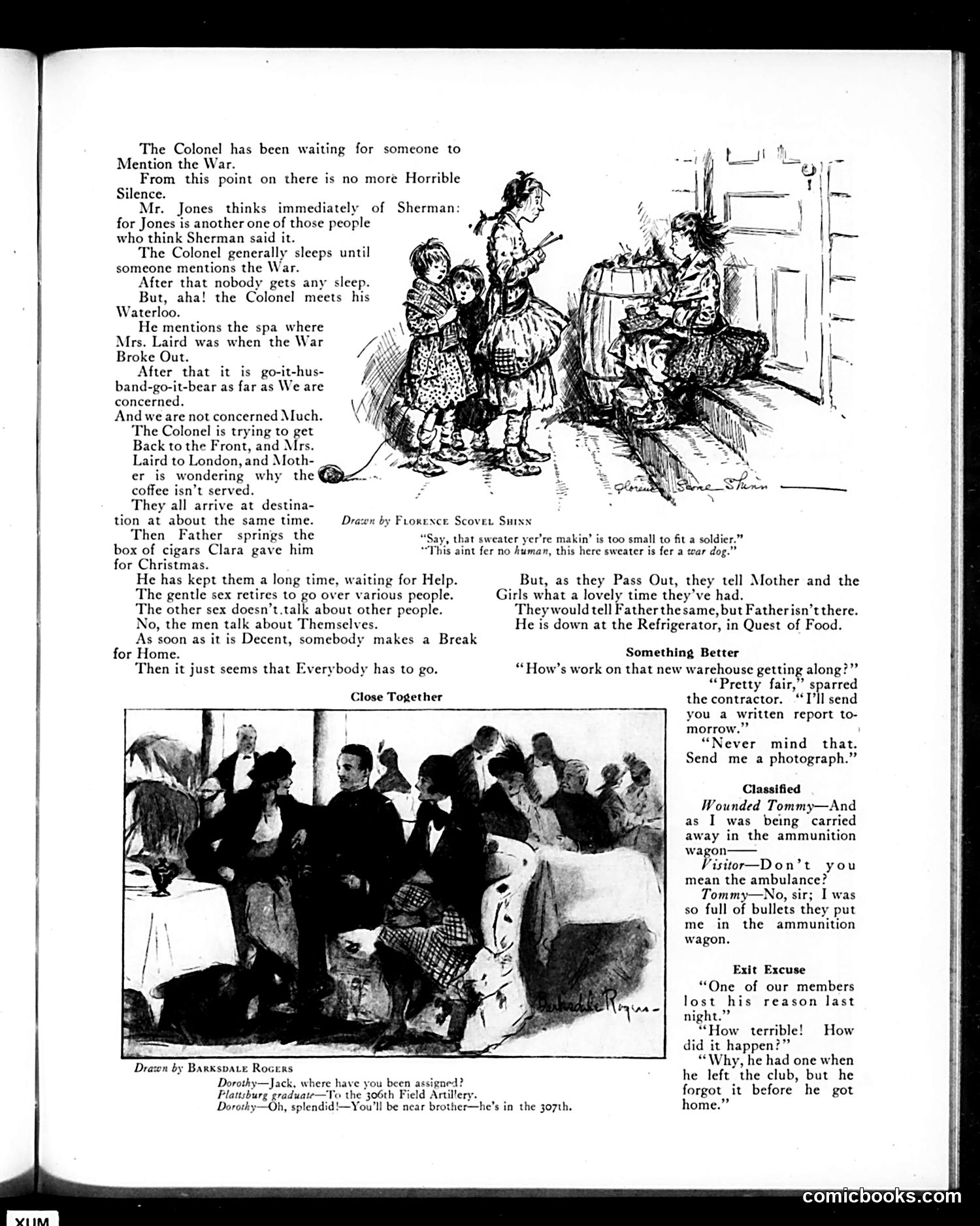
This page satirizes American home-front life during World War I, particularly the tedium of social interaction and war-related conversation. The main cartoon ("Close Together," by Barksdale Rogers) depicts a dinner party where mentioning the war triggers endless, exhausting discussion—the Colonel becomes unbearable once the topic arises. The satire mocks how civilians obsessively discuss the war while remaining disconnected from actual combat. Supporting jokes include: - A woman knitting a sweater supposedly for a "war dog" (absurdist humor about war efforts) - A wounded soldier so riddled with bullets he was transported in an ammunition wagon rather than an ambulance (dark humor about wartime chaos) - A club member who "lost his reason"—a pun on absent-mindedness The dialogue between Dorothy and a Plattsburg graduate references officer-training camps, suggesting the casual way Americans adapted to military mobilization. Overall, Judge portrays WWI's social impact as intrusive and ridiculous, turning genuine conflict into drawing-room tedium and fodder for puns.
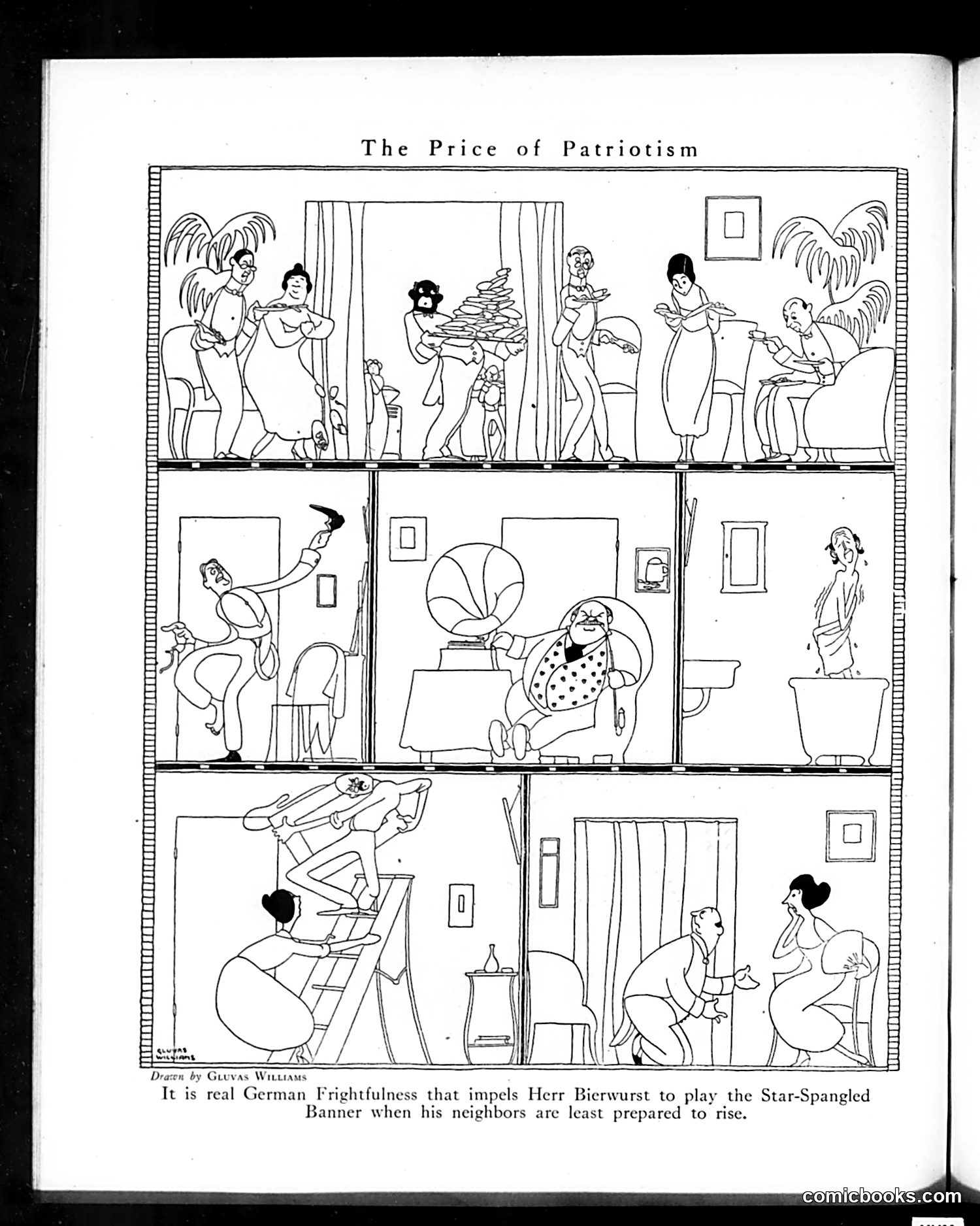
This satirical cartoon by Gluyas Williams depicts a multi-panel sequence showing a German-American character (Herr Bierwurst) engaging in domestic activities across different rooms of his home. The caption states: "It is real German Frightfulness that impels Herr Bierwurst to play the Star-Spangled Banner when his neighbors are least prepared to rise." The satire targets German-Americans during what appears to be WWI-era tensions. The cartoon mocks Herr Bierwurst for ostentatiously displaying American patriotism (playing the national anthem) in awkward moments—catching neighbors in embarrassing private situations where they cannot properly stand and salute. This ridicules performative or aggressive patriotism as a way for German-Americans to prove their loyalty, while simultaneously portraying German culture as inherently uncomfortable or inappropriate.
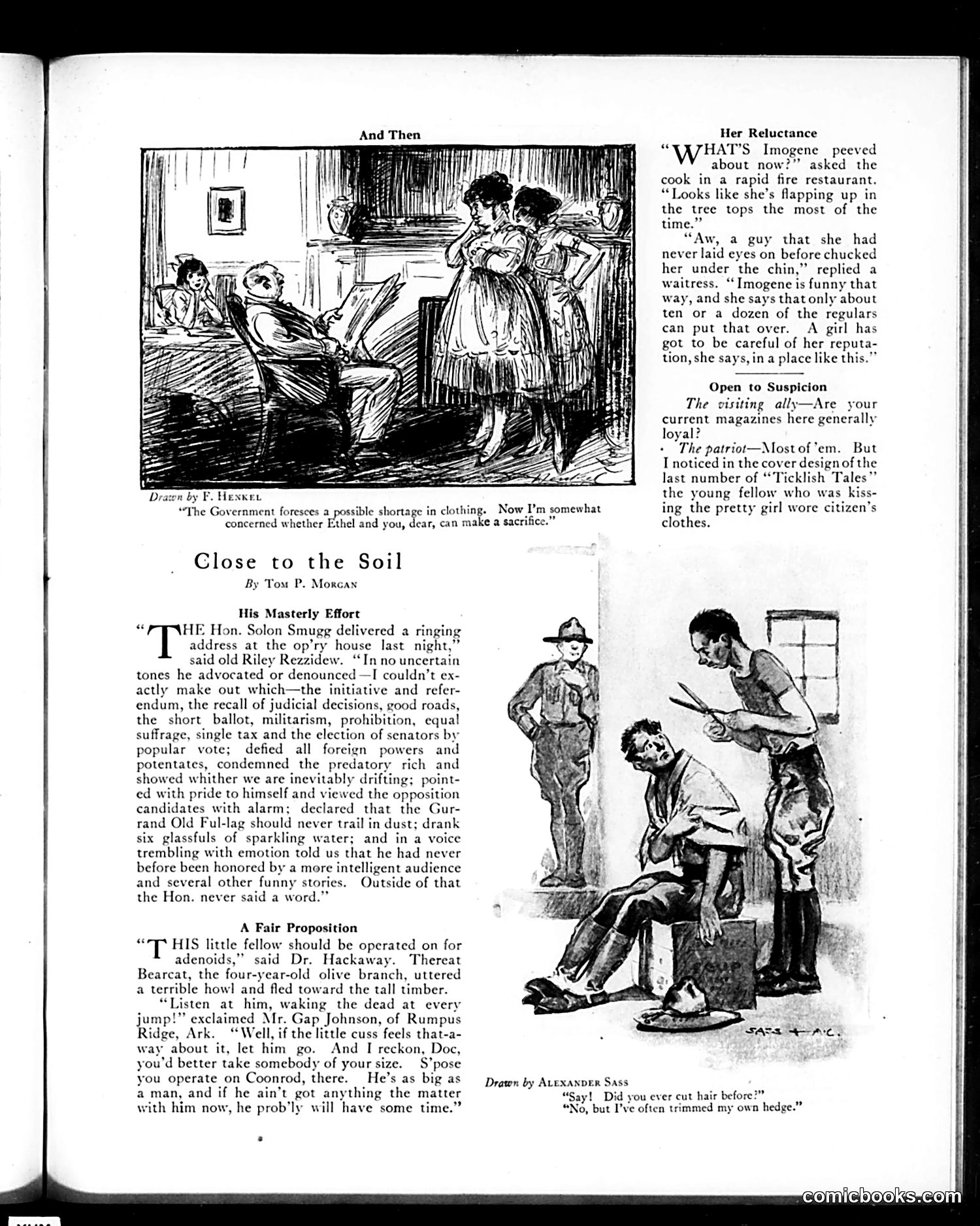
This page contains three satirical pieces mocking American political and social conventions circa the Progressive Era. **"Close to the Soil"** ridicules verbose politicians. Hon. Solon Smugg delivers a speech touching every current reform issue (initiative, referendum, prohibition, equal suffrage, single tax) without taking clear positions—he simply advocates *or* denounces each, leaving listeners confused about his actual stance. The joke: politicians use rhetoric to appear engaged while saying nothing substantive. **"A Fair Proposition"** satirizes rural frontier attitudes. When a boy refuses adenoid surgery, a backwoods father suggests the doctor operate on a large man instead—implying the procedure should be tested on someone bigger first, inverting medical logic humorously. **"Her Reluctance"** and the top cartoon mock female reputation anxieties in service-industry jobs. A waitress worries that allowing unknown men physical familiarity compromises her standing; only "regulars" earn that privilege. The final joke about amateur barbers uses hedge-trimming as absurd credential-building. All pieces employ rural dialect and working-class perspectives to highlight social absurdities.
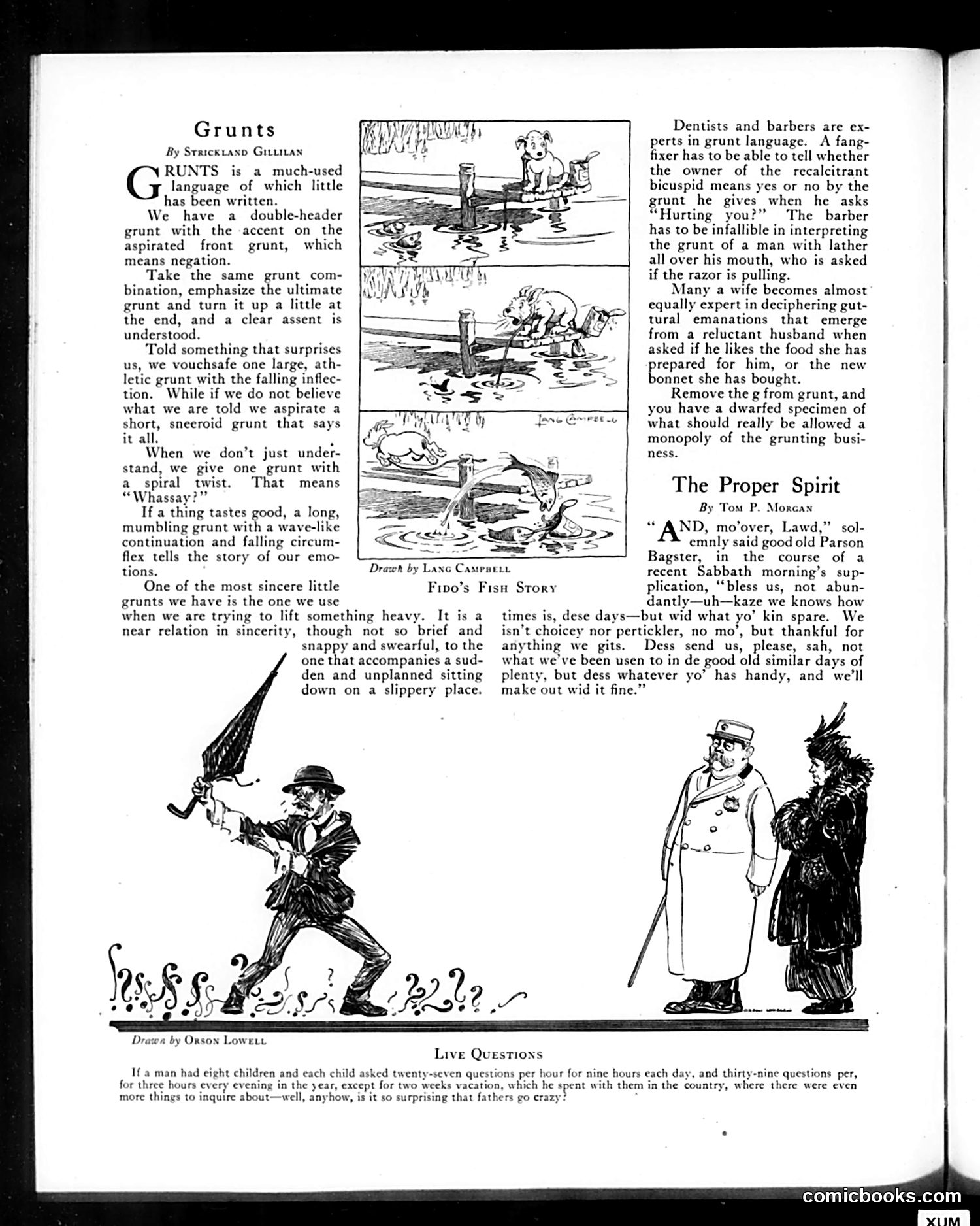
This page contains three distinct pieces of humor reflecting early 20th-century American social commentary: **"Grunts"** satirizes non-verbal communication, particularly how men communicate through inarticulate sounds. It pokes fun at masculine reluctance to speak clearly, noting that dentists, barbers, and wives must become expert "grunt interpreters" since men refuse proper verbal responses—whether answering "Does this hurt?" or "Do you like dinner?" **"Fido's Fish Story"** (the four panel cartoon) appears to show a dog's fishing misadventure, drawn by Lance Campbell. **"The Proper Spirit"** presents a Black minister's prayer asking God for modest blessings rather than abundance, reflecting Depression-era or post-war economic hardship and the necessity of gratitude for whatever one receives. **"Live Questions"** is a mathematical puzzle-joke about fathers driven to madness by their children's constant questioning during vacation—humor derived from parental exasperation. The overall theme: domestic frustration, gendered communication failures, and the challenges of family life.
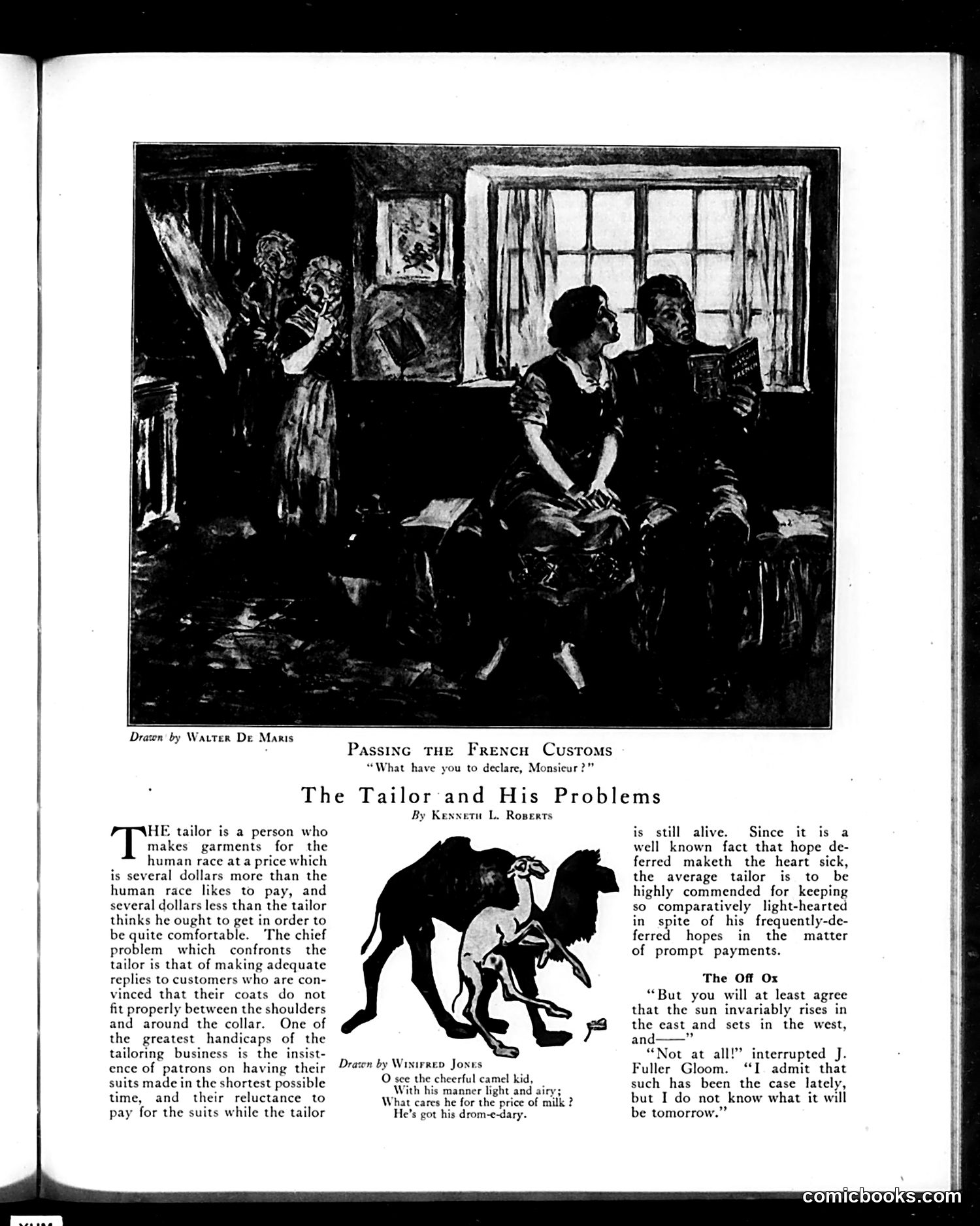
This page satirizes tailors' economic struggles. The top illustration shows a customs inspection scene—likely referencing travel between America and France, a common Judge magazine topic. The main article by Kenneth L. Roberts humorously details tailors' predicaments: customers demand quick turnaround times while refusing prompt payment, argue about fit ("between the shoulders and around the collar"), and expect cheap work. Roberts notes tailors deserve commendation for remaining "light-hearted" despite perpetually unpaid bills—the irony being their situation would depress anyone. The Winfred Jones illustration of a camel adds whimsy: the camel doesn't worry about milk prices because he has his "drom-e-dary" (dromedary—pun on the animal itself). The brief "Off Ox" anecdote mocks pessimist J. Fuller Gloom, who won't even confirm basic facts like sunrise/sunset—absurdist humor highlighting unreasonable customer attitudes tailors endure.
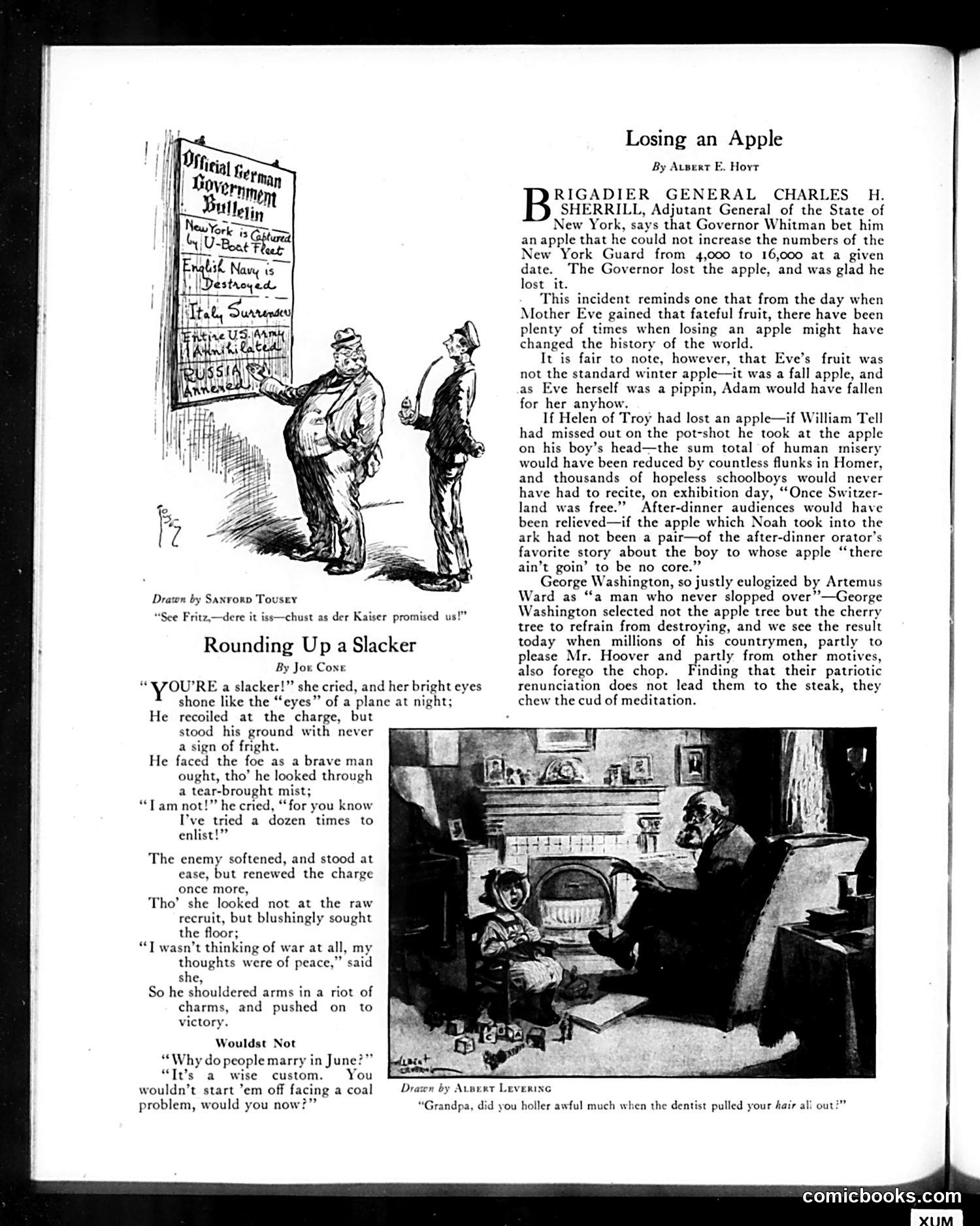
**"Losing an Apple"** is a humorous essay by Albert E. Hort riffing on Brigadier General Charles H. Sherrill's successful bet with New York Governor Whitman to expand the National Guard from 4,000 to 16,000 soldiers. The piece uses apple-related historical references—Eve's apple, Helen of Troy, William Tell, Noah's ark—to playfully suggest that lost apples have shaped human destiny. It concludes with a dig at George Washington: he famously *refused* to chop down a cherry tree (not an apple tree), establishing his honesty. The satire suggests this moral precedent now inspires Americans to sacrifice meat for Mr. Hoover (likely referring to food conservation during WWI) without receiving the reward they deserve—a steak—leaving them to contemplate their sacrifice. **"Rounding Up a Slacker"** depicts a young man defending himself against a woman's accusation of being a "slacker" (WWI-era term for draft dodger). He claims he's tried a dozen times to enlist but apparently failed. The woman's blush and admission she was thinking of peace, not war, reframes the encounter as flirtation rather than patriotic confrontation—a lighthearted romantic play on wartime anxiety.
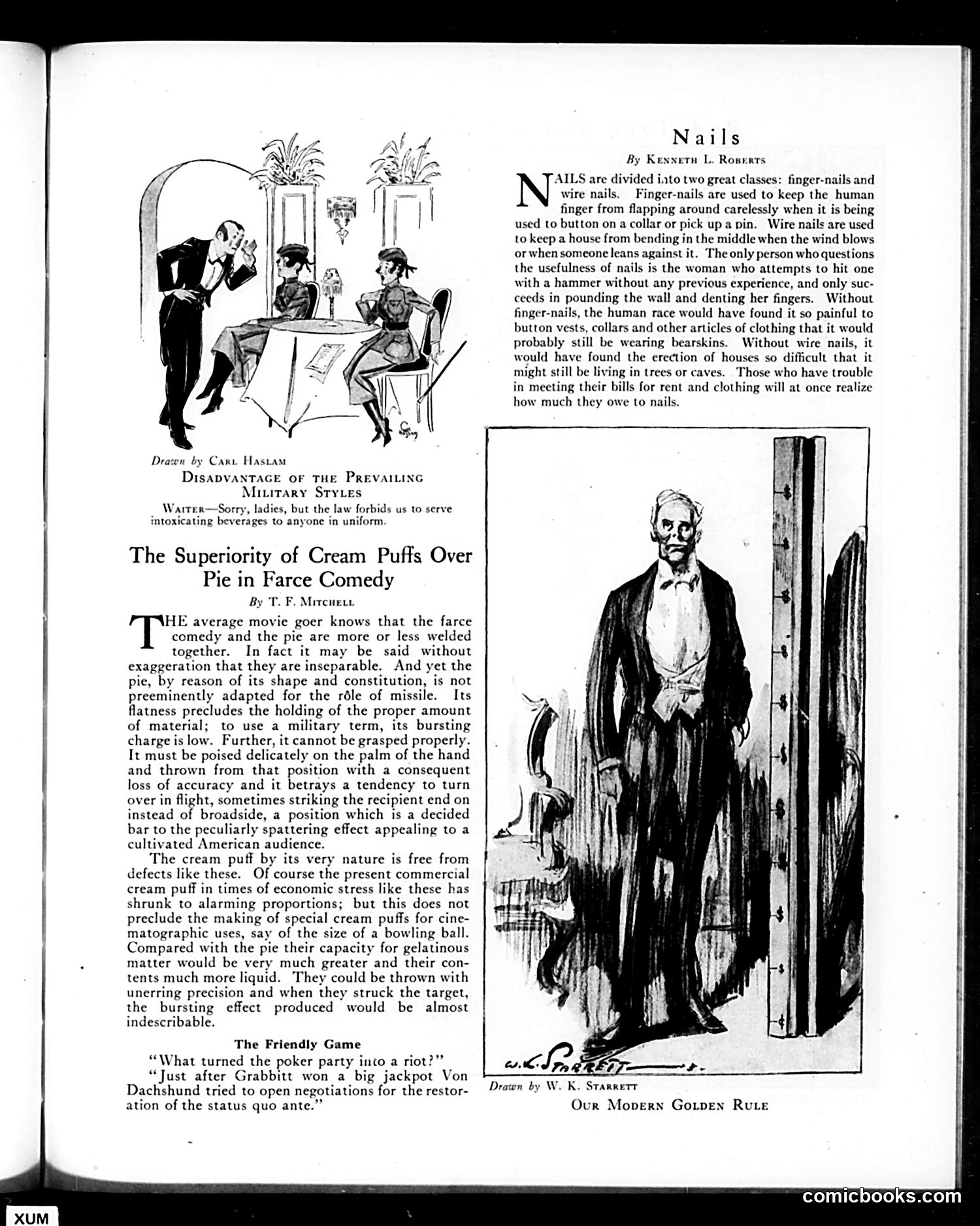
**Top Cartoon ("Disadvantage of the Prevailing Military Styles"):** A waiter refuses to serve intoxicating beverages to uniformed military personnel. This satirizes Prohibition-era laws that banned alcohol sales to soldiers, likely reflecting public concern about intoxicated servicemen's behavior or conduct. The humor lies in the absurdity of the rule's strict enforcement. **Middle Article ("Superiority of Cream Puffs Over Pie in Farce Comedy"):** A comedic film critique seriously analyzing slapstick physics. The author argues cream puffs—larger and more liquid-filled than pies—produce superior comedic "splattering effects" when thrown at targets due to better aerodynamics and impact. This parodies overly academic analysis of vaudeville-style film comedy. **"The Friendly Game":** A brief joke about a poker game riot triggered when winner Grabbitt's opponent Von Dachshund (likely a German name, potentially post-WWI satire) attempts renegotiating the jackpot—suggesting heated ethnic or national tensions. **"Nails" Essay:** Tongue-in-cheek praise of nails' civilizing importance, humorously crediting them with humanity's progress from caves to houses and formal dress.
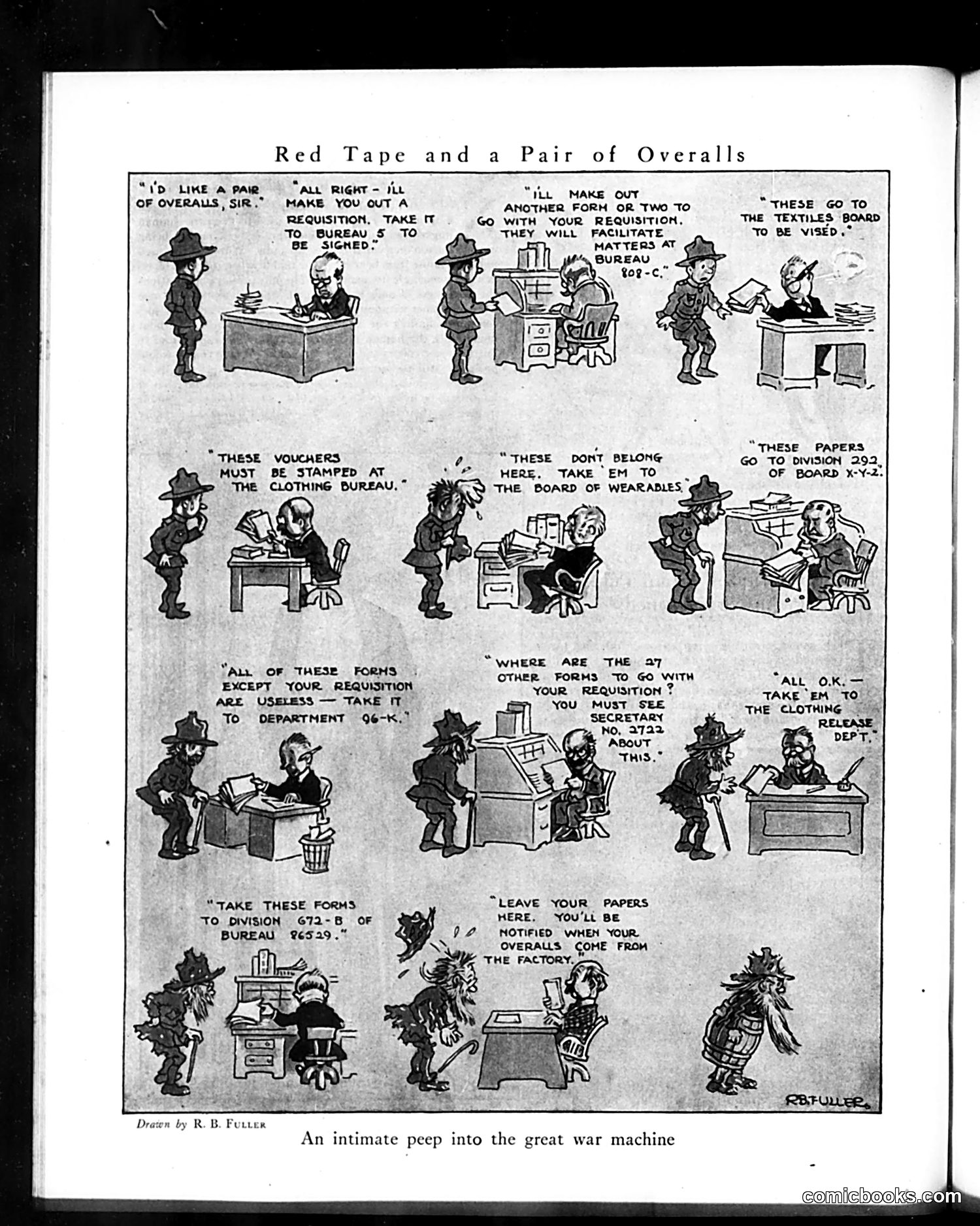
This cartoon satirizes the absurd bureaucratic inefficiency of World War I-era government procurement. A soldier seeking overalls is sent on a maddening runaround through multiple overlapping departments: Bureau 5, Department 96-K, Division 672-8, Bureau 6529, the Board of Wearables, the Textiles Board, Division 292, and various secretaries. The joke exposes how a simple request spawns endless forms, stamps, and referrals—each official redirecting him elsewhere. The caption "An intimate peep into the great war machine" delivers the satirical punch: the military bureaucracy itself is as much an obstacle as enemy forces. By war's end, the soldier still hasn't received his overalls, illustrating how government red tape wastes resources and time when military supplies are urgently needed.
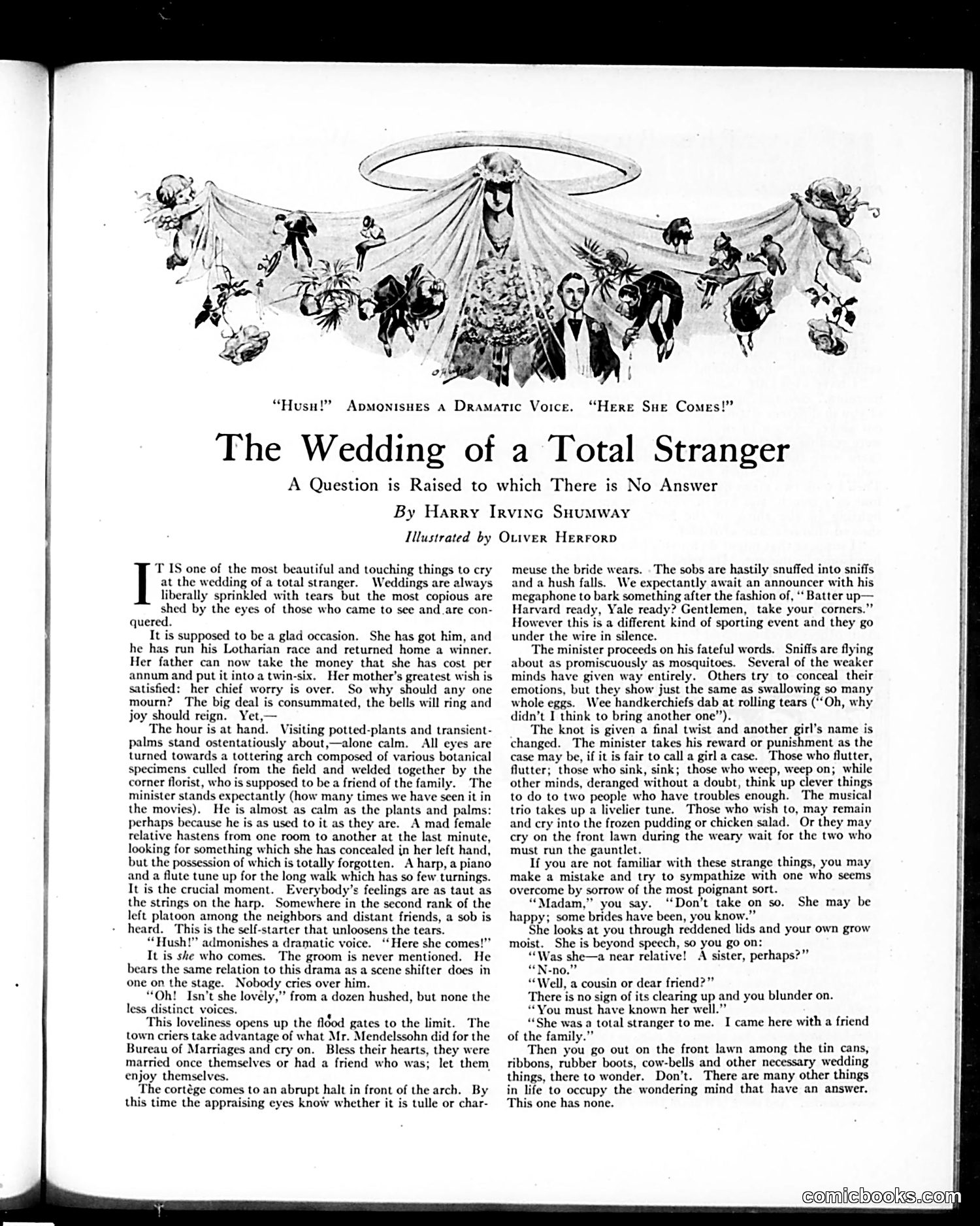
This is a satirical short story with illustration by Harry Irving Shumway, not a political cartoon. It mocks the emotional excess and absurdity of wedding ceremonies, particularly the tears shed by guests who barely know the couple. The satire targets how weddings function as social theater: the groom is irrelevant (described as a "scene shifter"), the bride's appearance matters more than the marriage itself, and strangers cry performatively. Shumway ridicules the artificial emotions, the hired decorations, the ceremonial machinery, and especially the hypocrisy—guests who "were married once themselves or had a friend who was" cry as if experiencing genuine joy rather than following social convention. The illustration shows cherubs presiding over the scene, emphasizing its theatrical unreality. The piece questions *why* we perform these emotions at weddings of people we scarcely know—a question the subtitle says "There is No Answer" to. It's gentle social satire on middle-class wedding customs rather than political commentary.
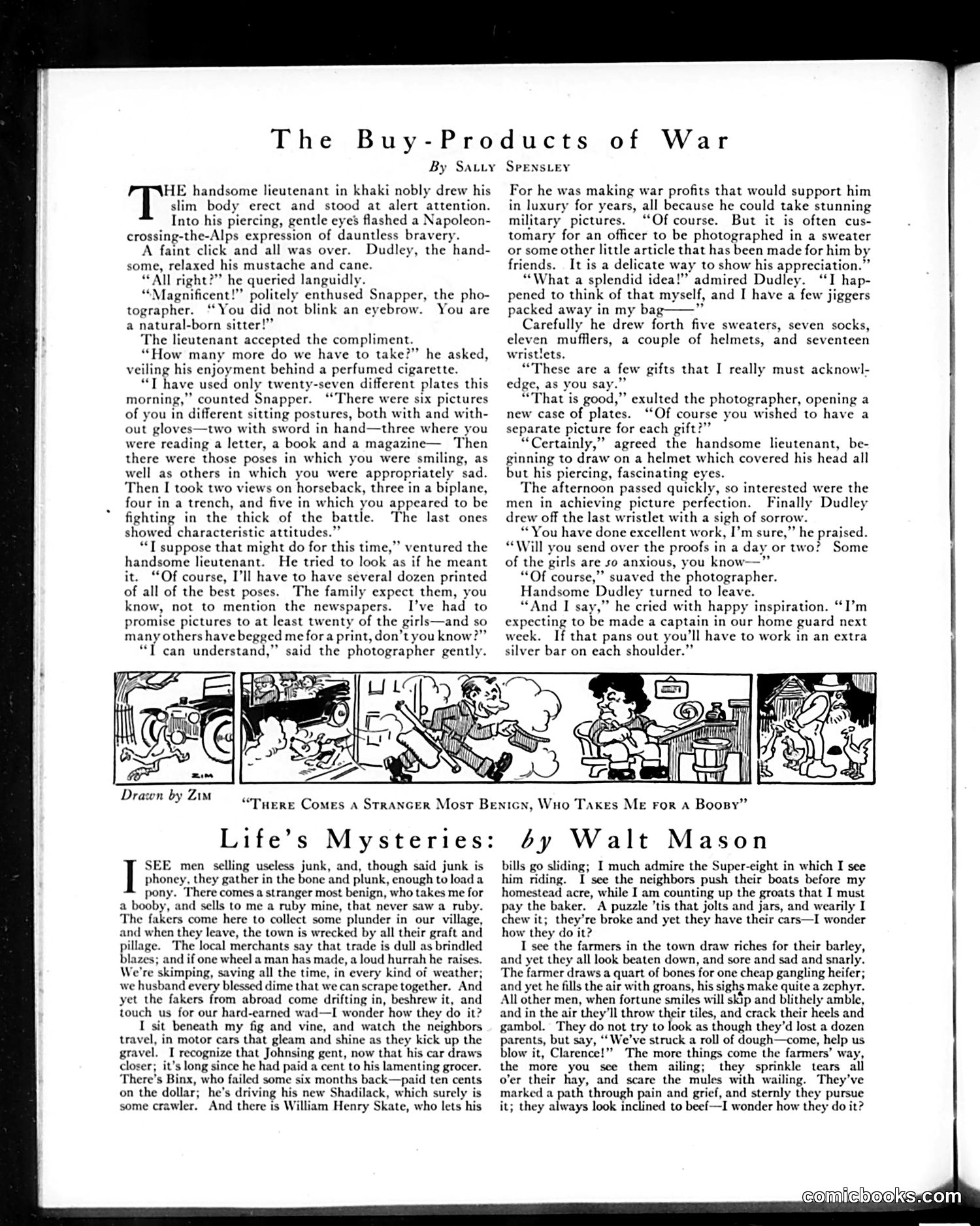
**"The Buy-Products of War"** satirizes military profiteering during wartime. A vain lieutenant named Dudley poses for photographer Snapper in an elaborate photo shoot—27 plates shot across multiple scenarios (on horseback, in trenches, fighting). The satire emerges when Dudley reveals his true motive: these photos aren't for military purposes but for personal profit and vanity. He plans mass-printing them for family, newspapers, and "twenty girls," while accepting gifts (sweaters, socks, helmets, wristlets) supposedly from friends—actually war materiel he's accumulated. The joke: officers exploit the patriotic fervor and wartime generosity of civilians, converting military service into personal commercial gain. The elaborate photography setup symbolizes how war creates market opportunities for those in uniform to profit from public admiration and gift-giving. It's satirical commentary on officers leveraging their status for personal enrichment rather than genuine service.
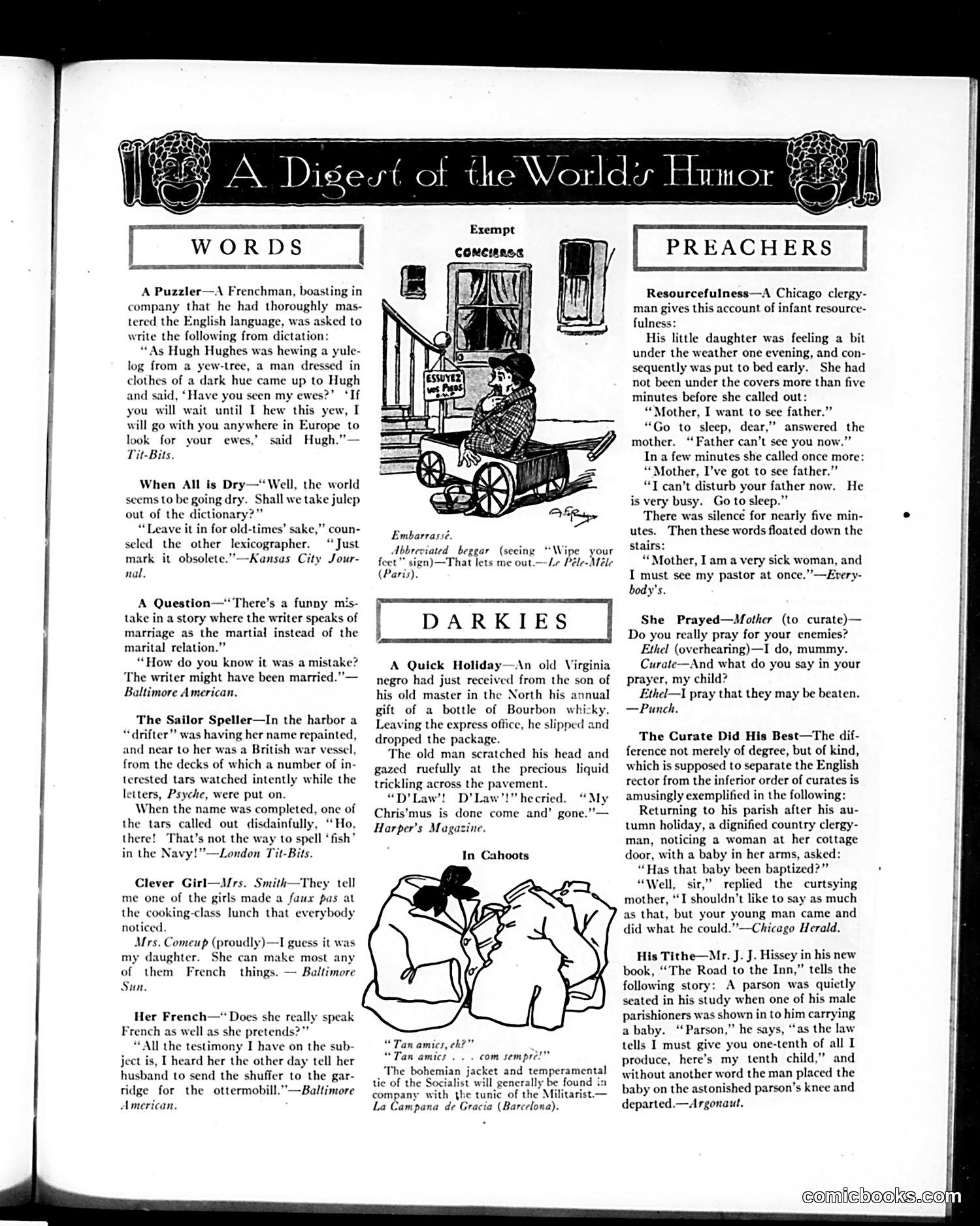
This page from *Judge* presents humor through wordplay, cultural stereotypes, and social commentary typical of early 20th-century American satire. **The cartoons and jokes target:** 1. **Language barriers**: French speakers struggling with English's homophone-heavy dictation ("ewes/yews/Hughes"); a woman mangling French pronunciation ("shuffer" for chauffeur, "ottermobill" for automobile). 2. **Prohibition-era humor**: A joke about removing "julep" from dictionaries as America goes "dry." 3. **Racial stereotyping**: The "Darkies" section uses derogatory language and dialect to mock Black Americans—standard for this era's "humor." 4. **Class commentary**: Priests and clergymen are portrayed as either out-of-touch or hypocritical. 5. **Social pretension**: People adopting French affectations or military-socialist political posturing are mocked. The cartoon of two cahoots figures illustrates how bohemian socialists and militarists are strange bedfellows despite opposing ideologies—likely Cold War-era political commentary. The page reflects *Judge*'s establishment perspective satirizing immigrants, linguistic pretension, and progressive politics.
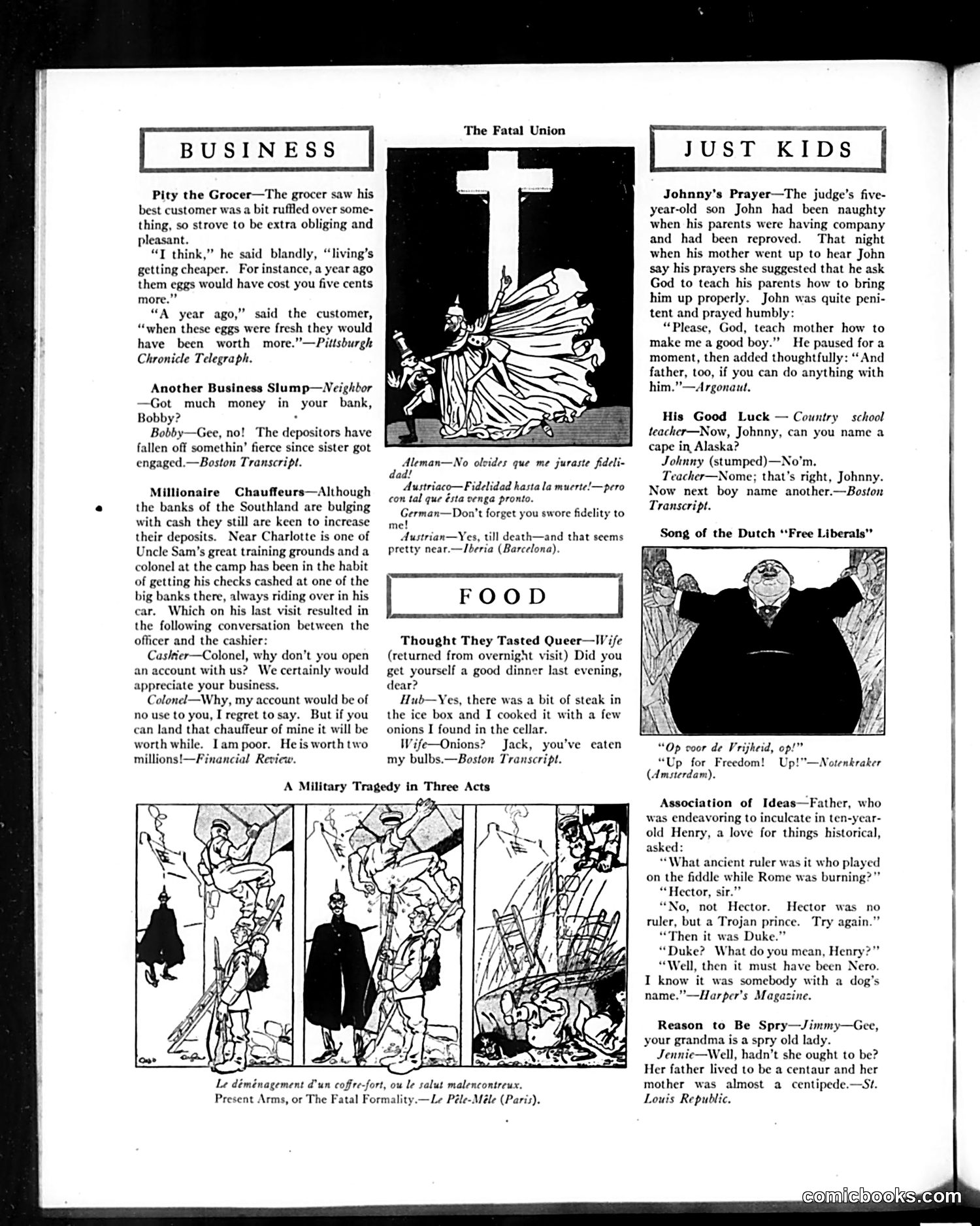
This page from Judge magazine contains several short humorous pieces satirizing American life: **"Pity the Grocer"** mocks customer complaints about inflation—a grocer tries flattering a disgruntled customer by claiming eggs are cheaper, but the customer counters that eggs were fresher a year ago, implying they've actually gotten worse value. **"Another Business Slump"** jokes that a bank's deposits have fallen because a young man's sister got engaged, suggesting men were withdrawing money for wedding expenses. **"Millionaire Chauffeurs"** satirizes wealthy Southern bankers' priorities: a colonel tells a banker his own account is worthless, but his chauffeur is worth millions—mocking how wealth concentrates among servants who manage their employers' spending. **"A Military Tragedy in Three Acts"** shows a German-Austrian military alliance where both swear eternal fidelity, but the Austrian hopes death comes quickly—dark satire on WW1-era unstable alliances. The remaining items are light domestic humor about cooking, children's malapropisms, and family jokes.
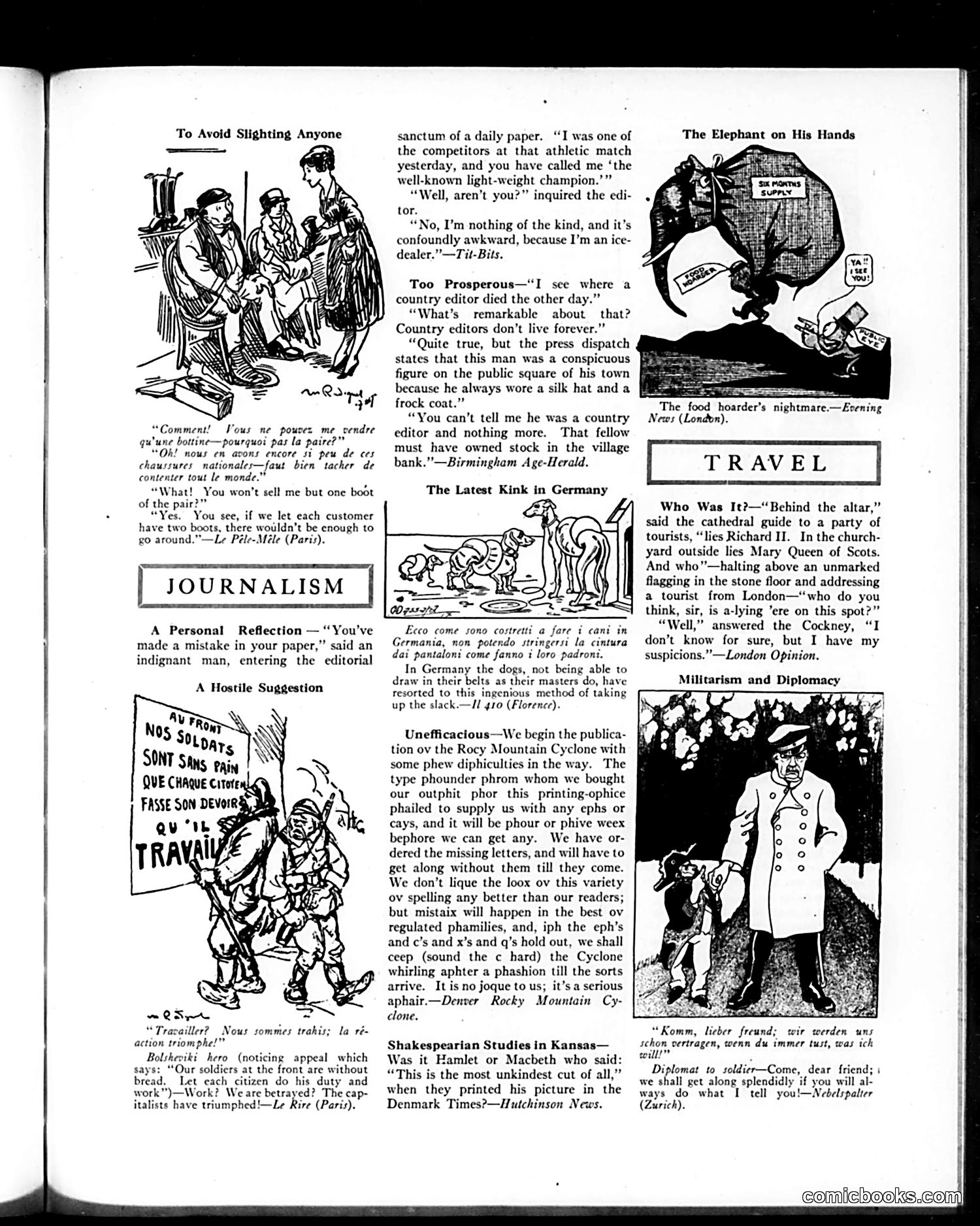
This page collects international satirical humor translated from European publications, reflecting post-WWI anxieties: **"To Avoid Slighting Anyone"** (French): Dark humor about wartime scarcity—a French shoe merchant sells only one boot per customer to stretch supplies. **"The Latest Kink in Germany"** (Italian): Biting satire on German post-war deprivation. Dogs, unable to tighten belts like starving humans, literally cinch their bodies with rope—a grotesque image of collective hunger. **"Unefficacious"** (American): Printer's mishap becomes comedy. A Rocky Mountain newspaper lacks letters "F," "C," and "X," forcing absurd substitutions ("phamily," "ceep"). Self-aware mockery of incompetence. **"Militarism and Diplomacy"** (Swiss/German): A uniformed officer tells a soldier they'll "get along splendidly if you always do what I tell you"—satirizing military obedience versus diplomatic pretense of friendship. These pieces mock post-war shortages, military authoritarianism, and institutional failures across nations.
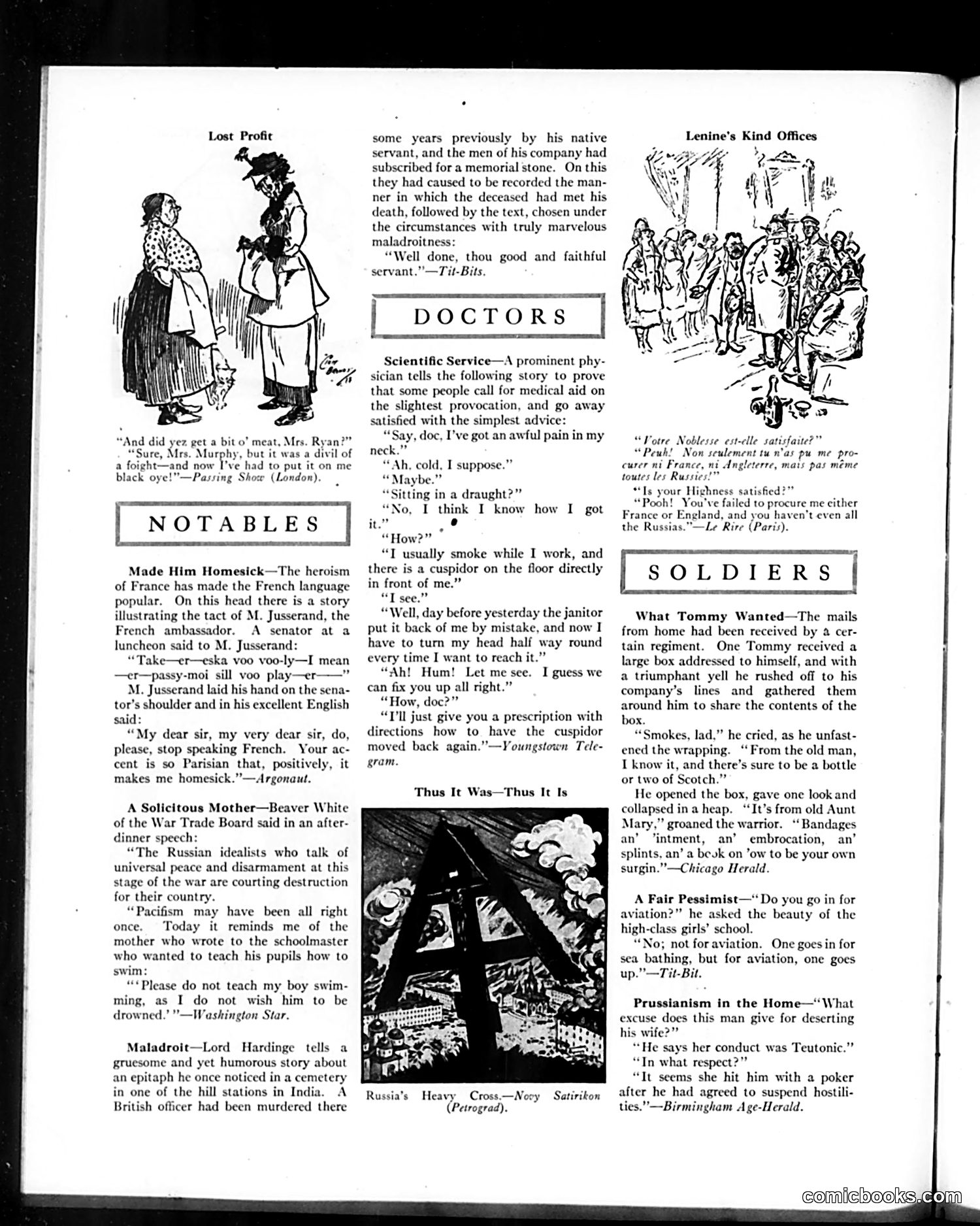
This page from the American satirical magazine *Judge* contains several brief humor pieces and cartoons: **"Lost Profit"** depicts an Irish working-class woman who obtained meat only after a physical fight, resulting in a black eye—satirizing wartime scarcity and rationing hardships. **"Notables"** section includes anecdotes about French Ambassador Jusserand (whose deliberately bad French he claims makes him homesick), and a War Trade Board official warning against pacifists during wartime. **"Doctors"** mocks hypochondriacs through a patient complaining of neck pain caused by a relocated spittoon—the doctor's "prescription" is simply to move it back. **"Lenine's Kind Offices"** (right cartoon) shows Lenin unable to deliver France, England, or "all the Russias" to a demanding nobleman—satirizing Lenin's limited actual power during the Russian Revolution and civil war period. **"Soldiers"** humorously depicts a British soldier disappointed that his father sent medical supplies rather than cigarettes and whisky.
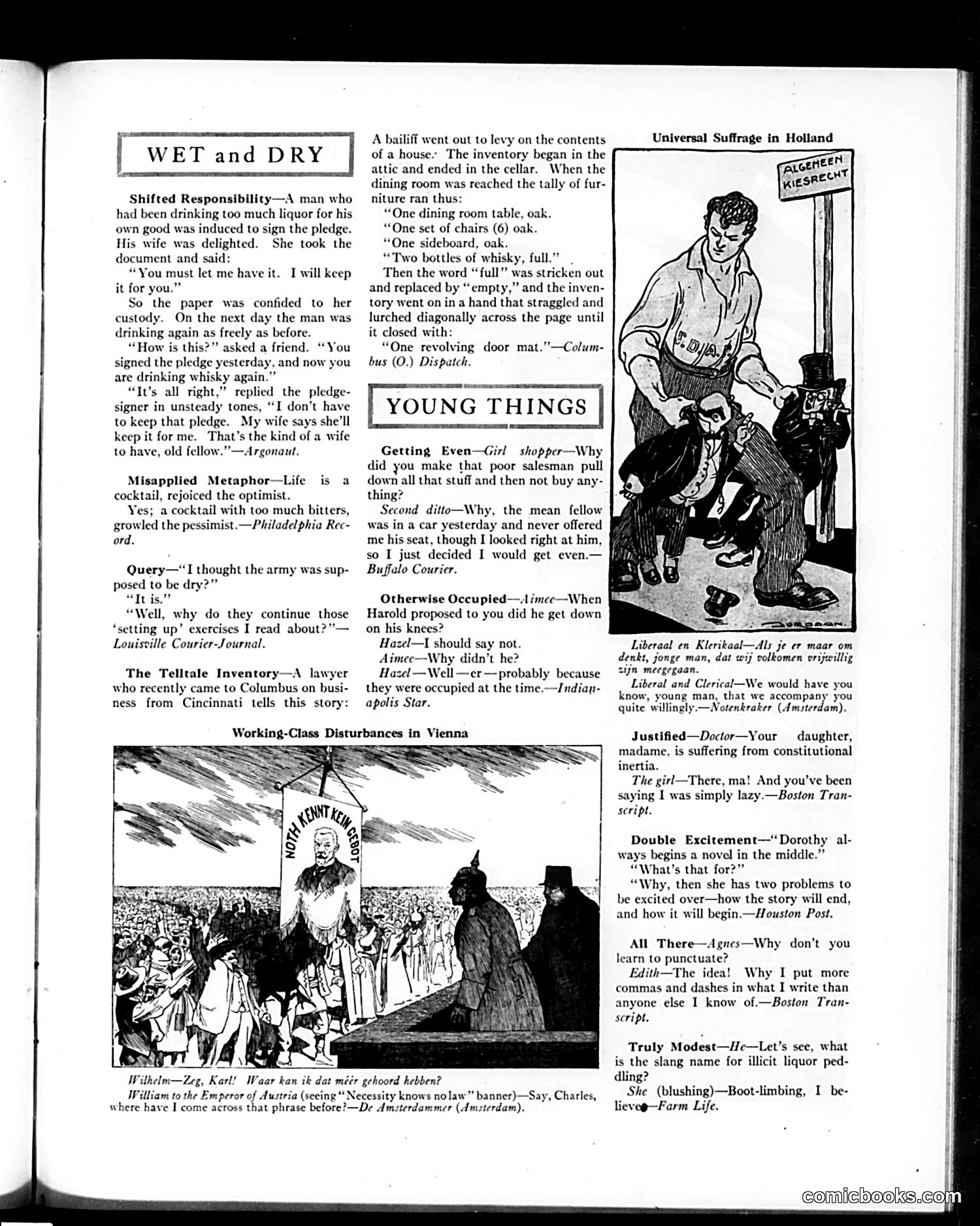
This page contains humor pieces satirizing Prohibition-era America and international politics. The central cartoon depicts working-class Viennese disturbances, showing a crowd confronting an authority figure with a "Necessity knows no law" banner—mocking how citizens justified breaking laws during hardship. The "Wet and Dry" section lampoons Prohibition enforcement through anecdotes: a man signs a temperance pledge but avoids responsibility by letting his wife keep it; a bailiff inventorying a house finds whisky bottles that mysteriously change from "full" to "empty" as he descends, suggesting he drank them. These jokes mock both the hypocrisy of pledges and the difficulty of enforcing alcohol bans. The Dutch cartoon on suffrage shows Liberals and Clericals claiming they willingly supported women's voting rights—a sardonic comment on their actual reluctance. Other items are light domestic humor about shopping, romance, and punctuation, typical of the magazine's lighter content. The overall theme: ordinary people subvert unpopular laws and regulations while authority figures pretend compliance exists.
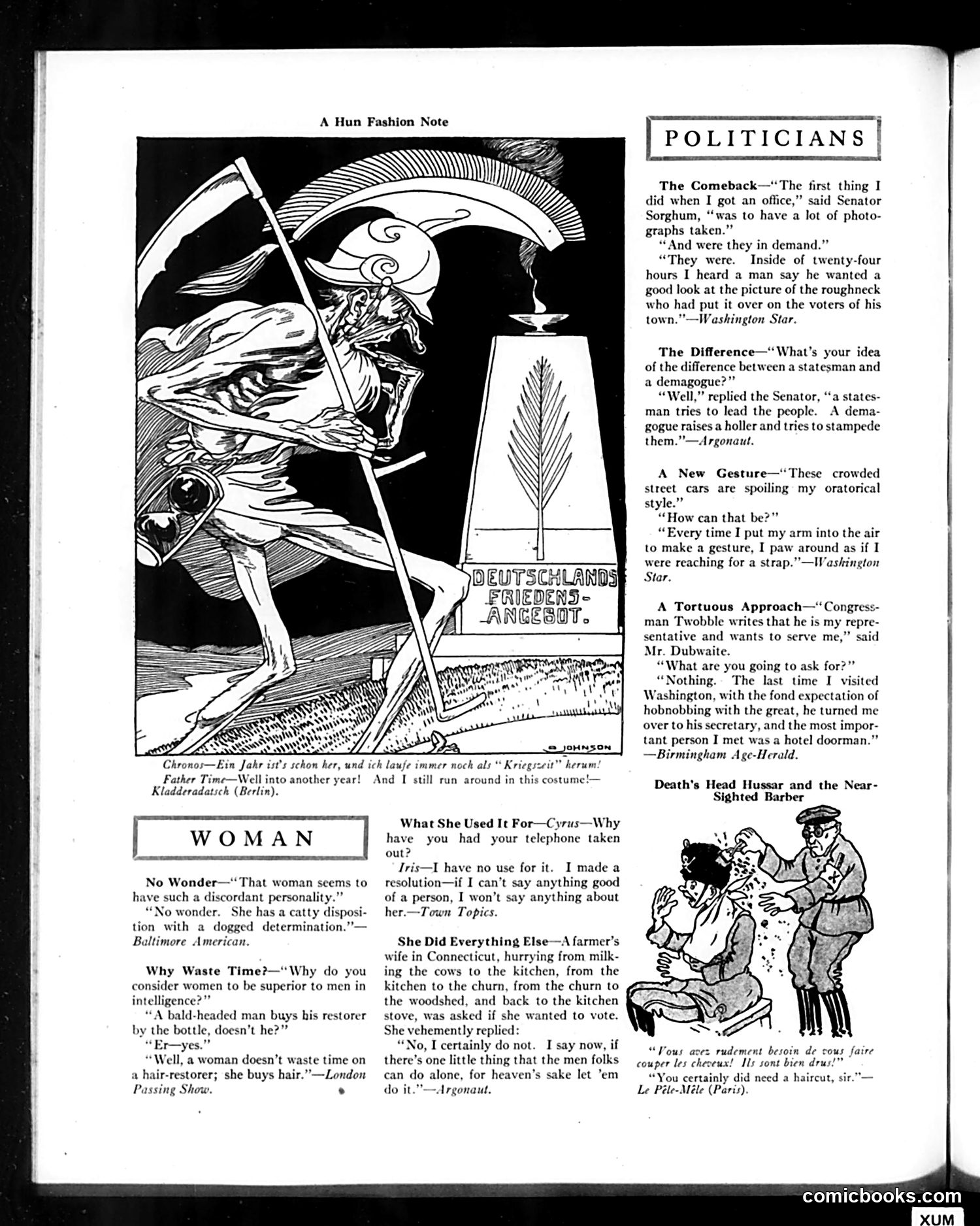
This page contains satirical anecdotes mocking American politicians and gender attitudes circa World War I era. **The main cartoon** depicts Death personified as a skeletal German soldier ("Hun") still wearing wartime costume, referencing the ongoing conflict. The German caption suggests the war has dragged on longer than expected. **Politicians section** ridicules senators and congressmen as vain, insincere, and inaccessible—caring more about publicity photos than constituent service, using rhetoric to manipulate rather than lead, and treating visitors dismissively. **Women section** contains period-typical gender humor: jokes about women's vanity (hair vs. restoration products), a woman avoiding voting because she's already busy enough, and a farmer's wife uninterested in suffrage—reflecting contemporary attitudes dismissing women's political participation as unnecessary. The barber cartoon appears to mock nearsightedness, using a German soldier as its subject—likely another WWI jab.
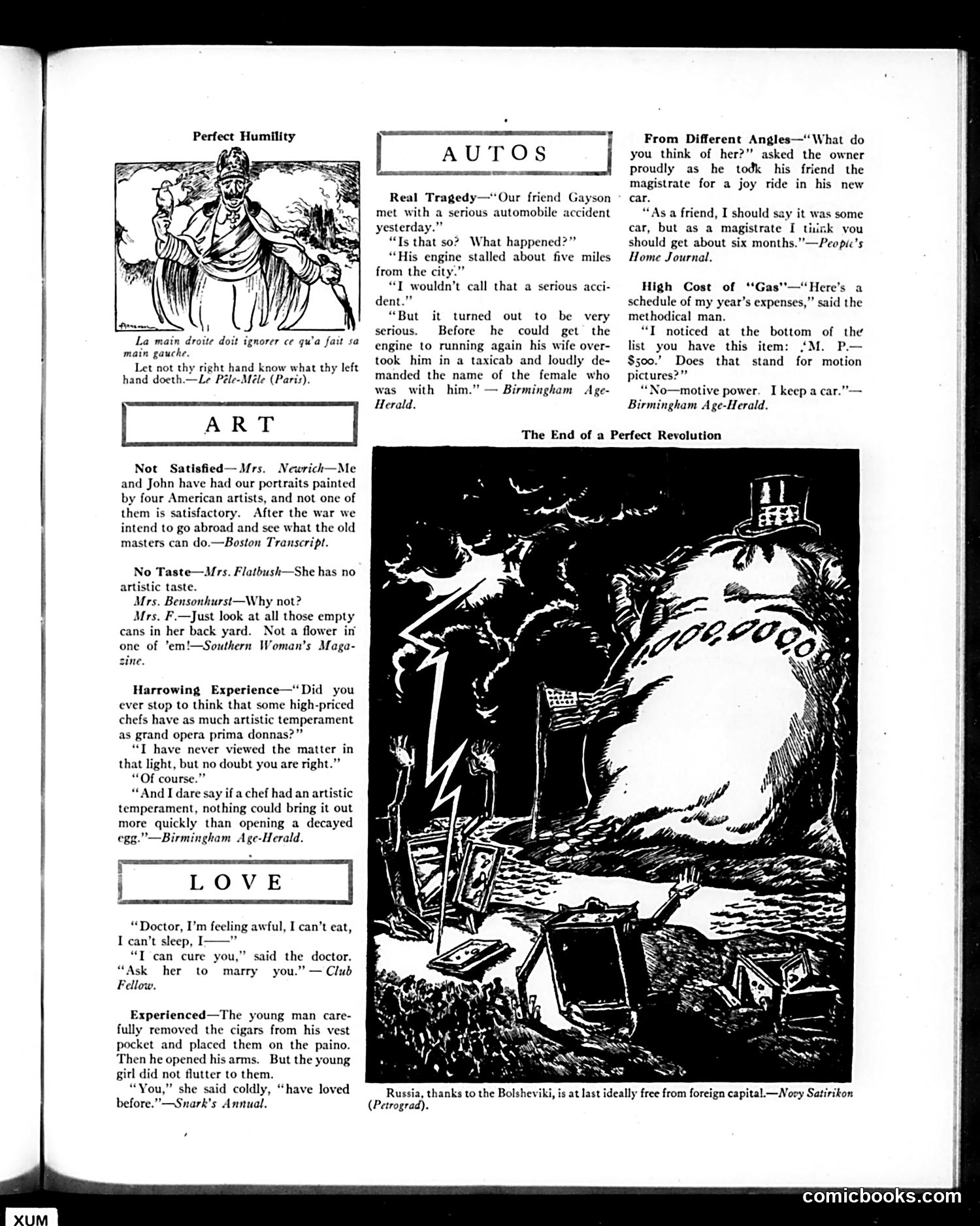
This page contains **humorous anecdotes and one political cartoon** typical of early 20th-century American satire. The **main cartoon** ("The End of a Perfect Revolution") depicts Russia after the Bolshevik Revolution, showing a giant money bag dominating the landscape with a factory or building visible. The caption suggests irony: Russia claims to be "free from foreign capital" under the Bolsheviks, but the cartoon implies capitalist interests (the enormous money bag) still control the nation—satirizing the gap between revolutionary ideals and economic reality. The **text sections** mock contemporary American life: wealthy "Newrich" society women obsessing over portraiture; automobile owners (a status symbol); and romantic/domestic situations. One joke contrasts a magistrate's professional judgment of a new car ("six months"—implying it's stolen goods) with the owner's pride. The satire reflects early 1900s concerns: **nouveau riche pretension, automobile culture as class marker, and skepticism toward communist ideology**—all framed through genteel humor typical of Judge's educated readership.
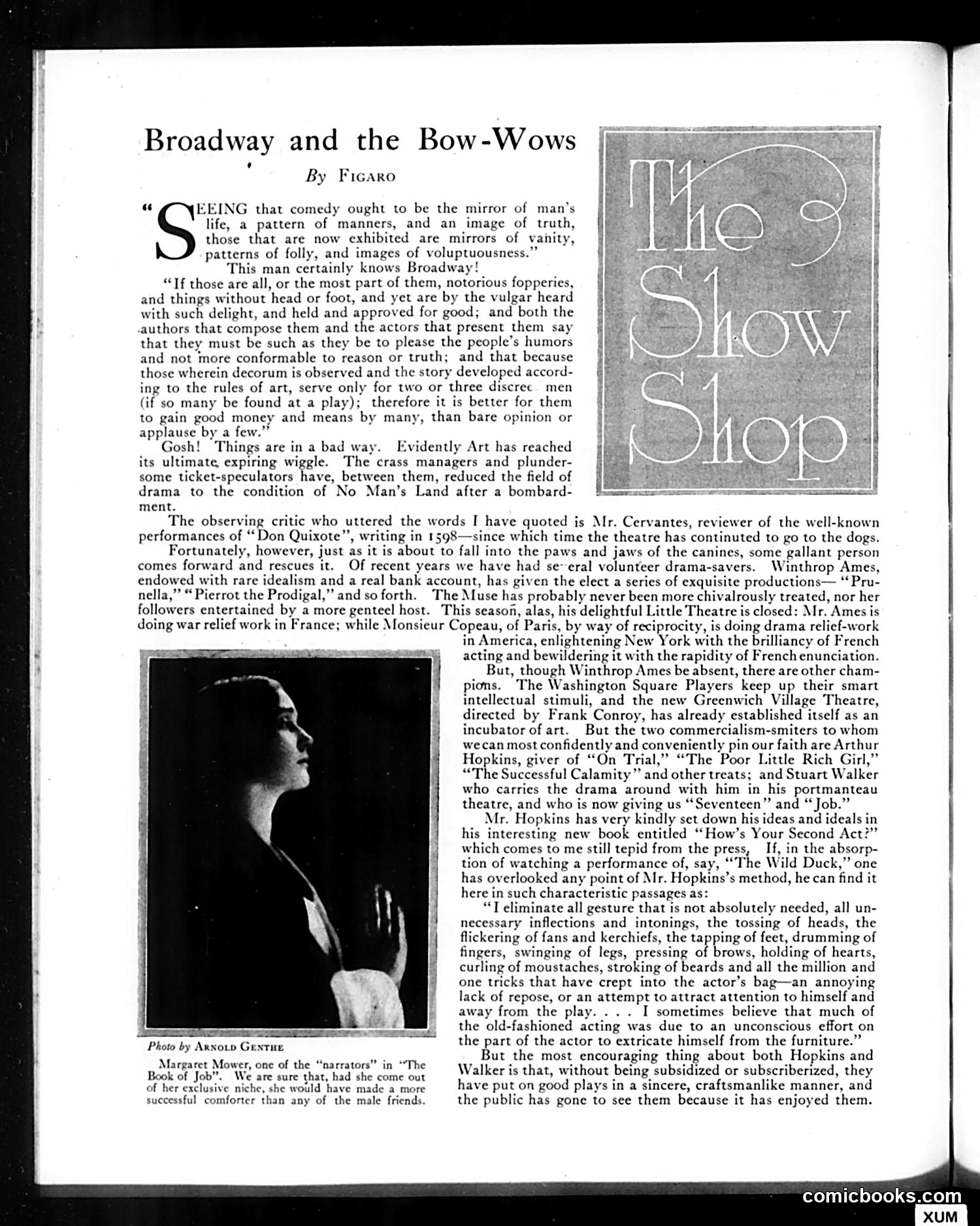
This article by Figaro critiques Broadway theatre for prioritizing commercial appeal over artistic merit. The author opens with a 1598 Cervantes quote lamenting that plays are "mirrors of vanity" rather than truth—establishing that theatre's decline is centuries old. The piece celebrates recent "drama-savers": Winthrop Ames (whose Little Theatre championed serious drama), Monsieur Copeau (a French director doing reciprocal work in America), and especially Arthur Hopkins and Stuart Walker. These producers are praised for resisting "commercialism" by staging quality plays with minimal, naturalistic acting—eliminating unnecessary gestures and affectations. The accompanying photograph shows Margaret Mower, described as a "narrator" in *The Book of Job*, exemplifying the refined, understated performance style being championed. The satire targets Broadway's "crass managers" and "ticket-speculators" who reduce drama to commercial formulas for mass audiences rather than art. The "Bow-Wows" reference suggests theatre has become degraded entertainment.
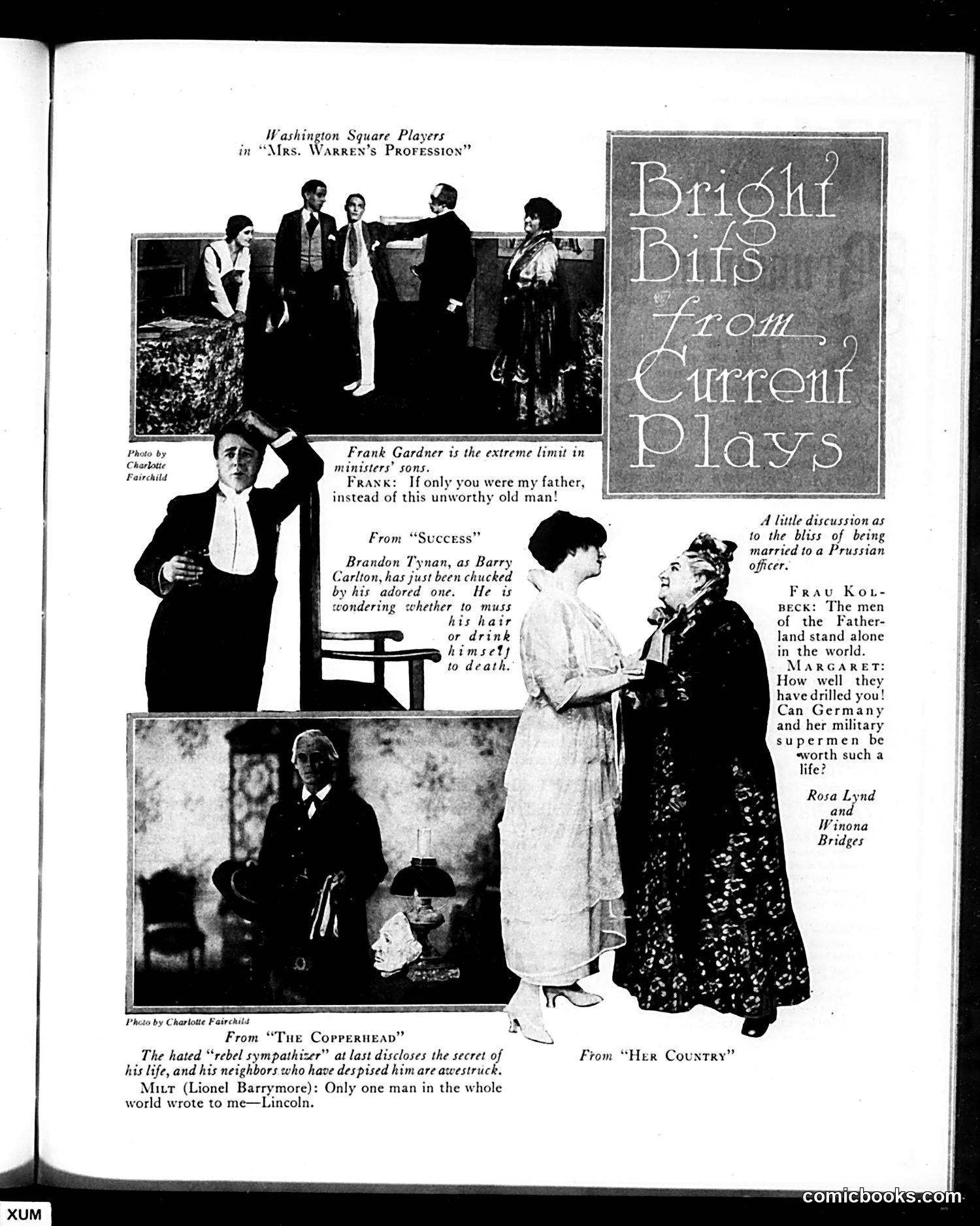
This page reviews four theatrical productions with photo stills and captions. The content reflects early 20th-century social attitudes: **"Mrs. Warren's Profession"** shows a scandalous plot point where a character wishes his father were someone else—likely referencing Shaw's controversial play about a woman's morally questionable past. **"Success"** depicts romantic rejection and despair in a comedic light. **"Her Country"** includes dialogue mocking German militarism and "Prussian" culture, reflecting anti-German sentiment (possibly from WWI era). A character boasts German men are "alone in the world," while another sarcastically asks if military discipline is worth sacrificing one's life. **"The Copperhead"** features a character whose secret correspondence with Lincoln earns neighbors' respect—likely about Civil War-era sympathy for the Union cause. The page presents theatrical reviews as entertainment, with emphasis on romantic drama and contemporary political/social anxieties.
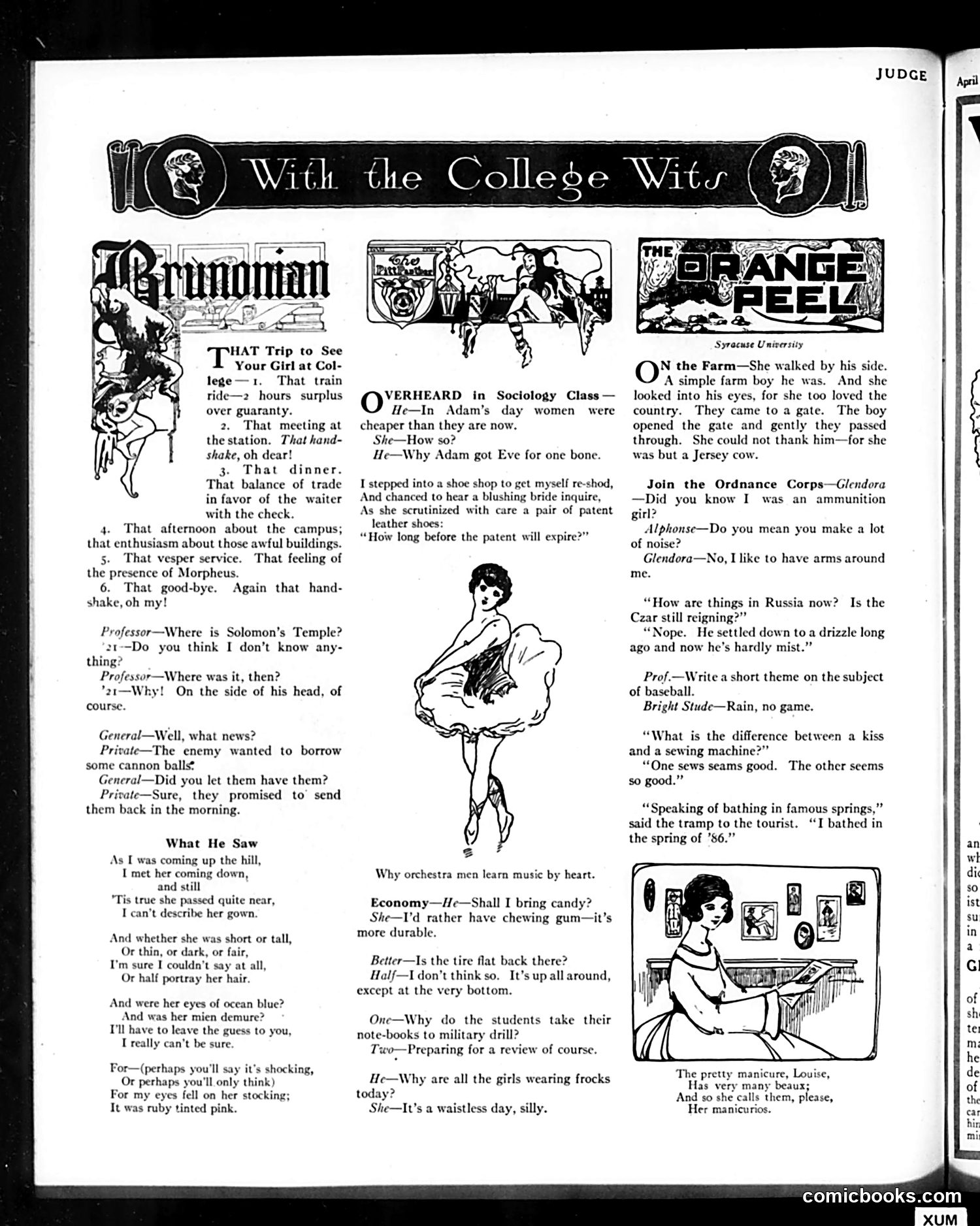
This page collects humorous one-liners and short comedic sketches targeting college life and contemporary social situations. The humor relies on wordplay, puns, and gentle mockery of dating, military service, and gender relations typical of early 20th-century American magazines. Key jokes exploit: awkward college visits ("that balance of trade in favor of the waiter"), malapropisms (a student placing Solomon's Temple "on the side of his head"), wartime references (ammunition girls in "Ordnance Corps"), fashion trends ("waistless day"), and flirtation. The sketches lampoon male inattentiveness during romance, female materialism, and young people's behavior. References to "military drill" and ammunition work suggest publication during or shortly after WWI. The overall tone is lighthearted ribaldry aimed at urban, educated audiences familiar with college culture and modern dating conventions.
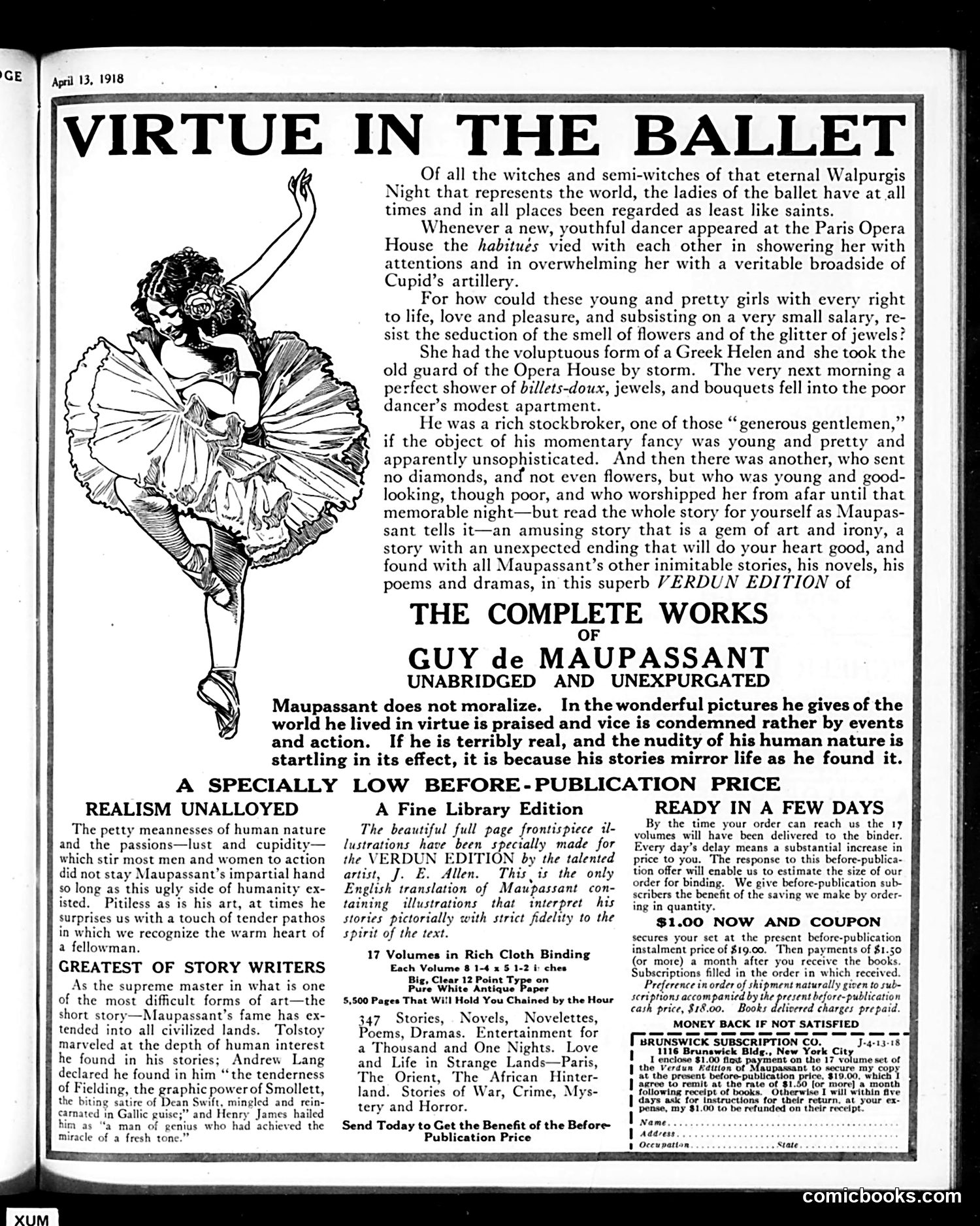
This page is primarily an advertisement for a complete works edition of Guy de Maupassant, framed as satirical commentary on ballet dancers and morality. The illustration shows a classical ballet dancer in a tutu. The accompanying text presents Maupassant's famous short story about a young Paris Opera House dancer who receives flowers, jewels, and attention from wealthy admirers—a "rich stockbroker" and other "generous gentlemen." However, a poor but handsome young man also pursues her, ultimately providing an ironic twist. The satire targets the presumed moral corruption of professional dancers, who, despite low wages, were stereotyped as vulnerable to seduction by wealthy patrons. The joke is that Maupassant's realist fiction subverts this expectation—virtue is "praised and vice is condemned rather by events and action." The advertisement emphasizes Maupassant's unflinching depiction of human nature without moralistic judgment, positioning his unabridged works as serious literature rather than scandalous material.
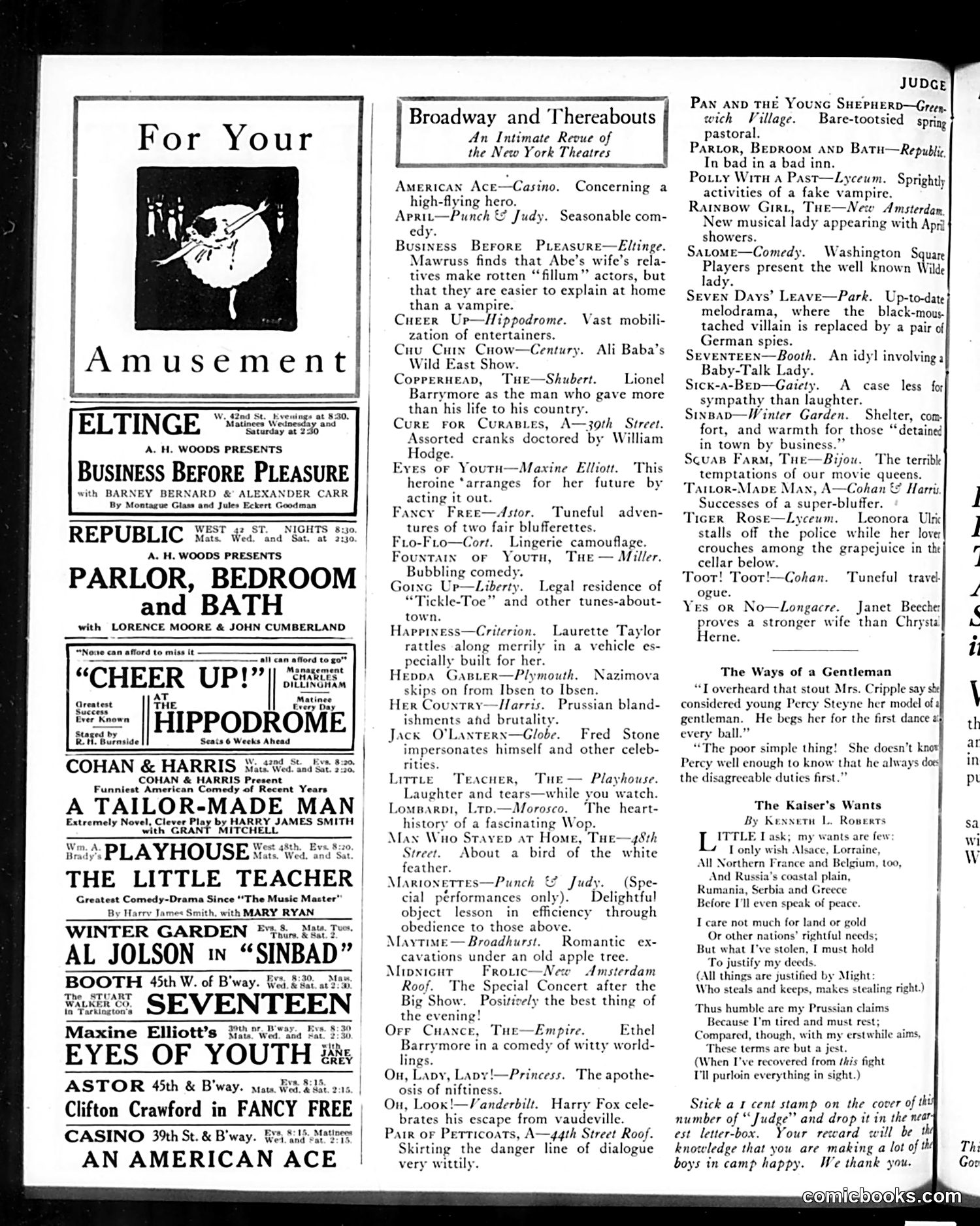
This page is primarily **theatrical advertising and reviews**, not political satire. It catalogs Broadway shows currently running, likely from around 1915-1917 based on references to Al Jolson in "Sinbad" and other era-specific productions. The left column contains advertisements for current plays, while the right column provides brief, witty synopses of theatrical productions. The reviews use pointed humor to describe plots: "Business Before Pleasure" notes that actors' relatives make worse "fillum" actors than vampires; "Parlor, Bedroom and Bath" is described as happening "in bad in a bad inn." The single cartoon visible (upper left) appears to be a simple decorative illustration unrelated to the theatrical content—just an artistic flourish for the "For Your Amusement" header. This page reflects **entertainment journalism of the era**, offering New York theatergoers quick, sarcastic summaries to help them choose among competing productions. The humor is theatrical rather than political.
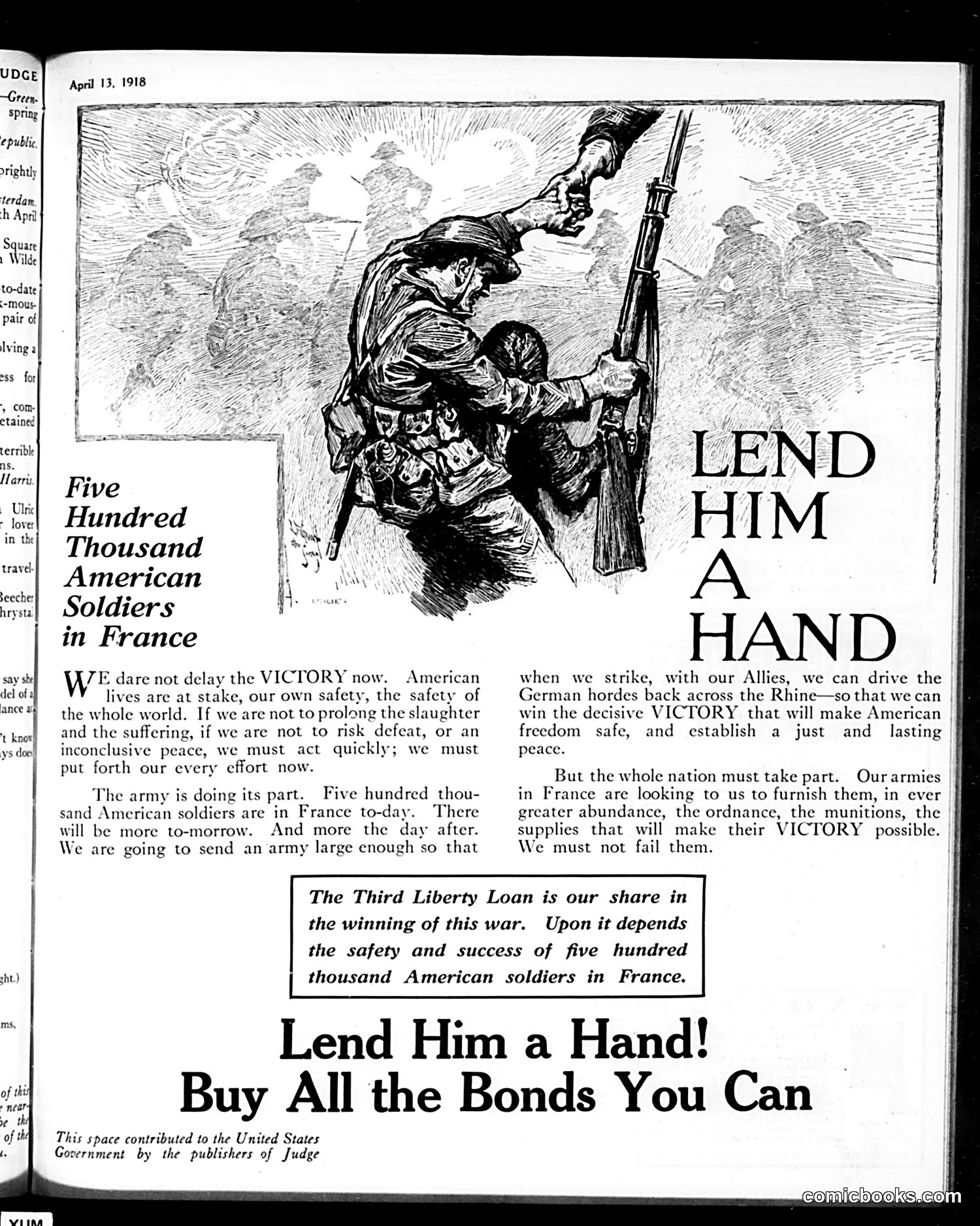
This April 1918 page is a **Liberty Bond propaganda advertisement**, not satire. It appeals to Americans to purchase government bonds to finance WWI military operations. The central image depicts a soldier in combat gear helping a wounded comrade—a emotional appeal to patriotic duty. The text emphasizes that 500,000 American soldiers are already in France and more are coming. The argument: bond purchases directly fund the supplies and ammunition these soldiers need to achieve victory and come home safely. The "Third Liberty Loan" reference indicates this was the government's third major bond drive. The rhetoric stresses urgency ("we dare not delay"), collective responsibility ("the whole nation must take part"), and moral obligation—failure to buy bonds means failing the soldiers. Modern context: This represents WWI-era propaganda using emotional appeals and patriotic framing to encourage civilian financial sacrifice for military goals. Judge magazine, typically satirical, here simply donated advertising space to the government effort.
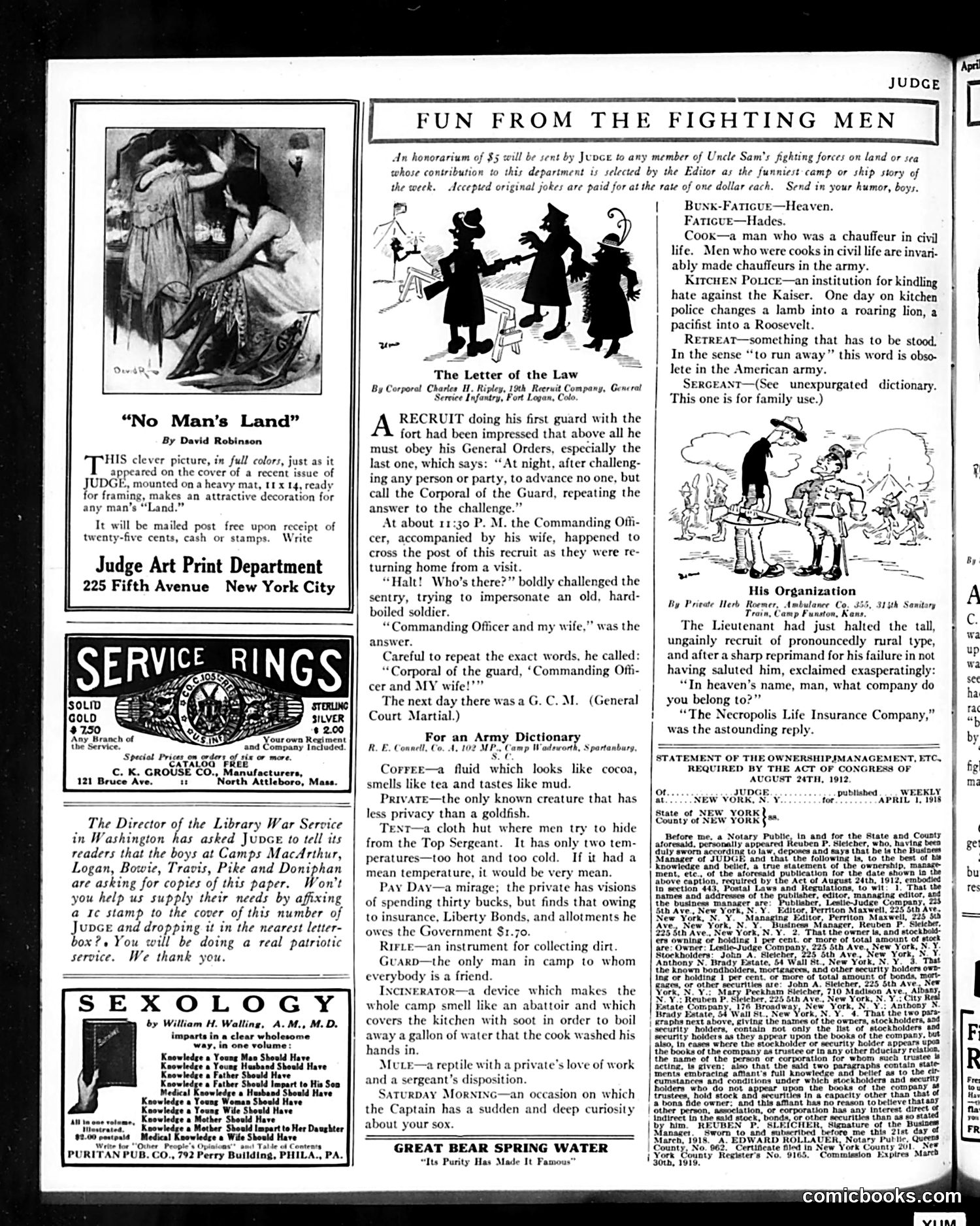
This page mixes advertising with military humor aimed at World War I soldiers and supporters. The main cartoon, "No Man's Land," depicts a woman in a suggestive pose—likely satirizing the contrast between soldiers' harsh battlefield reality and fantasies of home/romance. It's advertised as a purchasable print for "any man's 'Land'" (bedroom decoration). The central humor piece, "The Letter of the Law," mocks a naive recruit's literal obedience. When challenging his Commanding Officer at night, the sentry robotically repeats the officer's rank and companion—"Commanding Officer and MY wife!"—as instructed, leading to court martial. The joke: military discipline taken absurdly literally creates humiliation. The "Army Dictionary" provides satirical definitions (coffee tastes like mud; pay day is a mirage after deductions) expressing soldier frustration with military life. The page reflects WWI-era morale-building efforts, mixing patriotic appeals (donation request for camp newspapers) with irreverent humor that acknowledges soldiers' hardships while maintaining comedic distance.
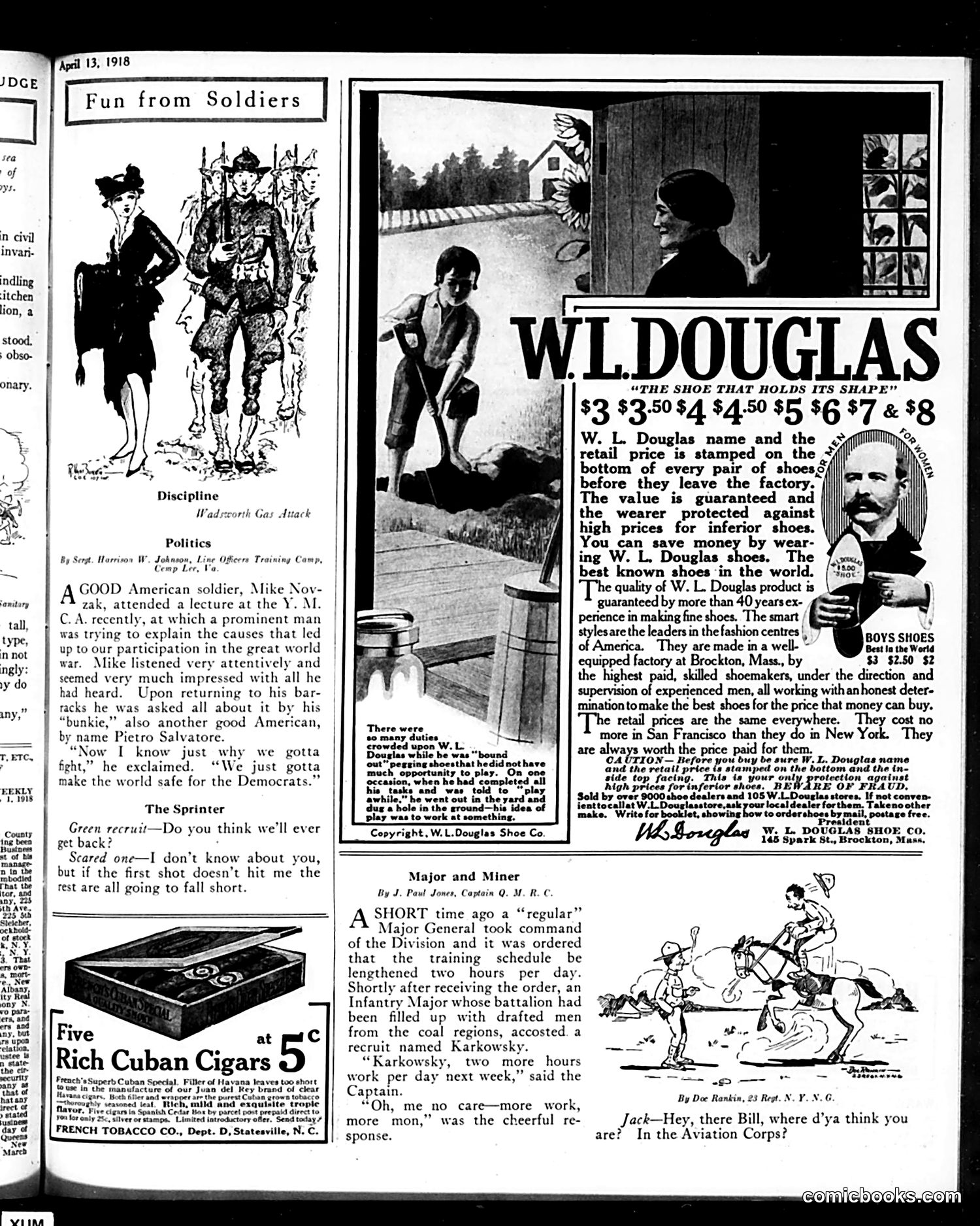
This page contains WWI-era military humor reflecting American soldiers' perspectives on the war effort. **"Politics"** satirizes a soldier's misunderstanding of war aims. Mike Novzak, after hearing a lecture on why America entered the war, concludes they're fighting "to make the world safe for the Democrats"—a garbled reference to President Woodrow Wilson's famous phrase about making the world safe for democracy. The joke mocks soldiers' incomplete grasp of complex political justifications for warfare. **"The Sprinter"** jokes darkly about combat mortality: a scared recruit declares if the first enemy shot misses him, he won't survive subsequent ones—expressing cynical fatalism about battlefield odds. **"Major and Miner"** contrasts an officer's stricter discipline with a coal-region drafted recruit's indifference. Karkowsky, unmoved by added work hours, responds only to payment increases, suggesting draftees lacked the professional soldier's commitment. The page also features shoe and cigar advertisements typical of period magazines.
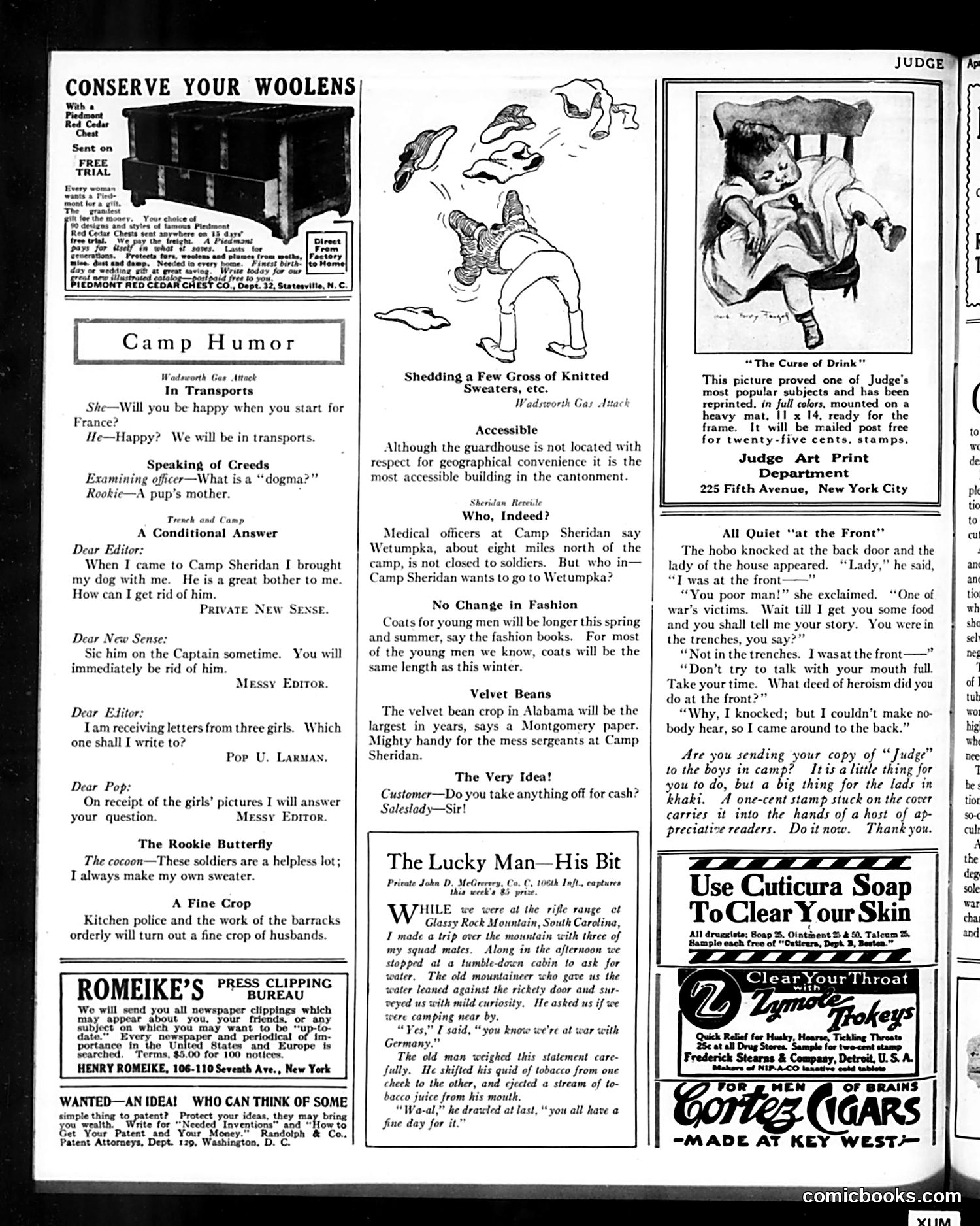
This page from *Judge* magazine contains WWI-era humor and advertisements. The "Camp Humor" section features jokes about soldiers at Camp Sheridan, Alabama, mocking military life: a rookie defines "dogma" as "a pup's mother"; officers debate whether closed towns are truly off-limits; fashion predictions jest that young soldiers' coats will stay the same length (implying their service might be lengthy). "The Lucky Man—His Bit" recounts a soldier asking a rural mountaineer for water. When told America is at war with Germany, the old man contemplates this gravely before spitting tobacco—a humorous understatement of the war's significance to civilians removed from military life. "All Quiet at the Front" satirizes charity: a homeless man tells a woman he was "at the front," she assumes combat heroism, but he clarifies he merely knocked at her front door unsuccessfully. The cartoons mock both military bureaucracy and civilian naiveté about the war.
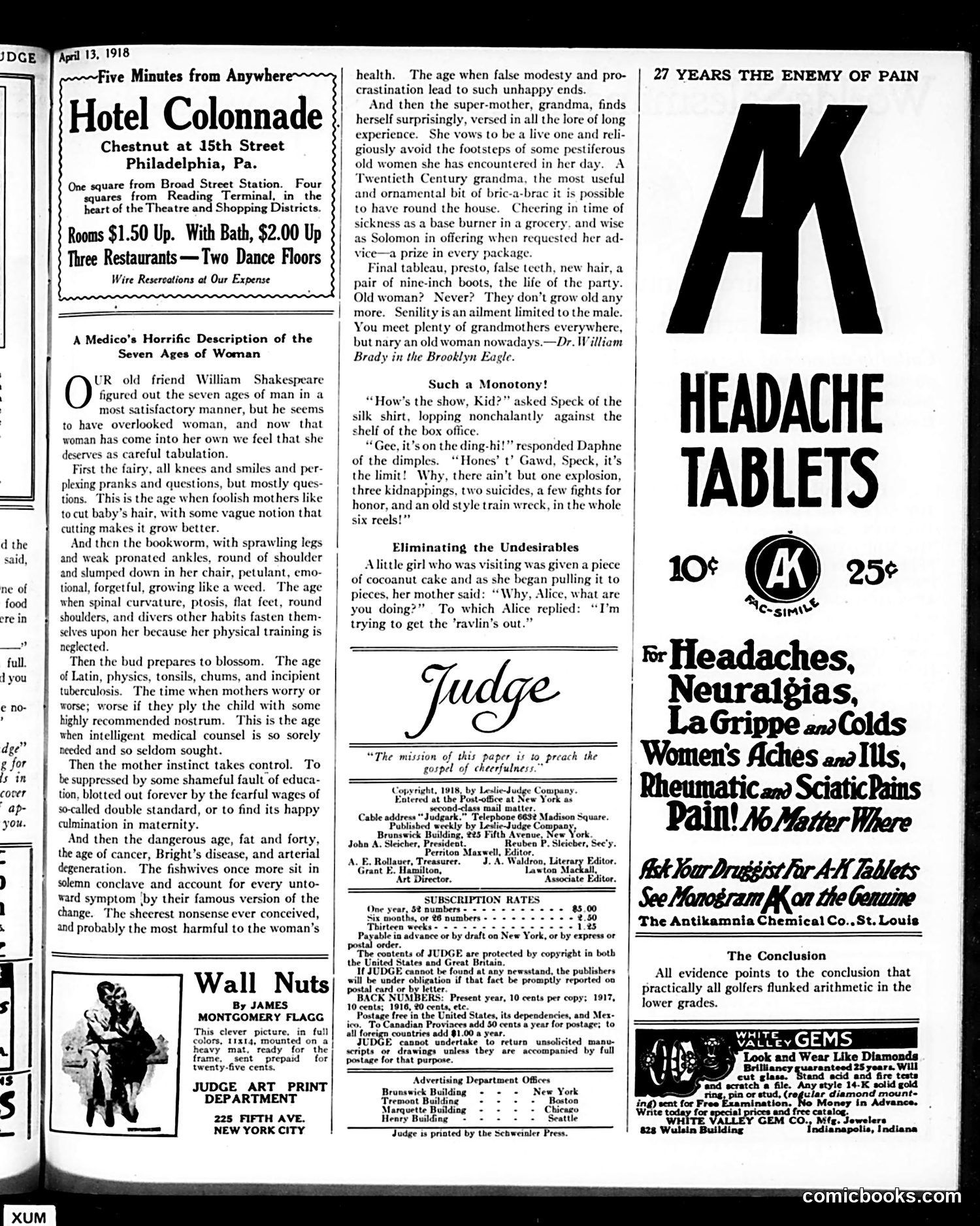
This page is primarily **advertising and commentary** rather than political satire. The main article, "A Medico's Horrific Description of the Seven Ages of Woman," is a medical commentary (attributed to Dr. William Brady) that describes women's life stages through a lens of physical and moral decline—from childhood through old age. It reflects early 20th-century medical attitudes about female bodies, emphasizing ailments, physical deterioration, and the dangers of "false modesty." The accompanying James Montgomery Flagg illustration appears to depict these stages visually. The page also contains hotel advertisements, a headache tablet advertisement, and humor pieces ("Such a Monotony," "Eliminating the Undesirables") typical of Judge magazine's light content. The satire here is **unintentional by modern standards**—the "horrific description" reflects genuine medical paternalism of the era rather than mocking it. Modern readers would recognize it as deeply sexist pseudomedical commentary presented as factual health guidance.
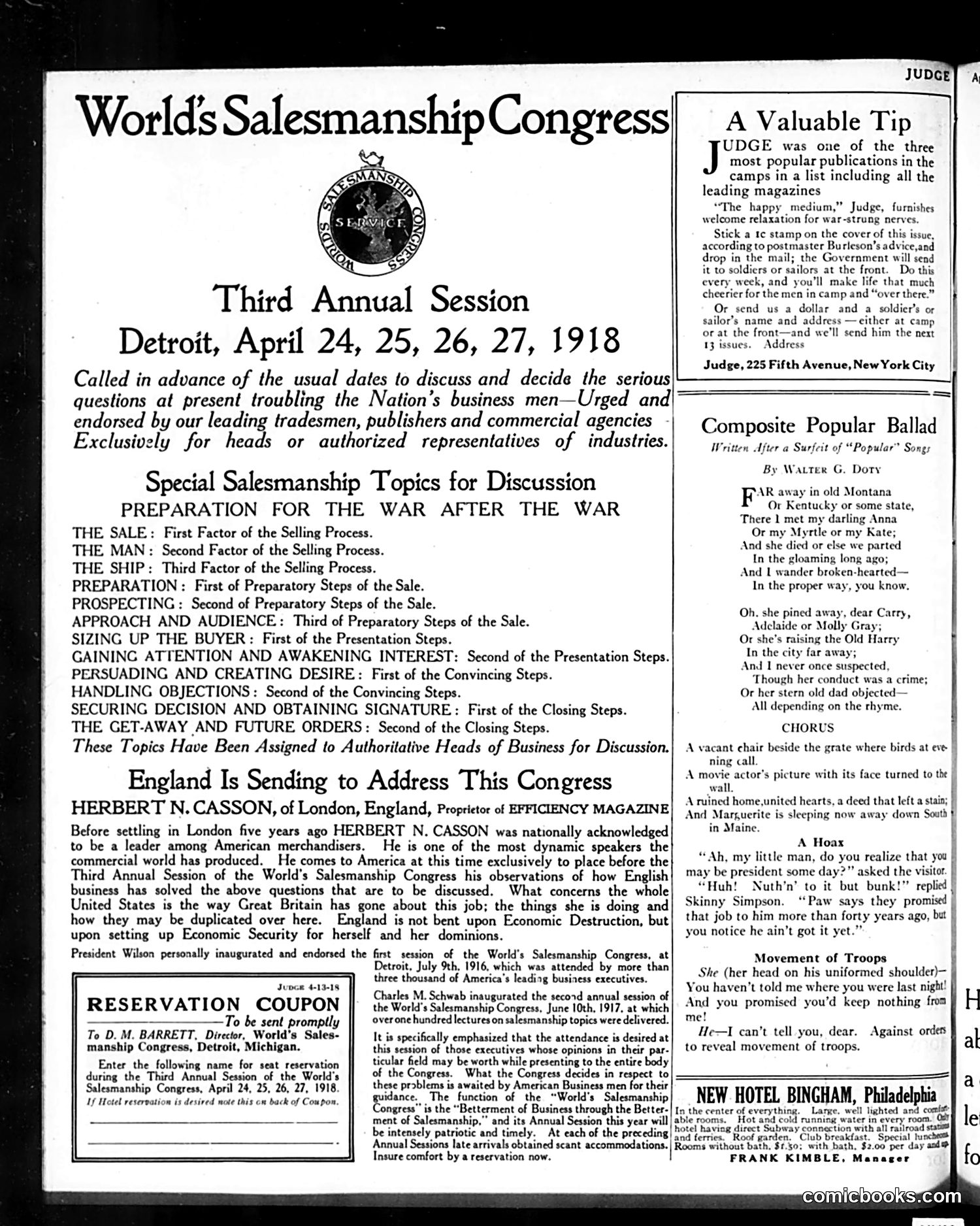
This is primarily an advertisement and informational page announcing the Third Annual World's Salesmanship Congress in Detroit, April 24-27, 1918. The page is **not satirical cartoons** but rather promotional content featuring business/sales topics. However, the historical context is significant: this congress was being held during **World War I**, with the theme "Preparation for the War After the War"—reflecting American business leaders' focus on post-war economic competition. The notable element is **Herbert N. Casson**, a British businessman, traveling to America to share how England was building "Economic Security" rather than pursuing "Economic Destruction." This reflects wartime Allied cooperation and America's concern about maintaining commercial advantage after the conflict. The page also includes patriotic messaging about President Wilson and Steel magnate Charles M. Schwab's involvement, linking American business interests to the war effort. The sidebar advertisement for *Judge* magazine notes its popularity in military camps, reinforcing the publication's patriotic appeal.
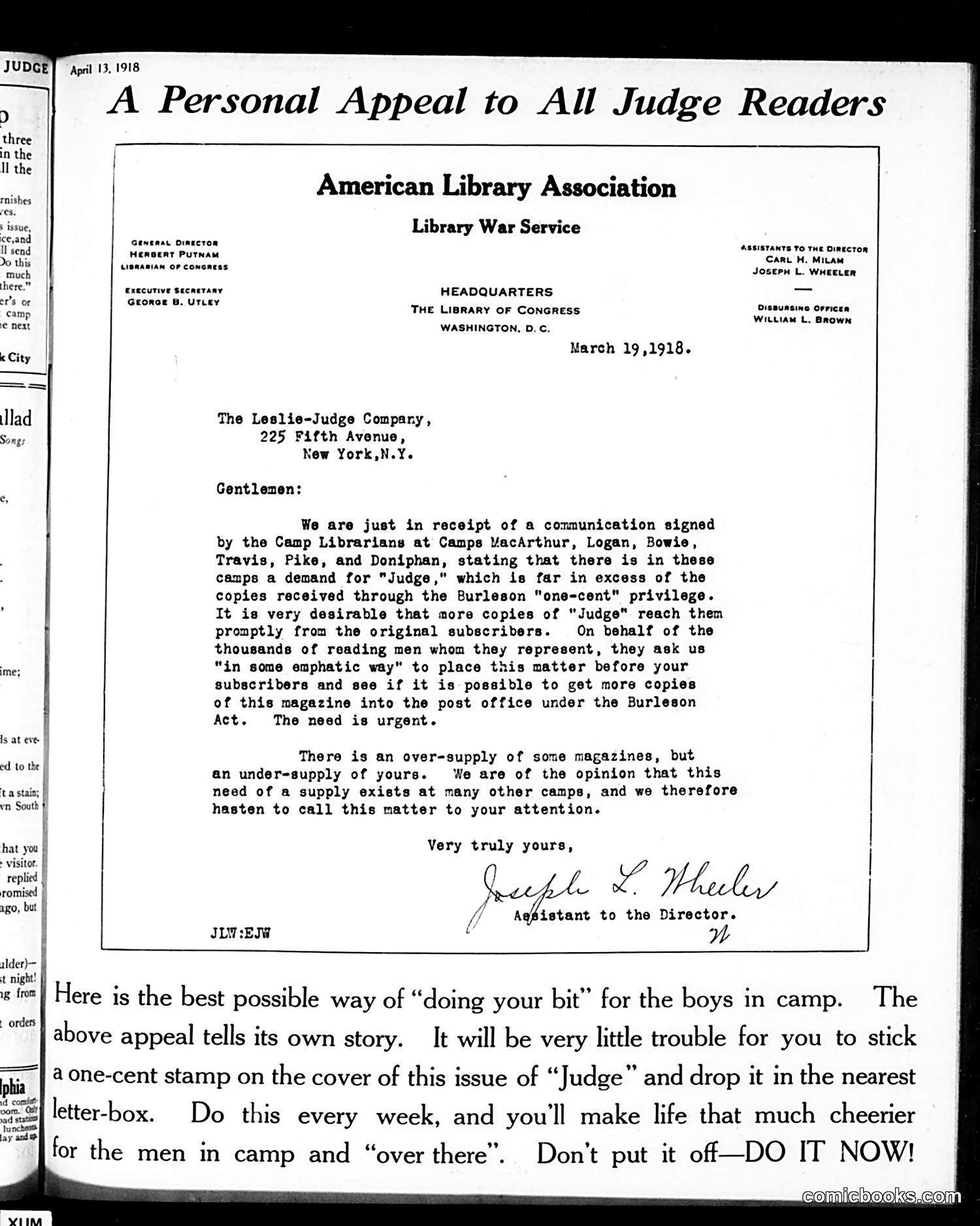
This is not a cartoon but a **wartime public service announcement** from April 1918 (World War I era). The American Library Association's "Library War Service" appeals to *Judge* magazine readers to help circulate the magazine to soldiers in military camps. **The context:** Under the Postmaster General's "Burleson Act," magazines could be mailed at reduced postal rates (one cent). Camp librarians report *Judge* is in high demand at training camps but undersupplied. The ALA asks subscribers to affix one-cent stamps to spare copies and mail them to soldiers weekly. **The appeal's logic:** Reading material boosts morale for troops "in camp and over there" (overseas in WWI). The accompanying text frames this as an easy patriotic gesture—"doing your bit" for soldiers. **Key figure:** Herbert Putnam, Librarian of Congress, lends his authority to the request. This reflects how magazines served as morale-boosting tools during wartime, and how civilian participation was framed as direct support for troops.
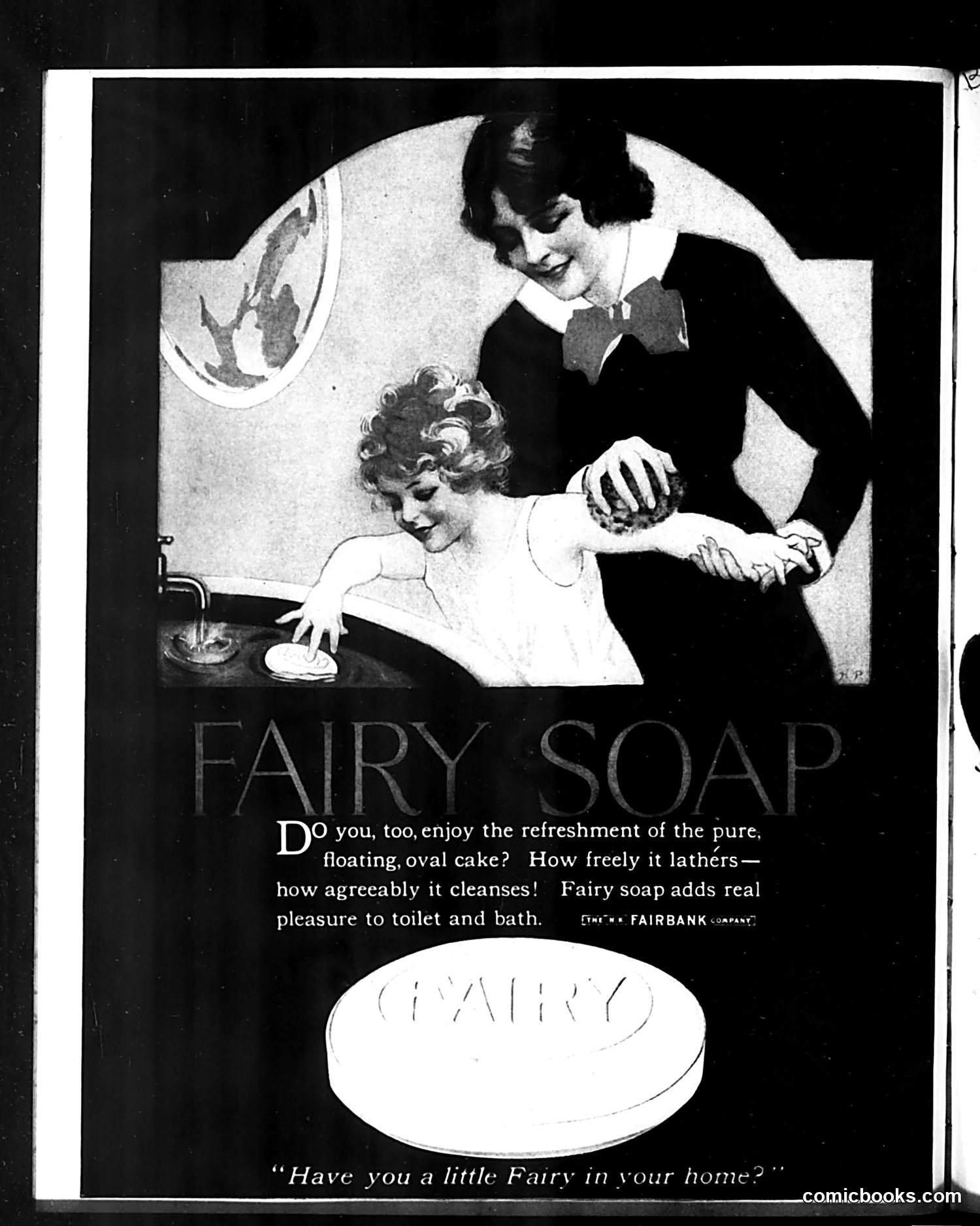
This is a **Fairy Soap advertisement**, not a political cartoon. It depicts a woman bathing a child, showcasing the product's qualities: a pure, floating oval cake that lathers freely and cleanses agreeably. The ad uses the product's name ("Fairy") playfully in its tagline—"Have you a little Fairy in your home?"—suggesting the soap makes bathing pleasant for children. The manufacturer is listed as the **Fairbank Company**. This represents early 20th-century advertising strategy: associating a mundane household product with cleanliness, purity, and domestic comfort. The elegant presentation and refined language ("adds real pleasure") were typical of period advertising that positioned soap as a luxury item enhancing family life.