
Judge, 1918-04-13 · page 24 of 36
Judge — April 13, 1918 — page 24: what you’re looking at
What you’re looking at
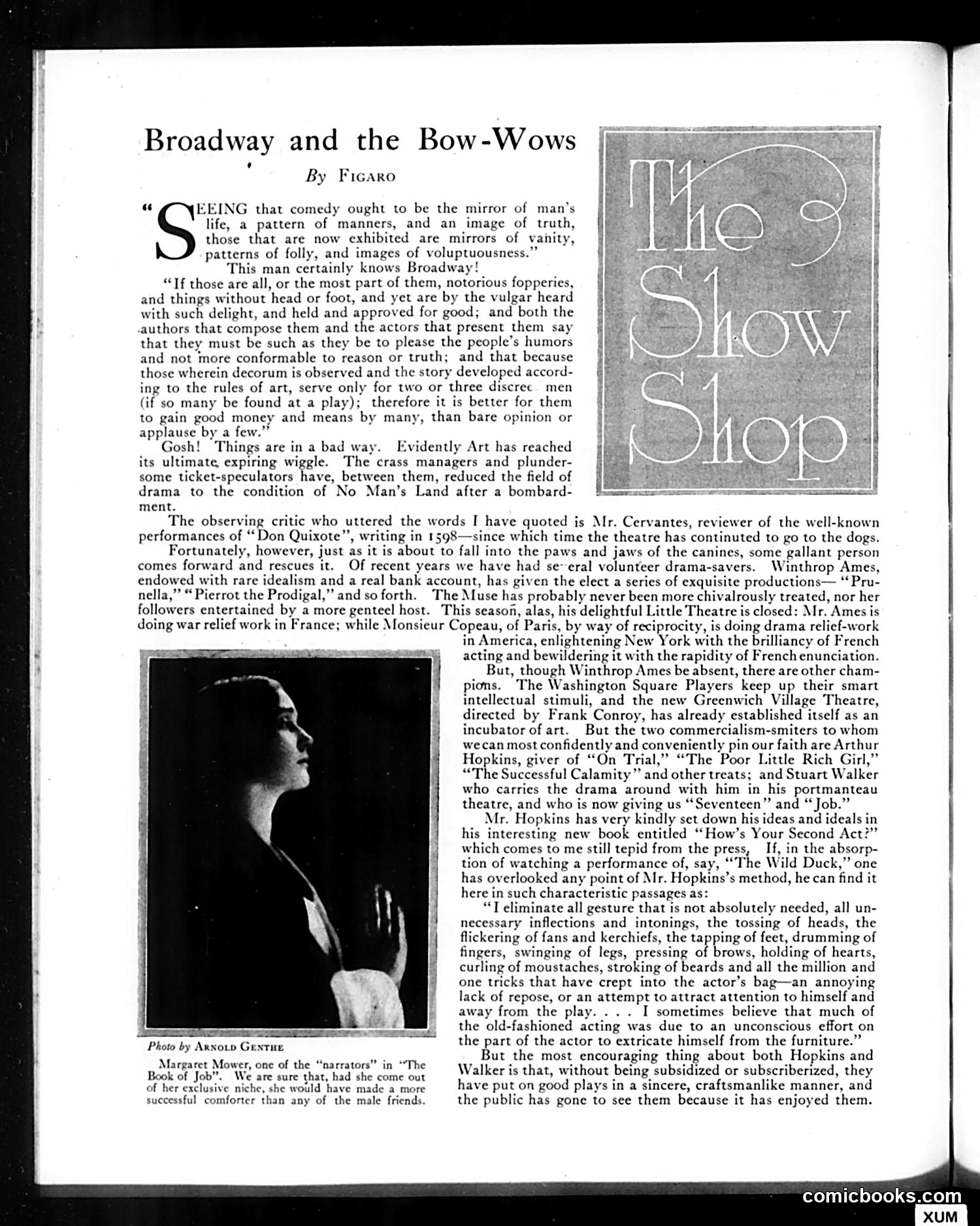
This article by Figaro critiques Broadway theatre for prioritizing commercial appeal over artistic merit. The author opens with a 1598 Cervantes quote lamenting that plays are "mirrors of vanity" rather than truth—establishing that theatre's decline is centuries old. The piece celebrates recent "drama-savers": Winthrop Ames (whose Little Theatre championed serious drama), Monsieur Copeau (a French director doing reciprocal work in America), and especially Arthur Hopkins and Stuart Walker. These producers are praised for resisting "commercialism" by staging quality plays with minimal, naturalistic acting—eliminating unnecessary gestures and affectations. The accompanying photograph shows Margaret Mower, described as a "narrator" in *The Book of Job*, exemplifying the refined, understated performance style being championed. The satire targets Broadway's "crass managers" and "ticket-speculators" who reduce drama to commercial formulas for mass audiences rather than art. The "Bow-Wows" reference suggests theatre has become degraded entertainment.
📄 Transcribed text from this page (OCR, searchable)
Machine-transcribed from the original scan — historical spelling and the odd misread are preserved.
Broadway and the Bow-Wows ‘ By Ficaro EEING that comedy ought to be the mirror of man’s life, a pattern of manners, and an image of truth, those that are now exhibited are mirrors of vanity, patterns of folly, and images of voluptuousness.”” This man certainly knows Broadway! “Tf those are all, or the most part of them, notorious fopperies, and things without head or foot, and yet are by the vulgar heard with such delight, and held and approved for good; and both the authors that compose them and the actors that present them say that they must be such as they be to please the people’s humors and not more conformable to reason or truth; and that because those wherein decorum is observed and the story developed accord- ing to the rules of art, serve only for two or three discrec men (if so many be found at a play); therefore it is better for them = <i to gain good money and means by many, than bare opinion or r applause by a few.’ Gosh! Things are in a bad way. Evidently Art has reached its ultimate expiring wiggle. The crass managers and plunder- some ticket-speculators have, between them, reduced the field of drama to the condition of No Man’s Land after a bombard- ment. The observing critic who uttered the words I have quoted is Mr. Cervantes, reviewer of the well-known performances of “Don Quixote”, writing in 1598—since which time the theatre has continuted to go to the dogs. Fortunately, however, just as it is about to fall into the paws and jaws of the canines, some gallant person comes forward and rescues it. Of recent years we have had se~eral volunteer drama-savers. Winthrop Ames, endowed with rare idealism and a real bank account, has given the elect a series of exquisite productions— ‘ Pru- nella,” “ Pierrot the Prodigal,” and so forth. The Muse has probably never been more chivalrously treated, nor her followers entertained by a more genteel host. This season, alas, his delightful Little Theatre is closed: Mr. Ames is doing war relief work in France; while Monsieur Copeau, of Paris, by way of reciprocity, is doing drama relief-work in America, enlightening New York with the brilliancy of French acting and bewildering it with the rapidity of French enunciation. But, though Winthrop Ames be absent, there are other cham- pions. The Washington Square Players keep up their smart intellectual stimuli, and the new Greenwich Village Theatre, directed by Frank Conroy, has already established itself as an incubator of art. But the two commercialism-smiters to whom wecan most confidently and conveniently pin our faith are Arthur Hopkins, giver of “On Trial,” “The Poor Little Rich Girl,” “The Successful Calamity” and other treats; and Stuart Walker who carries the drama around with him in his portmanteau theatre, and who is now giving us “Seventeen” and “Job.” Mr. Hopkins has very kindly set down his ideas and ideals in his interesting new book entitled “How’s Your Second Act?” which comes to me still tepid from the press, If, in the absorp- tion of watching a performance of, say, ““The Wild Duck,” one has overlooked any point of Mr. Hopkins’s method, he can find it here in such characteristic passages as: “T eliminate all gesture that is not absolutely needed, all un- necessary inflections and intonings, the tossing of heads, the flickering of fans and kerchiefs, the tapping of feet, drumming of fingers, swinging of legs, pressing of brows, holding of hearts, curling of moustaches, stroking of beards and all the million and one tricks that have crept into the actor’s bag—an annoying lack of repose, or an attempt to attract attention to himself and away from the play. . . . I sometimes believe that much of the old-fashioned acting was due to an unconscious effort on the part of the actor to extricate himself from the furniture.” But the most encouraging thing about both Hopkins and Book of Job”. We are sure that, had she come out Walker is that, without being subsidized or subscriberized, they of her exclusive niche, she would have made a more have put on good plays in a sincere, craftsmanlike manner, and successful comforter than any of the male friends. the public has gone to see them because it has enjoyed them. oF ST ee Photo by Anxoun Gextue Margaret Mower, one of the “narrators” in “The comicbooks.com