
Judge, 1918-04-13 · page 17 of 36
Judge — April 13, 1918 — page 17: what you’re looking at
What you’re looking at
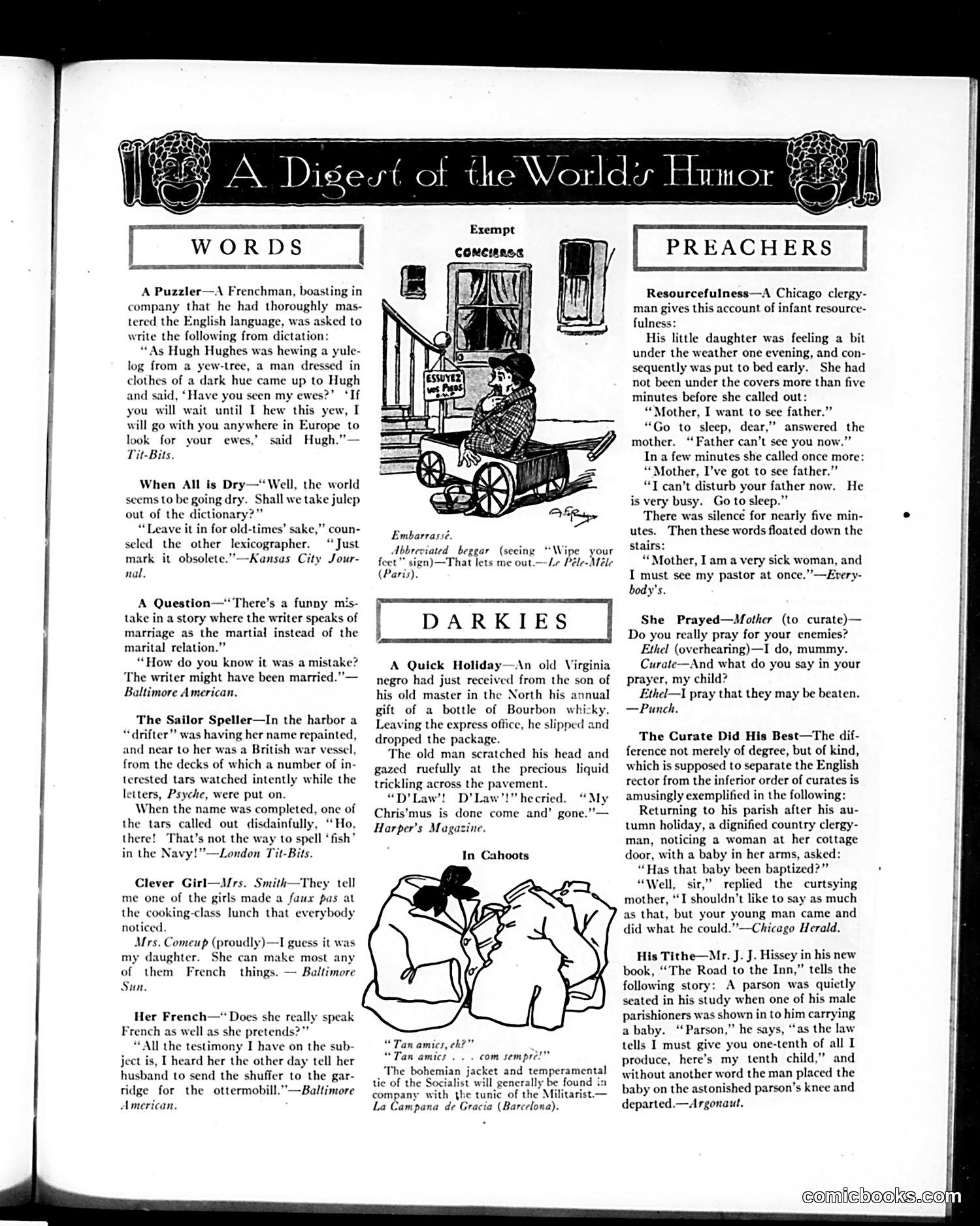
This page from *Judge* presents humor through wordplay, cultural stereotypes, and social commentary typical of early 20th-century American satire. **The cartoons and jokes target:** 1. **Language barriers**: French speakers struggling with English's homophone-heavy dictation ("ewes/yews/Hughes"); a woman mangling French pronunciation ("shuffer" for chauffeur, "ottermobill" for automobile). 2. **Prohibition-era humor**: A joke about removing "julep" from dictionaries as America goes "dry." 3. **Racial stereotyping**: The "Darkies" section uses derogatory language and dialect to mock Black Americans—standard for this era's "humor." 4. **Class commentary**: Priests and clergymen are portrayed as either out-of-touch or hypocritical. 5. **Social pretension**: People adopting French affectations or military-socialist political posturing are mocked. The cartoon of two cahoots figures illustrates how bohemian socialists and militarists are strange bedfellows despite opposing ideologies—likely Cold War-era political commentary. The page reflects *Judge*'s establishment perspective satirizing immigrants, linguistic pretension, and progressive politics.
📄 Transcribed text from this page (OCR, searchable)
Machine-transcribed from the original scan — historical spelling and the odd misread are preserved.
A Puzzler—A Frenchman, boasting in company that he had thoroughly mas- tered the English language, was asked to write the following from dictation: “As Hugh Hughes was hewing a yule- log from a yew-tree, a man dressed in clothes of a dark hue came up to Hugh and said, ‘Have you seen my ewes?’ ‘If you will wait until I hew this yew, I will go with you anywhere in Europe to look for your ewes,’ said Hugh.” — Tit-Bits. When All is Dry—‘Well, the world scems to be going dry. Shall we take julep out of the dictionary?” “Leave it in for old-times’ sake,” coun- seled the other lexicographer. “Just mark it obsolete.”—Kansas City Jour- nal. A Question—‘There’s a funny mis- take in a story where the writer speaks of marriage as the martial instead of the marital relation.” “How do you know it was a mist The writer might have been married. Baltimore American. The Sailor Speller—In the harbor a “drifter” was having her name repainted, and near to her was a British war from the decks of which a number of in- terested tars watched intently while the letters, Psyche, were put on. When the name was completed, one of the tars called out disdainfully, “Ho, there! That’s not the way to spell ‘fish’ in the Navy!"—London Tit-Bits. Clever Girl—Mrs. Smith—They tell me one of the girls made a faux pas at the cooking-class lunch that everybody noticed. Mrs. Comeup (proudly)—I guess it was my daughter. She can make most any of them French things. — Baltimore Sun. Her French—* Does she really speak French as well as she pretends?” “All the testimony I have on the sub- ject is, | heard her the other day tell her husband to send the shuffer to the gar- ridge for the ottermobill.”"—Baltimore American. Exempt COmcienes Embarrass. Abbreviated beggar (seeing “Wipe your feet” sign)—That lets me out.—Le Péle-Méle (Paris). j DARKIES A Quick Holiday—An old Virginia negro had just received from the son of his old master in the North his annual gift of a bottle of Bourbon whicky. Leaving the express office, he slipped and dropped the package. The old man scratched his head and gazed ruefully at the precious liquid trickling across the pavement. “D’Law’! D’Law’!"hecried. “My Chris’mus is done come and’ gone.”— Harper's Magazine. In Cahoots Ca “Tan amics, eh?” “Tan amics . . . com sempre!” The bohemian jacket and temperamental tie of the Socialist will generally be found in company with the tunic of the Militarist— La Campana de Gracia (Barcelona). S Hn Mor PREACHERS Resourcefulness—A Chicago clergy- man gives this account of infant resource- fuln His little daughter was feeling a bit under the weather one evening, and con- sequently was put to bed early. She had not been under the covers more than five minutes before she called out: “Mother, I want to see father.” “Go to sleep, dear,” answered the mother. “Father can’t see you now.” In a few minutes she called once more: “Mother, I’ve got to see father.” “T can’t disturb your father now. He is very busy. Go to sleep.” There was silence for nearly five min- utes. Then these words floated down the stairs: “Mother, I am a very sick woman, and I must see my pastor at once.” —Every- body's. She Prayed—Mother (to curate)— Do you really pray for your enemies? Ethel (overhearing)—I do, mummy. Curate—And what do you say in your prayer, my child? Ethel—I pray that they may be beaten. —Punch. The Curate Did His Best—The dif- ference not merely of degree, but of kind, which is supposed to separate the English rector from the inferior order of curates is amusingly exemplified in the following: Returning to his parish after his au- tumn holiday, a dignified country clergy- man, noticing a woman at her cottage door, with a baby in her arms, asked: “Has that baby been baptized?” “Well, sir,” replied the curtsying mother, “I shouldn’t like to say as much as that, but your young man came and did what he could.”—Chicago Herald. His Tithe—Mr. J. J. Hissey in his new book, “The Road to the Inn,” tells the following story: A parson was quietly seated in his study when one of his male parishioners was shown in to him carrying ababy. “Parson,” he says, “as the law tells I must give you one-tenth of all I produce, here’s my tenth child,” and without another word the man placed the baby on the astonished parson’s knee and departed.—Argonaut. comichooks.co mn