
Judge, 1918-04-13 · page 18 of 36
Judge — April 13, 1918 — page 18: what you’re looking at
What you’re looking at
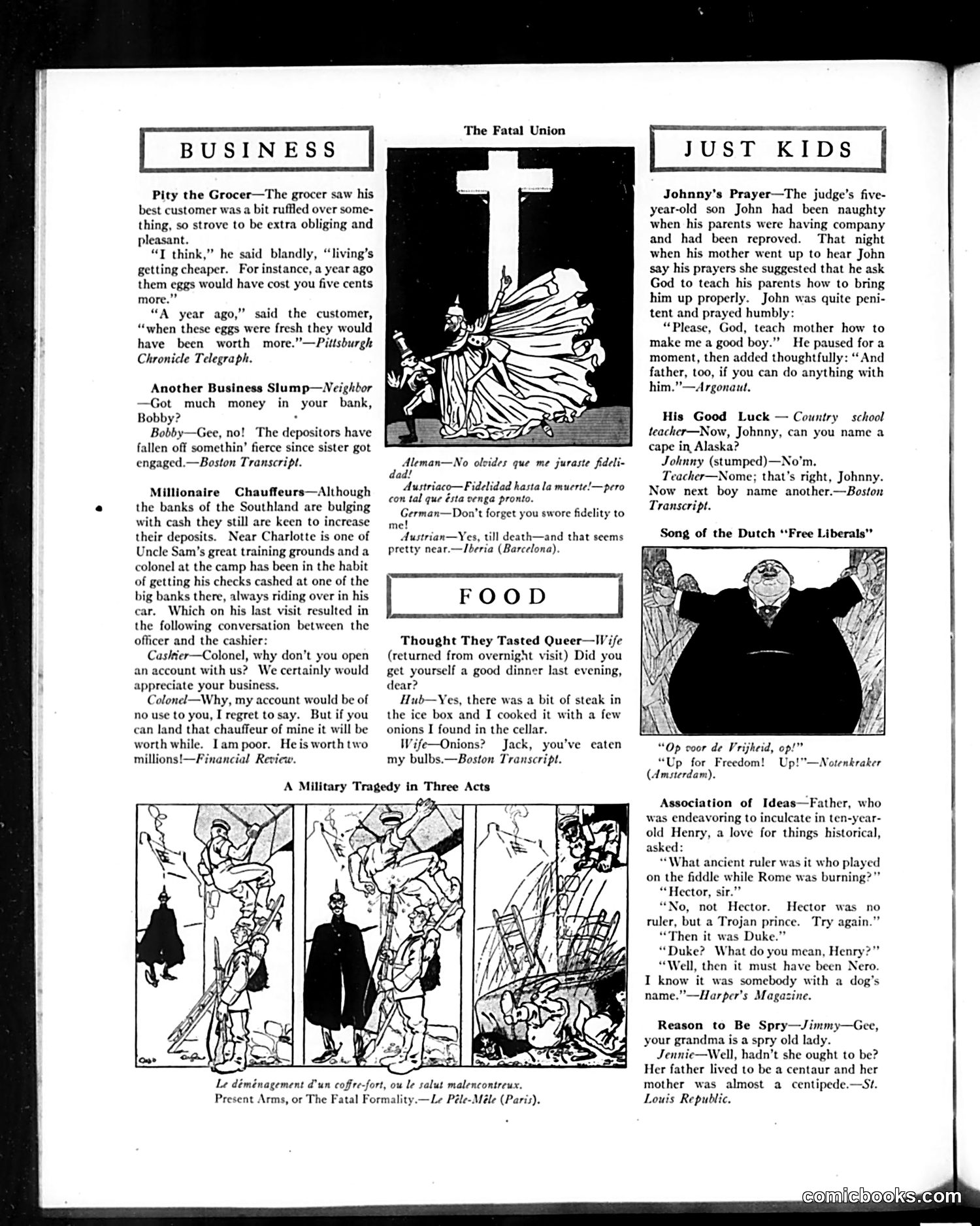
This page from Judge magazine contains several short humorous pieces satirizing American life: **"Pity the Grocer"** mocks customer complaints about inflation—a grocer tries flattering a disgruntled customer by claiming eggs are cheaper, but the customer counters that eggs were fresher a year ago, implying they've actually gotten worse value. **"Another Business Slump"** jokes that a bank's deposits have fallen because a young man's sister got engaged, suggesting men were withdrawing money for wedding expenses. **"Millionaire Chauffeurs"** satirizes wealthy Southern bankers' priorities: a colonel tells a banker his own account is worthless, but his chauffeur is worth millions—mocking how wealth concentrates among servants who manage their employers' spending. **"A Military Tragedy in Three Acts"** shows a German-Austrian military alliance where both swear eternal fidelity, but the Austrian hopes death comes quickly—dark satire on WW1-era unstable alliances. The remaining items are light domestic humor about cooking, children's malapropisms, and family jokes.
📄 Transcribed text from this page (OCR, searchable)
Machine-transcribed from the original scan — historical spelling and the odd misread are preserved.
Pity the Grocer—The grocer saw his best customer was a bit ruffled over some- thing, so strove to be extra obliging and pleasant. “T think,” he said blandly, “living’s getting cheaper. For instance, a year ago them eggs would have cost you five cents more.” “A year ago,” said the customer, “when these eggs were fresh they would have been worth more.”—Pittsburgh Chronicle Telegraph. Another Business Slump—Neighbor —Got much money in your bank, Bobby? : Bobby—Gee, no! The depositors have fallen off somethin’ fierce since sister got engaged.—Boston Transcript. Millionaire Chauffeurs—Although the banks of the Southland are bulging with cash they still are keen to increase their deposits. Near Charlotte is one of Uncle Sam’s great training grounds and a colonel at the camp has been in the habit of getting his checks cashed at one of the big banks there, always riding over in his car. Which on his the following conversation between the officer and the cashier: Cas/tier—Colonel, why don’t you open an account with us? We certainly would appreciate your business. Colonel—Why, my account would be of no use to you, I regret to say. But if you can land that chauffeur of mine it will be worth while. Lam poor. He is worth two millions!—Financial Review. A Military Tragedy in Three Acts The Fatal Union Aleman—No olvides que me juraste fideli- dad! Austriaco—Fidelidad hasta la muerte!—pero con tal que ésta venga pronto. German—Don't forget you swore fidelity to me! Austrian—Yes, till death—and that seems pretty near.—J/beria (Barcelona). | OOD | Thought They Tasted Queer—IVife (returned from overnight visit) Did you get yourself a good dinner last evening, dear? Hub—Yes, there was a bit of steak in the ice box and I cooked it with a few onions I found in the cellar. Wife—Onions? Jack, you've eaten my bulbs.—Boston Transcript. Le déméinagement d'un coffre-fort, ou le salut malencontrewx. Present Arms, or The Fatal Formality.—Le Péle-Méle (Paris). your grandma is a spry old lady. JUST KIDS Johnny’s Prayer—The judge’s five- year-old son John had been naughty when his parents were having company and had been reproved. That night when his mother went up to hear John say his prayers she suggested that he ask God to teach his parents how to bring him up properly. John was quite peni- tent and prayed humbly: “Please, God, teach mother how to make me a good boy.”” He paused for a moment, then added thoughtfully: “And father, too, if you can do anything with him.”"—Argonaut. His Good Luck — Country school teacherp—Now, Johnny, can you name a cape in Alaska? Johnny (stumped)—No’m. Teacher—Nome; that’s right, Johnny. Now next boy name another.—Boston Transcript. Song of the Dutch ‘*Free Liberals” “Op coor de Vrijheid, op!” “Up for Freedom! Up!"—Notenkraker (Amsterdam). Association of Ideas—Father, who was endeavoring to inculcate in ten-year- old Henry, a love for things historical, askes “What ancient ruler was it who playe« on the fiddle while Rome was burning?” “Hector, sir.” “No, not Hector. but a Trojan pri en it was Duke.” “Duke? What do you mean, Henry?” “Well, then it must have been Nero. I know it was somebody with a dog’s name.”—Harper’s Magazine. Hector was no ru e. Try again.” Reason to Be Spry—Jimmy—Gee, Jennie—Well, hadn’t she ought to be? Her father lived to be a centaur and her mother was almost a centipede.—St. Louis Republic.