
Judge, 1918-04-13 · page 5 of 36
Judge — April 13, 1918 — page 5: what you’re looking at
What you’re looking at
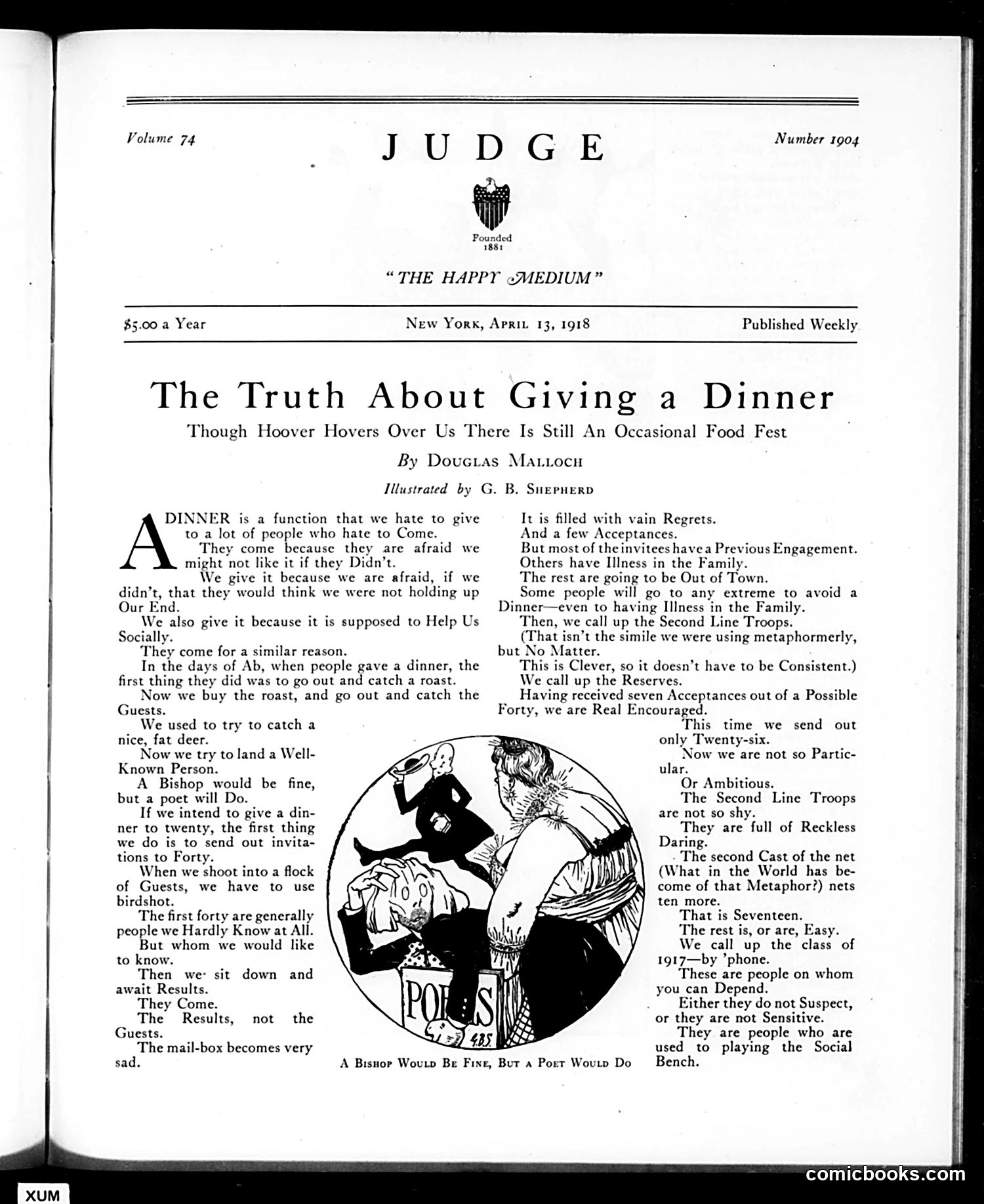
This satirical article by Douglas Malloch mocks the social obligation of hosting dinner parties. The accompanying cartoon depicts a chaotic dinner scene where guests appear disheveled and uncomfortable, illustrating the author's central point: that dinner parties are tedious social duties rather than genuine enjoyments. The text humorously catalogs why people actually attend dinners—obligation, fear of social judgment, illness excuses—rather than genuine enthusiasm. References to "Second Line Troops" and calling up "Reserves" suggest difficulty securing willing guests, using World War I military terminology for comic effect (published April 1918, during active U.S. involvement). The satire critiques upper-class social conventions that compel uncomfortable gatherings, presenting dinner hosting as an exhausting performance of civility rather than authentic hospitality.
📄 Transcribed text from this page (OCR, searchable)
Machine-transcribed from the original scan — historical spelling and the odd misread are preserved.
XUM Volume 74 J UDGE Number 1904 Pounded 1881 “THE HAPPY eMEDIUM” $5.00 a Year New York, Aprit 13, 1918 Published Weekly The Truth About Giving a Dinner Though Hoover Hovers Over Us There Is Still An Occasional Food Fest By Doucias MA..ocu Illustrated by G. B. Sueruerp DINNER is a function that we hate to give to a lot of people who hate to Come. They come because they are afraid we might not like it if they Didn’t. We give it because we are afraid, if we didn’t, that they would think we were not holding up Our End. We also give it because it is supposed to Help Us Socially. They come for a similar reason. In the days of Ab, when people gave a dinner, the first thing they did was to go out and catch a roast. Now we buy the roast, and go out and catch the Guests. We used to try to catch a nice, fat deer. Now we try to land a Well- Known Person. A Bishop would be fine, but a poet will Do. If we intend to give a din- ner to twenty, the first thing we do is to send out invita- tions to Forty. When we shoot into a flock of Guests, we have to use birdshot. The first forty are generally people we Hardly Know at All. But whom we would like to know. Then we: sit down and await Results. They Come. The Results, not the Guests. The mail-box becomes very sad. A Bisnor Woutp Be Fixe, But a Port Wovtp Do It is filled with vain Regrets. And a few Acceptances. But most of the invitees havea Previous Engagement. Others have Illness in the Family. The rest are going to be Out of Town. Some people will go to any extreme to avoid a Dinner—even to having Illness in the Family. Then, we call up the Second Line Troops. (That isn’t the simile we were using metaphormerly, but No Matter. This is Clever, so it doesn’t have to be Consistent.) We call up the Reserves. Having received seven Acceptances out of a Possible Forty, we are Real Encouraged. This time we send out only Twenty-six. Now we are not so Partic- ular. Or Ambitious. The Second Line Troops are not so shy. They are full of Reckless Daring. The second Cast of the net (What in the World has be- come of that Metaphor?) nets ten more. That is Seventeen. The rest is, or are, Easy. We call up the class of 1917—by ’phone. These are people on whom you can Depend. Either they do not Suspect, or they are not Sensitive. They are people who are used to playing the Social Bench. comicbooks.com