
Judge, 1918-04-13 · page 15 of 36
Judge — April 13, 1918 — page 15: what you’re looking at
What you’re looking at
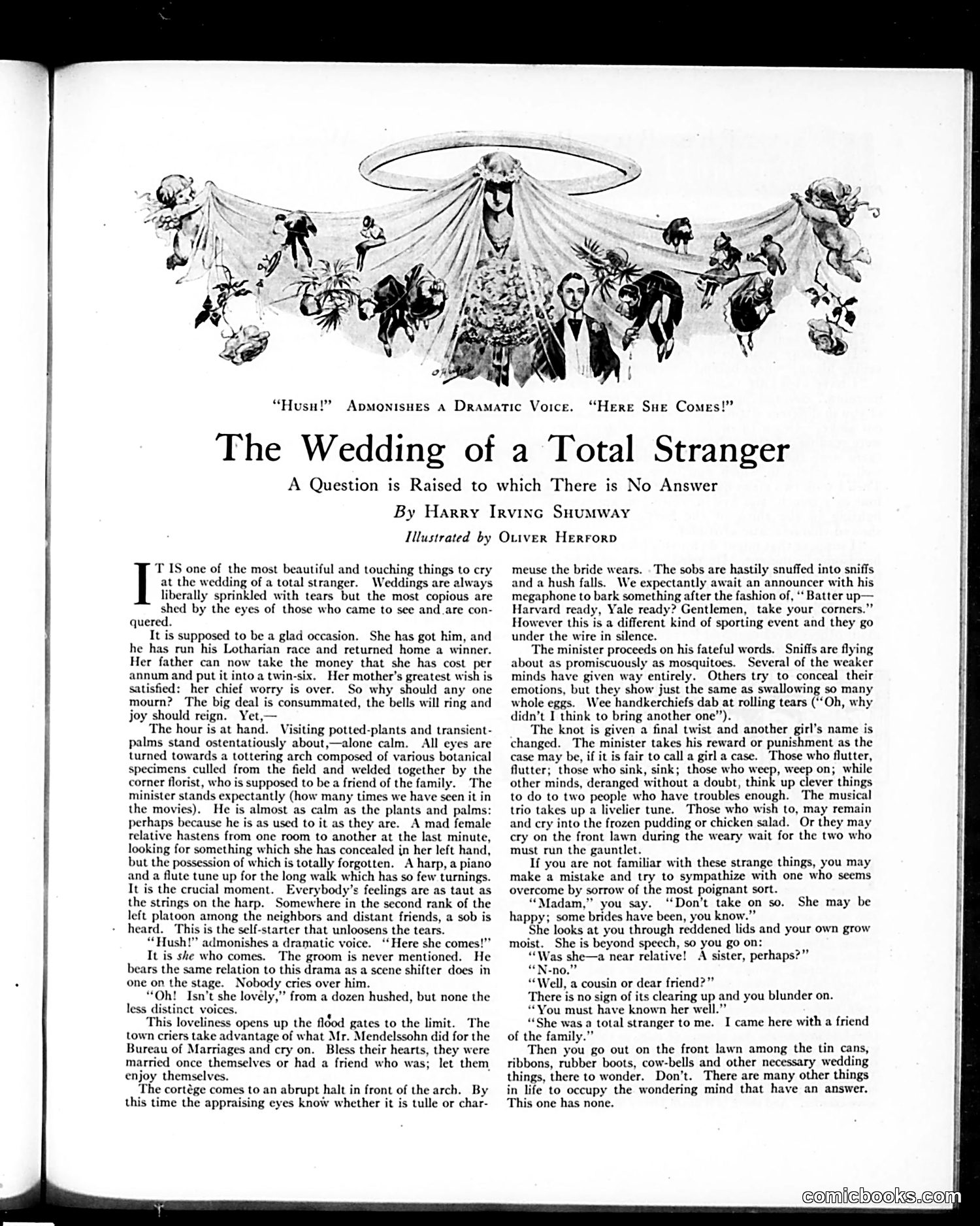
This is a satirical short story with illustration by Harry Irving Shumway, not a political cartoon. It mocks the emotional excess and absurdity of wedding ceremonies, particularly the tears shed by guests who barely know the couple. The satire targets how weddings function as social theater: the groom is irrelevant (described as a "scene shifter"), the bride's appearance matters more than the marriage itself, and strangers cry performatively. Shumway ridicules the artificial emotions, the hired decorations, the ceremonial machinery, and especially the hypocrisy—guests who "were married once themselves or had a friend who was" cry as if experiencing genuine joy rather than following social convention. The illustration shows cherubs presiding over the scene, emphasizing its theatrical unreality. The piece questions *why* we perform these emotions at weddings of people we scarcely know—a question the subtitle says "There is No Answer" to. It's gentle social satire on middle-class wedding customs rather than political commentary.
📄 Transcribed text from this page (OCR, searchable)
Machine-transcribed from the original scan — historical spelling and the odd misread are preserved.
| “Husu!” Apmonisues a Dramatic Voice. “Here Sue Comes!” The Wedding of a Total Stranger A Question is Raised to which There is No Answer By Harry Irvinc Suyumway Illustrated by Oviver Herrorp at the wedding of a total stranger. Weddings are always liberally sprinkled with tears but the most copious are shed by the eyes of those who came to see and.are con- quered. It is supposed to be a glad occasion. She has got him, and he has run his Lotharian race and returned home a winner. Her father can now take the money that she has cost per annum and put it into a twin-six. Her mother’s greatest wish is satisfied: her chief worry is over. So why should any one mourn? The big deal is consummated, the bells will ring and joy should reign. Yet,— The hour is at hand. Visiting potted-plants and transient- palms stand ostentatiously about,—alone calm. All eyes are turned towards a tottering arch composed of various botanical specimens culled from the field and welded together by the corner florist, who is supposed to be a friend of the family. The minister stands expectantly (how many times we have seen it in the movies). He is almost as calm as the plants and palms: perhaps because he is as used to it as they are. A mad female relative hastens from one room to another at the last minute, looking for something which she has concealed jn her left hand, but the possession of which is totally forgotten. A harp, a piano and a flute tune up for the long Walk which has so few turnings. It is the crucial moment. Everybody’s feelings are as taut as the strings on the harp. Somewhere in the second rank of the left platoon among the neighbors and distant friends, a sob is heard. This is the self-starter that unloosens the tears. “Hush!” admonishes a dramatic voice. ‘Here she comes!” It is she who comes. The groom is never mentioned. He bears the same relation to this drama as a scene shifter does in one on the stage. Nobody cries over him. ! Isn't she lovely,” from a dozen hushed, but none the tinct voices. * This loveliness opens up the flood gates to the limit. The town criers take advantage of what Mr. Mendelssohn did for the Bureau of Marriages and cry on. Bless their hearts, they were married once themselves or had a friend who was; let them enjoy themselves. The cortége comes to an abrupt halt in front of the arch. By this time the appraising eyes know whether it is tulle or char- I T IS one of the most beautiful and touching things to cry meuse the bride wears. . The sobs are hastily snuffed into sniffs and a hush falls. We expectantly await an announcer with his megaphone to bark something after the fashion of, ‘‘ Batter up— Harvard ready, Yale ready? Gentlemen, take your corners.”” However this is a different kind of sporting event and they go under the wire in silence. The minister proceeds on his fateful words. Sniffs are flying about as promiscuously as mosquitoes. Several of the weaker minds have given way entirely. Others try to conceal their emotions, but they show just the same as swallowing so many whole eggs. Wee handkerchiefs dab at rolling tears (Oh, why didn’t I think to bring another one”). The knot is given a final twist and another girl’s name is changed. The minister takes his reward or punishment as the case may be, if it is fair to call a girl a case. Those who flutter, flutter; those who sink, sink; those who weep, weep on; while other minds, deranged without a doubt, think up clever things to do to two people who have troubles enough. The musical trio takes up a livelier tune. Those who wish to, may remain and cry into the frozen pudding or chicken salad. Or they may cry on the front lawn during the weary wait for the two who must run the gauntlet. If you are not familiar with these strange things, you may make a mistake and try to sympathize with one who seems overcome by sorrow of the most poignant sort. “Madam,” you say. ‘Don’t take on so. She may be happy; some brides have been, you know.” She looks at you through reddened lids and your own grow moist. She is beyond speech, so you go on: P “Was she—a near relative! A sister, perhaps?” a cousin or dear friend?” There is no sign of its clearing up and you blunder on. “You must have known her well.” “She was a total stranger to me. I came here with a friend of the family.” ‘ Then you go out on the front lawn among the tin cans, ribbons, rubber boots, cow-bells and other necessary wedding things, there to wonder. Don’t. There are many other things in life to occupy the wondering mind that have an answer. This one has none. comichooks.