
Judge, 1918-04-13 · page 16 of 36
Judge — April 13, 1918 — page 16: what you’re looking at
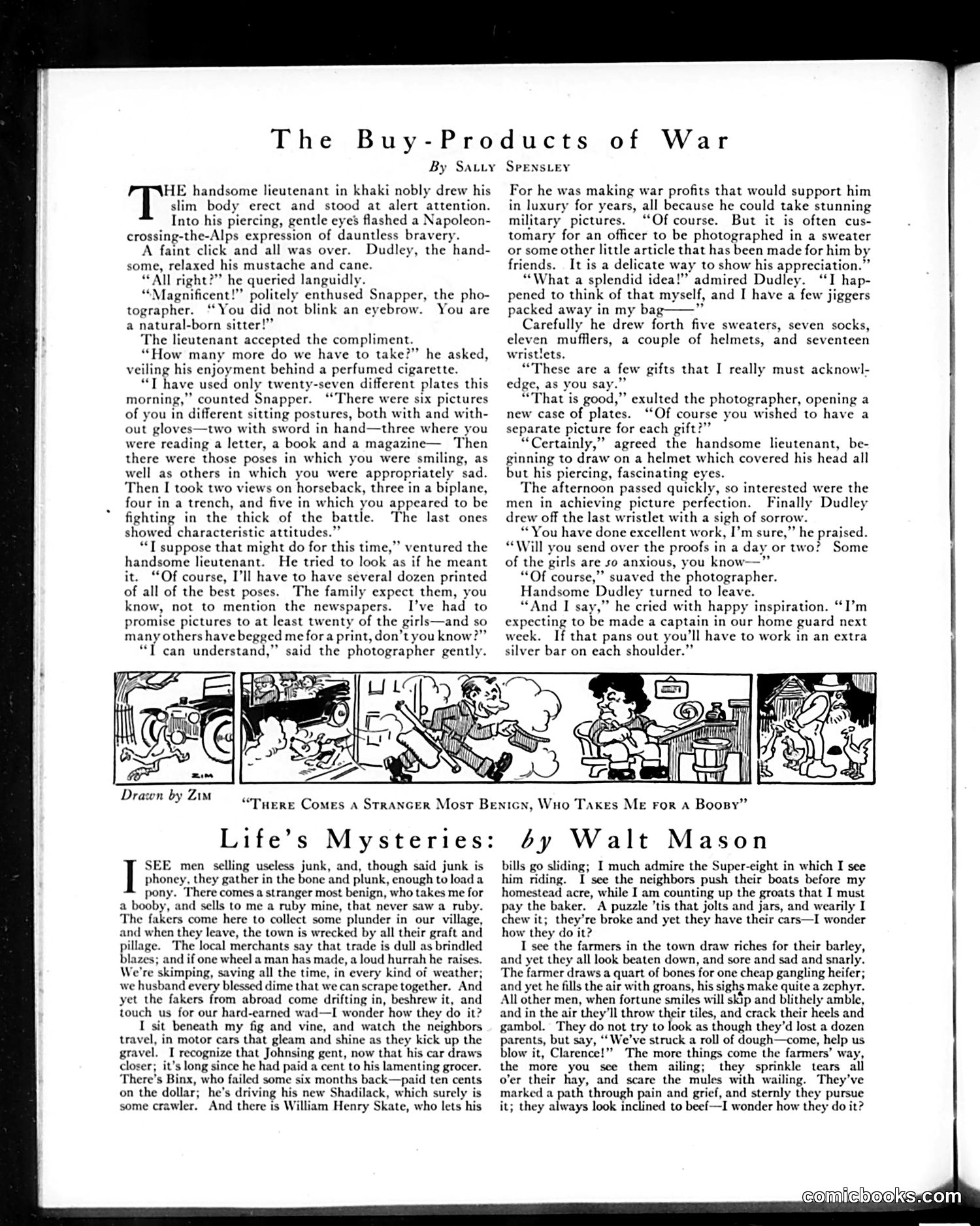
What you’re looking at
**"The Buy-Products of War"** satirizes military profiteering during wartime. A vain lieutenant named Dudley poses for photographer Snapper in an elaborate photo shoot—27 plates shot across multiple scenarios (on horseback, in trenches, fighting). The satire emerges when Dudley reveals his true motive: these photos aren't for military purposes but for personal profit and vanity. He plans mass-printing them for family, newspapers, and "twenty girls," while accepting gifts (sweaters, socks, helmets, wristlets) supposedly from friends—actually war materiel he's accumulated. The joke: officers exploit the patriotic fervor and wartime generosity of civilians, converting military service into personal commercial gain. The elaborate photography setup symbolizes how war creates market opportunities for those in uniform to profit from public admiration and gift-giving. It's satirical commentary on officers leveraging their status for personal enrichment rather than genuine service.
📄 Transcribed text from this page (OCR, searchable)
Machine-transcribed from the original scan — historical spelling and the odd misread are preserved.
The Buy-Products of War By Satiy HE handsome lieutenant in khaki nobly drew his slim body erect and stood at alert attention. Into his piercing, gentle eyes flashed a Napoleon- crossing-the-Alps expression of dauntless bravery. A faint click and all was over. Dudley, the hand- some, relaxed his mustache and cane. “All right?” he queried languidly. “Magnificent!” politely enthused Snapper, the pho- tographer. ‘You did not blink an eyebrow. You are a natural-born sitter!” The lieutenant accepted the compliment. “How many more do we have to take?” he asked, veiling his enjoyment behind a perfumed cigarette. “T have used only twenty-seven different plates this morning,” counted Snapper. ‘There were six pictures of you in different sitting postures, both with and with- out gloves—two with sword in hand—three where you were reading a letter, a book and a magazine— Then there were those poses in which you were smiling, as well as others in which you were appropriately sad. Then I took two views on horseback, three in a biplane, four in a trench, and five in which you appeared to be fighting in the thick of the battle. The last ones showed characteristic attitudes.” “T suppose that might do for this time,” ventured the handsome lieutenant. He tried to look as if he meant it. “Of course, I’ll have to have several dozen printed of all of the best poses. The family expect them, you know, not to mention the newspapers. I’ve had to promise pictures to at least twenty of the girls—and so many others have begged me fora print, don’t you know?” “T can understand,” said the photographer gently. Drawn by Zim Life’s Mysteries: SEE men selling useless junk, and, though said junk is phoney, they gather in the bone and plunk, enough to load a There comes a stranger most benign, who takes me for and sells to me a ruby mine, that never saw a ruby. The fakers come here to collect some plunder in our village, and when they leave, the town is wrecked by all their graft and pillage. The local merchants say that trade is dull as brindled \d if one wheel a man has made, a loud hurrah he raises. We're skimping, saving all the time, in every kind of weather; we husband every blessed dime that we can scrape together. And yet the fakers from abroad come drifting in, beshrew it, and touch us for our hard-earned wad—I wonder how they do it? I sit beneath my fig and vine, and watch the neighbors travel, in motor cars that gleam and shine as they kick up the gravel. I recognize that Johnsing gent, now that his car draws closer; it’s long since he had paid a cent to his lamenting grocer. There's Binx, who failed some six months back—paid ten cents on the dollar; he’s driving his new Shadilack, which surely is some crawler. And there is William Henry Skate, who lets his Se. For he was making war profits that would support him in luxury for years, all because he could take stunning military pictures. “Ofcourse. But it is often cus- tomary for an officer to be photographed in a sweater or some other little article that has been made for him by friends. It is a delicate way to show his appreciation.” “What a splendid idea!” admired Dudley. “I hap- pened to think of that myself, and I have a few jiggers packed away in my bag——” Carefully he drew forth five sweaters, seven socks, eleven mufflers, a couple of helmets, and seventeen wristlets. “These are a few gifts that I really must acknowl- edge, as you say.” “That is good,” exulted the photographer, opening a new case of plates. “Of course you wished to have a separate picture for each gift?” “Certainly,” agreed the handsome lieutenant, be- ginning to draw on a helmet which covered his head all but his piercing, fascinating eyes. The afternoon passed quickly, so interested were the men in achieving picture perfection. Finally Dudley drew off the last wristlet with a sigh of sorrow. “You have done excellent work, I’m sure,” he praised. “Will you send over the proofs in a day or two? Some of the girls are so anxious, you know—” “Of course,” suaved the photographer. Handsome Dudley turned to leave. “And I say,” he cried with happy inspiration. “I’m expecting to be made a captain in our home guard next week. If that pans out you’ll have to work in an extra silver bar on each shoulder.” LEY “Tuere Comes a STRANGER Most Benicn, Wuo Takes Me For A Boosy” by Walt Mason bills go sliding; I much admire the Super-eight in which I see him riding. I see the neighbors push their boats before my homestead acre, while I am counting up the groats that I must pay the baker. A puzzle ’tis that jolts and jars, and wearily I chew it; they’re broke and yet they have their cars—I wonder how they do it? I see the farmers in the town draw riches for their barley, and yet they all look beaten down, and sore and sad and snarly. The farmer draws a quart of bones for one cheap gangling heifer; and yet he fills the air with groans, his sighs make quite a zephyr. All other men, when fortune smiles will skip and blithely amble, and in the air they'll throw their tiles, and crack their heels and gambol. They do not try to look as though they’d lost a dozen arents, but say, “We've struck a roll of dough—come, help us low it, Clarence!” The more things come the farmers’ way, the more you sce them ailing; they sprinkle tears all o'er their hay, and scare the mules with wailing. They've marked a path through pain and grief, and sternly they pursue it; they always look inclined to beef—I wonder how they do it?