
A complete issue · 28 pages · 1918
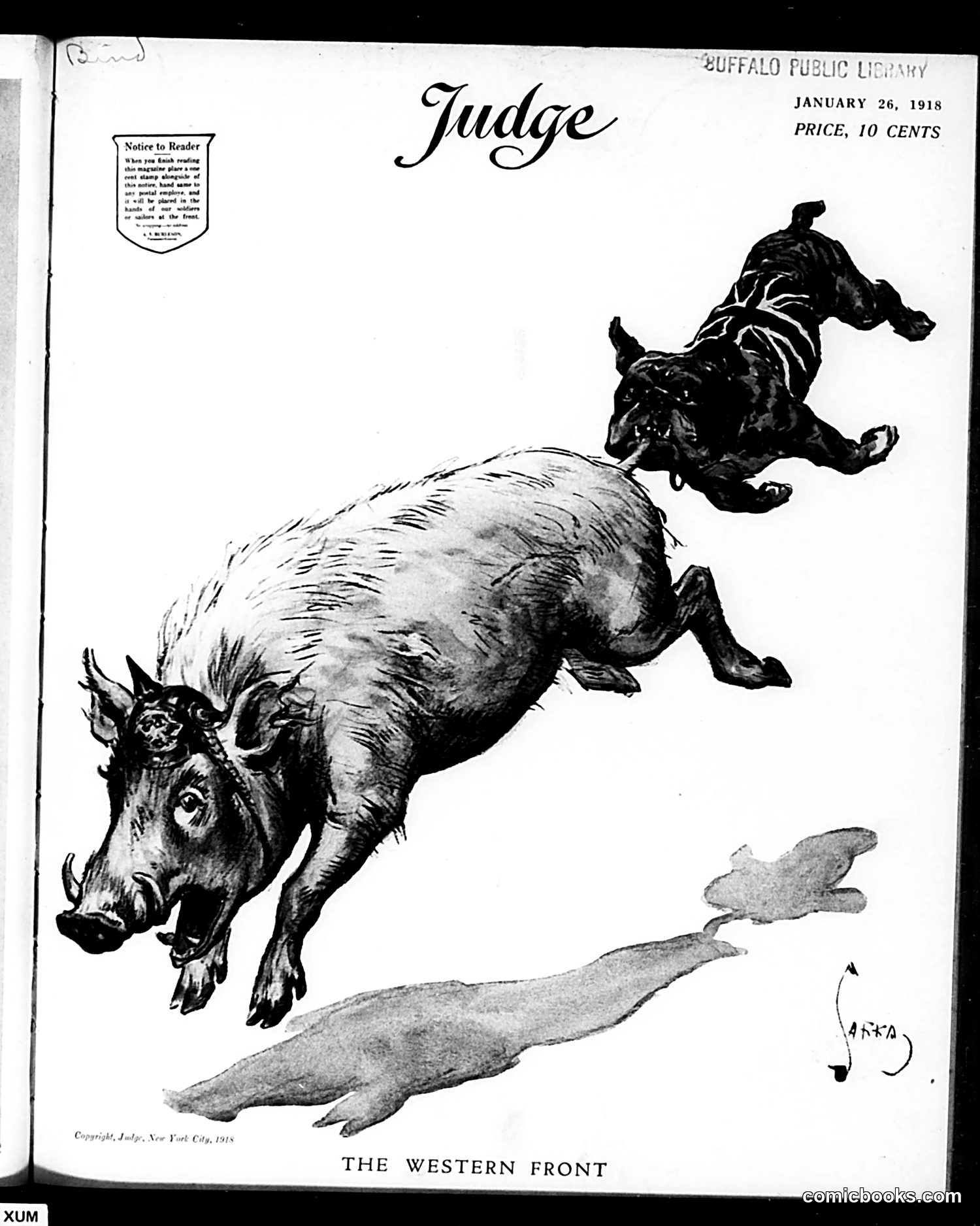
Judge — January 26, 1918
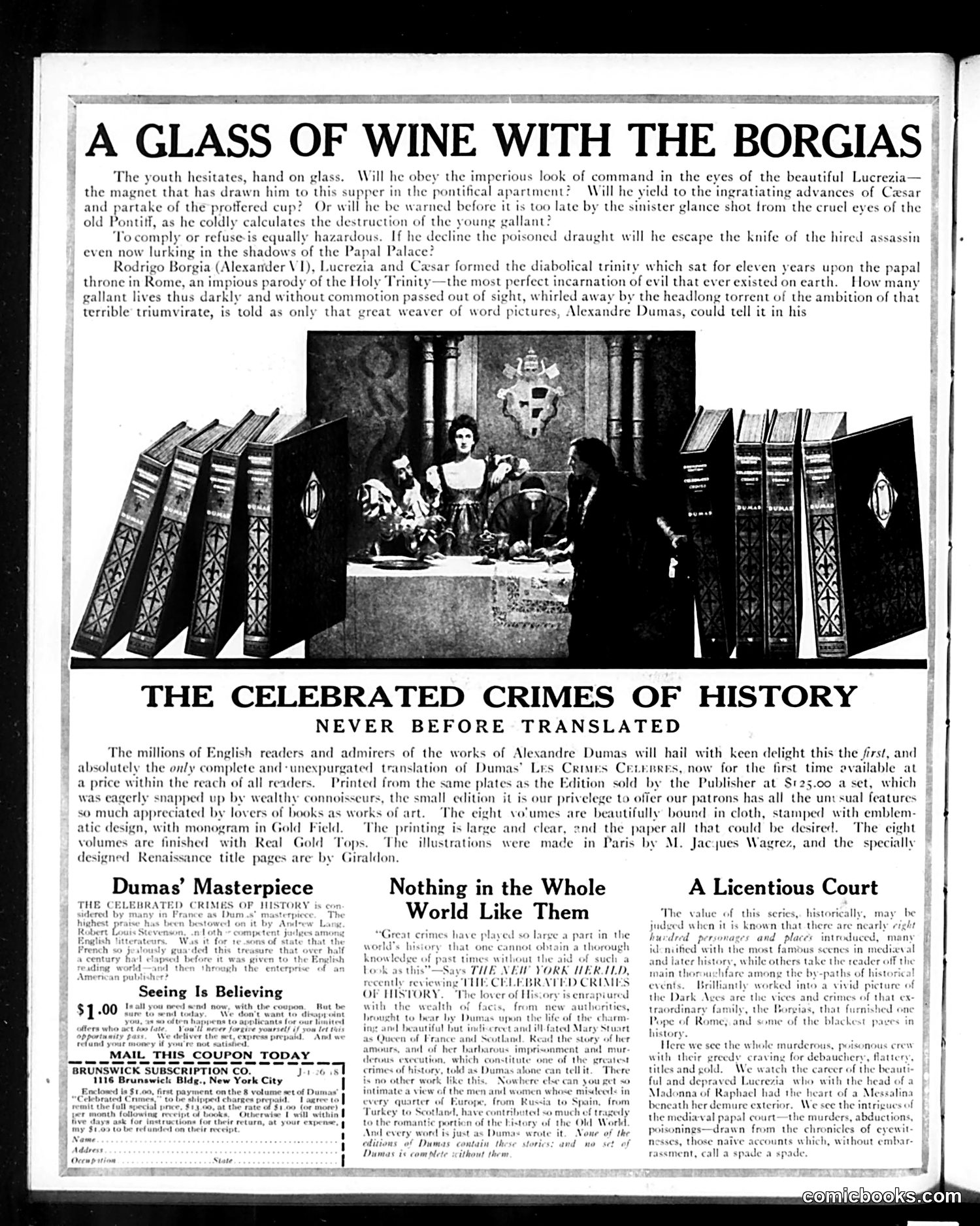
This page is primarily **advertising for a book series**, not political satire. It promotes "The Celebrated Crimes of History," a newly translated English edition of Alexandre Dumas' work about historical crimes and criminals. The central image shows a dramatic scene—likely depicting one of the crimes described—with figures in period dress around a table, flanked by volumes of the book set. The advertisements emphasize this is the "first" complete English translation, available at affordable prices ($15.50 for the eight-volume set). The promotional text highlights Dumas' storytelling ability and the series' coverage of crimes across European history. There is no clear political satire visible. This appears to be a commercial page capitalizing on Victorian-era interest in sensational historical narratives, presented as literary entertainment for mass audiences.
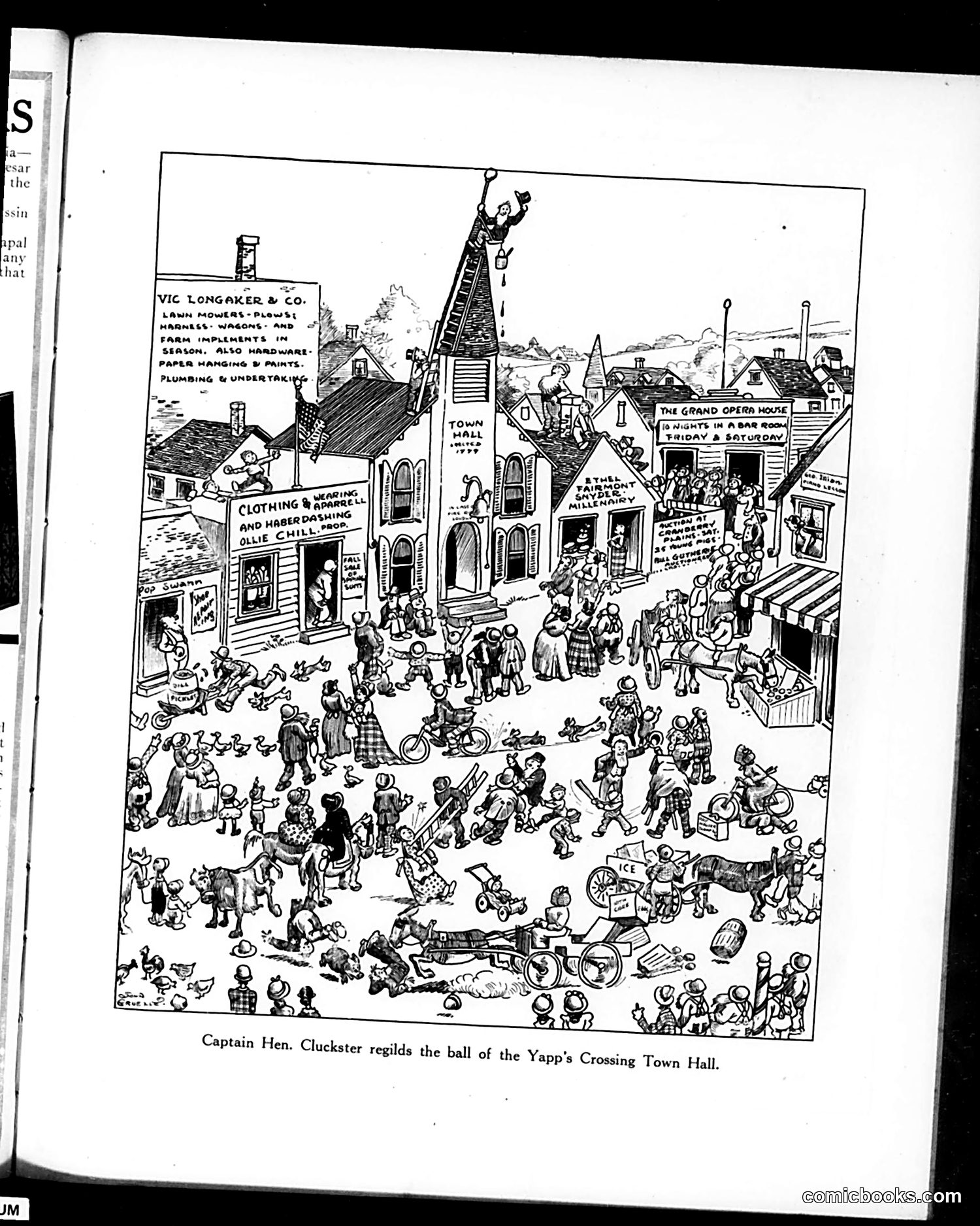
This page is primarily a **detailed illustration** rather than a political cartoon. The caption reads: "Captain Hen. Cluckster regidls the ball of the Yapp's Crossing Town Hall." The image depicts a bustling town square scene centered around a town hall building, with a prominent figure (Captain Hen. Cluckster) on a ladder or elevated platform overlooking a crowded gathering. The illustration is packed with small figures, activities, and labeled storefronts including "Vic Longaker & Co." (farm implements) and "Ollie Chilling" (clothing/mending services). This appears to be **satirical social commentary** on small-town American life, using animal character names (Cluckster) for humorous effect. The crowded, chaotic scene likely mocks provincial society and civic gatherings, though the specific historical context and whether this references a particular event remains unclear from the image alone.
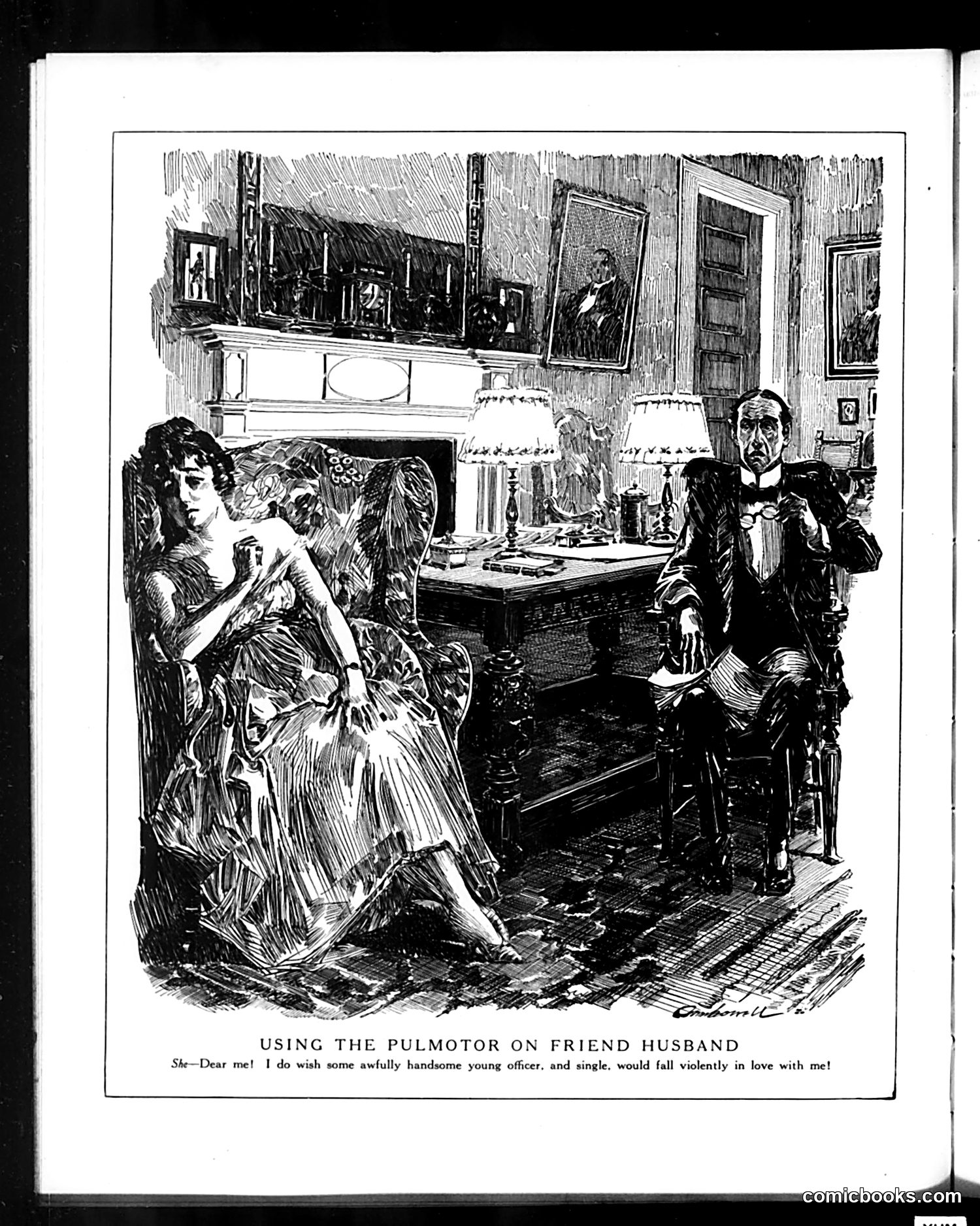
This cartoon satirizes a "pulmotor"—an early mechanical resuscitation device popular in the early 20th century. The caption reveals the joke: a woman tells her husband she wishes to use the pulmotor on "some awfully handsome young officer" to make him "fall violently in love" with her. The satire mocks both the pulmotor's exaggerated reputation for miraculous effects and the woman's infidelity. By suggesting the device could magically induce love, the cartoonist ridicules contemporary faith in new technology while commenting on marital discord and female desire. The illustration's domestic setting—an elegant study with the husband present—emphasizes the scandal of her stated intention. Judge's audience would recognize the pulmotor reference as topical humor about newfangled inventions.
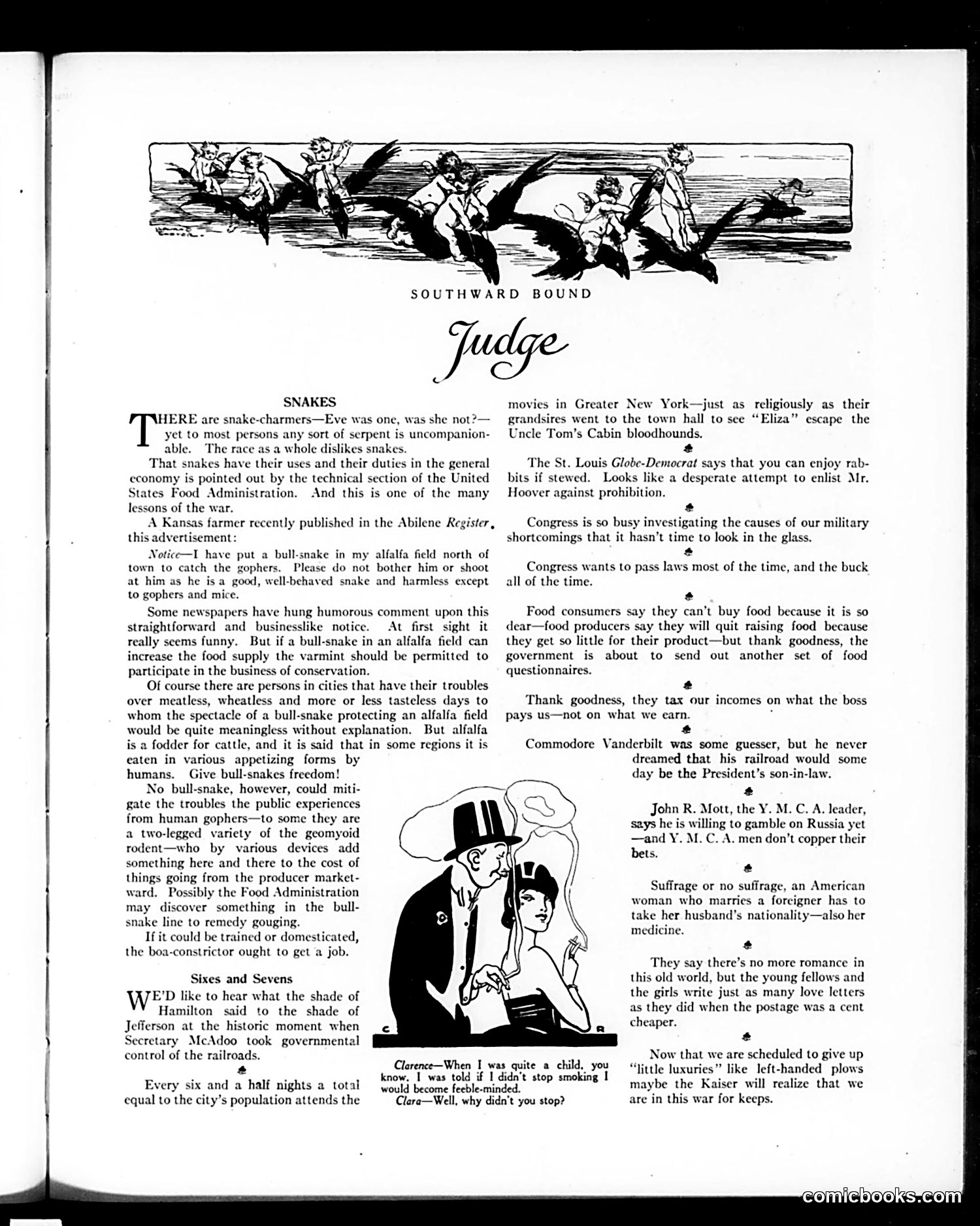
This page contains editorial commentary rather than traditional political cartoons. The main illustration depicts two figures—a man in a top hat and a woman—in what appears to be a romantic or intimate moment, labeled "Clarence" in the dialogue below. The satirical pieces mock various contemporary issues: bull-snakes in alfalfa fields (food supply concerns), Congress's inefficiency, food price disputes between producers and consumers, income taxation, and railroad monopolies under figures like Commodore Vanderbilt. The "Clarence" dialogue jokes about smoking habits and courtship. Overall, Judge targets government inefficiency, economic disputes, and changing social mores of the era—likely early 20th century based on references to taxation and railroad regulation.
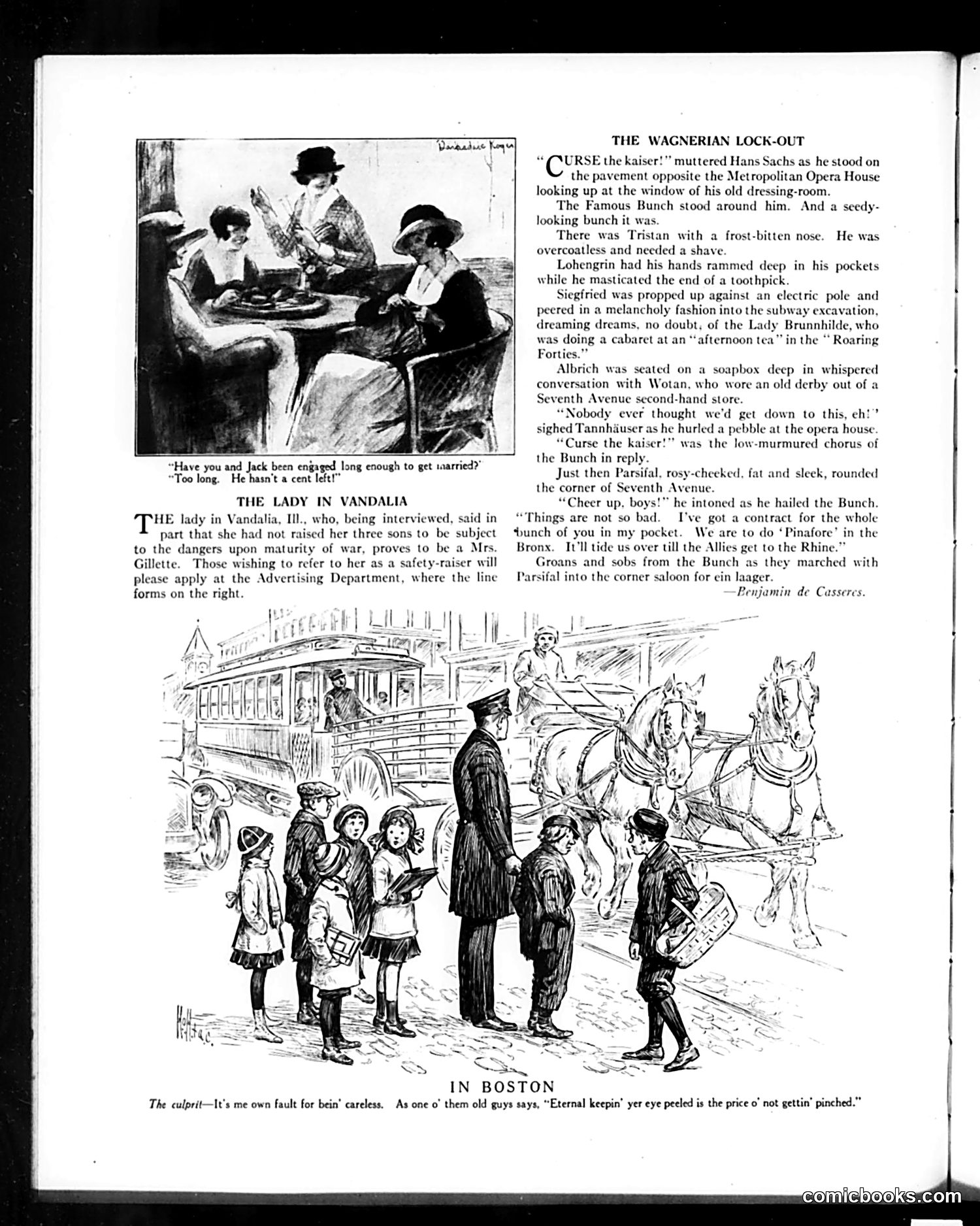
This page contains three distinct pieces of social satire: **"The Wagnerian Lock-Out"** (top right): A humorous story about unemployed opera performers gathering outside the Metropolitan Opera House. The title puns on "Curse the Kaiser!" and Wagner's operas. Characters include struggling musicians like Tristan and Lohengrin (Wagner opera names), depicting Depression-era unemployment among entertainers. **"The Lady in Vandalia"** (left): A brief anecdote about a woman raising three sons to be safe drivers, presented as a humorous safety-awareness piece. **"In Boston"** (bottom): A street scene illustration about carelessness, with the caption suggesting urban poverty and children begging—a social commentary on economic hardship and street life. The page reflects early 20th-century concerns about unemployment, poverty, and public safety through humor and satirical illustration.
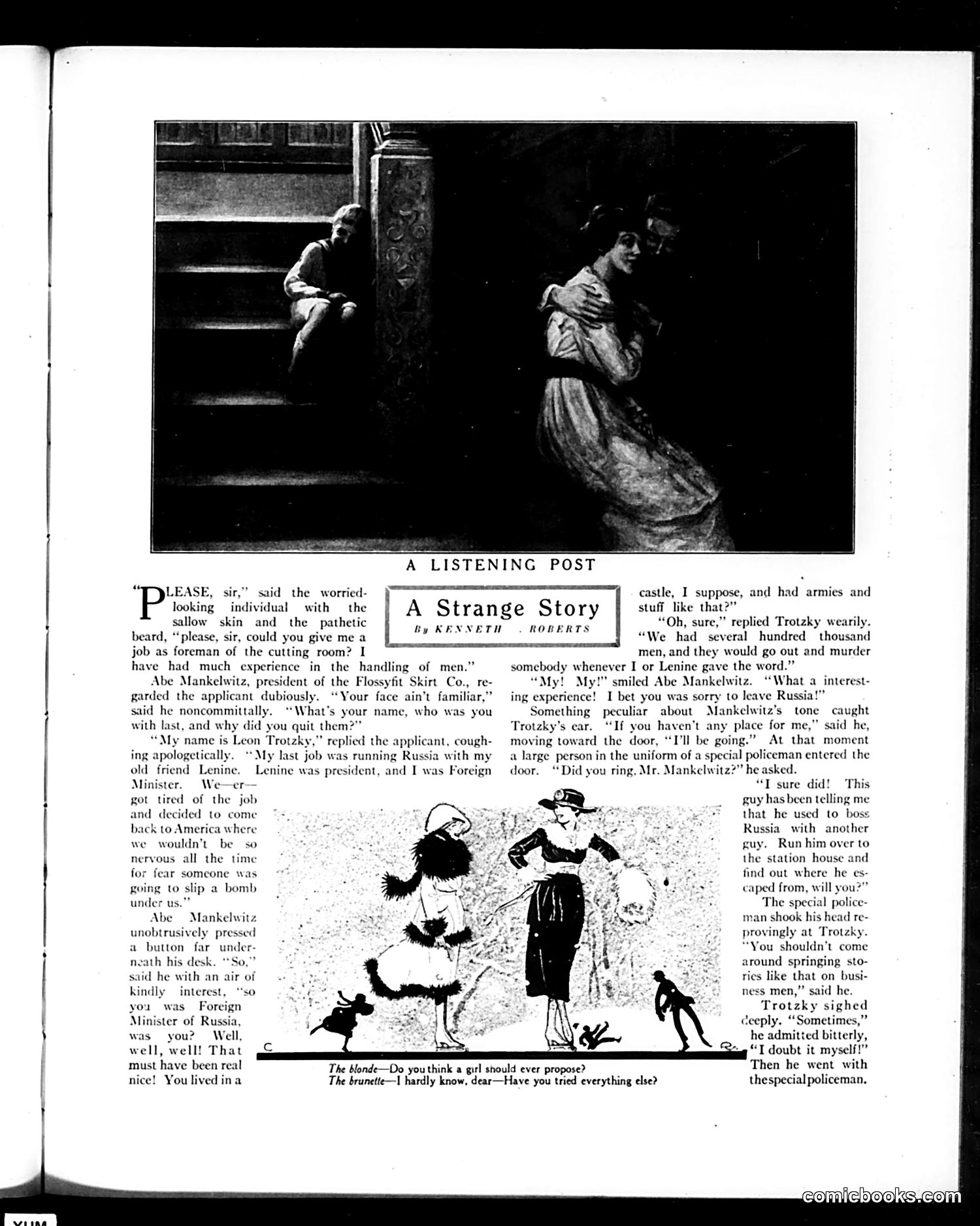
This story mocks Leon Trotsky, the Soviet revolutionary and Red Army organizer who was exiled from Russia in the 1920s. The satire depicts Trotsky attempting to find work as a factory foreman in America, absurdly claiming he previously "ran Russia" with Lenin, commanding "several hundred thousand men" to "murder somebody whenever I or Lenine gave the word." The joke targets both Trotsky's implausibility as a job applicant and American anticommunist sentiment. When factory owner Mankelwitz hears these claims, he immediately calls police, treating Trotsky as a dangerous radical rather than a legitimate job seeker. The final panel's dismissive policeman reinforces the era's hostile view of communist immigrants. The cartoon reflects post-Russian Revolution American anxiety about radical foreign influence, portraying Bolshevik leaders as untrustworthy outsiders unfit for American employment or society.
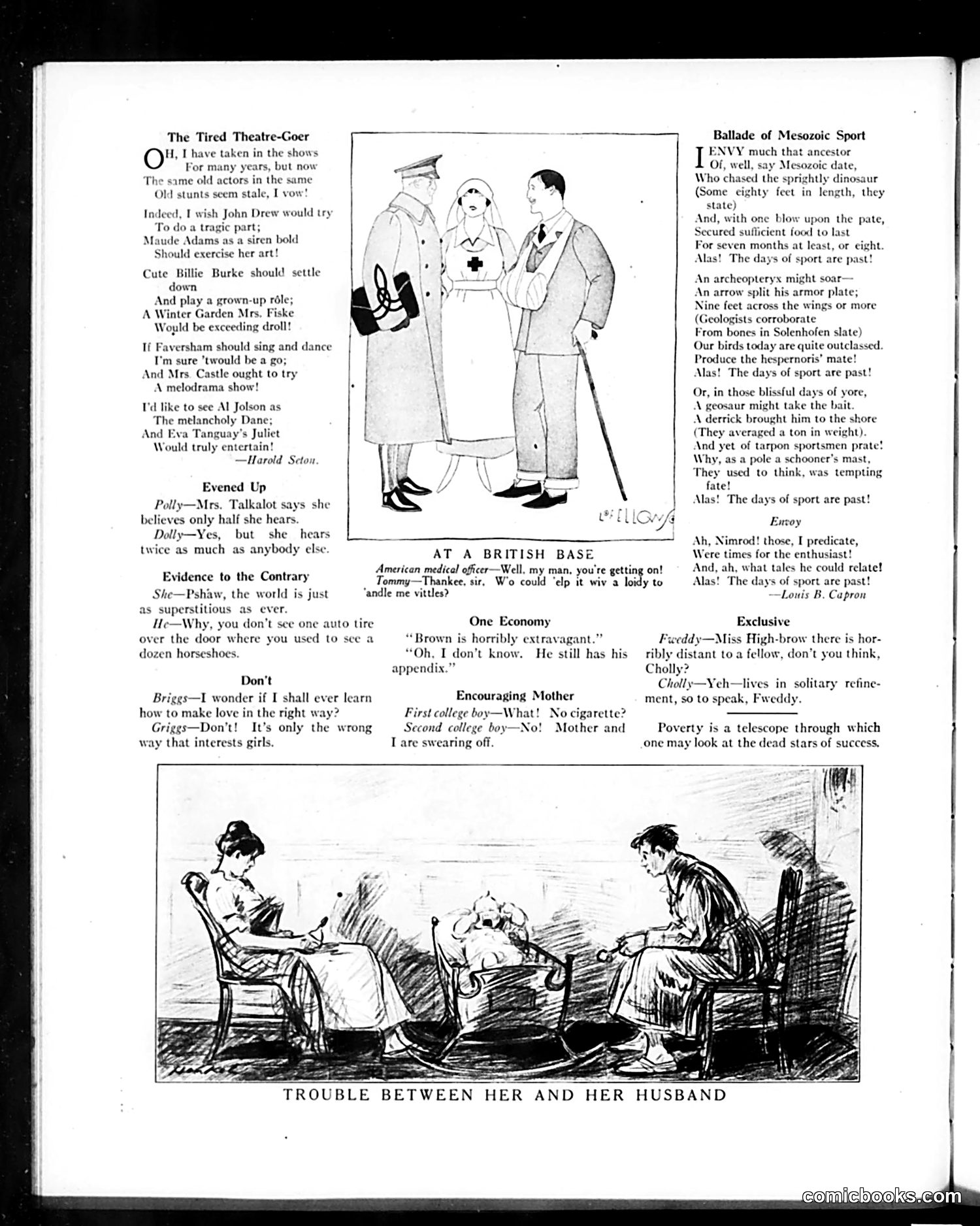
This page from *Judge* magazine contains satirical commentary on early 20th-century American culture. **"The Tired Theatre-Goer"** mocks predictable Broadway casting by suggesting famous actors of the era (John Drew, Maude Adams, Al Jolson) perform wildly inappropriate roles—a star comedian as Hamlet, a dancer as tragic Juliet. The satire targets both formulaic theatre and typecasting. **"At a British Base"** is a WWI-era joke: an American officer compliments a British soldier on his health, assuming wartime hardship; the soldier credits good nursing care from female medical personnel ("a loidy"). The remaining items are brief social humor: a chatty wife who hears gossip anyway; automobile ownership replacing horseshoes as status symbols; college boys quitting smoking to impress mothers; and a wealthy man's "economy" of keeping his appendix (avoiding surgery costs). **"Ballade of Mesozoic Sport"** nostalgically compares prehistoric dinosaur hunting to modern fishing—implying modern recreation is tame compared to ancestral adventure. Overall, the page satirizes theatre conventions, wartime observations, and class pretensions.
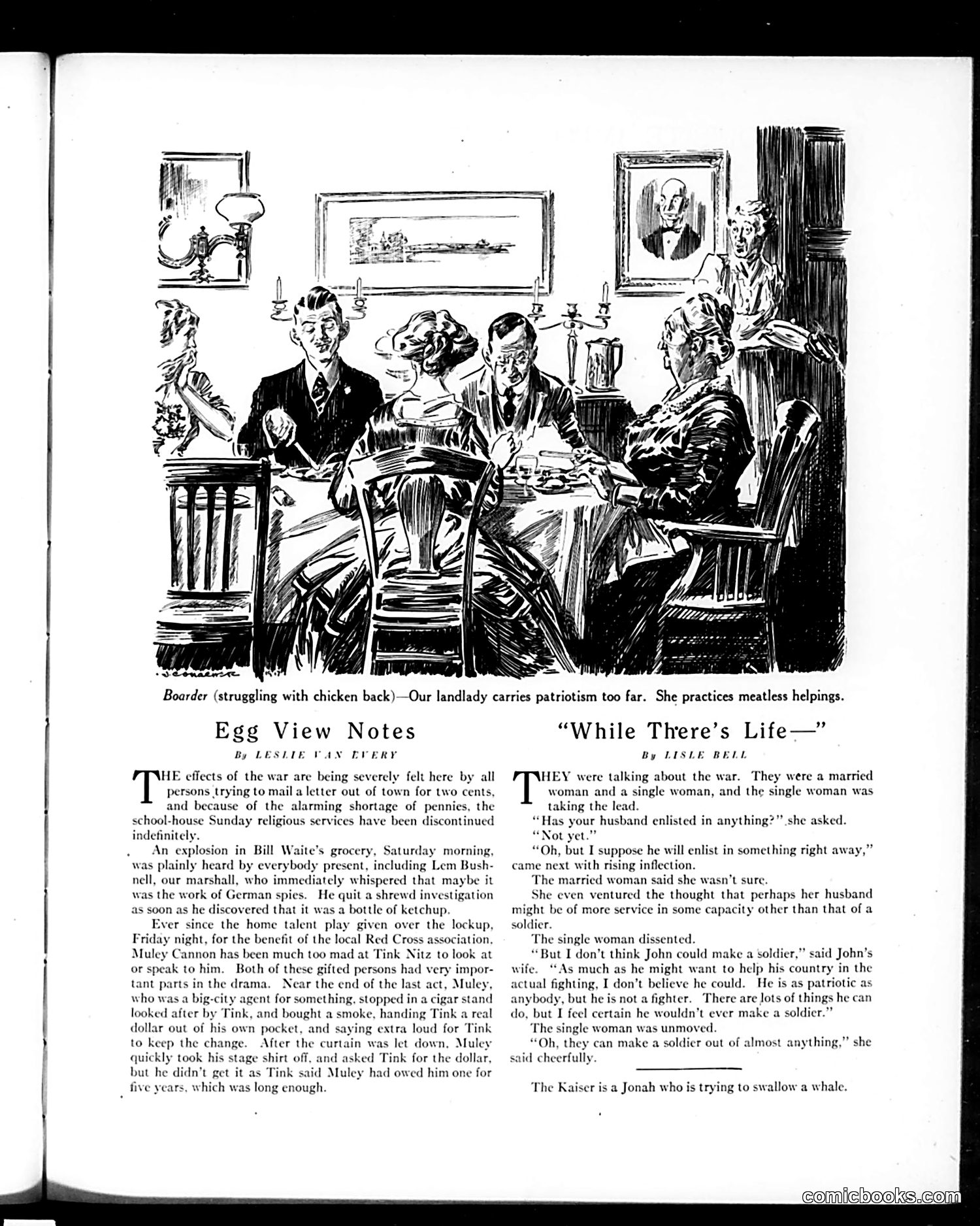
This page contains two satirical pieces about World War I home-front effects: **"Egg View Notes"** mocks small-town wartime adjustments—penny shortages halting mail service, church closures, and absurd spy hysteria (mistaking a ketchup bottle explosion for German sabotage). The cartoon's caption ridicules landlords imposing patriotic "meatless helpings" as war sacrifice, showing a boarder struggling with meager food. **"While There's Life"** satirizes the social pressure on married women to push their husbands into military service. A single woman aggressively questions why the married woman's husband hasn't enlisted, dismissing his wife's concerns that he's unsuited to combat. The satire targets both aggressive home-front nationalism and women shaming men into warfare. The final line—"The Kaiser is a Jonah who is trying to swallow a whale"—suggests Germany will be destroyed attempting the impossible (echoing the biblical story). Together, these pieces critique both excessive wartime sacrifice demands and aggressive enlistment pressure on civilians.
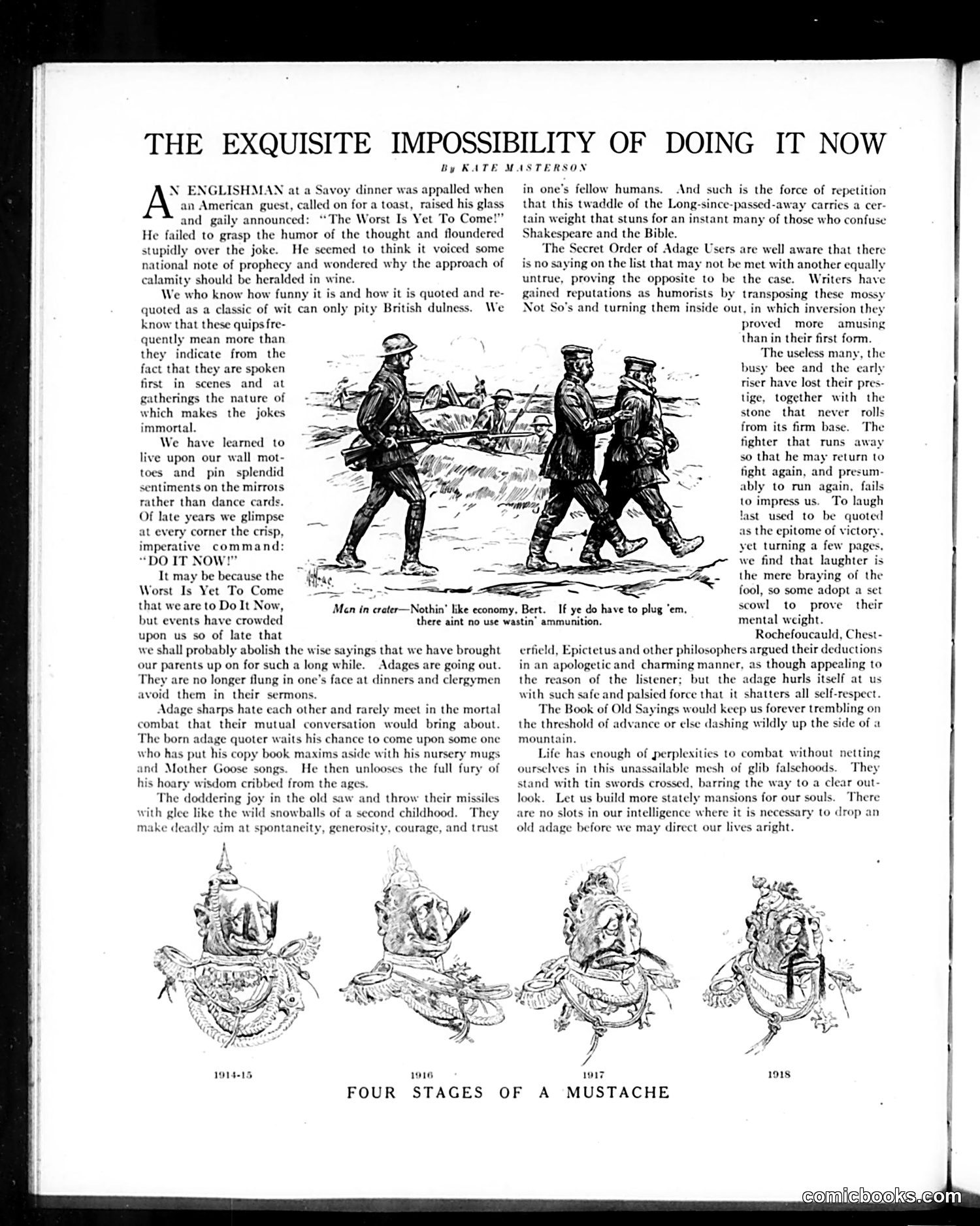
This 1918 Judge magazine page satirizes the overuse of old adages and proverbs in American culture. **Main Satire:** Writer Kate Masterson argues that tired sayings like "The Worst Is Yet To Come" have lost their wit through repetition. She contrasts an Englishman's literal interpretation of an American's joke toast with American sophistication in understanding such ironic inversions. **The Cartoon:** The middle illustration showing soldiers in a WWI trench exemplifies this theme—a soldier quips about "economy" in ammunition while men die around him, gallows humor rendered cynical rather than clever. **"Four Stages of a Mustache" (1914-1918):** This appears to track grooming changes during World War I's progression, likely satirizing how even personal appearance reflects wartime's grinding toll. **Context:** Published during final year of WWI, the piece critiques how Americans hide behind witty sayings and old wisdom rather than confronting harsh modern realities directly. The adages have become intellectual cowardice.
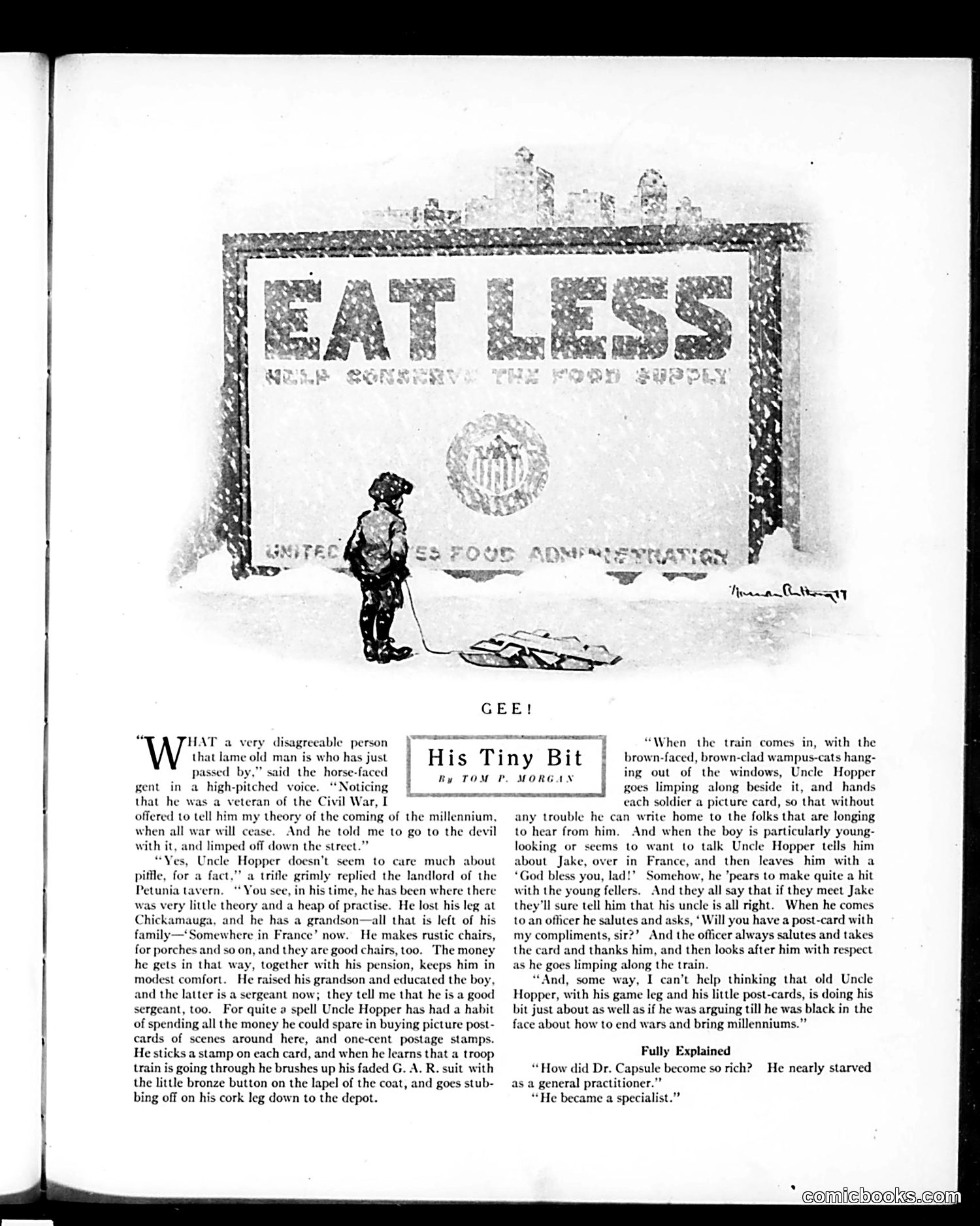
The main cartoon depicts an elderly Civil War veteran (Uncle Hopper, identifiable by his wooden leg and G.A.R. button) handing picture postcards to soldiers on a troop train, likely during World War I. The satire contrasts two approaches to supporting the war effort: a verbose young man who lectures about idealistic theories of ending all wars, versus Uncle Hopper—a disabled veteran with practical experience of war's brutality—who quietly supports soldiers through a simple, personal gesture (sending postcards home). The text's point is clear: actual wartime sacrifice and direct service to troops matters more than abstract philosophical arguments about peace. Uncle Hopper's modest contribution—spending his meager pension on postcards and stamps—represents genuine patriotism grounded in experience, not empty rhetoric. The bottom joke about Dr. Capsule is unrelated advertising/filler typical of period magazines.
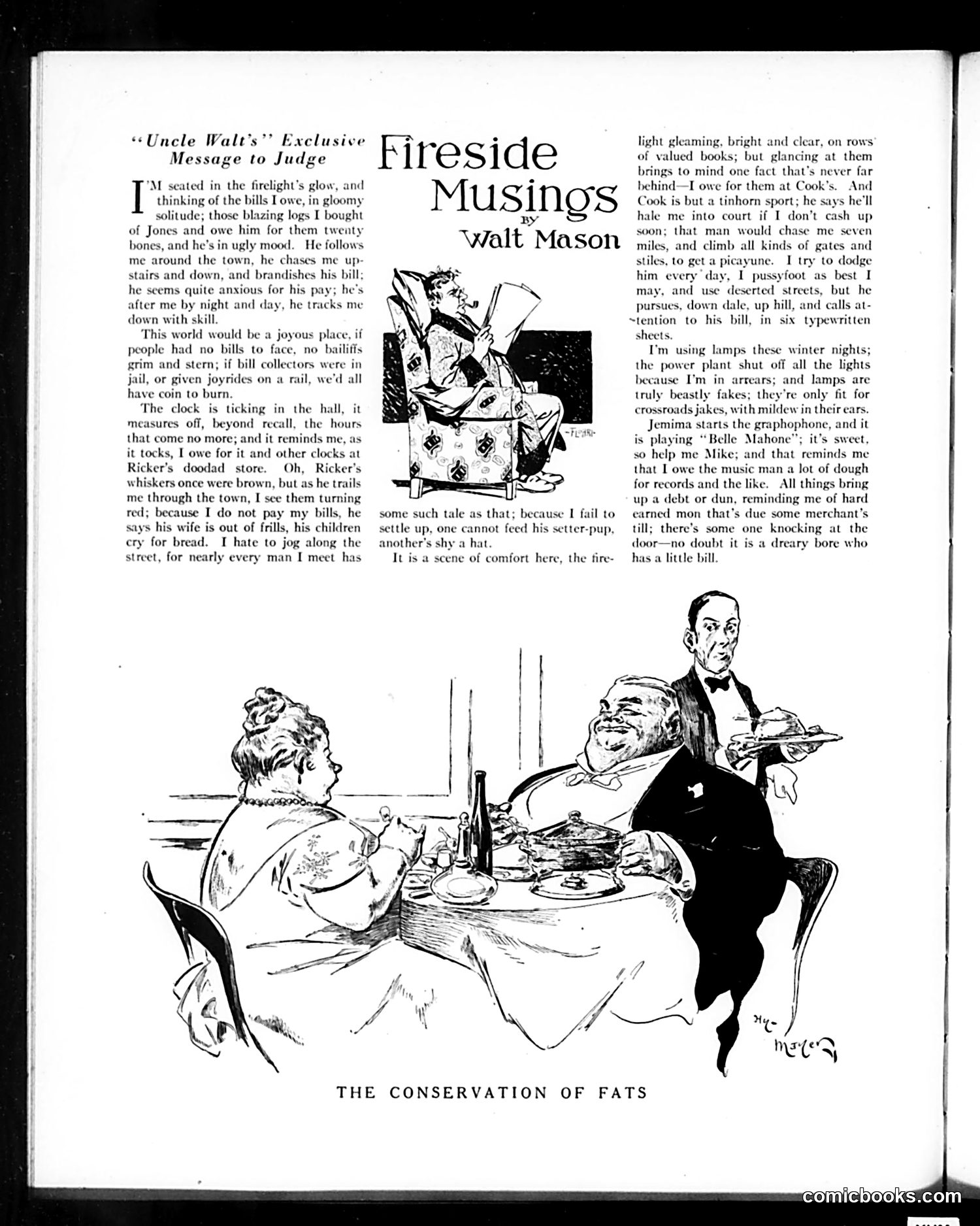
This page features two satirical pieces about debt and financial hardship, likely from the early 20th century. **Main Text:** Walt Mason's poem depicts a man drowning in unpaid bills. Despite sitting comfortably by his fireplace surrounded by books, he cannot enjoy any aspect of his life—not even purchased goods or utilities—because bill collectors pursue him relentlessly. He owes money to Jones for firewood, Ricker for clocks, Cook for books, and various merchants for goods. The humor lies in the relatable exasperation: every comfort he tries to enjoy comes with the reminder of debt owed. **Bottom Cartoon ("The Conservation of Fats"):** Shows a well-fed couple dining while a thin waiter serves them. The caption suggests ironic commentary on "conservation"—the wealthy couple appears to be conserving nothing while food and resources pass before them, contrasting with Depression-era scarcity concerns. The satire critiques wealth inequality and frivolous consumption among the affluent. Both pieces mock financial anxiety and social inequality with period-appropriate humor.
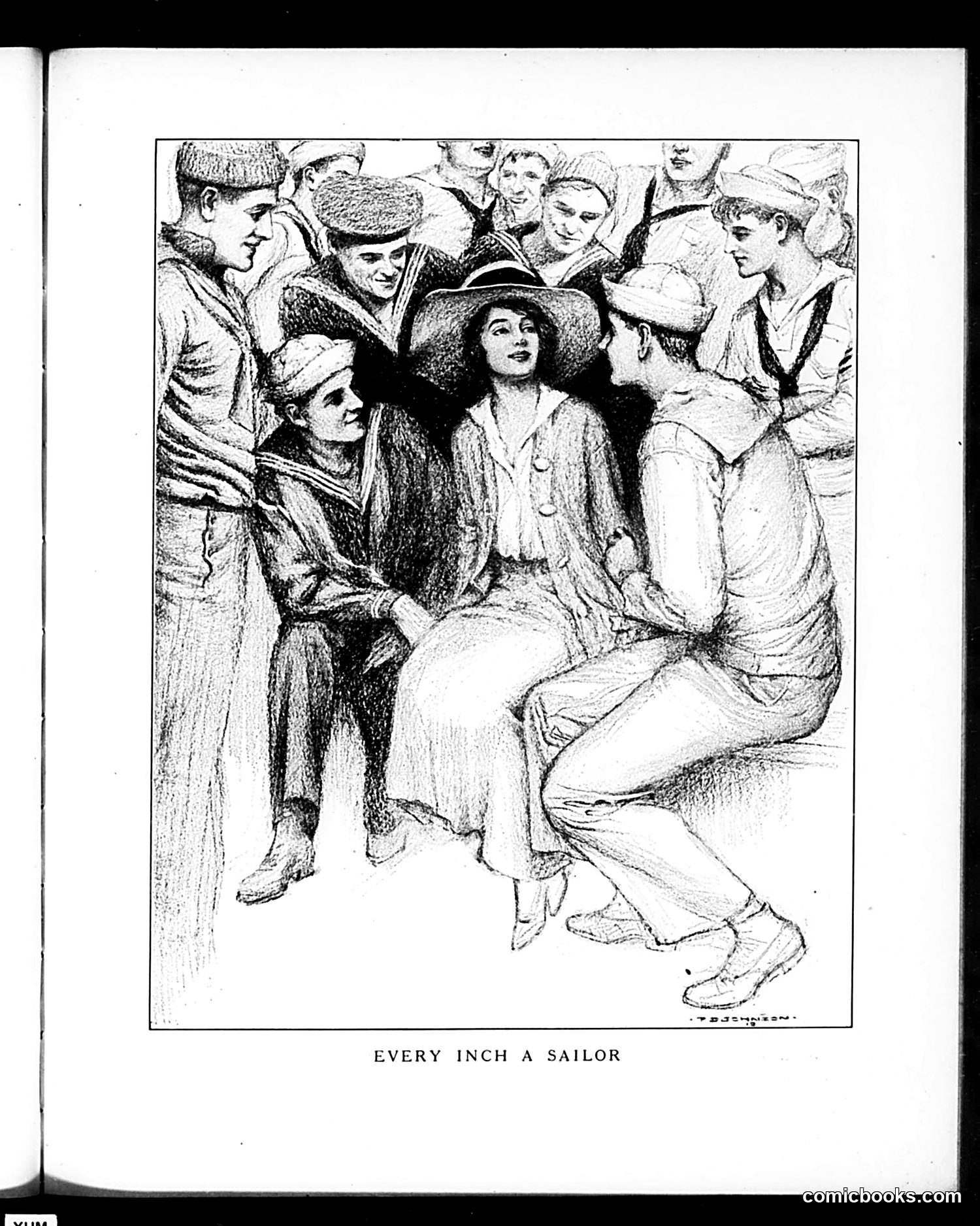
This cartoon depicts a woman surrounded by sailors in what appears to be a naval or maritime setting. The caption "Every Inch a Sailor" is the key to understanding the satire. This likely references the expression "every inch a [profession]"—meaning thoroughly or completely that thing. The joke appears to be a play on words: the woman is literally surrounded by sailors ("every inch" covered by them), making her "every inch a sailor" in the most literal sense. The cartoon likely satirizes either women's increasing presence in wartime naval contexts, or the colloquial behavior of sailors around women. Without additional context about Judge magazine's publication date, the specific historical moment remains unclear, though this appears to be early 20th-century humor based on the art style and clothing depicted.
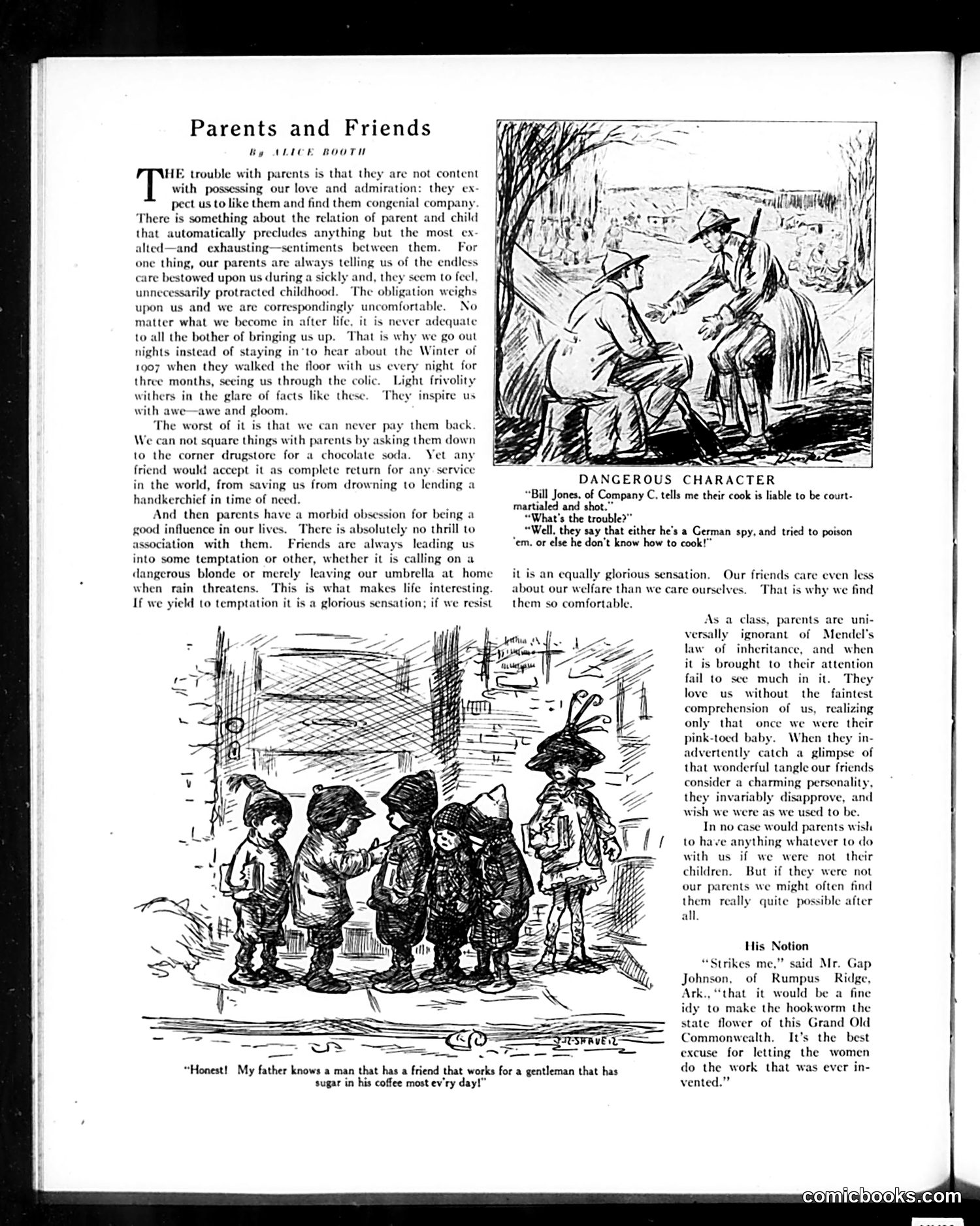
This satirical essay by Alice Root humorously critiques the generational gap between parents and children. The piece argues that while parents demand gratitude and filial devotion in return for childhood care, this obligation creates an unequal, uncomfortable relationship. Friends, by contrast, are "comfortable" because they make no such demands and actively encourage questionable behavior. The two cartoon vignettes illustrate this theme: the first shows children sharing absurd gossip (one child exaggerating a tenuous social connection about sugar in coffee), while the second depicts a WWI-era soldier anecdote about a cook accused of being a German spy or incompetent cook—illustrating how friends bond through amusing, inconsequential stories without moral judgment. The final sidebar by "Mr. Gap Johnson" satirizes Southern attitudes, joking that hookworms should be the state flower as an excuse to exempt women from work—likely a dig at regional backwardness. The satire ultimately defends youthful irreverence against parental disapproval.
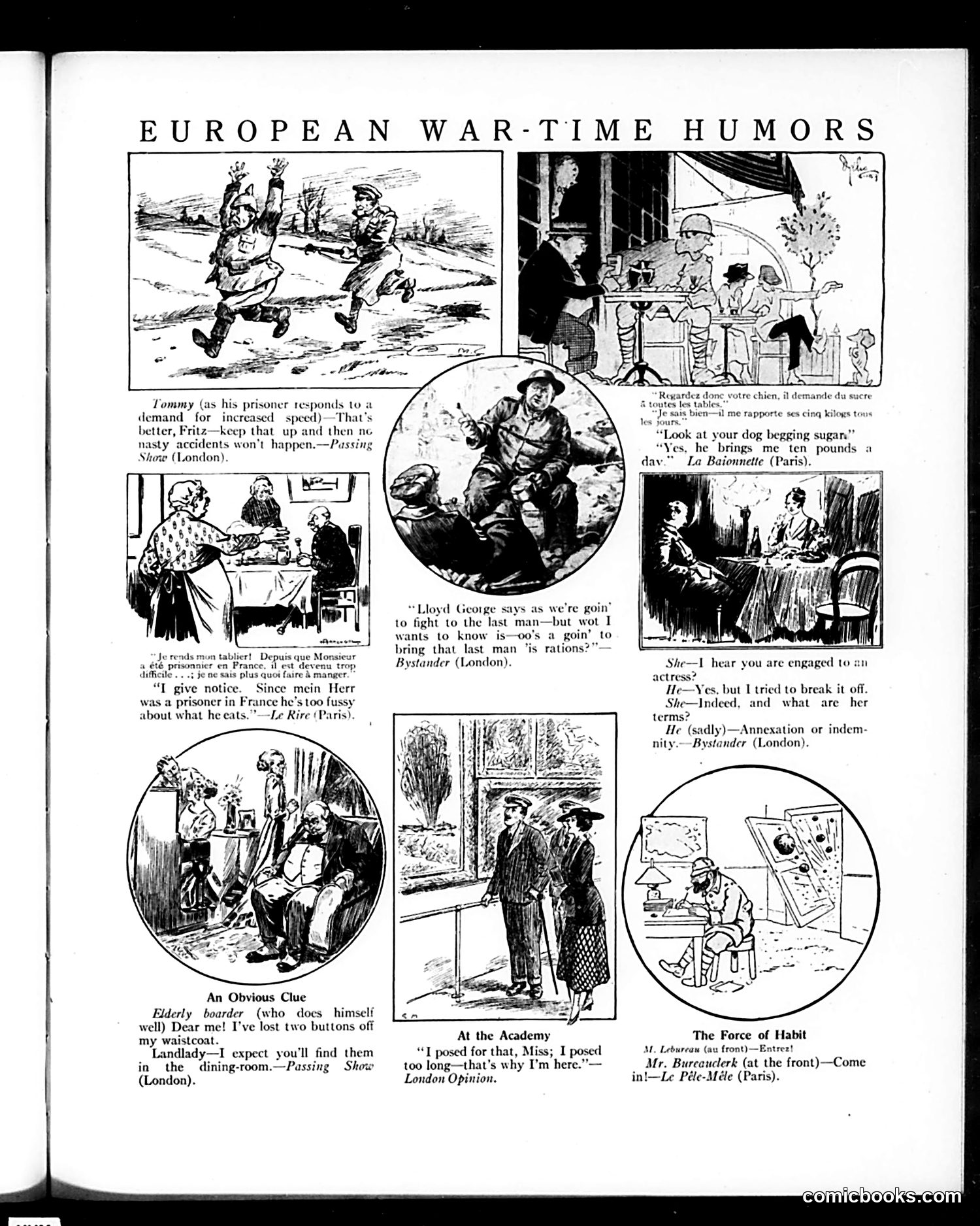
This page collects satirical cartoons from Allied and neutral publications during World War I, using humor to comment on wartime conditions and attitudes. Key themes include: **Military discipline & rationing**: Jokes about German prisoners being driven hard ("keep that up"), and concerns about feeding troops through war's end (Lloyd George reference). **Home front anxieties**: Lost buttons, romantic entanglements, and the strain on civilians—including a woman breaking off an engagement with demanding terms of "annexation or indemnity" (a joke equating personal relationships to territorial disputes). **Allied mockery of Germans**: References to "Fritz" (typical German name) suggest contempt for enemy soldiers and their supposed fusspot attitudes about food. **Class commentary**: Elderly boarders and landlords represent domestic preoccupations continuing despite war. The cartoons are reprinted from *Passing Show*, *London Opinion*, *Le Rire*, and *La Baionnette*—publications from Britain and France using humor as morale-boosting propaganda while satirizing both enemy and home-front conditions.
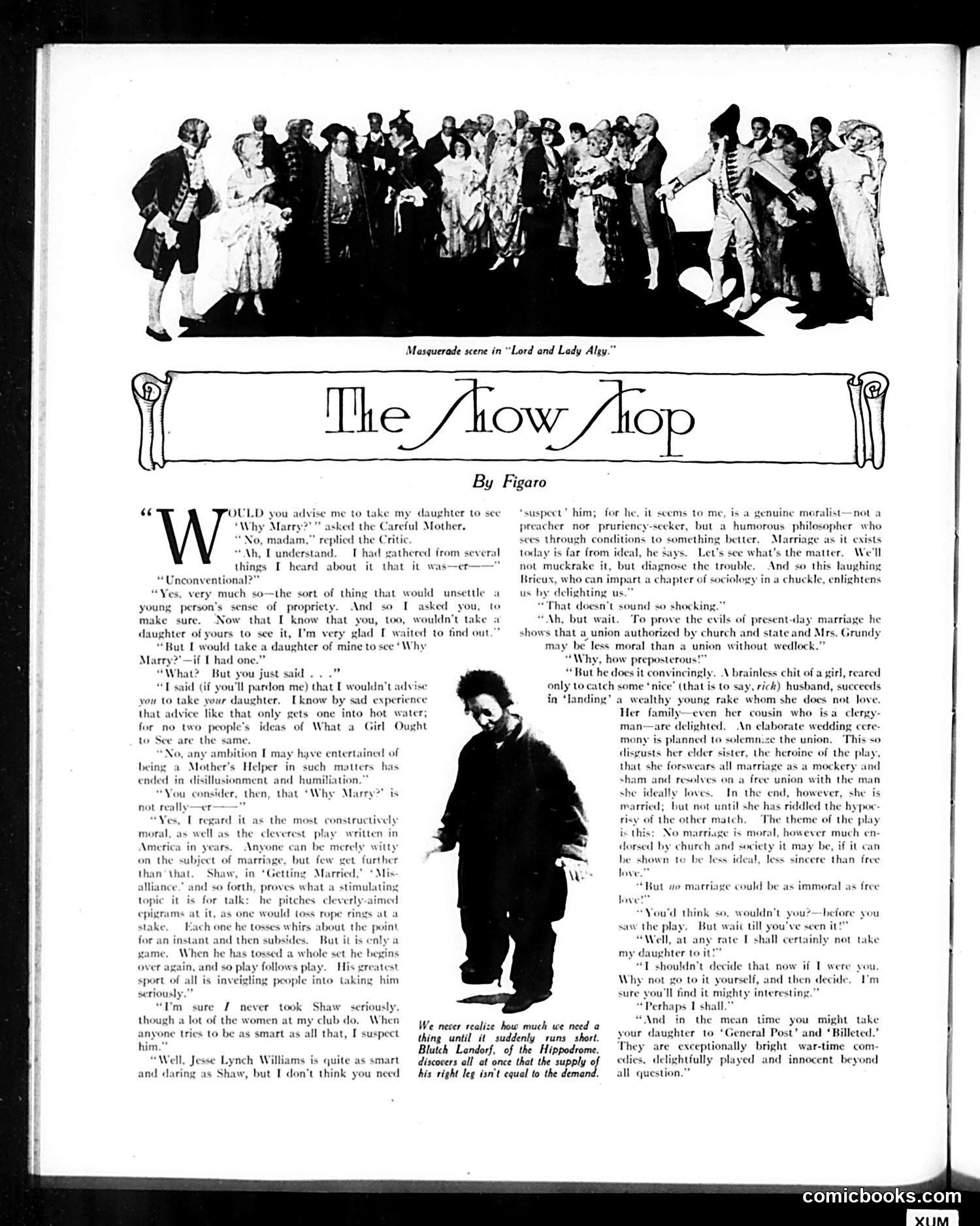
This page reviews "Why Marry?" by Brieux, a contemporary play (text references it as "the cleverest play written in America in years"). The dialogue frames a debate between a Careful Mother and a Critic about whether the play is appropriate for young women. The satire targets Victorian prudishness: the Mother fears the play is "unconventional," while the Critic praises it as moral philosophy disguised as comedy. The play apparently argues that church-sanctioned marriages can be less sincere than "free unions" based on love—a radical position for the era. The joke is that the Critic's assurances that the play is "constructively moral" actually make it *more* scandalous by showing respectable marriage as hypocritical. The Mother's final hesitation—"Perhaps I shall"—suggests she's been persuaded by reverse psychology: being told to see it herself makes her curious despite her disapproval.
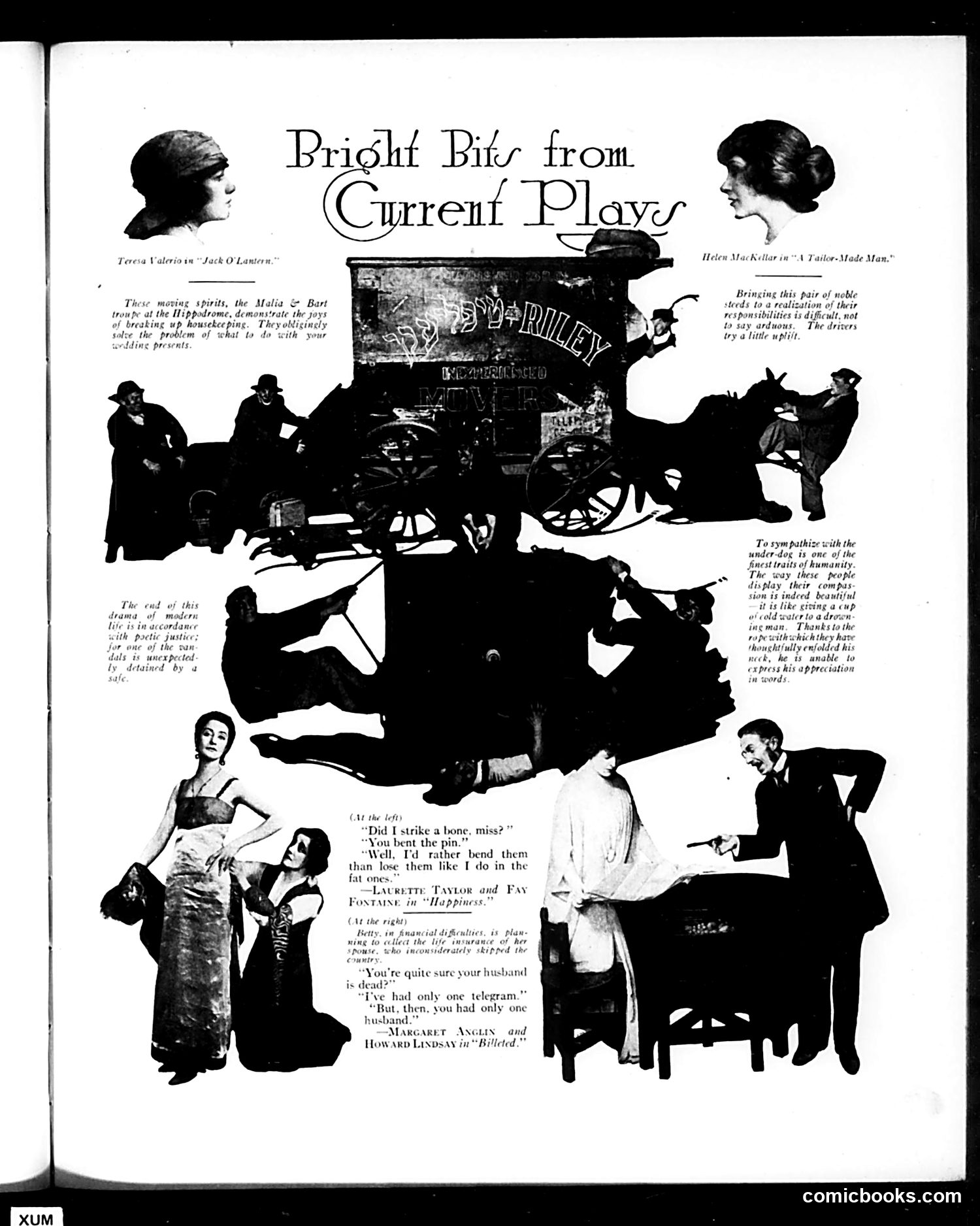
This page collects theatrical humor and quotes from 1910s Broadway productions. The title references plays like "Jack O'Lantern," "A Tailor-Made Man," "Happiness," and "Billeted." The silhouetted vignettes depict comedic scenes: a couple breaking up housekeeping at the Hippodrome; people sympathizing with an underdog (presented as noble virtue); and domestic comedy exchanges about striking bones while cooking, bending pins, and telegrams about a dead husband. The satire mocks sentimental middle-class attitudes—particularly the "uplift" sentiment around helping the unfortunate—while contrasting this with petty domestic squabbles and dark humor. The dialogue jokes trade on misunderstandings and class-conscious observations. These were popular theatrical moments that *Judge* magazine's readers would recognize, offering entertainment commentary rather than political critique.
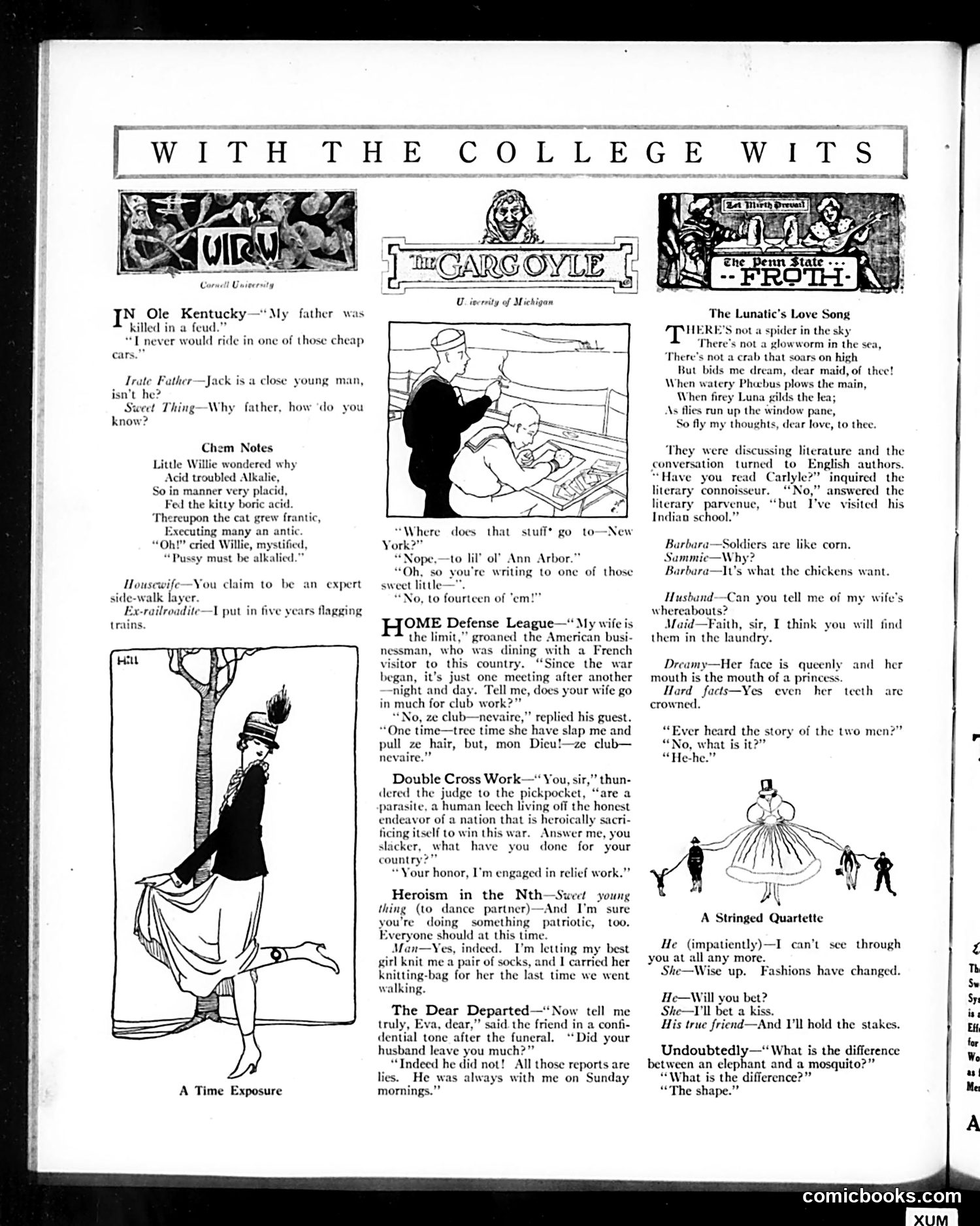
This page collects humorous one-liners and short jokes typical of Judge's "college wit" format. Key satirical targets include: **WWI Context**: Multiple jokes reference wartime sacrifice and patriotism. The "Double Cross Work" joke mocks a pickpocket claiming "relief work" as his war contribution—satirizing slackers who evade duty. The "HOME Defense League" joke contrasts American wives' constant club meetings with a French visitor's wife, suggesting American women abuse wartime activism. **Social Commentary**: The "Dear Departed" joke satirizes materialistic widows. Several jokes mock pretension—a literary snob hasn't read Carlyle but visited his "Indian school"; young couples perform patriotic performance (knitting socks) rather than genuine sacrifice. **Dating/Romance**: Multiple jokes target young courtship, fashion consciousness, and relationship dynamics with mild cynicism typical of the era. The illustrations include "A Time Exposure" (a flapper in scandalous pose) and "A Stringed Quartette" (silhouettes of couples), reinforcing themes of modern youth and changing social mores during the WWI period.
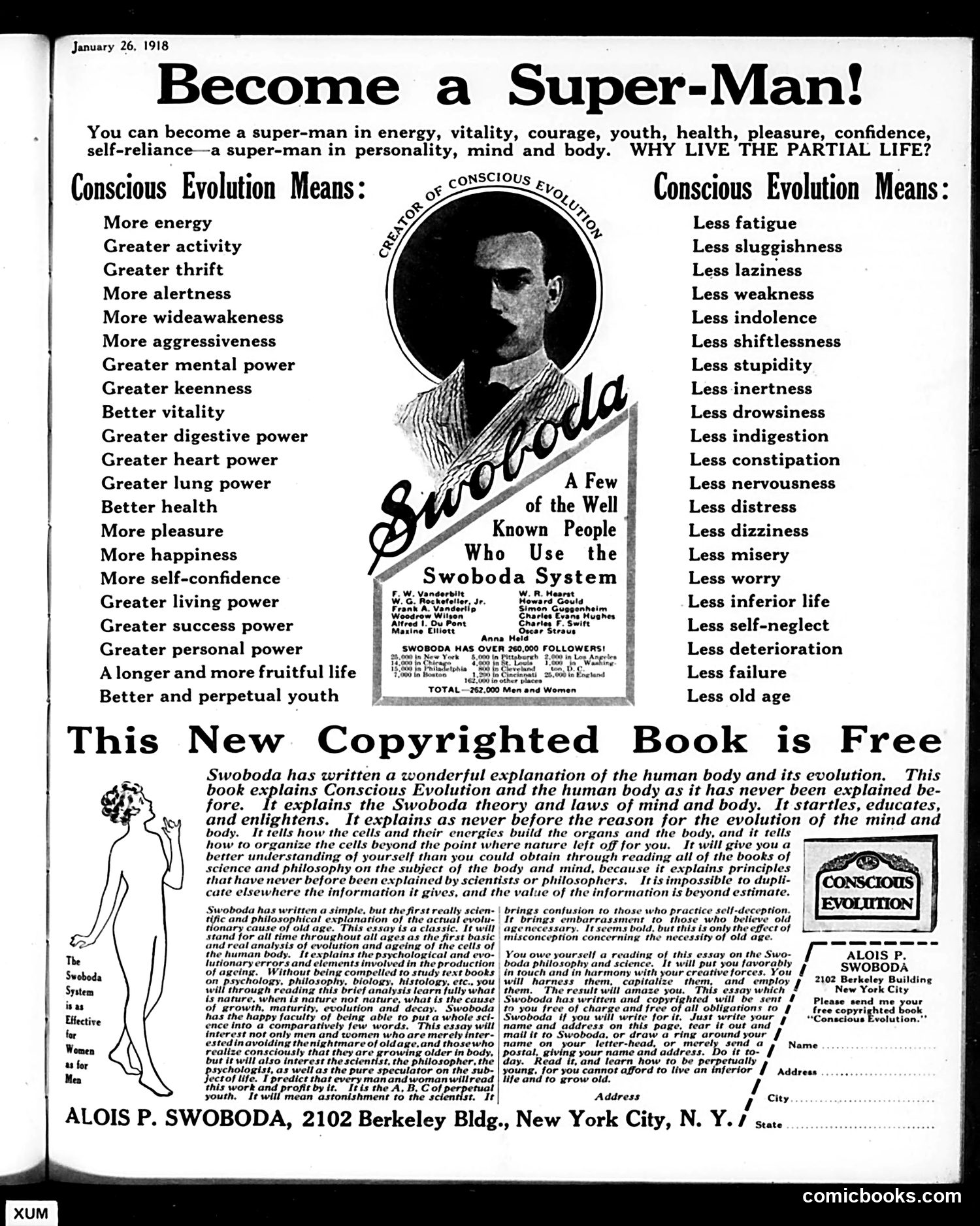
This is primarily a **full-page advertisement**, not political satire. It promotes Alois P. Swoboda's "Conscious Evolution" self-improvement system—a pseudo-scientific health and vitality program popular in the early 20th century. The ad claims users can achieve superhuman qualities through Swoboda's methods: greater energy, mental power, health, and "perpetual youth." It lists prominent names (Vanderbilt, Hearst, Gould) as supposed endorsers, claims 260,000 followers, and offers a free copyrighted book. The appeal reflects contemporary anxieties about aging and decline, while the "super-man" language echoes early 1900s vitalism movements. The extensive list of promised benefits—from digestive power to "less old age"—reveals the pitch's grandiose nature. For modern readers, this exemplifies how unregulated health claims and celebrity endorsements marketed pseudoscience before FDA regulation.
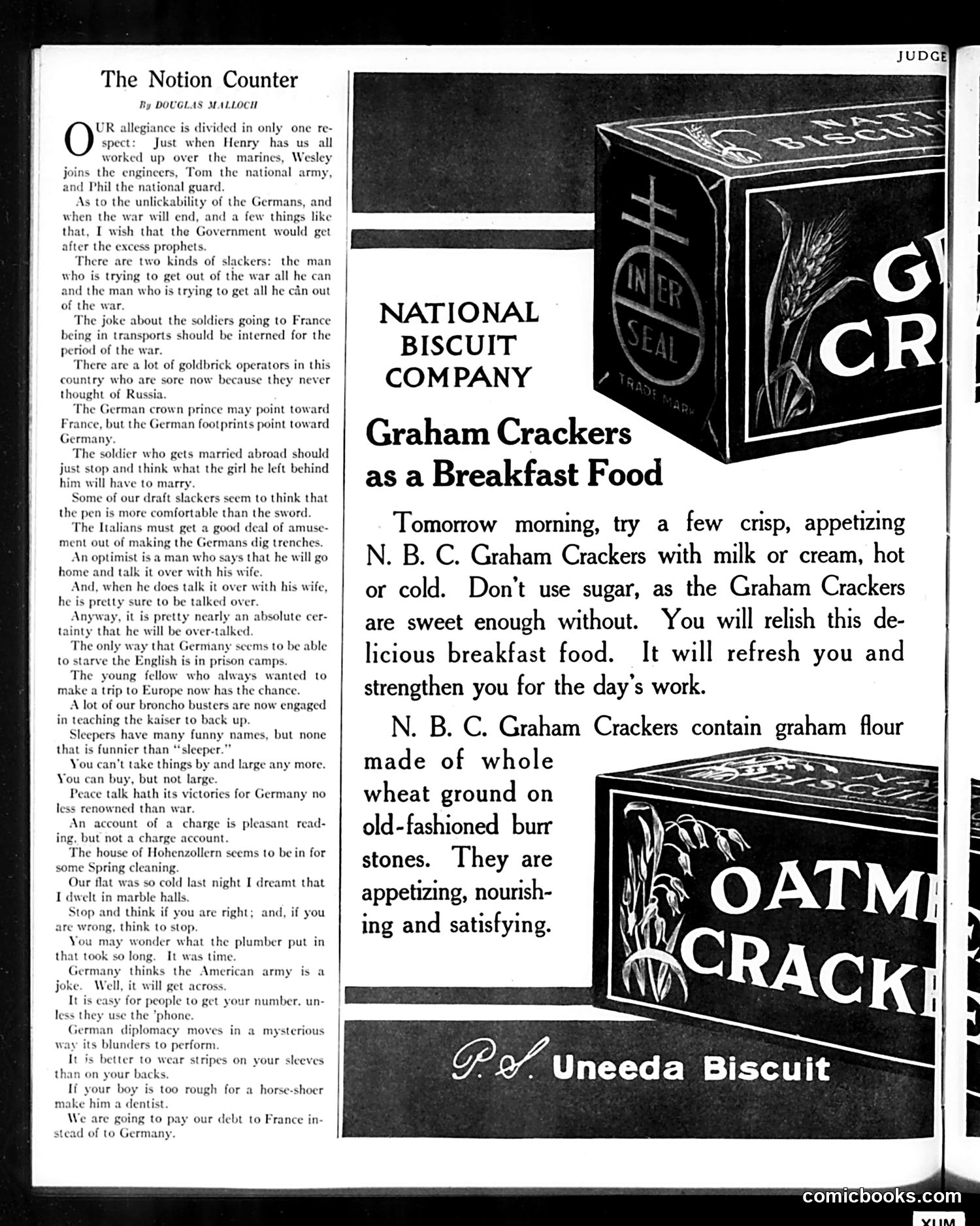
This page combines satirical commentary on World War I with period advertising. The left column presents Douglas Malloch's humor column, offering brief social observations about the war effort. **The Satire:** Malloch mocks various aspects of American wartime life—family divisions over military branches, "slackers" (those avoiding service or profiteering), draft dodgers, and soldiers marrying foreign women. He pokes fun at optimists, German diplomacy, and American military readiness. References to "the kaiser" (German Emperor) and France indicate this is WWI-era commentary. The jokes are gentle observations rather than sharp political critique. **The Advertisements:** The right side features National Biscuit Company ads promoting Graham Crackers and Oatmeal Crackers as nutritious breakfast foods—patriotic messaging suggesting these products will "strengthen you for the day's work," implicitly supporting the war effort through consumer goods. The page reflects American WWI sentiment: generally supportive of the cause while finding humor in domestic complications and cultural absurdities surrounding mobilization.
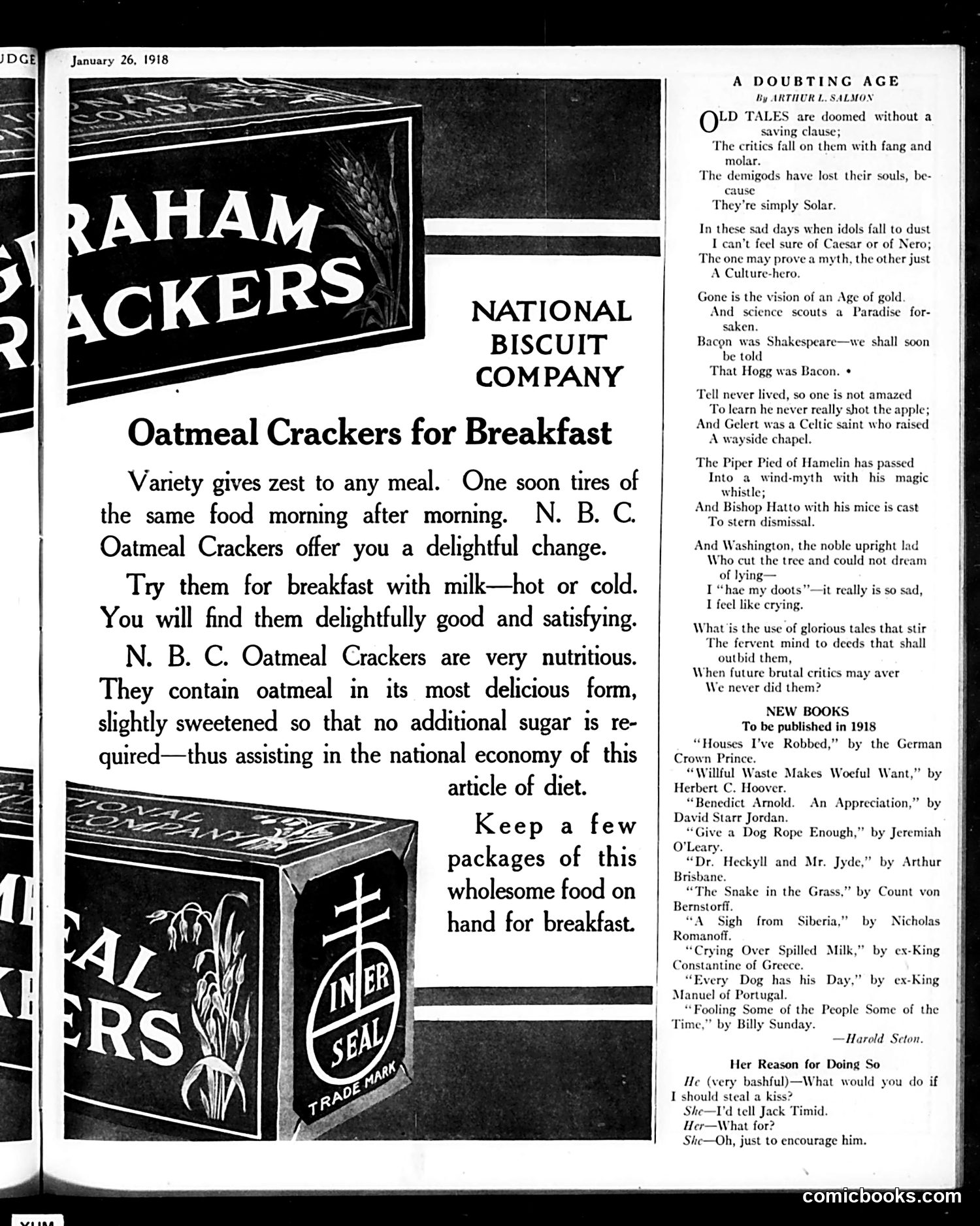
This page combines an advertisement with satirical poetry. The poem, by Arthur L. Salmon, mocks contemporary scholarly debunking of historical and legendary figures—a trend of the era. Salmon laments how modern "science scouts" are dismissing famous figures as myths or frauds: Bacon may have written Shakespeare's works; Tell never shot an apple; Washington's cherry tree story is false. The satire targets early-20th-century higher criticism and mythological scholarship that questioned historical authenticity. The mock book titles reinforce this: "Houses I've Robbed" (credited to the German Crown Prince), "Crying Over Spilled Milk" (ex-King Constantine)—suggesting even current leaders' legacies will be debunked. The accompanying N.B.C. Oatmeal Crackers advertisement is unrelated content, typical of Judge's mixed format. The page's humor assumes readers recognize the scholarly fashion for "demythologizing" history that characterized the period.
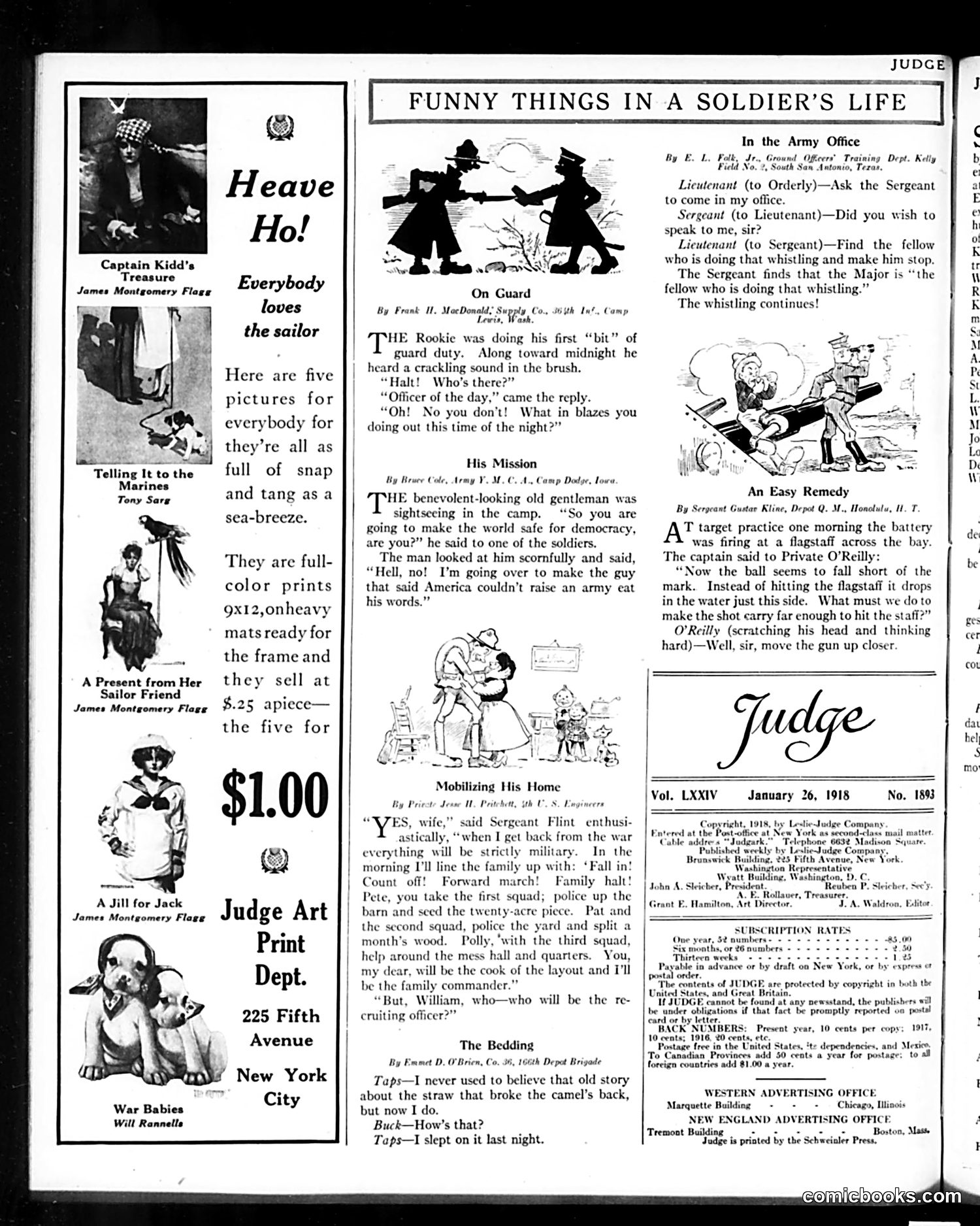
This January 1918 **Judge** magazine page contains satirical military humor from World War I. The cartoons target the absurdities of military life and military thinking during wartime. Key jokes include: A rookie guard challenges his superior officer on duty because the timing seems suspicious; a soldier reframes patriotic duty as personal vengeance; a sergeant humorously plans to run his home like military drill, requiring his wife's input on the "recruiting officer" position; soldiers debate the poor quality of bedding straw; an officer can't identify a whistler outranking him; and an Irish soldier comically suggests moving a cannon *closer* to hit a distant target, missing the point of artillery. The magazine also advertises "Judge Art Print" products (patriotic sailor-themed prints) on the left, capitalizing on wartime sentiment. Overall, the page mocks military logic, hierarchy confusion, and soldier naiveté while promoting patriotic imagery—typical of American humor during WWI.
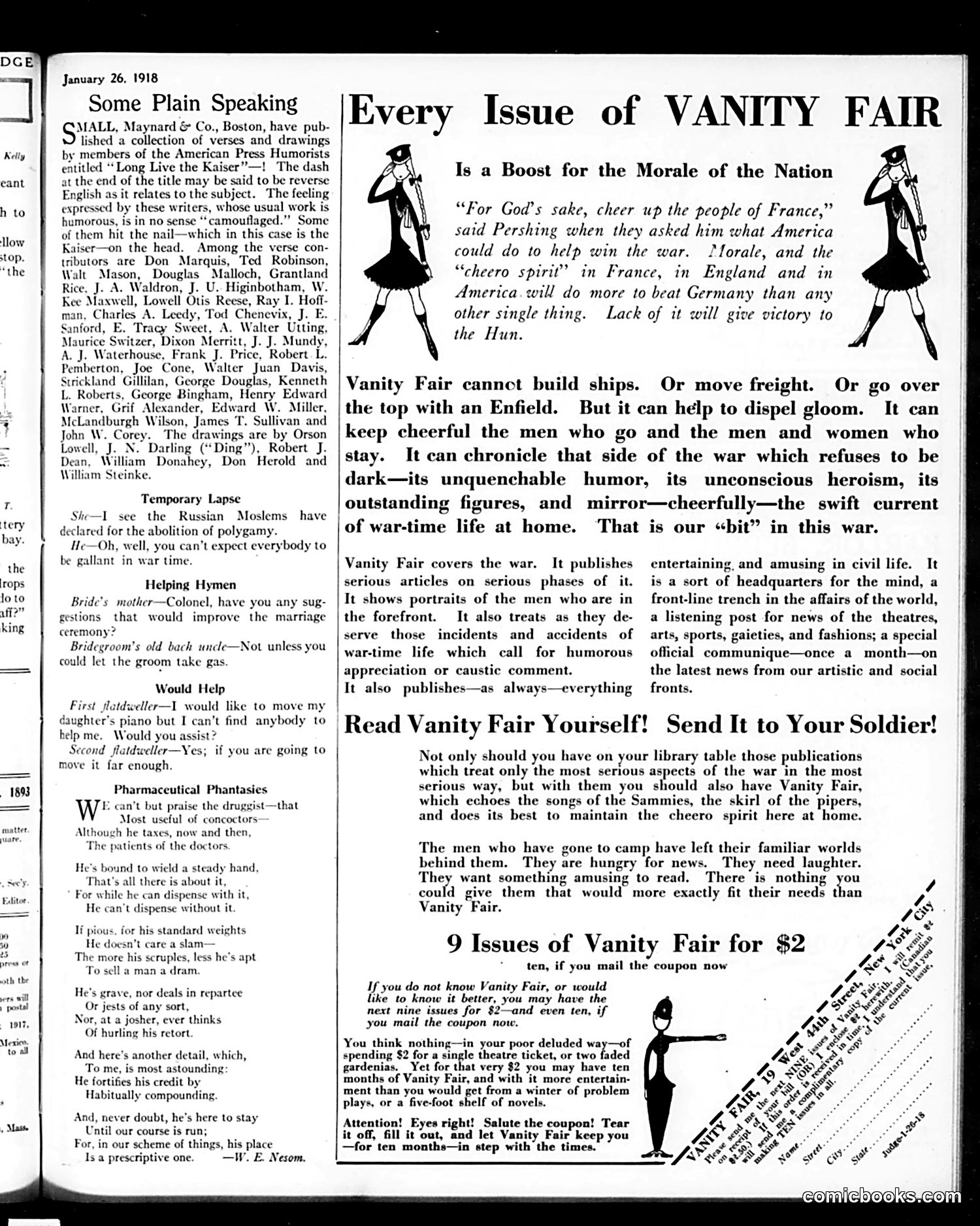
This January 1918 page is primarily a **Vanity Fair advertisement** disguised as editorial content, published during America's involvement in World War I. **The Central Argument:** Vanity Fair magazine claims its role is boosting national morale by publishing humor and lighter content about the war. It quotes General Pershing saying morale matters as much as military equipment in defeating Germany. **Key Points:** - The magazine positions itself as essential reading for soldiers and the home front, claiming entertainment maintains "cheero spirit" - It contrasts what Vanity Fair *cannot* do (build ships, move freight) with what it *can* do (dispel gloom, chronicle humor) - The left column contains unrelated short humor pieces and a book review—typical magazine filler **The Pitch:** A subscription offer: "9 Issues of Vanity Fair for $2"—presented as patriotic duty. Readers should send it to soldiers and maintain it at home. **Historical Context:** This reflects WWI-era propaganda viewing entertainment as a morale weapon. The advertisement conflates consumerism with patriotism, a common wartime marketing strategy.
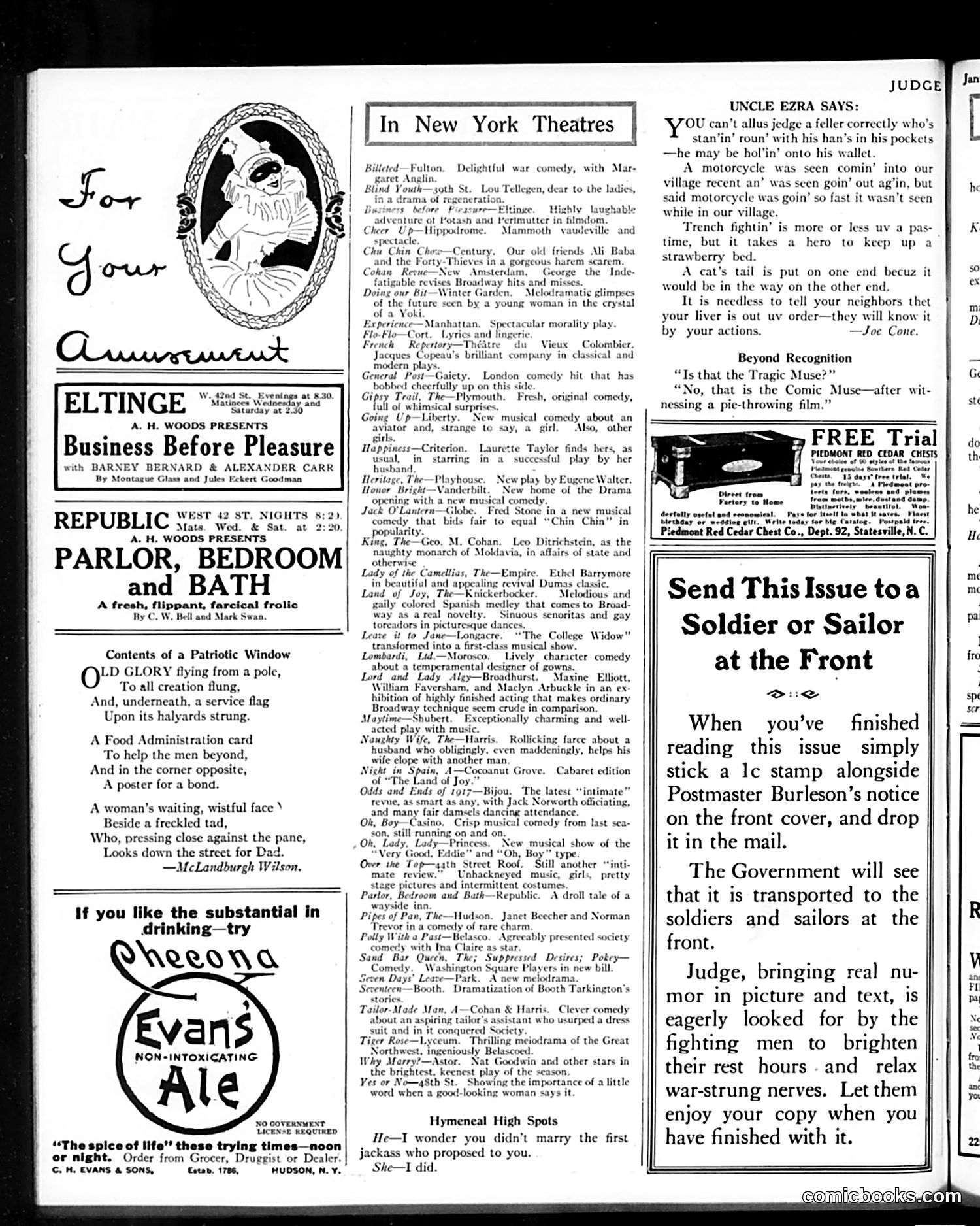
This page is primarily **theatrical advertising and criticism**, not political satire. It lists New York theatre productions from what appears to be **World War I era** (references to "service flags," "Food Administration card," and soldier/sailor appeals date it to circa 1917-1918). The main content is **"In New York Theatres,"** a theater review column covering contemporary Broadway shows like *Chu Chin Chow*, *Going Up*, and *Maytime*. The patriotic framing appears in the poem **"Contents of a Patriotic Window,"** which describes a domestic scene: an American flag, a service flag (indicating a family member in military service), a worried woman and child waiting for the father/soldier to return home. This reflects **WWI-era American civilian experience**. The page also includes **commercial advertisements** for non-intoxicating ale and theatrical productions, plus an appeal encouraging readers to send the magazine to soldiers and sailors at the front—typical wartime patriotic messaging. There are **no political cartoons or caricatures** on this page worthy of historical analysis.
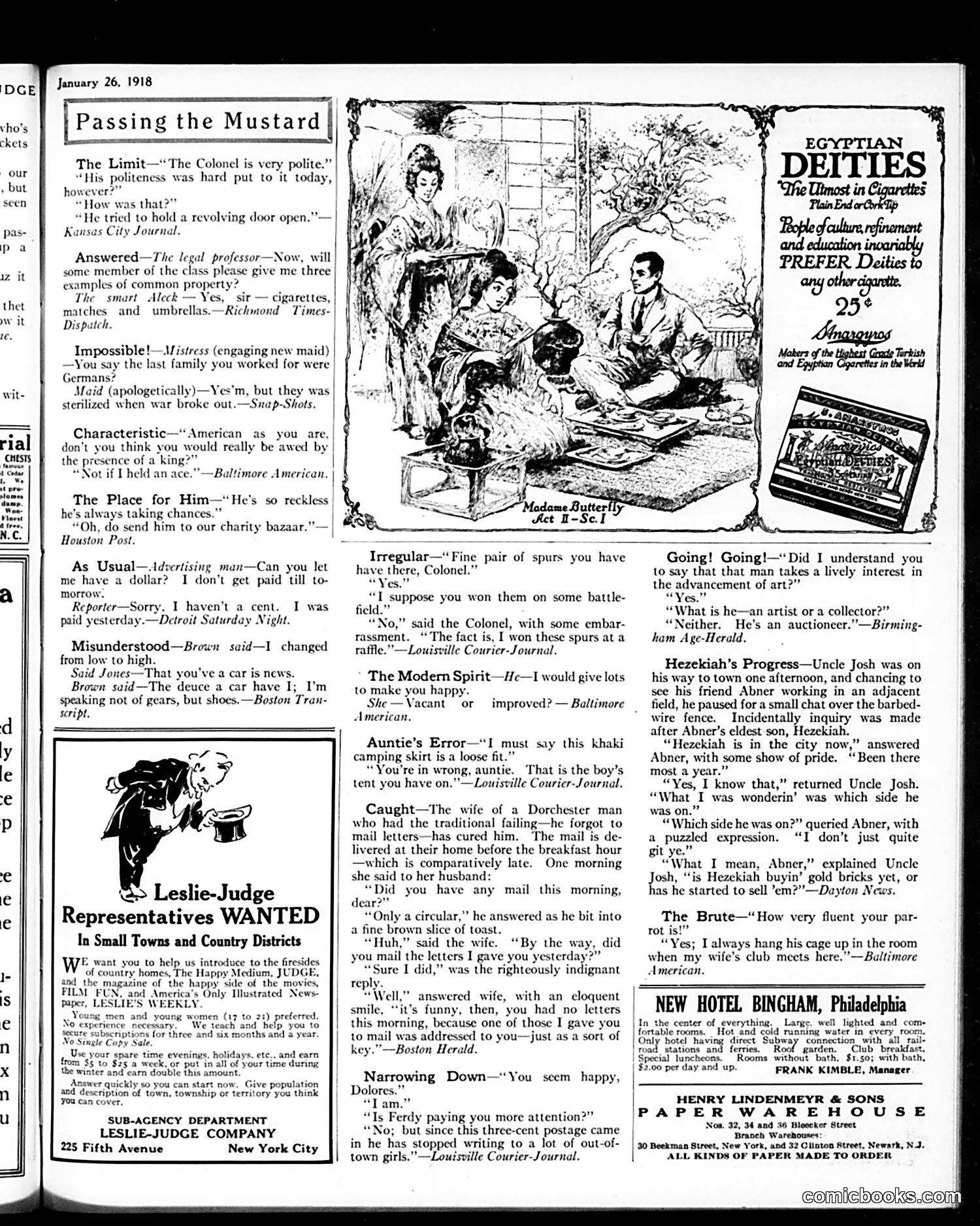
This page is primarily **light humor and joke columns** rather than political cartoons. The jokes satirize American domestic life and social customs during World War I. Key themes: - **Gender and marriage humor**: Women's forgetfulness ("Narrowing Down"), wives reforming husbands' habits ("Caught"), courtship ("Ferdy paying you more attention") - **Class/manners satire**: A Colonel winning spurs at a raffle rather than battle, confusion about umbrellas and cigarettes as "common property" - **Wartime references**: A maid mentioning families "sterilized when war broke out" (unclear reference, possibly German-American families), khaki camping skirts, and postal rates increasing to three cents - **Advertising**: The page includes recruitment ads for magazine subscription agents in rural areas The overall tone is genteel, middle-class American humor typical of Judge magazine's conservative, family-oriented readership. No specific political figures are caricatured; the satire targets universal human foibles.
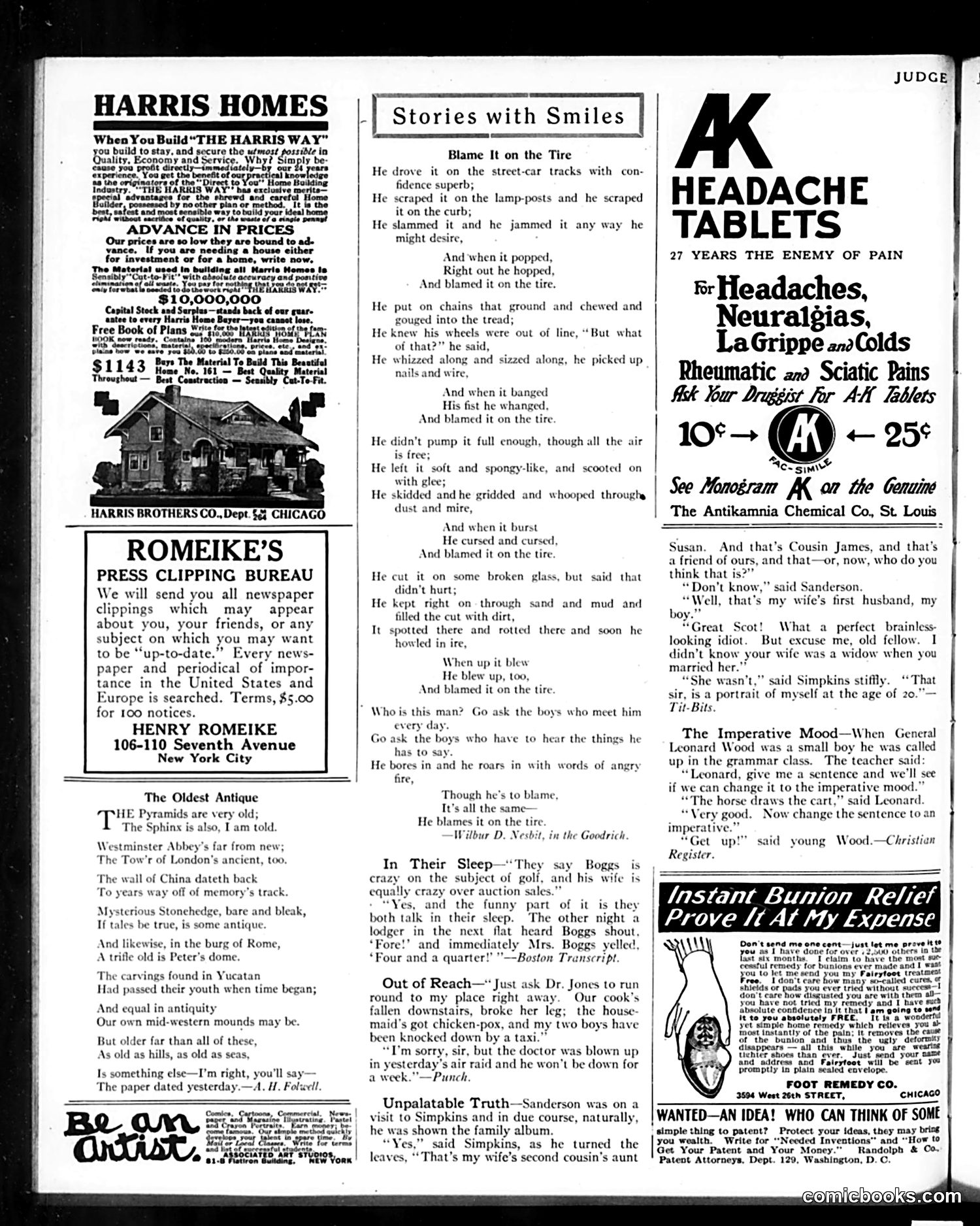
This humorous poem satirizes a chronic complainer—a man who recklessly mistreats his automobile tire through negligence (underinflating it, driving carelessly, picking up nails, cutting it on glass) yet consistently blames external circumstances rather than accepting responsibility. Each stanza follows the same pattern: he abuses the tire, it fails, and he curses "the tire" itself rather than his own actions. The satire targets a recognizable social type: the perpetual griper who "bores in and roars in with words of angry fire" to anyone who will listen, yet refuses accountability. The poem's repetitive structure reinforces how predictably and absurdly this person deflects blame. Published in *Judge*, a satirical magazine, it mocks both mechanical ignorance and the broader human tendency to externalize fault—a timeless character flaw made concrete through the then-familiar frustrations of early automobile ownership.
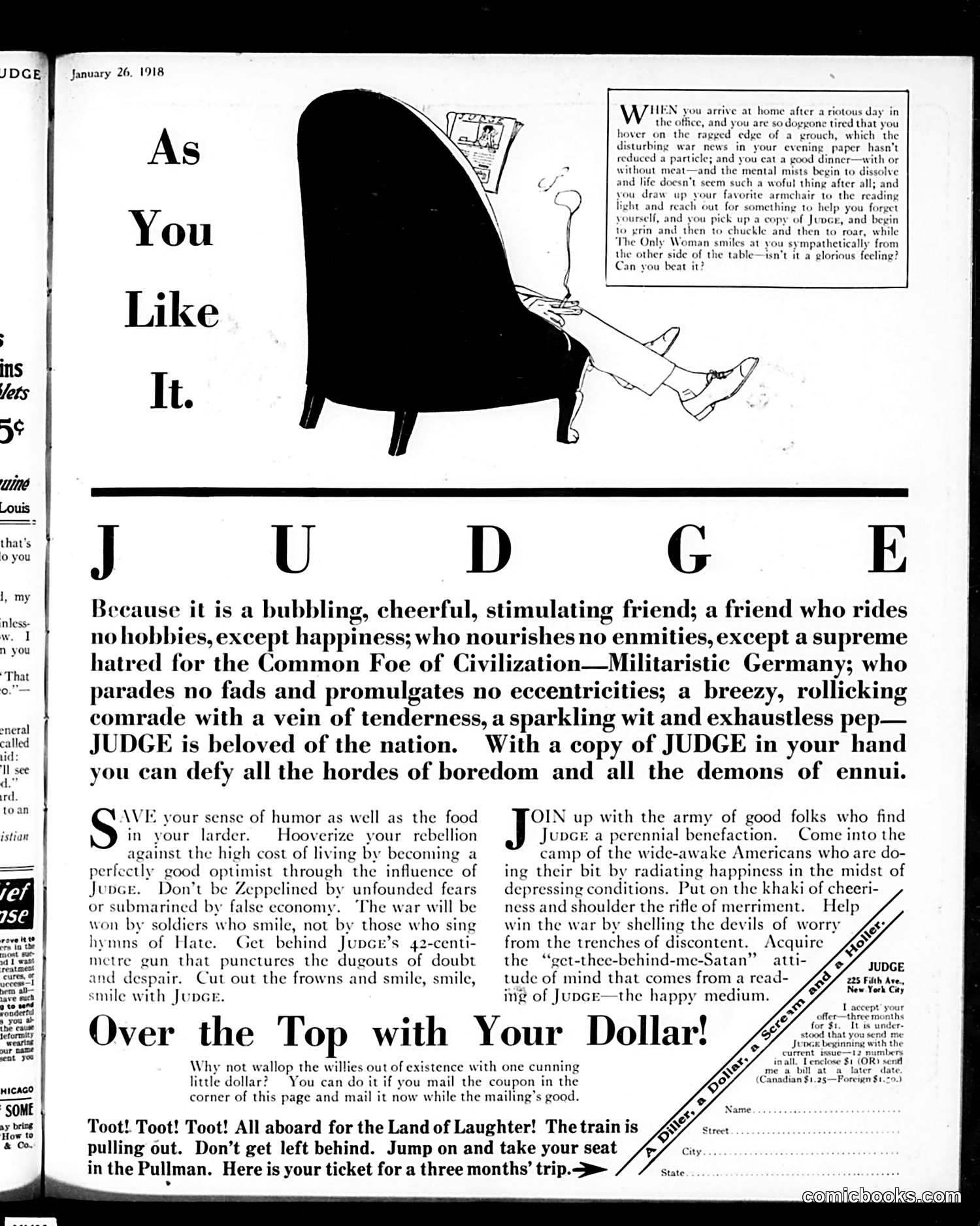
This is a promotional page for *Judge* magazine itself, framed as wartime morale-boosting propaganda. The central figure—a silhouette of a person relaxing in a chair—represents the weary American worker seeking relief from war anxiety and domestic hardship. The satire targets middle-class anxieties during World War I. References to "Hooverize" (rationing under Herbert Hoover's food administration), "Zeppelined" (German airship attacks), and "submarined" (German U-boat warfare) ground the pitch in contemporary fears. The text urges readers to combat wartime depression through humor rather than "hymns of Hate." The "Land of Laughter" and military metaphors ("42-centimetre gun," "over the top," "khaki of cheeriness") repurpose combat language to describe *Judge*'s role as psychological warfare against despair. Essentially, the magazine sells itself as patriotic duty—reading *Judge* becomes a form of civilian morale-building that supports the war effort. The subscription coupon at bottom converts this emotional appeal into sales.
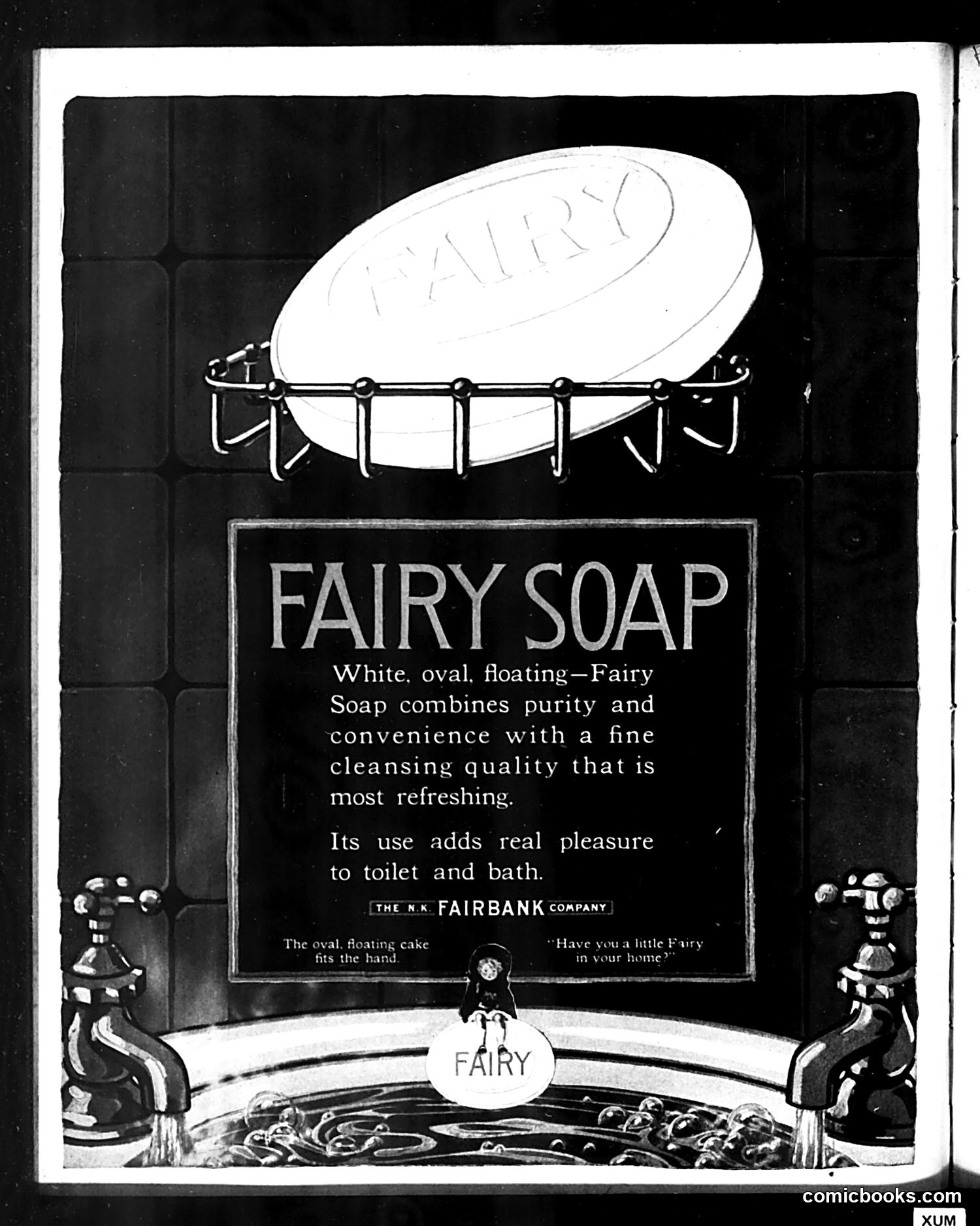
This page is a straightforward **advertisement, not satire or political commentary**. It promotes Fairy Soap by the R.K. Fairbank Company, emphasizing the product's practical virtues: it's white, oval-shaped, and notably *floats*—a significant selling point for bath soap at the time, as it prevents loss down the drain. The visual imagery shows the soap cake suspended in an elegant bathtub fixture, flanked by decorative faucets. The taglines highlight convenience ("fits the hand") and aspirational pleasure ("adds real pleasure to toilet and bath"). This appears to be a vintage print advertisement from Judge magazine, likely early-to-mid 20th century. It contains no political message or social commentary—simply product marketing emphasizing cleanliness, quality, and household utility typical of the era's advertising approach.