
Judge, 1918-01-26 · page 12 of 28
Judge — January 26, 1918 — page 12: what you’re looking at
What you’re looking at
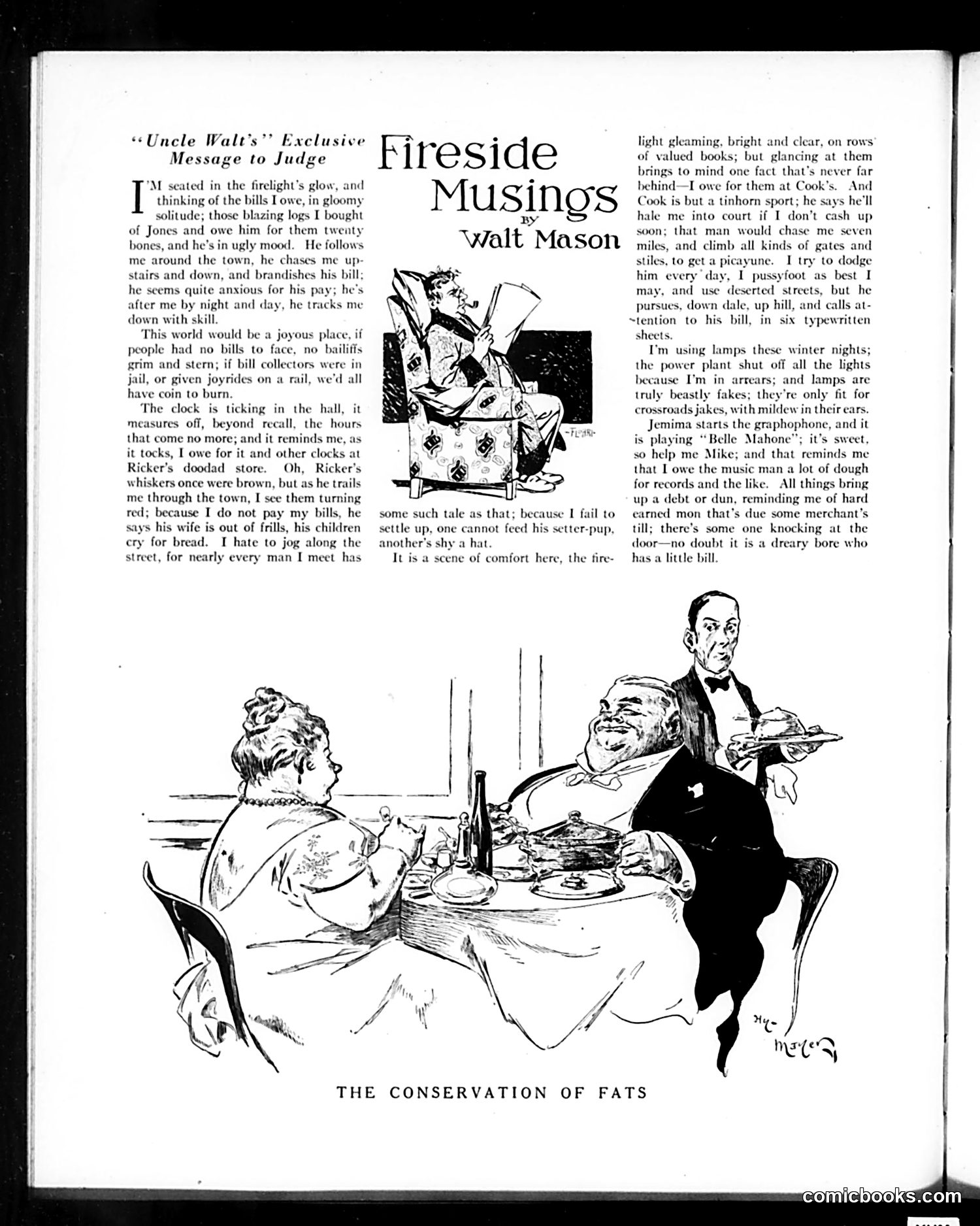
This page features two satirical pieces about debt and financial hardship, likely from the early 20th century. **Main Text:** Walt Mason's poem depicts a man drowning in unpaid bills. Despite sitting comfortably by his fireplace surrounded by books, he cannot enjoy any aspect of his life—not even purchased goods or utilities—because bill collectors pursue him relentlessly. He owes money to Jones for firewood, Ricker for clocks, Cook for books, and various merchants for goods. The humor lies in the relatable exasperation: every comfort he tries to enjoy comes with the reminder of debt owed. **Bottom Cartoon ("The Conservation of Fats"):** Shows a well-fed couple dining while a thin waiter serves them. The caption suggests ironic commentary on "conservation"—the wealthy couple appears to be conserving nothing while food and resources pass before them, contrasting with Depression-era scarcity concerns. The satire critiques wealth inequality and frivolous consumption among the affluent. Both pieces mock financial anxiety and social inequality with period-appropriate humor.
📄 Transcribed text from this page (OCR, searchable)
Machine-transcribed from the original scan — historical spelling and the odd misread are preserved.
“Uncle Walt’s”’ Exclusive Message to Judge 'M seated in the firelight’s glow, and thinking of the bills I owe, in gloomy solitude; those blazing logs I bought of Jones and owe him for them tweaty bones, and he’s in ugly mood. He follows me around the town, he chases me up stairs and down, and brandishes his bill; he seems quite anxious for his pay; he's after me by night and day, he tracks me down with skill This world would be a joyous place, if people had no bills to face, no bailiffs grim and stern; if bill collectors were in jail, or given joyrides on a rail, we'd all have coin to burn. The clock is ticking in the hall, it measures off, beyond recall, the hours that come no more; and it reminds me, it tocks, I owe for it and other cloc! Ricker’s doodad store. Oh, Ricker’s whiskers once were brown, but as he trails me through the town, I see them turning because I do not pay my bills, he says his wife is out of frills, his children cry for bread. I hate to jog along the street, for nearly every man I meet has Fireside Musings BY Walt Mason some such tale as that; because I fail to settle up, one cannot feed his setter-pup, another's shy a hat. It is a scene of comfort here, the fire- light gleaming, bright and clear, on rows of valued books; but glancing at them brings to mind one fact that’s never far behind—I owe for them at Cook’s. And Cook is but a tinhorn sport; he says he'll hale me into court if I don’t cash up soon; that man would chase me seven miles, and climb all kinds of gates and stiles, to get a picayune. I try to dodge him everyday, I pussyfoot as best I may, and use deserted streets, but he pursues, down dale, up hill, and calls at- ~tention to his bill, in six typewritten sheets. I'm using lamps these winter nights; the power plant shut off all the lights because I'm in arrears; and lamps are truly beastly fakes; they're only fit for crossroads jakes, with mildew in their ears Jemima starts the graphophone, and it is playing “Belle Mahone”; it’s sweet, so help me Mike; and that reminds me that I owe the music man a lot of dough for records and the like. All things bring up a debt or dun, reminding me of hard earned mon that’s due some merchant's till; there’s some one knocking at the door—no doubt it is a dreary bore who has a little bill. sar Ga / mS) THE CONSERVATION OF FATS