
Judge, 1918-01-26 · page 14 of 28
Judge — January 26, 1918 — page 14: what you’re looking at
What you’re looking at
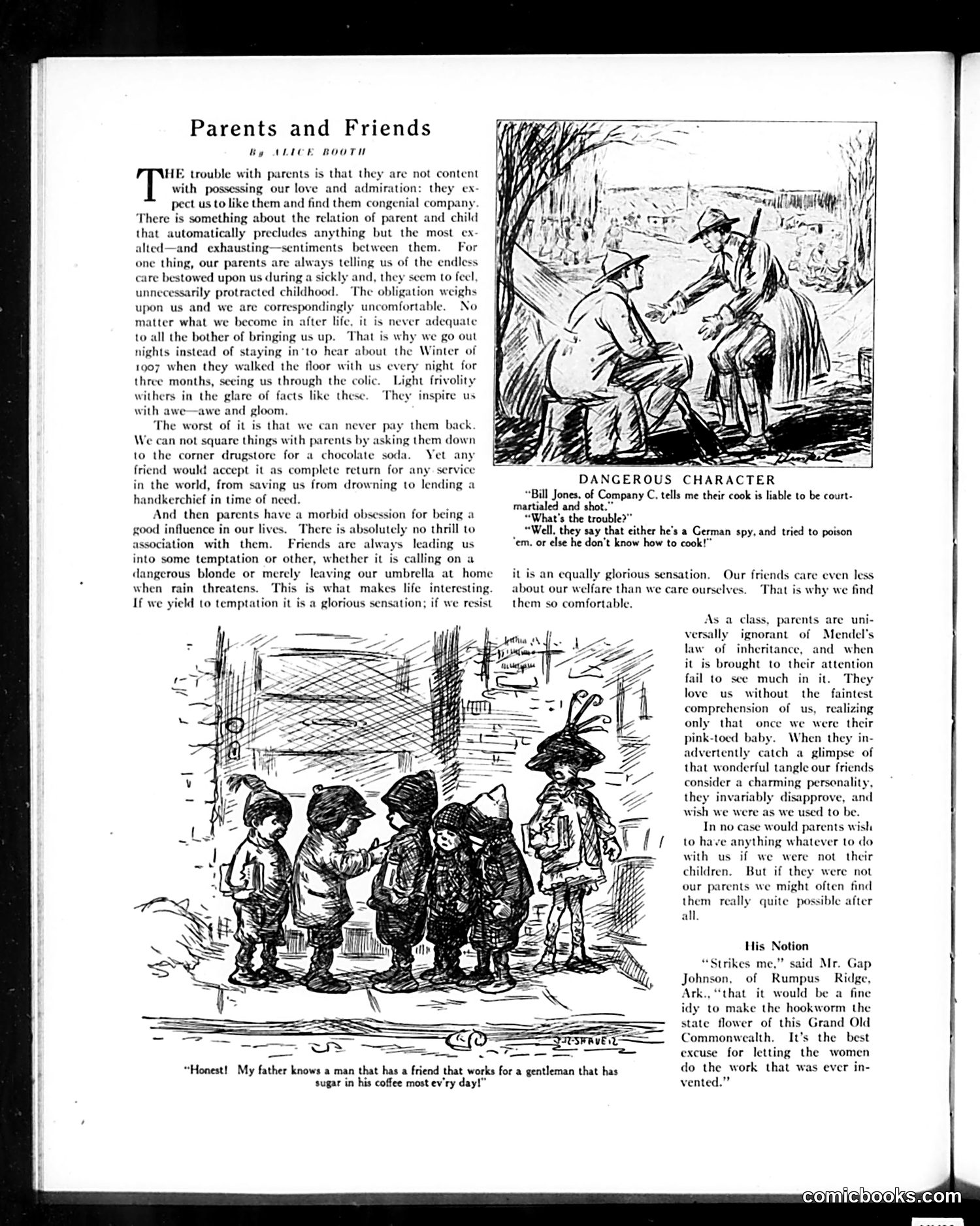
This satirical essay by Alice Root humorously critiques the generational gap between parents and children. The piece argues that while parents demand gratitude and filial devotion in return for childhood care, this obligation creates an unequal, uncomfortable relationship. Friends, by contrast, are "comfortable" because they make no such demands and actively encourage questionable behavior. The two cartoon vignettes illustrate this theme: the first shows children sharing absurd gossip (one child exaggerating a tenuous social connection about sugar in coffee), while the second depicts a WWI-era soldier anecdote about a cook accused of being a German spy or incompetent cook—illustrating how friends bond through amusing, inconsequential stories without moral judgment. The final sidebar by "Mr. Gap Johnson" satirizes Southern attitudes, joking that hookworms should be the state flower as an excuse to exempt women from work—likely a dig at regional backwardness. The satire ultimately defends youthful irreverence against parental disapproval.
📄 Transcribed text from this page (OCR, searchable)
Machine-transcribed from the original scan — historical spelling and the odd misread are preserved.
Parents and Friends By ALICE ROOT HE trouble with parents is that they are not content T with possessing our love and admiration: they ex- pect us to them and find them congenial company. ‘There is something about the relation of parent and child that automatically precludes anything but the most ex alted—and_ exhausting—sentiments between them. For one thing, our parents are always telling us of the endless care bestowed upon us during a sickly and, they seem to feel, unnecessarily protracted childhood. ‘The obligation weighs upon us and we are correspondingly uncomfortable. No matter what we become in after | it is never adequate to all the bother of bringing us up. That is why we go out nights instead of staying in‘to hear about the Winter of 1007 when they walked the floor with us every night for three months, seeing us through the colic. Light frivolity withers in the glare of facts like these. They inspire us with awe—awe and gloom. The worst of it is that we can never pay them back We can not square things with parents by asking them down to the corner drugstore for a chocolate soda. Yet any friend would accept it as complete return for any. service in the world, from saving us from drowning to lending a handkerchief in time of need. And then parents have a morbid obsession for being a good influence in our lives. There is absolutely no thrill to association with them. Friends are always leading us into some temptation or other, whether it is calling on a dangerous blonde or merely leaving our umbrella at home when rain threatens. This is what makes life interesting. If we yield to temptation it is a glorious sensation; if we re “Honest! My father knows a man that has a friend that works for a gentleman that has sugar in his coffee most ev'ry day!” “Bill Jones, of Company C. tells me their cook is liable to be court- martialed and shot.” “What's the trouble?” _ “Well, they say that either he’s a German spy, and tried to poison ‘em. or else he don’t know how to cook!” Our friends care even less it is an equally glorious sensation. That is why we find about our welfare than we care ourse them so comfortable. As a class, parents are uni versally ignorant of Mendel’s law of inheritance, and when it is brought to their attention fail to see much in it. love us without the comprehension of us, realizing only that once we were their pink-toed baby. When they in- advertently catch a glimpse of that wonderful tangle our friends. consider a charming personality, they invariably disapprove, and wish we were as we used to be. In no case would parents wish to have anything whatever to do. with us if we were not their children. But if they were not our parents we might often find them really quite possible after all. “Strikes me,” said Mr. Gap Johnson, of Rumpus Ridge, Ark., “that it would be a fine idy to make the hookworm the state flower of this Grand Old Commonwealth, It's the best excuse for letting the women do the work that was ever in- vented.”