
Judge, 1918-01-26 · page 21 of 28
Judge — January 26, 1918 — page 21: what you’re looking at
What you’re looking at
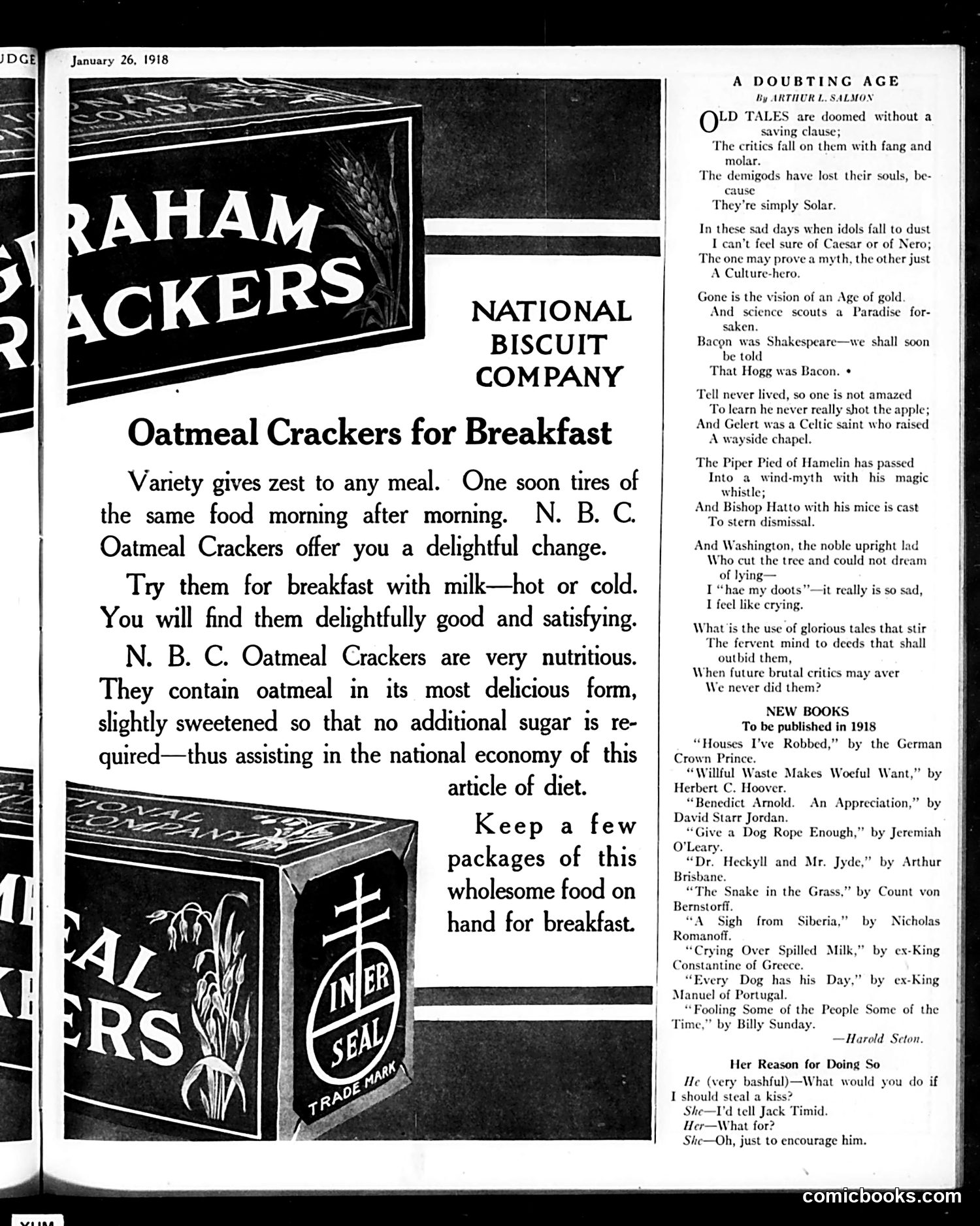
This page combines an advertisement with satirical poetry. The poem, by Arthur L. Salmon, mocks contemporary scholarly debunking of historical and legendary figures—a trend of the era. Salmon laments how modern "science scouts" are dismissing famous figures as myths or frauds: Bacon may have written Shakespeare's works; Tell never shot an apple; Washington's cherry tree story is false. The satire targets early-20th-century higher criticism and mythological scholarship that questioned historical authenticity. The mock book titles reinforce this: "Houses I've Robbed" (credited to the German Crown Prince), "Crying Over Spilled Milk" (ex-King Constantine)—suggesting even current leaders' legacies will be debunked. The accompanying N.B.C. Oatmeal Crackers advertisement is unrelated content, typical of Judge's mixed format. The page's humor assumes readers recognize the scholarly fashion for "demythologizing" history that characterized the period.
📄 Transcribed text from this page (OCR, searchable)
Machine-transcribed from the original scan — historical spelling and the odd misread are preserved.
A DOUBTING AGE By ARTHUR L.. SALMON LD TALES are doomed without a saving clause; The critics fall on them with fang and molar. The demigods have lost their souls, be- cause They're simply Solar. In these sad days when idols fall to dust I can’t feel sure of Caesar or of Nero; The one may prove a myth, the other just A Culture-hero. Gone is the vision of an Age of gold And science scouts a Paradise for- NATIONAL saken. B I SC U IT Bacon was Shakespeare—we shall soon be told COMPANY That Hogg was Bacon. + Tell never lived, so one is not amazed To learn he never really shot the apple; And Gelert was a Celtic saint who raised Oatmeal Crackers for Breakfast pee ai * . . 5 The Piper Pied of Hamelin has passed . Variety gives zest to any meal. One soon tires of Unto: & wins-myaby, with his: magic And Bishop Hatto with his mice is cast the same food morning after moming. N. B. C. rroistent dismissal Oatmeal Crackers offer you a delightful change. And Washington, the noble upright lad Who cut the tree and could not dream i rn lying— them for breakfast with milk—hot or cold. hae oots”—it really isso sad, Try I feel like crying. You will find them delightfully good and satisfying. What ‘is the use of glorious tales that stir The fervent mind to deeds that shall N. B. C. Oatmeal Crackers are very nutritious. outbid them, . * . ar When future brutal critics may aver They contain oatmeal in its most delicious form, We never did them? . - : NEW BOOKS slightly sweetened so that no additional sugar is re- To be published in 1918 6 . . . “Houses I’ve Robbed,” by the German quired—thus assisting In the national economy of this | crown Prince. . ° “Willful Waste Makes Woeful Want,” by article of diet. Herbert C. Hoover. “Benedict Arnold. An Appreciation,” by id Starr Jordan. Keep a few “G » a Dog Rope Enough,” by Jeremiah packages of this wholesome food on Bernstorff. hand for breakfast. “A Sigh from Siberia,” by Nicholas Romanoff. “Crying Over Spilled Milk,” by ex-King Constantine of Greece. “Every Dog has his Day,” by ex-King Manuel of Portugal. “Fooling Some of the People Some of the Time,” by Billy Sunday. —Harold Seton. Her Reason for Doing So He (very bashful)—What would you do if I should steal a kiss? | She—I'd tell Jack Timid. Her—What for? She—Oh, just to encourage him. comicbooks.com