
Judge, 1918-01-26 · page 15 of 28
Judge — January 26, 1918 — page 15: what you’re looking at
What you’re looking at
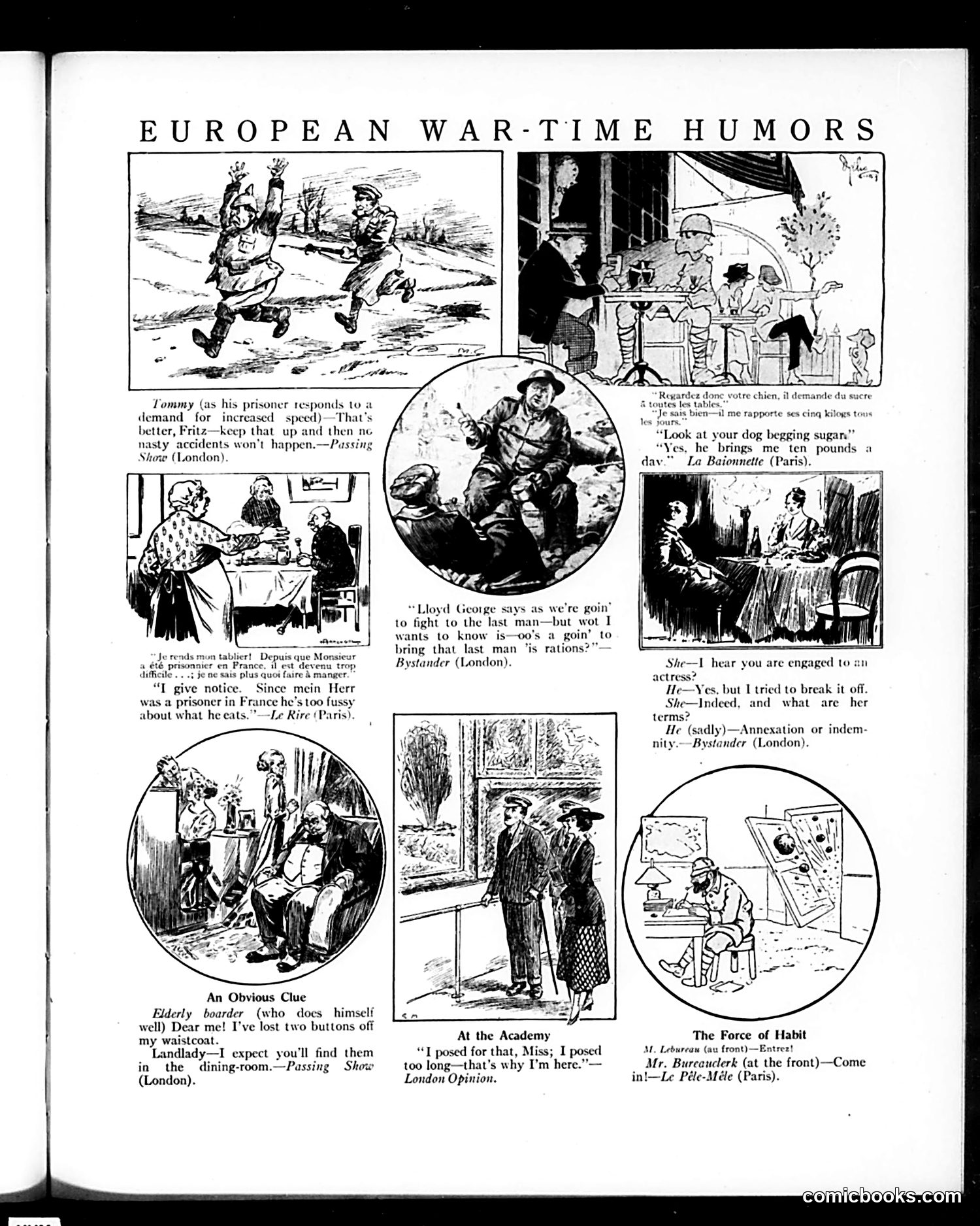
This page collects satirical cartoons from Allied and neutral publications during World War I, using humor to comment on wartime conditions and attitudes. Key themes include: **Military discipline & rationing**: Jokes about German prisoners being driven hard ("keep that up"), and concerns about feeding troops through war's end (Lloyd George reference). **Home front anxieties**: Lost buttons, romantic entanglements, and the strain on civilians—including a woman breaking off an engagement with demanding terms of "annexation or indemnity" (a joke equating personal relationships to territorial disputes). **Allied mockery of Germans**: References to "Fritz" (typical German name) suggest contempt for enemy soldiers and their supposed fusspot attitudes about food. **Class commentary**: Elderly boarders and landlords represent domestic preoccupations continuing despite war. The cartoons are reprinted from *Passing Show*, *London Opinion*, *Le Rire*, and *La Baionnette*—publications from Britain and France using humor as morale-boosting propaganda while satirizing both enemy and home-front conditions.
📄 Transcribed text from this page (OCR, searchable)
Machine-transcribed from the original scan — historical spelling and the odd misread are preserved.
was a prisoner in France he’s too fussy about what he eats.’’—Le Rire (Paris). An Obvious Clue Elderly boarder (who docs himseli well) Dear me! I've lost two buttons off my waistcoat. At the Academy i Landlady—I expect you'll find them “T posed for that, Miss; I posed in the dining-room.—Passing Show too long—that’s why I’m here.”"— (London). London Opinion. Tommy (as his prisoner responds to a demand for increased speed) —That's better, Fritz—keep that up and then no nasty ‘accidents won't happen.—Passing Show (London). = ts < x .\ 4 q . “Lloyd George says as we're goin” | (| ri y to fight to the last man—but wot I b wants to know is—oo's a goin’ to . re bring that last man ‘is rations?”— Bystander (London). sais plus qu “T give not Since mein Herr M. Lebureau (au front)—Entrez! Mr. Burcauclerk (at the front)—Come in!—Le Péle-Méle (Paris). il demande du sucre ses cing kilogs t “Look at your dog begging sugan”” . he brings me ten pounds a La Baionnette (Paris). Yes, but I tried to break it off. She—Indeed, and what are her terms? He (sadly)—Annexation or indem- nity.-Bystander (London). The Force of Habit