
Judge, 1918-01-26 · page 16 of 28
Judge — January 26, 1918 — page 16: what you’re looking at
What you’re looking at
This page reviews "Why Marry?" by Brieux, a contemporary play (text references it as "the cleverest play written in America in years"). The dialogue frames a debate between a Careful Mother and a Critic about whether the play is appropriate for young women. The satire targets Victorian prudishness: the Mother fears the play is "unconventional," while the Critic praises it as moral philosophy disguised as comedy. The play apparently argues that church-sanctioned marriages can be less sincere than "free unions" based on love—a radical position for the era. The joke is that the Critic's assurances that the play is "constructively moral" actually make it *more* scandalous by showing respectable marriage as hypocritical. The Mother's final hesitation—"Perhaps I shall"—suggests she's been persuaded by reverse psychology: being told to see it herself makes her curious despite her disapproval.
📄 Transcribed text from this page (OCR, searchable)
Machine-transcribed from the original scan — historical spelling and the odd misread are preserved.
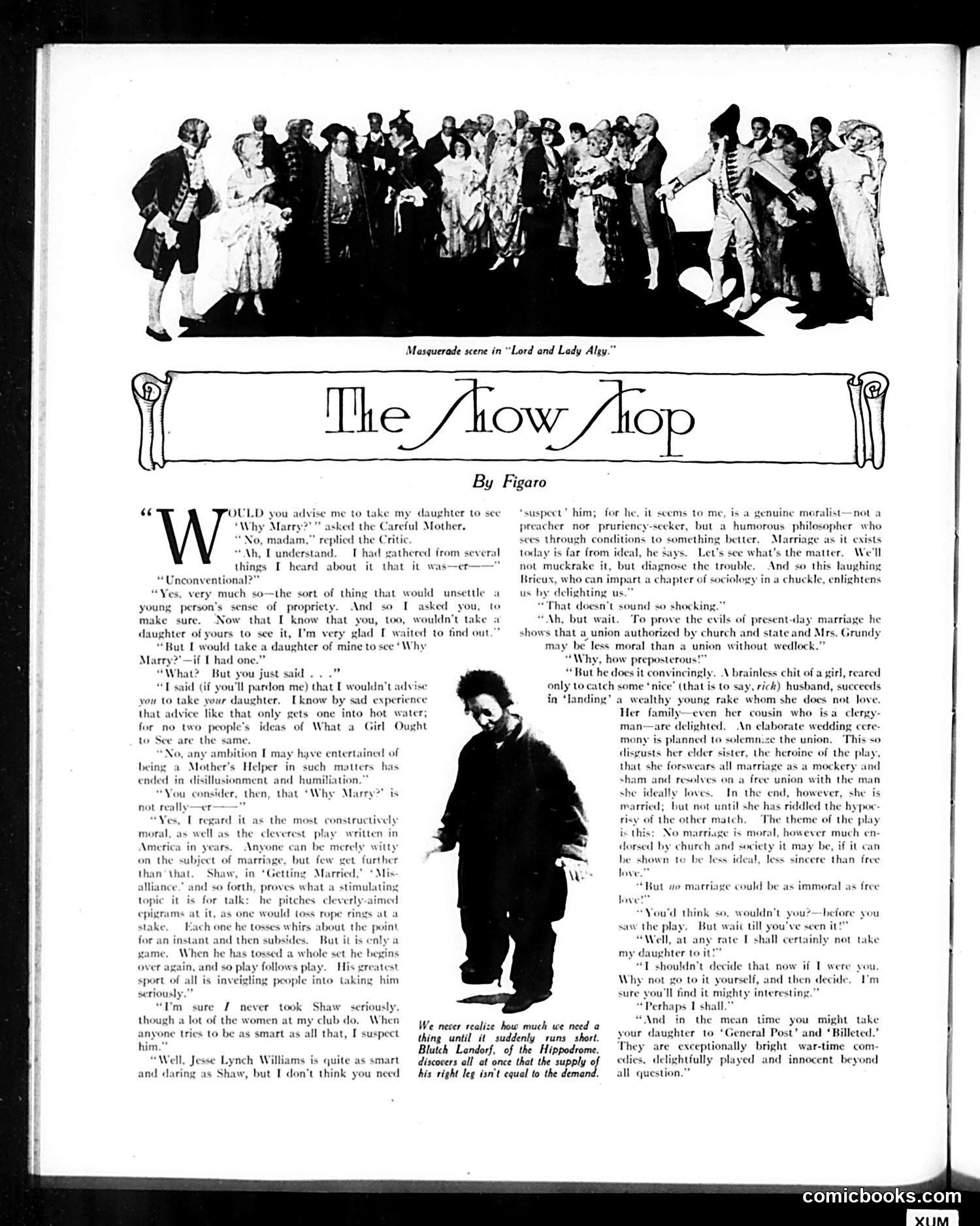
Masquerade scene in “Lord and Lady Aley.” By Figaro OULD you advise me to take my daughter to see ‘suspect’ him; for he, it seems to me, is a genuine moralist—not a ‘Why Marry?’ asked the Careful Mother. preacher nor pruriency-secker, but a humorous philosopher who *No, madam,” replied the Critic sees through conditions to something better. Marriage as it exists “\h, Dunderstand. Thad gathered from several today is far from ideal, he Says. Let’s see what’s the matter. We'll things T heard about it that it was—er——" not muckrake it, but diagnose the trouble. And so this laughing “Unconventional?” Bricux, who can impart a chapter of sociology in a chuckle, enlightens “Yes, very much so—the sort of thing that would unsettle a us by delighting us young person’s sense of propriety. And so [ asked you, ¢ “That doesn’t sound so shocking.” make sure. Now that I know that you, too, wouldn't take a “Ah, but wait. To prove the evils of present-day marriage he daughter of yours to sce it, I'm very glad [ waited to find out.” shows that a union authorized by church and state and Mrs. Grundy “But [ would take a daughter of mine to see ‘Why may be less moral than a union without wedlock.” Marry?’—if I had one.” “Why, how preposterous!” What? But you just said... “ But he does it convincingly. .\ brainless chit of a girl, reared “T said (if you'll pardon me) that [ wouldn't advise only to catch some ‘nice’ (that is to say, rick) husband, succeeds you to take your daughter. [know by sad experience in ‘landing’ a wealthy young rake whom she does not love. that advice like that only gets one into hot water; Her family—even her cousin who isa clergy for no two people's ideas of What a Girl Ought man—are delighted. An elaborate wedding cere- to Sce are the same. mony is planned to solemnize the union. This so yy ambition T may have entertained of disgusts her elder sister, the heroine of the play, being a Mother’s Helper in such matters has that she forswears all marriage as a mockery and din disillusionment and humiliation sham and resolves on a free union with the man “You consider, then, that ‘Why Marry?” is she ideally loves. In the end, however, she is not really —er _ married; but not until she has riddled the hypoc Yes, [ regard it as the most constructively . risy of the other match. The theme of the play moral, as well as the cleverest play. written in is this: No marriage is moral, however much en America in years, Anyone can be merely witty P dosed by church and society it may be, if it can on the subject of marriage, but few get further be shown to be less ideal, less sincere than free than Vhat. Shaw, in ‘Getting Married,’ * Mis we love,” alliance,’ and so forth, proves what a stimulating “But vo marriage could be as immoral as free topic it is for talk: he pitches cleverly-aimed love!” epigrams at it, as one would Loss rope rings at a “You'd think so, wouldn't you?—hefore you stake. Each one he tosses whirs about the point saw the play. But wait till you've seen it!” for an instant and then subsides. But it is enly @ Well, at any rate T shall certainly not take xame, When he has tossed a whole set he begins my daughter to it!” over again, and so play follows play. His greatest “T shouldn't decide that now if T were you sport of all is inveigling people into taking him Why not go to it yourself, and then decide. I'm seriously.” sure you'll find it mighty interesting “Lm sure J never took Shaw seriou Perhaps I shall though a lot of the women at my club do. When — ye never realize how much we need @ “And in the mean time you might take anyone tries to be as smart as all that, F suspect hing “until it suddenly runs short, YOUr daughter to ‘General Post’ and ‘Billeted. him Blutch Londorf. of the Hippodrome, They are exceptionally bright war-time com “Well, Jesse Lynch Williams is quite as smart discovers alll at once that the supply of | cdics. delightfully played and innocent beyond and daring as Shaw, but [don’t think you need — Ais right leg isn't equal to the demand. all question.” comicbooks.com