
Judge, 1918-01-26 · page 5 of 28
Judge — January 26, 1918 — page 5: what you’re looking at
What you’re looking at
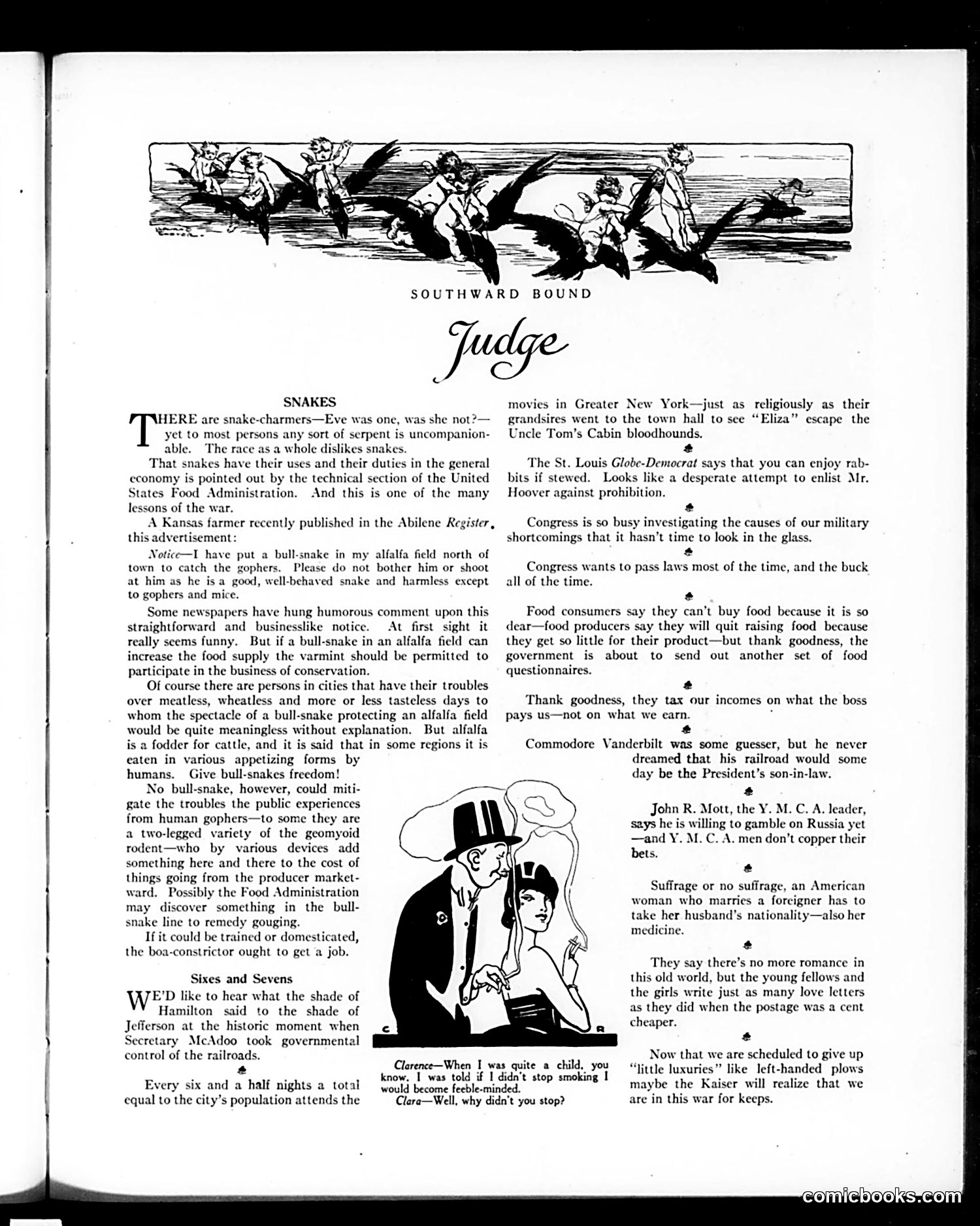
This page contains editorial commentary rather than traditional political cartoons. The main illustration depicts two figures—a man in a top hat and a woman—in what appears to be a romantic or intimate moment, labeled "Clarence" in the dialogue below. The satirical pieces mock various contemporary issues: bull-snakes in alfalfa fields (food supply concerns), Congress's inefficiency, food price disputes between producers and consumers, income taxation, and railroad monopolies under figures like Commodore Vanderbilt. The "Clarence" dialogue jokes about smoking habits and courtship. Overall, Judge targets government inefficiency, economic disputes, and changing social mores of the era—likely early 20th century based on references to taxation and railroad regulation.
📄 Transcribed text from this page (OCR, searchable)
Machine-transcribed from the original scan — historical spelling and the odd misread are preserved.
SR SNAKES HERE are snake-charmers—Eve was one, was she not?— T yet to most persons any sort of serpent is uncompanion- The race as a whole dislikes snake: akes have their uses and their duties in the general economy is pointed out by the technical section of the United States Food Administration. And this is one of the many lessons of the war. farmer recently published in the Abilene Register, Notice—I have put a bull-snake in my alfalfa field north of town to catch the gophers. Please do not bother him or shoot at him as he is a good, well-behaved snake and harmless except to gophers and mice. Some newspapers have hung humorous comment upon this straightforward and businesslike notice. At first sight it really seems funny. But if a bull-snake in an alfalfa field can increase the food supply the varmint should be permitted to participate in the business of conservation. Of course there are persons in cities that have their troubles over meatless, wheatless and more or less tasteless days to whom the spectacle of a bull-snake protecting an alfalfa field would be quite meaningless without explanation. But alfalfa is a fodder for cattle, and it is said that in some regions it is eaten in various appetizing forms by humans. Give bull-snakes freedom! No bull-snake, however, could miti- gate the troubles the public experiences from human gophers—to some they are a two-legged variety of the geomyoid rodent—who by various devices add something here and there to the cost of things going from the producer market- ward. Possibly the Food Administration may discover something in the bull- snake line to remedy gouging. If it could be trained or domesticated, the boa-constrictor ought to get a job. Sixes and Sevens E’D like to hear what the shade of Hamilton said to the shade of Jefferson at the historic moment when Secretary McAdoo took governmental control of the railroads. r Clarence—When 1 was quite a child, you know. I was told if I didn't stop smoking I would become feeble-minded. Clara—Well, why didn’t you stop? Every six and a half nights a total equal to the city’s population attends the SOUTHWARD BOUND movies in Greater New York—just as religiously as their grandsires went to the town hall to see “Eliza” escape the Uncle Tom’s Cabin bloodhounds. # The St. Louis Globe-Democrat says that you can enjoy rab- bits if stewed. Looks like a desperate attempt to enlist Mr. Hoover against prohibition. ¢ Congress is so busy investigating the causes of our military shortcomings that it hasn’t time to look in the glass. s Congress wants to pass laws most of the time, and the buck all of the time. e Food consumers say they can’t buy food because it is so dear—food producers say they will quit raising food because they get so little for their product—but thank goodness, the government is about to send out another set of food questionnaires. 2 Thank goodness, they tax our incomes on what the boss pays us—not on what we earn. : £ Commodore Vanderbilt was some guesser, but he never dreamed that his railroad would some day be the President’s son-in-law. 2 John R, Mott, the Y. M. C. A. leader, says he i: ing to gamble on Russia yet —and Y. M. C. A. men don’t copper their bets. e Suffrage or no suffrage, an American woman who marries a foreigner has to take her husband’s nationality—also her medicine. + They say there’s no more romance in this old world, but the young fellows and the girls write just as many love letters as they did when the postage was a cent cheaper. 2 Now that we are scheduled to give up “little luxuries” like left-handed plows maybe the Kaiser will realize that we are in this war for keeps.