
Judge, 1918-01-26 · page 11 of 28
Judge — January 26, 1918 — page 11: what you’re looking at
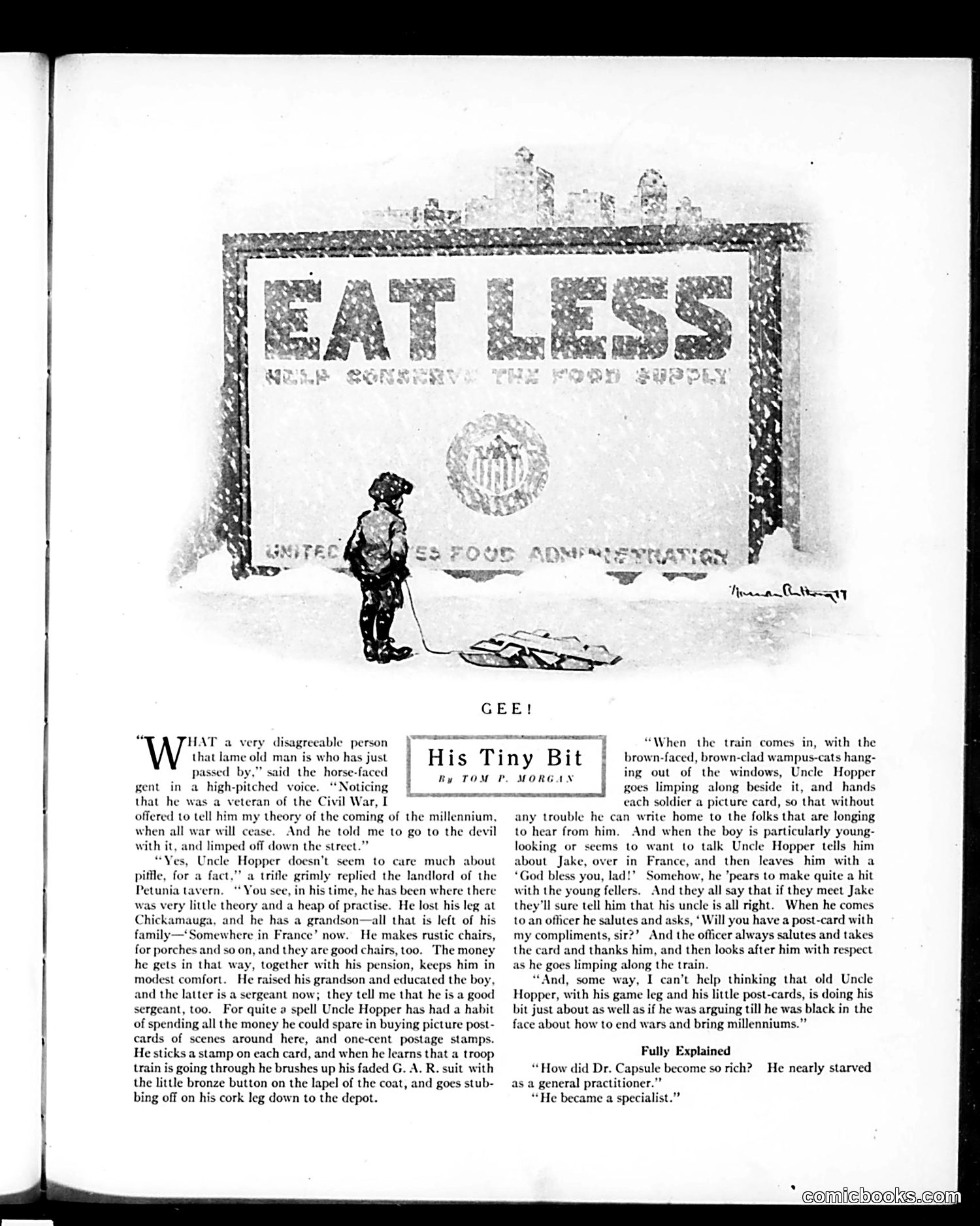
What you’re looking at
The main cartoon depicts an elderly Civil War veteran (Uncle Hopper, identifiable by his wooden leg and G.A.R. button) handing picture postcards to soldiers on a troop train, likely during World War I. The satire contrasts two approaches to supporting the war effort: a verbose young man who lectures about idealistic theories of ending all wars, versus Uncle Hopper—a disabled veteran with practical experience of war's brutality—who quietly supports soldiers through a simple, personal gesture (sending postcards home). The text's point is clear: actual wartime sacrifice and direct service to troops matters more than abstract philosophical arguments about peace. Uncle Hopper's modest contribution—spending his meager pension on postcards and stamps—represents genuine patriotism grounded in experience, not empty rhetoric. The bottom joke about Dr. Capsule is unrelated advertising/filler typical of period magazines.
📄 Transcribed text from this page (OCR, searchable)
Machine-transcribed from the original scan — historical spelling and the odd misread are preserved.
SSS “ve Ty ww n tren Rteny GEE! “ HAT a very disagreeable person W that lame old man is who has just | His Ti passed by,” said the horse-faced | ‘ gent in a high-pitched voice. “Noticing | "" 70™ ? that he was a veteran of the C War, I offered to tell him my theory of the coming of the millennium, when all war will cease. And he told me to go to the devil nd limped off down the street.” Uncle Hopper doesn’t seem to care much about piffle, for a fact,” a trifle grimly replied the landlord of the Petunia tavern. “ou see, in his time, he has been where there was very little theory and a heap of practise. He lost his leg at Chickamauga, and he has a grandson—all that is left of his family— Somewhere in France’ now. He makes rustic chairs, for porches and so on, and they are good c! too. The money he gets in that way, together with his pension, keeps him in modest comfort. He raised his grandson and educated the boy, and the latter is a sergeant now; they tell me that he good sergeant, too. For quite a spell Uncle Hopper has had a habit of spending all the money he could spare in buying picture post- cards of scenes around here, and one-cent postage stamps. He sticks a stamp on each card, and when he learns that a troop train is going through he brushes up his faded G. A. R. suit with the little bronze button on the lapel of the coat, and goes stub- bing off on his cork leg down to the depot. 2 neice “When ny Bit MORGAN the train comes in, with the brown-faced, brown-clad wampus-cats hang- ing out of the windows, Uncle Hopper goes limping along beside it, and hands each soldier a picture card, so that without any trouble he can write home to the folks that are longing to hear from him. And when the boy is particularly young- looking or seems to want to talk Uncle Hopper tells him about Jake, over in France, and then leaves him with a ‘God bless you, lad!’ Somehow, he ‘pears to make quite a hit with the young fellers. And they all say that if they meet Jake they'll sure tell him that his uncle is all right. When he comes to an officer he salutes and asks, ‘Will you have a post-card with my compliments, sir?’ And the officer always salutes and tal the card and thanks him, and then looks after him with respect as he goes limping along the train. “And, some way, I can’t help thinking that old Uncle Hopper, with his game leg and his little post-cards, is doing his bit just about as well as if he was arguing till he was black in the face about how to end wars and bring millenniums.” Fully Explained “How did Dr. Capsule become so rich? He nearly starved as a general practitioner.” “He became a specialist.” * comicbooks,