
A complete issue · 27 pages · 1917
Judge — July 7, 1917
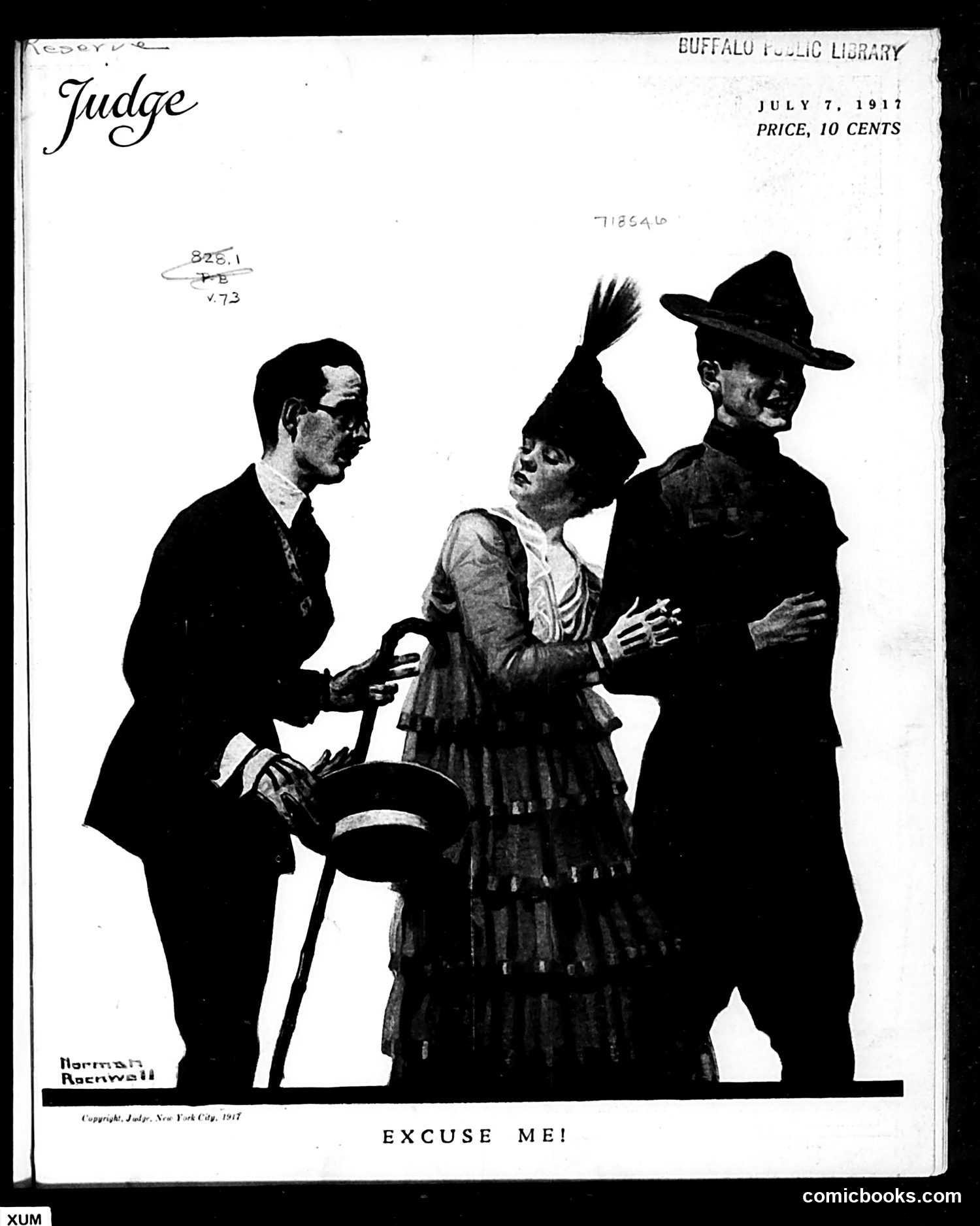
This cartoon by Norman Rockwell depicts a social awkwardness scenario typical of Judge's humor. Two well-dressed men in formal attire (suits and hats) flank a young woman in an elaborate dress with a distinctive high feathered hat. The caption "EXCUSE ME!" suggests an interruption or intrusion on the couple's interaction. The satire likely comments on wartime social etiquette or romantic entanglements during World War I (1917). The woman's fashionable appearance and the men's formal dress suggest upper-class society. The humor derives from the awkward moment of interruption—whether representing unwanted advances, romantic rivalry, or social protocol violations—common themes in Judge's satirical commentary on contemporary manners and morals.
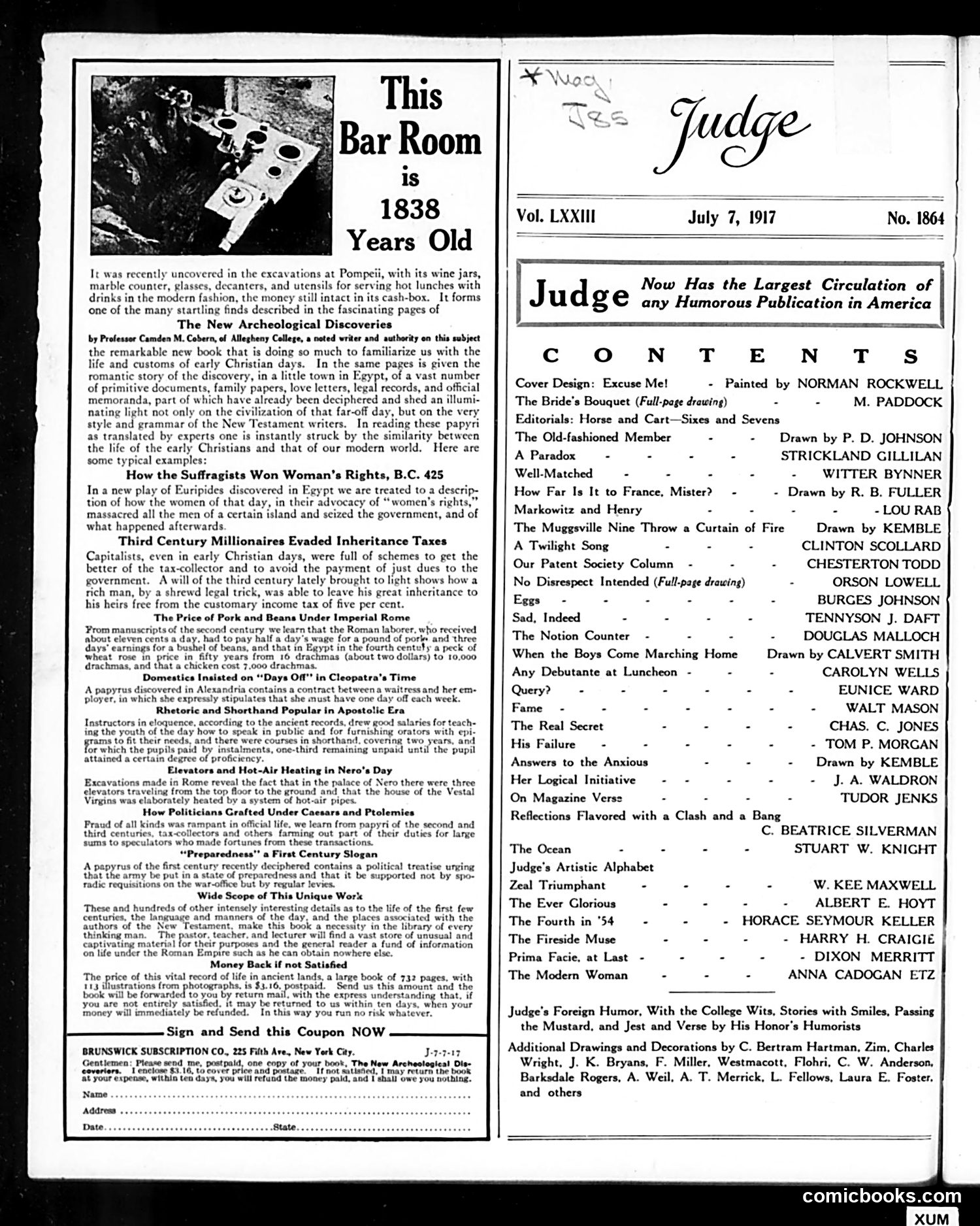
This page is primarily a **table of contents** for Judge's weekly issue, listing articles and illustrations by various contributors. The left side contains an advertisement for a book about a 1,838-year-old Roman bar room excavated at Pompeii, with historical commentary about early Christian customs and New Testament language. The cover design by **Norman Rockwell** is titled "Excuse Me!" The contents suggest typical Judge fare: political satire ("Horse and Cart—Sizes and Sevens"), social commentary, and humorous illustrations. Given the July 1917 date, this was published during American involvement in **World War I** — suggested by the article "When the Boys Come Marching Home." The page itself contains no visible political cartoons to analyze.
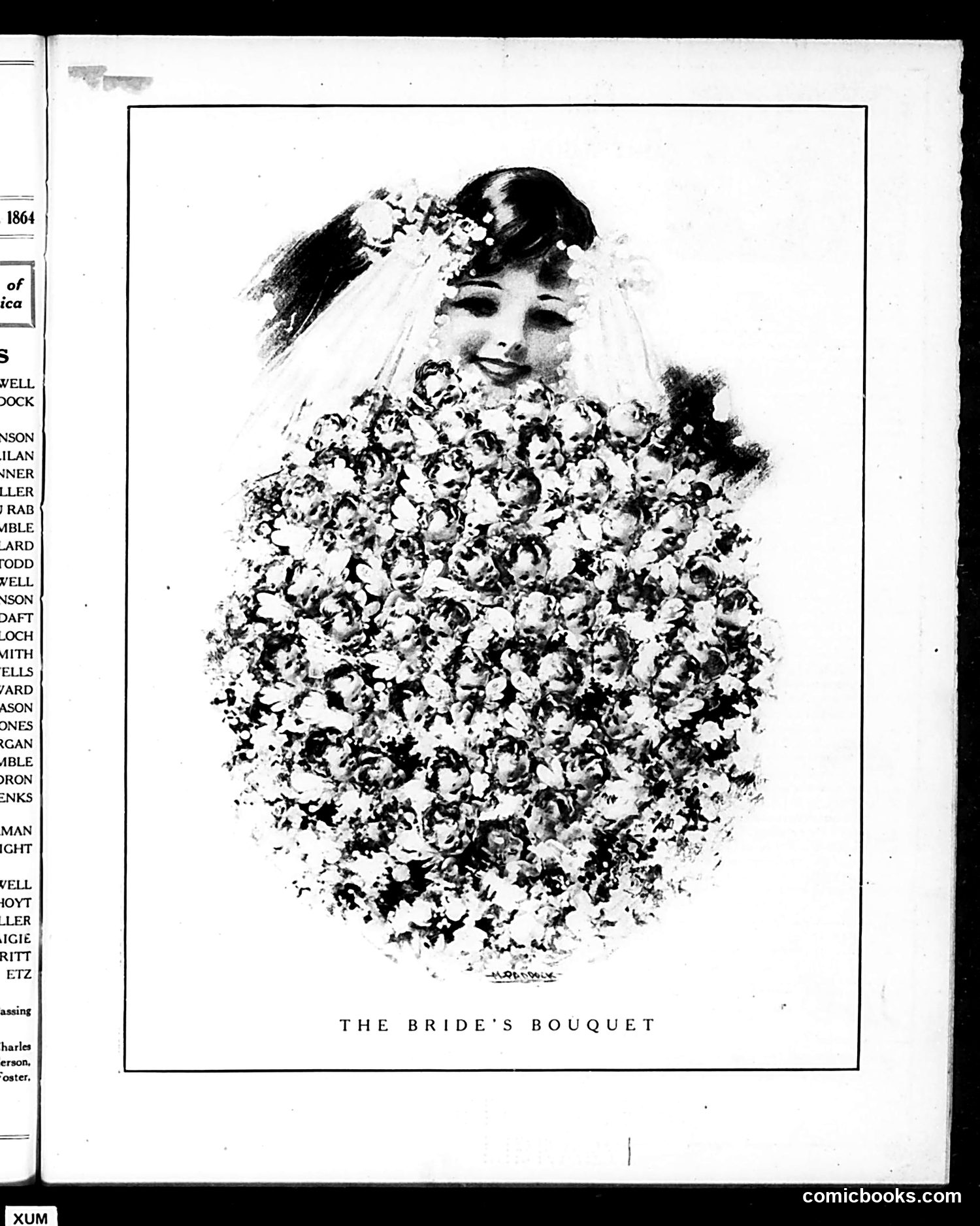
This illustration shows a bride's face above an enormous floral bouquet composed entirely of tiny cherub or baby faces. The title "THE BRIDE'S BOUQUET" is printed below. The satire likely comments on Victorian marriage customs and expectations about fertility and motherhood. By replacing flowers with infant faces, the cartoon sarcastically suggests that a bride's primary value or destiny is producing children. This plays on period anxieties about women's roles—the bouquet, traditionally a symbol of beauty and celebration at weddings, becomes instead a visual joke about the bride's future as a mother. The image reflects Judge magazine's tendency toward commentary on gender roles and domestic life in the late 19th century.
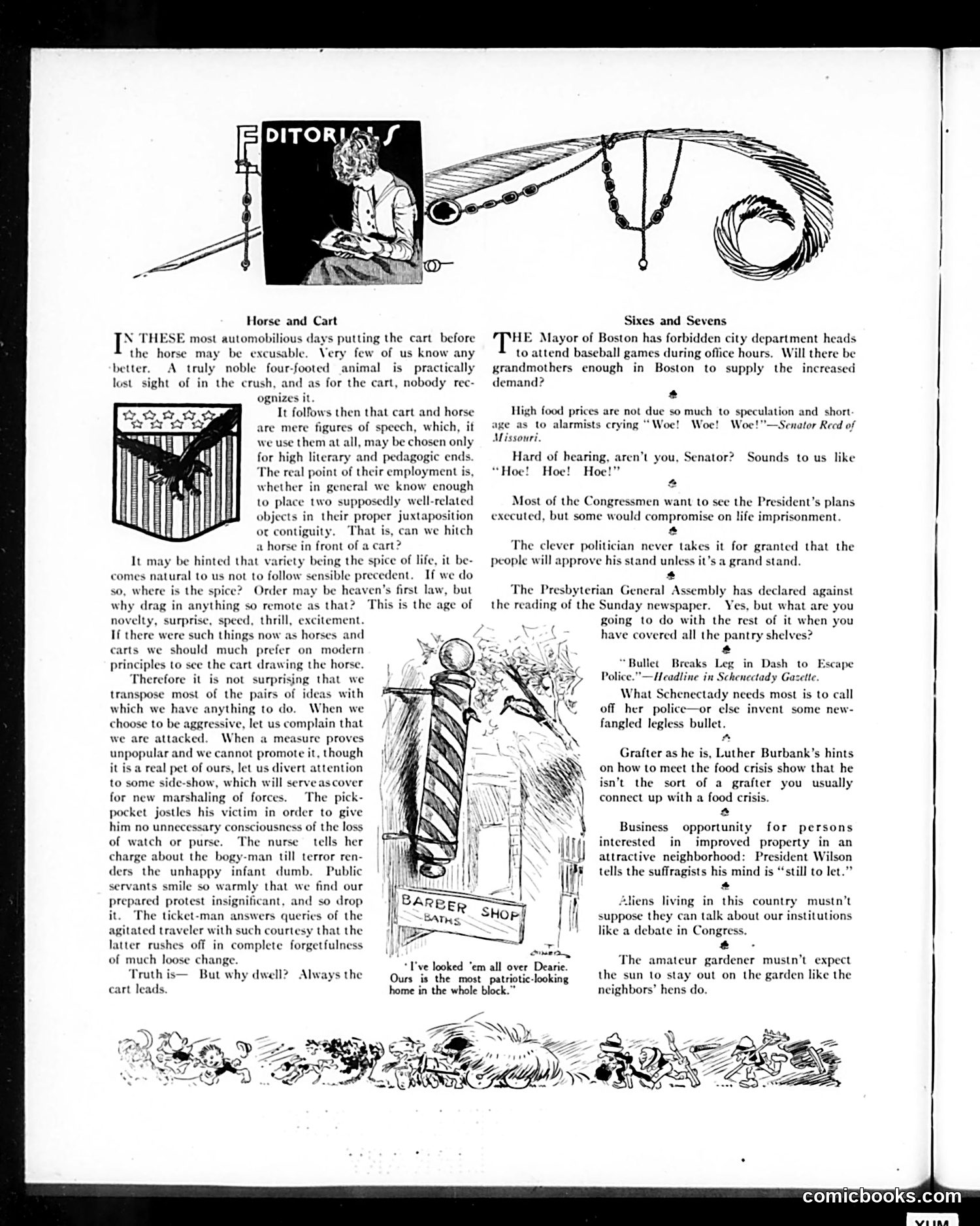
This page contains political commentary and social satire typical of early 20th-century Judge magazine. The left column's "Horse and Cart" essay argues for keeping traditional horse-drawn vehicles, framing modernization skeptically—a common theme as automobiles displaced horses. The right column, "Sizes and Sevens," collects brief satirical quips about contemporary issues: Senator Reed of Missouri's food price complaints, Congressional criticism of the President, the Presbyterian General Assembly's stance on Sunday newspapers, and workplace matters. The central cartoon depicts a bullet escaping a barber shop, illustrating a Schenectady Gazette headline about someone fleeing police—likely darkly humorous commentary on local crime or social disorder. The overall tone reflects Judge's typical approach: mocking politicians, social reformers, and modern anxieties through brief, pointed observations.
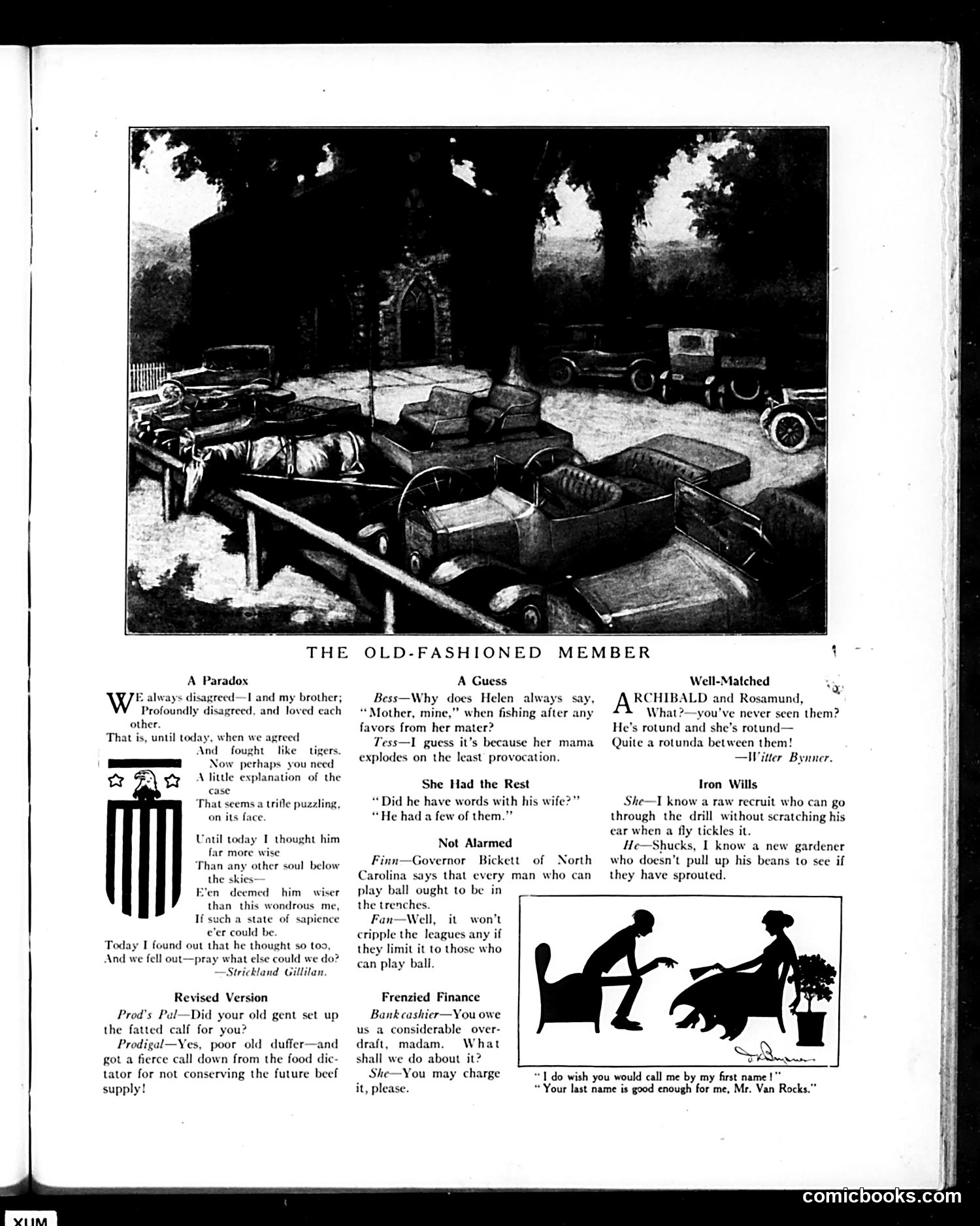
This Judge magazine page satirizes early 20th-century social attitudes and gender relations through brief comedic sketches and dialogue. **"A Paradox"** mocks a man who disagrees with his brother yet holds identical views—suggesting hypocrisy in male bonding over disagreement. **"A Guess"** and related items joke about wives managing husbands' behavior, with Helen allegedly controlling her mate through maternal-style discipline ("explodes on the least provocation"). **"From Willis"** pokes fun at military/gardening incompetence—a gardener can't detect whether plants are sprouting. The **silhouette illustration** shows a woman rejecting formal address ("Mr. Van Rocks"), preferring familiarity—commenting on shifting social conventions regarding propriety and relationships. Overall, the page satirizes outdated masculine authority and changing domestic power dynamics of the era.
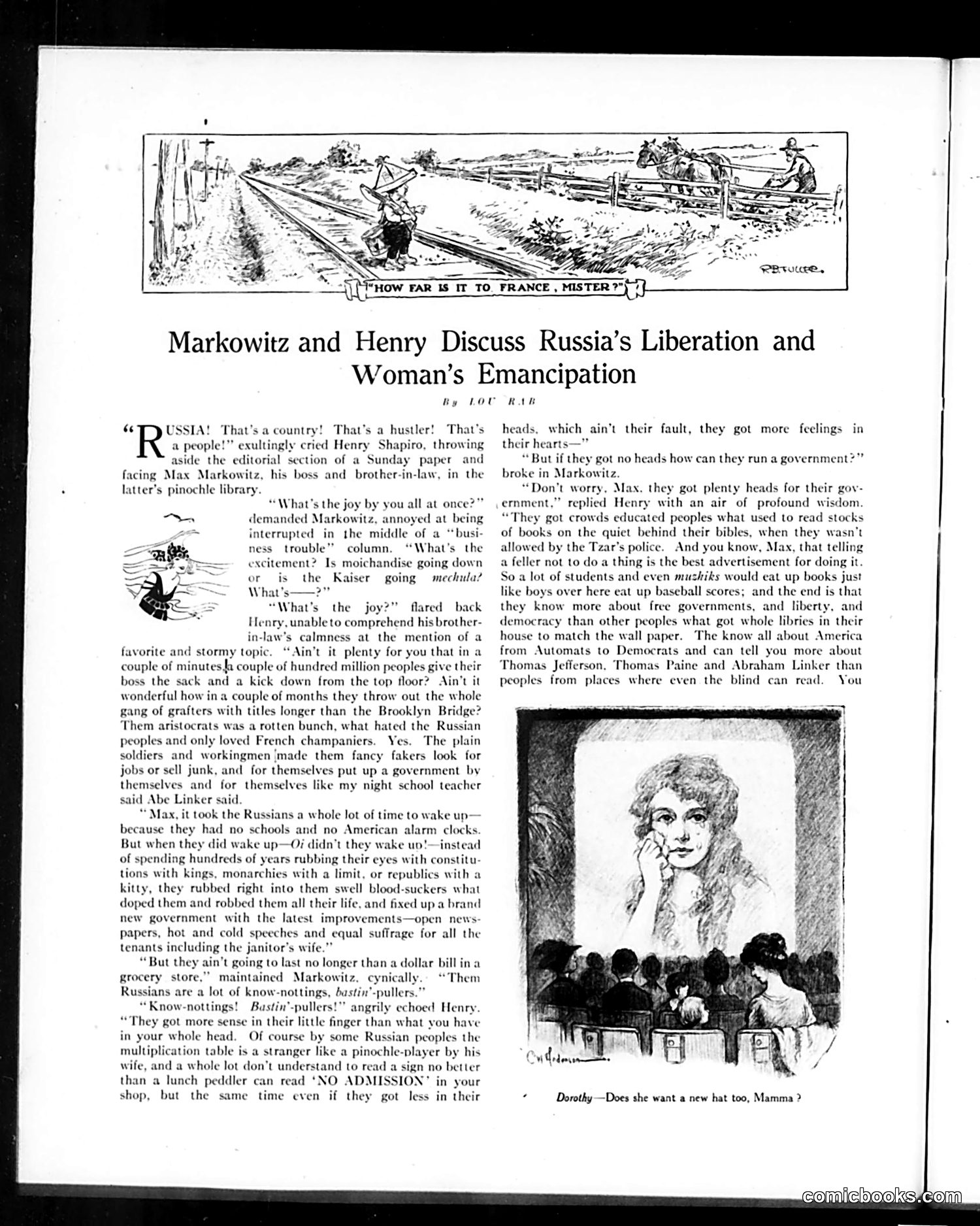
This page satirizes a debate between **Max Markowitz** and **Henry Shapiro** about Russia's recent revolution and women's rights. The dialogue mocks Henry's idealistic enthusiasm for Russian liberation, while Markowitz cynically counters that Russian crowds lack education for self-governance. The satire targets American radicals who romanticize the Russian Revolution. Henry champions Russian democracy and women's suffrage, citing how educated Russians know more about American political figures than average Americans. Markowitz responds that Russians are "know-nothings" and "Bolshie-pullers"—suggesting they're ignorant revolutionaries. The illustration shows a woman asking "Does she want a new hat too, Mama?"—likely mocking women's emancipation as superficial materialism. The page reflects **Judge** magazine's conservative skepticism toward both Russian communism and progressive American causes like women's equality.
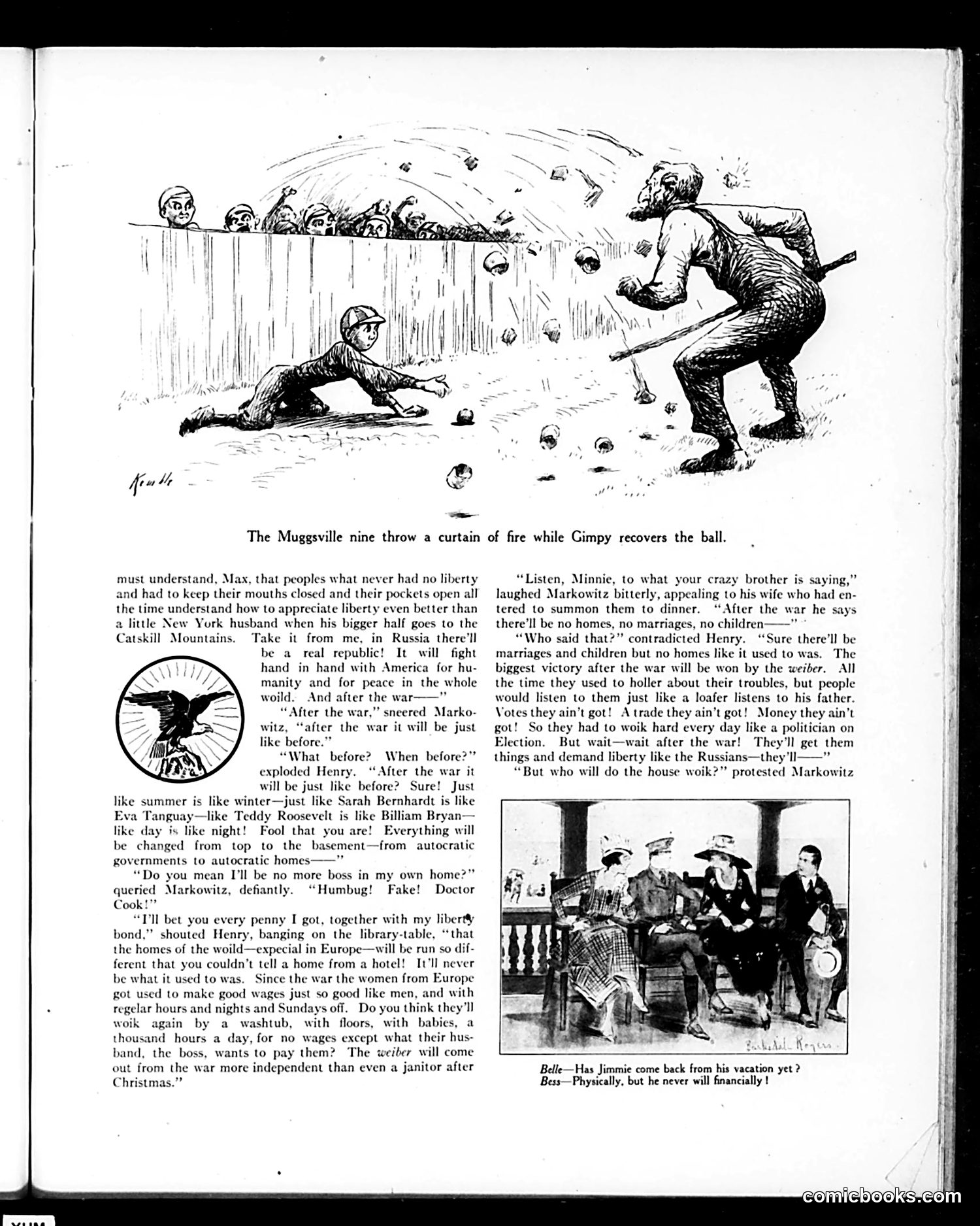
This page satirizes post-WWI optimism about social change, particularly regarding women's liberation and labor rights. The main text features a heated debate between Henry (an idealistic immigrant) and Markowitz (a skeptical traditionalist) about how war will transform society—especially European women's independence and domestic arrangements. Henry argues women will demand voting rights, trades, and freedom from unpaid housework, becoming as independent as "the Russians" (likely referencing Bolshevik revolution rhetoric). Markowitz dismissively counters: "who will do the house work?"—capturing male anxiety about losing domestic control. The top cartoon shows "Muggsville nine" (a baseball team) playing while "Gimpy recovers the ball," likely a mundane sports reference contrasting with the grandiose political debate below. The satire mocks both Henry's naive idealism and Markowitz's stubborn resistance to inevitable social change, while the small caption joke about Jimmie's vacation reinforces financial anxieties of the era.
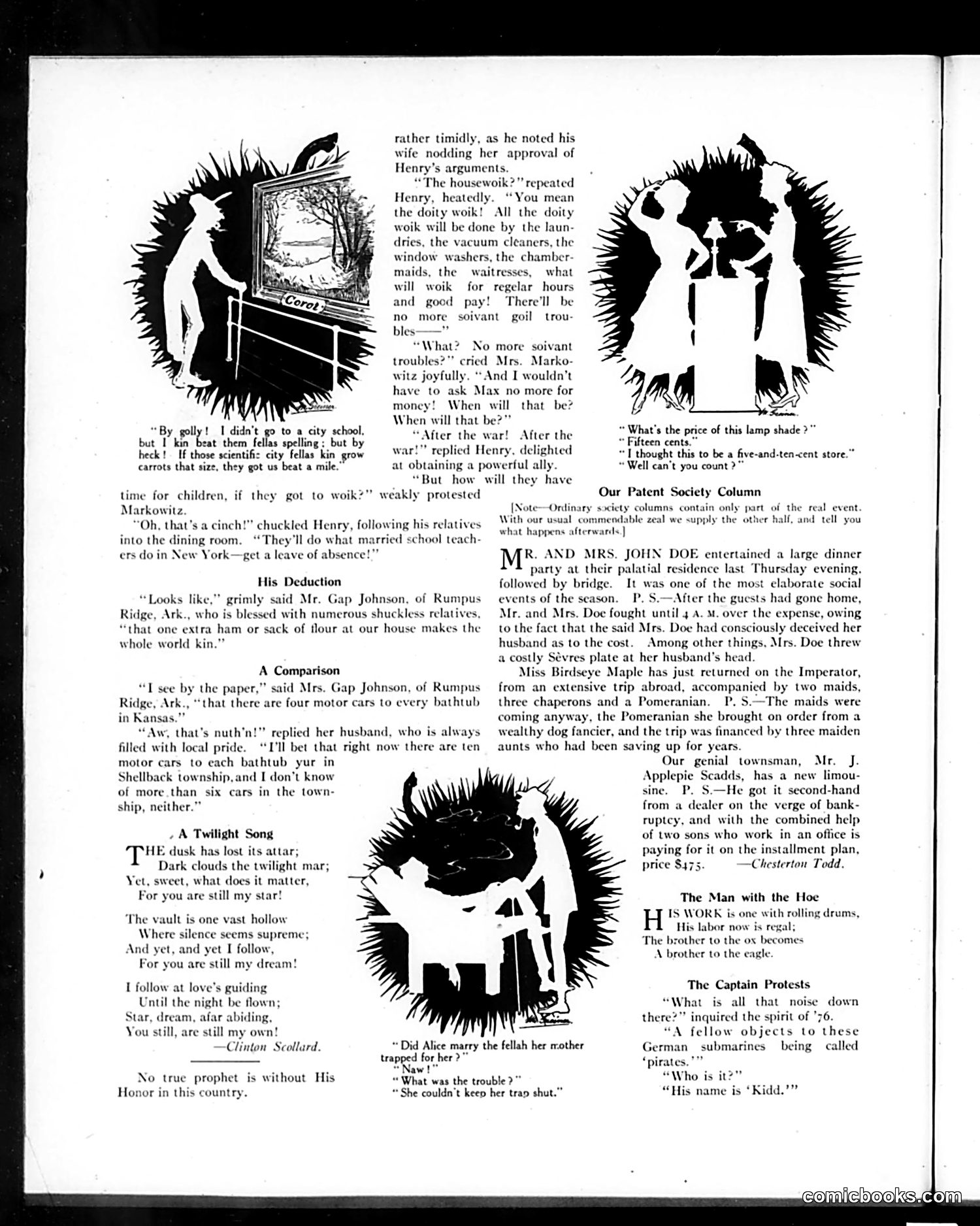
This page contains domestic humor satirizing early 20th-century American life, likely WWI-era based on "After the war!" references. **Main cartoons:** Three illustrated vignettes mock middle-class aspirations and gender dynamics. One shows a man pitching labor-saving ideas to his wife (laundries, vacuum cleaners replacing servants). Another depicts a couple discussing motor cars versus bathtubs, with rural characters boasting about their township's car-to-bathtub ratio—satire of rural one-upmanship and consumerism disconnected from actual wealth. **"Patent Society Column":** A satirical society gossip section mocking wealthy pretense. It describes the Does' "elaborate" dinner party, then parenthetically notes they fought over expenses until 4 AM and she threw a Sèvres plate. Similar deflating details follow about Miss Maple's trip and Mr. Scadds' second-hand limousine bought on installment. **The satire's point:** Exposing the gap between appearances and reality—the performative nature of middle and upper-class social life masking financial strain, marital discord, and actual modest circumstances.
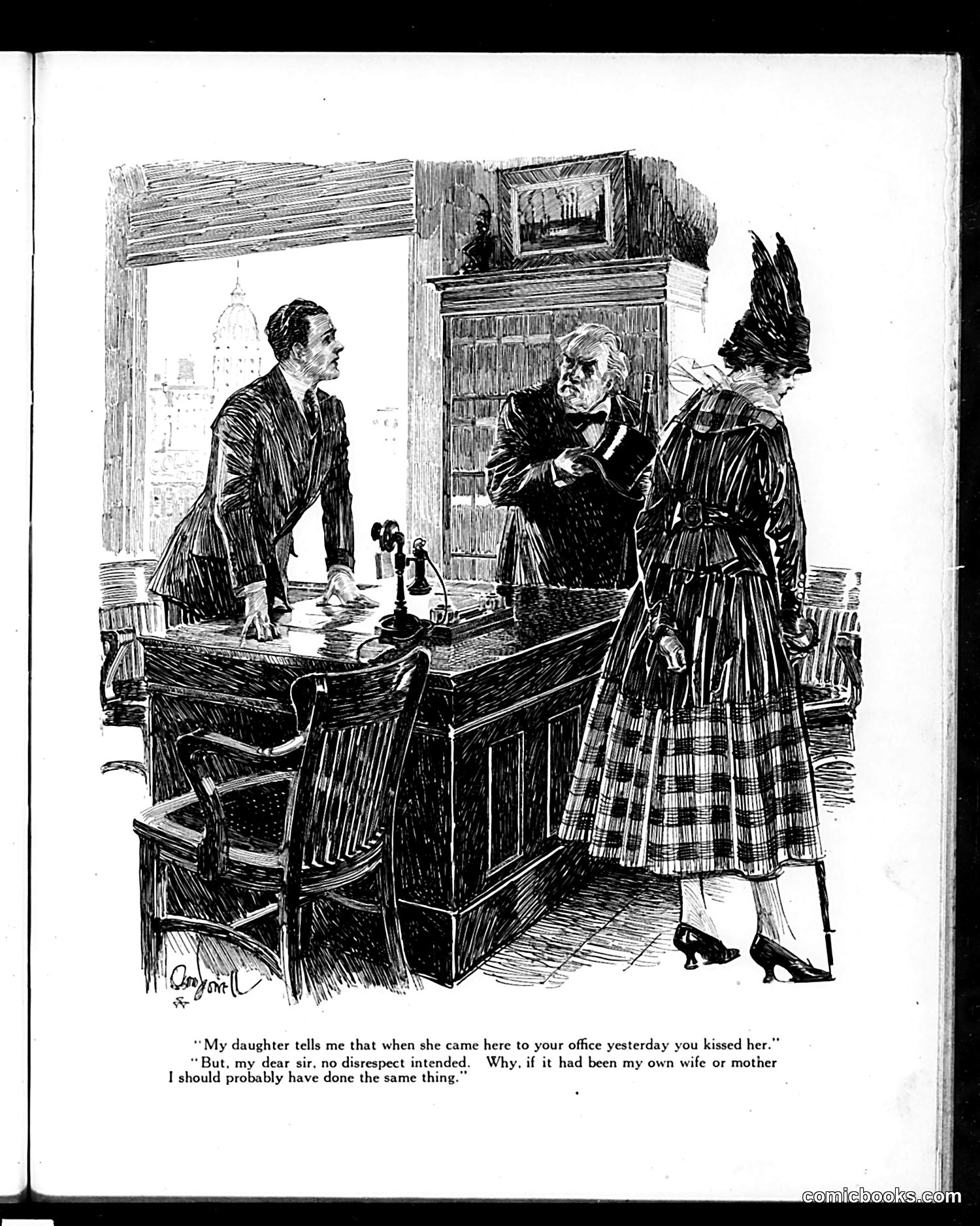
This is a satirical cartoon about workplace conduct and Victorian-era social norms. A father confronts an office worker about kissing his daughter during a visit. The worker's defense—that he'd have kissed the man's wife or mother too—is meant to be humorous through its absurdity and the casual sexism it reveals. The joke relies on early 20th-century assumptions: that men routinely kissed women they encountered socially, that this was expected behavior among "respectable" people, and that the worker's indiscriminate friendliness somehow excuses the inappropriate advance on the daughter. The satire mocks both the worker's obliviousness and the broader social double-standards regarding women's treatment in professional spaces. The cartoon criticizes workplace impropriety while highlighting how normalized such behavior was.
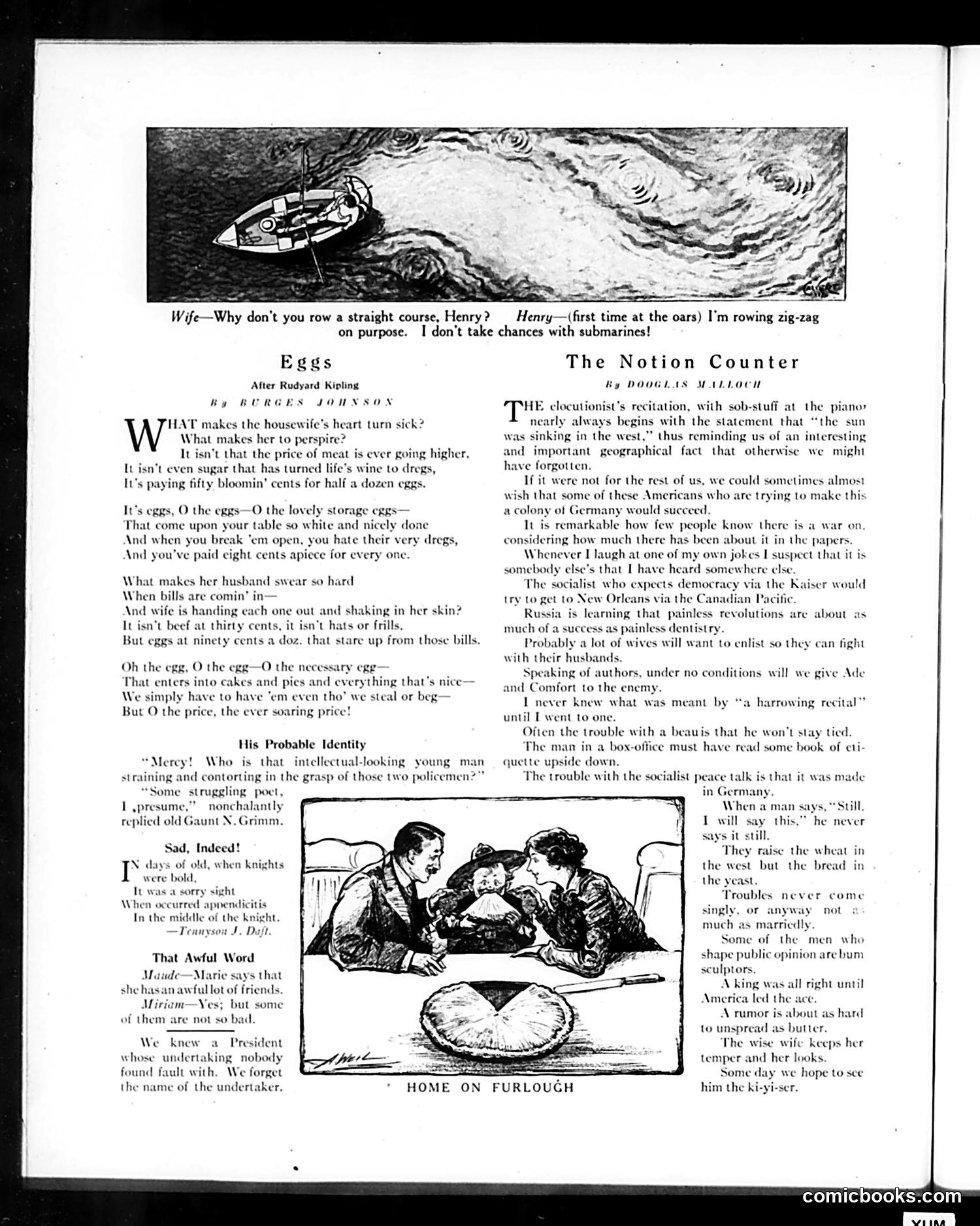
This page contains multiple satirical pieces reflecting WWI-era American concerns: **Top Cartoon**: Shows a couple rowing in a zigzag pattern. The husband claims he's deliberately zig-zagging to avoid submarines—a reference to the German U-boat threat during WWI. The satire mocks wartime paranoia, suggesting civilians are applying wartime anxiety to everyday activities. **"Eggs" Poem**: A Kipling-style parody lamenting skyrocketing egg prices (90 cents a dozen mentioned). This reflects severe WWI food inflation and shortages affecting American households. The humor targets how domestic economic hardship—not military danger—most distresses the average housewife. **"The Notion Counter"**: A series of brief satirical observations. Key references include mocking "Americans who are trying to make this a colony of Germany" (likely pro-German sympathizers), socialist peace advocates, and the Kaiser. One line suspects "the trouble with the socialist peace talk is that it was made in Germany"—expressing skepticism about German-backed peace proposals. The page overall uses humor to process wartime anxieties: submarine threats, inflation, and domestic political divisions over the war.
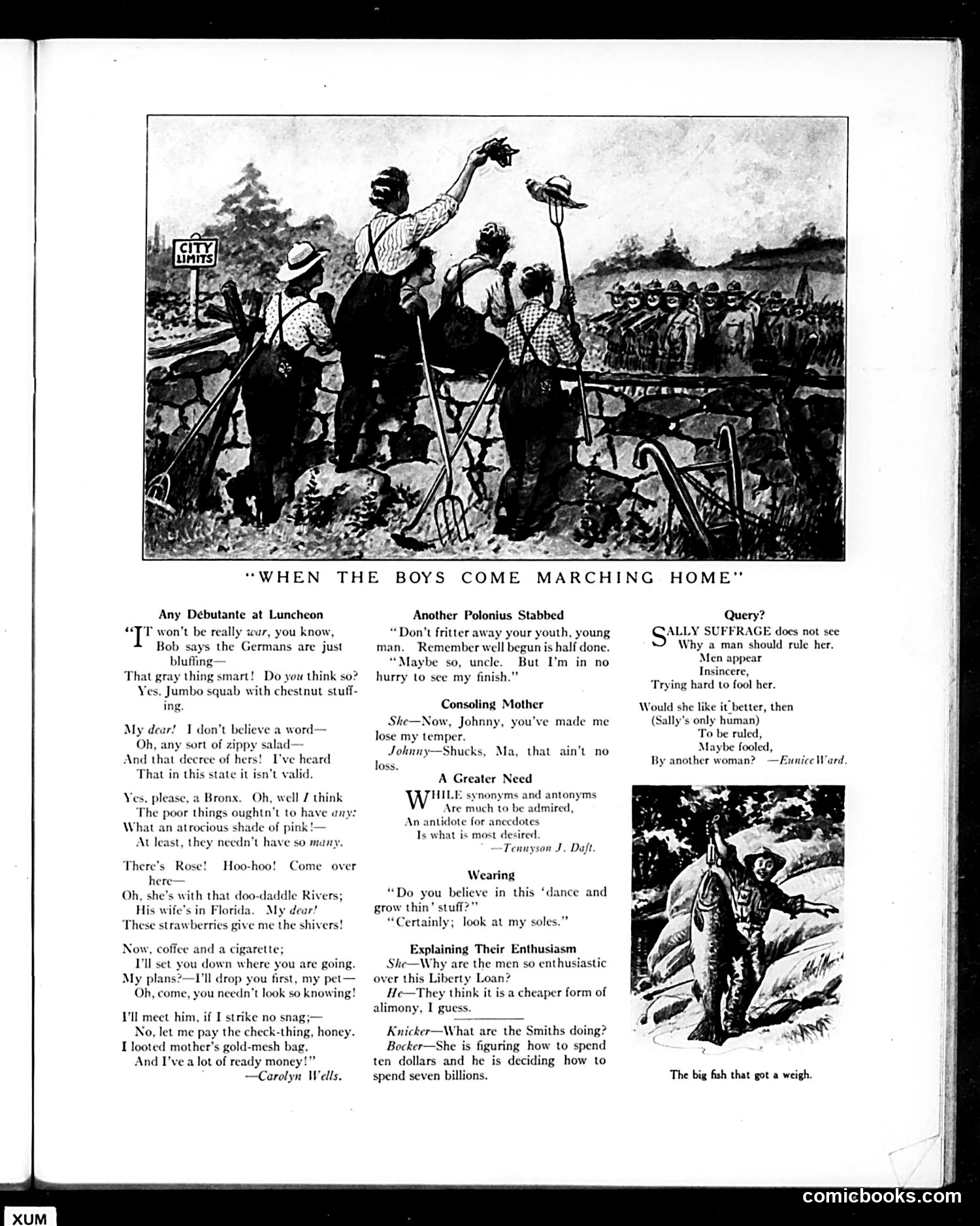
This page satirizes American home-front attitudes during World War I. The title illustration shows civilians at what appears to be a patriotic gathering with farming tools, suggesting mobilization efforts. The accompanying sketches mock the disconnect between wartime rhetoric and actual behavior: **"Any Debutante at Luncheon"** ridicules wealthy women dismissing the war as minor ("Germans are just bluffing") while obsessing over luxuries, gossip, and romantic affairs—utterly detached from sacrifice. **Other vignettes** joke about: - Marital infidelity during wartime ("doo-daddle Rivers") - Youth's indifference to parental wisdom - The Liberty Loan (war bonds) being cynically viewed as "cheaper alimony"—mocking men's reluctant patriotism - Gender dynamics ("Sally Suffrage" commentary on women's rights) The humor targets American complacency and hypocrisy: citizens aren't truly committed to war effort, treating it as background noise while pursuing pleasure and profit. The satire suggests America's civilian population views the conflict with moral detachment.
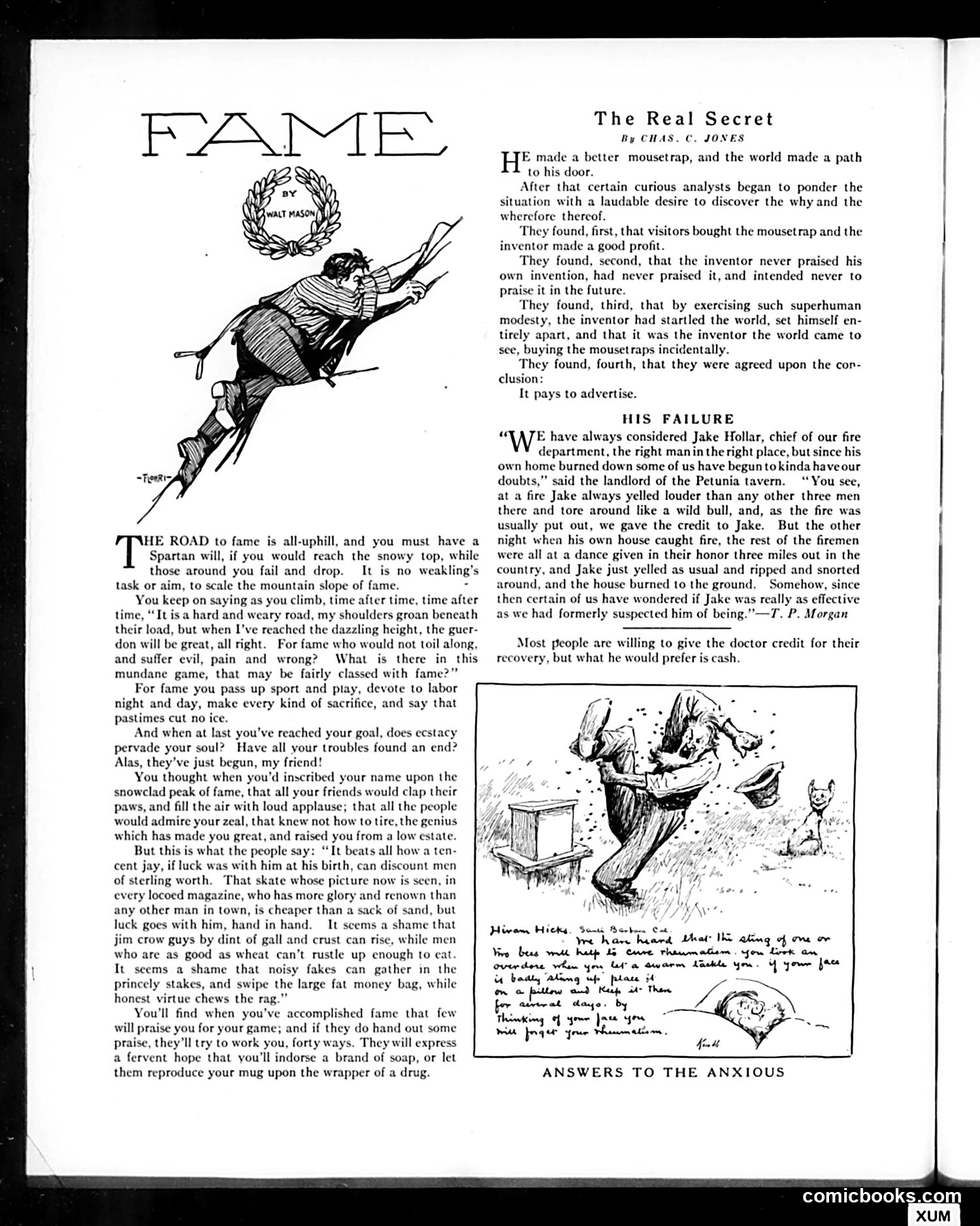
This page contains two distinct satirical pieces: **"FAME"** (left): A cynical poem mocking the pursuit of celebrity and public success. The accompanying illustration shows a figure ascending toward a wreath labeled "FAME." The satire argues that achieving renown requires relentless sacrifice, yet once attained, the public credits your success to luck rather than merit, dismisses you as cheap despite your accomplishments, and immediately tries to exploit you for commercial endorsements (soap wrappers, drug advertisements). The piece suggests fame brings envy and attempted exploitation rather than genuine admiration. **"The Real Secret"** and **"His Failure"** (right): Two brief anecdotes. The first notes that a mousetrap inventor succeeded through *not* self-promotion—his modesty attracted attention. The second mocks Fire Chief Jake Hollar, who performed spectacularly at others' fires (earning credit), but when his own house burned, his heroics couldn't save it, revealing his competence was circumstantial. Both mock the gap between public perception and actual ability.
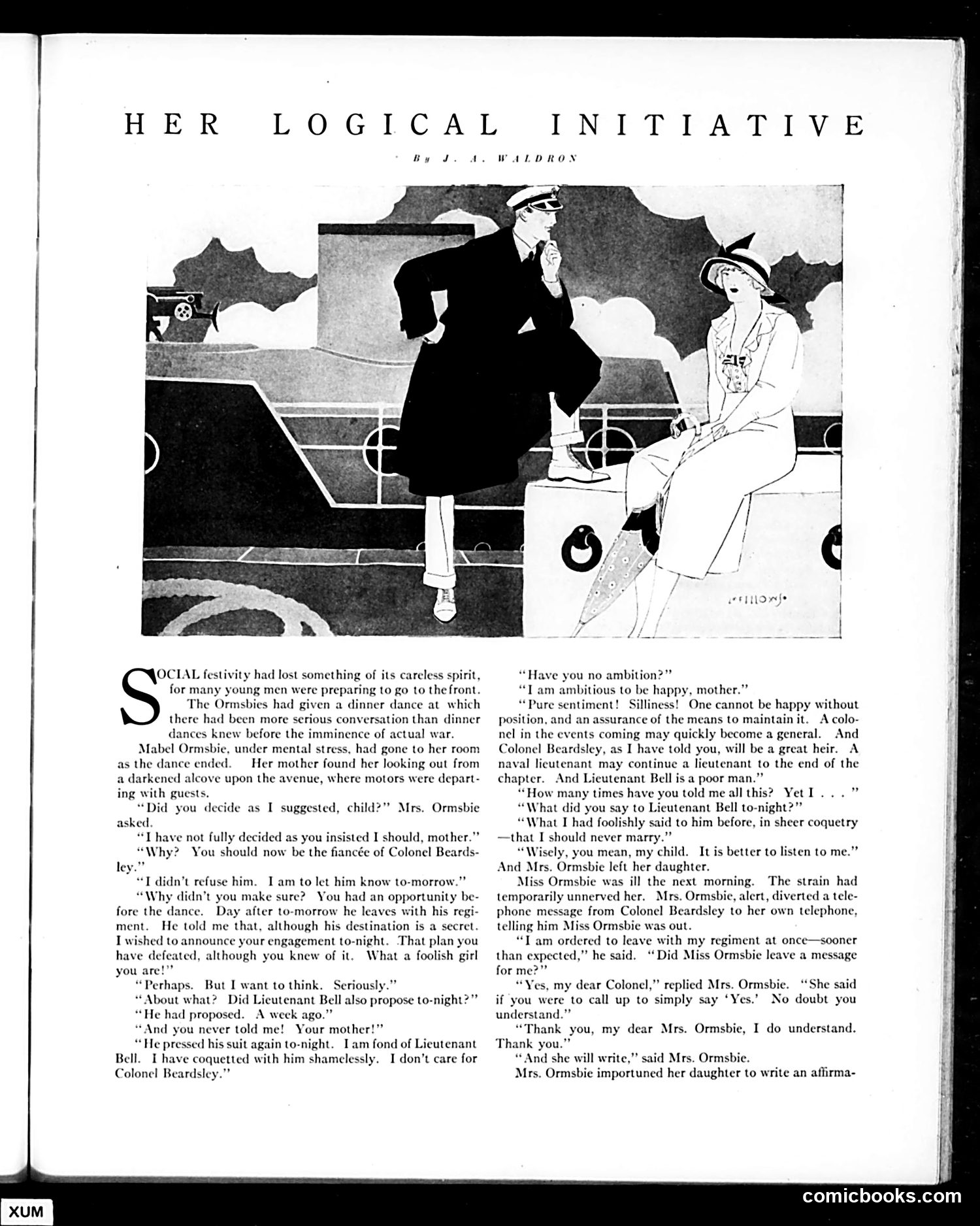
This story satirizes early-20th-century upper-class social pressures and maternal manipulation during wartime (likely WWI, given references to regiments deploying). **The setup:** Mabel Ormsbie, a young woman, has received proposals from two suitors—Colonel Beardsley (wealthy, likely to become a general) and Lieutenant Bell (poor but apparently genuinely loved). Her mother pressures her toward the Colonel for financial security and social advancement. **The satire:** The title "Her Logical Initiative" is ironic. Rather than Mabel making her own choice, her mother *intercepts* Colonel Beardsley's call, fabricates an affirmative answer ("Yes"), and manipulates her daughter into writing confirmation—all without Mabel's genuine consent. The "logic" is the mother's calculated social ambition, not Mabel's authentic preference. **The point:** This critiques how mothers and society coerced young women into marriages for status rather than love, overriding their agency even during serious circumstances like war. The irony exposes how patriarchal "logic" prioritizes wealth over happiness and female autonomy.
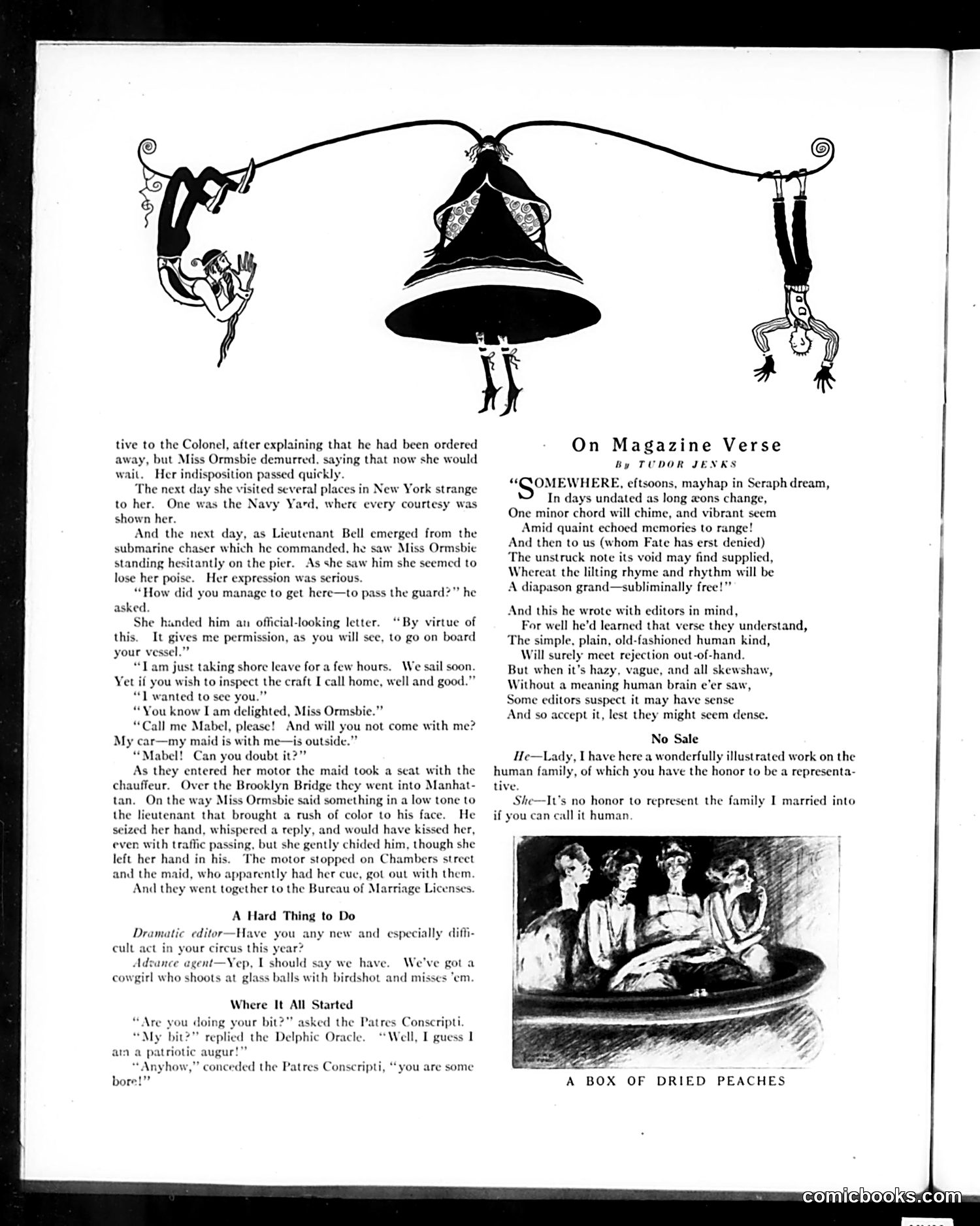
This page contains multiple satirical pieces typical of Judge's humor: **Main Story ("A Hard Thing to Do")**: A romantic narrative about a woman (Miss Ormsbie) and Lieutenant Bell who marry impulsively after visiting the Navy Yard during WWI. The satire appears to mock wartime romance and hasty military marriages—common social anxieties of the era. **"On Magazine Verse"**: Mocks pretentious, deliberately obscure poetry that editors accept out of fear of appearing unsophisticated. The joke: incomprehensible verse gets published while clear, human writing gets rejected. **"No Sale"**: A brief domestic joke where a woman sarcastically refuses to represent her husband's family as "human," satirizing marriage discord and in-law relationships. **The cartoons**: Three whimsical illustrations of figures suspended from ropes, likely accompanying the magazine verse section—decorative rather than political commentary. The page reflects Judge's focus on social satire over political content, targeting literary pretension, wartime romance, and domestic life.
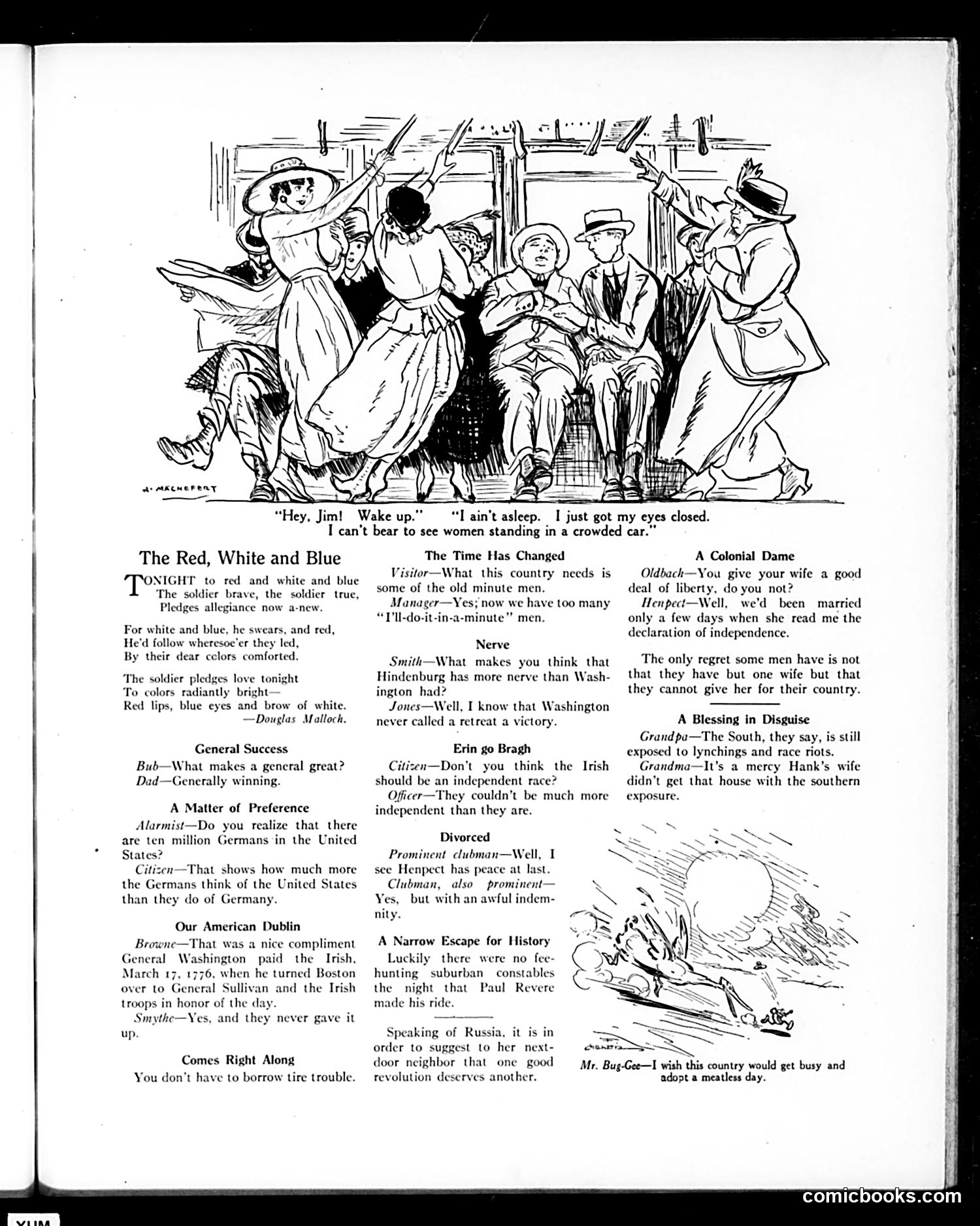
This page from Judge (likely WWI-era, based on references to Hindenburg and Washington comparisons) contains multiple brief satirical jokes rather than a single cartoon. The top illustration depicts a crowded streetcar with the caption about a man keeping his eyes closed rather than seeing "women standing in a crowded car"—satire of male discomfort with women's increasing public presence and mobility. The text pieces mock various contemporary issues: - **Military leadership**: A joke contrasting Washington's honesty (never calling retreats "victories") with Hindenburg's dishonesty - **Immigration anxiety**: A German-American population concern, deflated by noting Germans value America more than Germany itself - **Irish independence**: Play on Irish stubbornness and their dominant presence in Boston politics - **Women's liberation**: A wife citing the Declaration of Independence to her newly married husband, satirizing women's expanded demands for rights - **WWI references**: Comparisons to historical American figures, suggesting modern leaders lack their predecessors' character The humor relies on readers' familiarity with contemporary social anxieties: women's changing roles, ethnic politics, and wartime leadership debates.
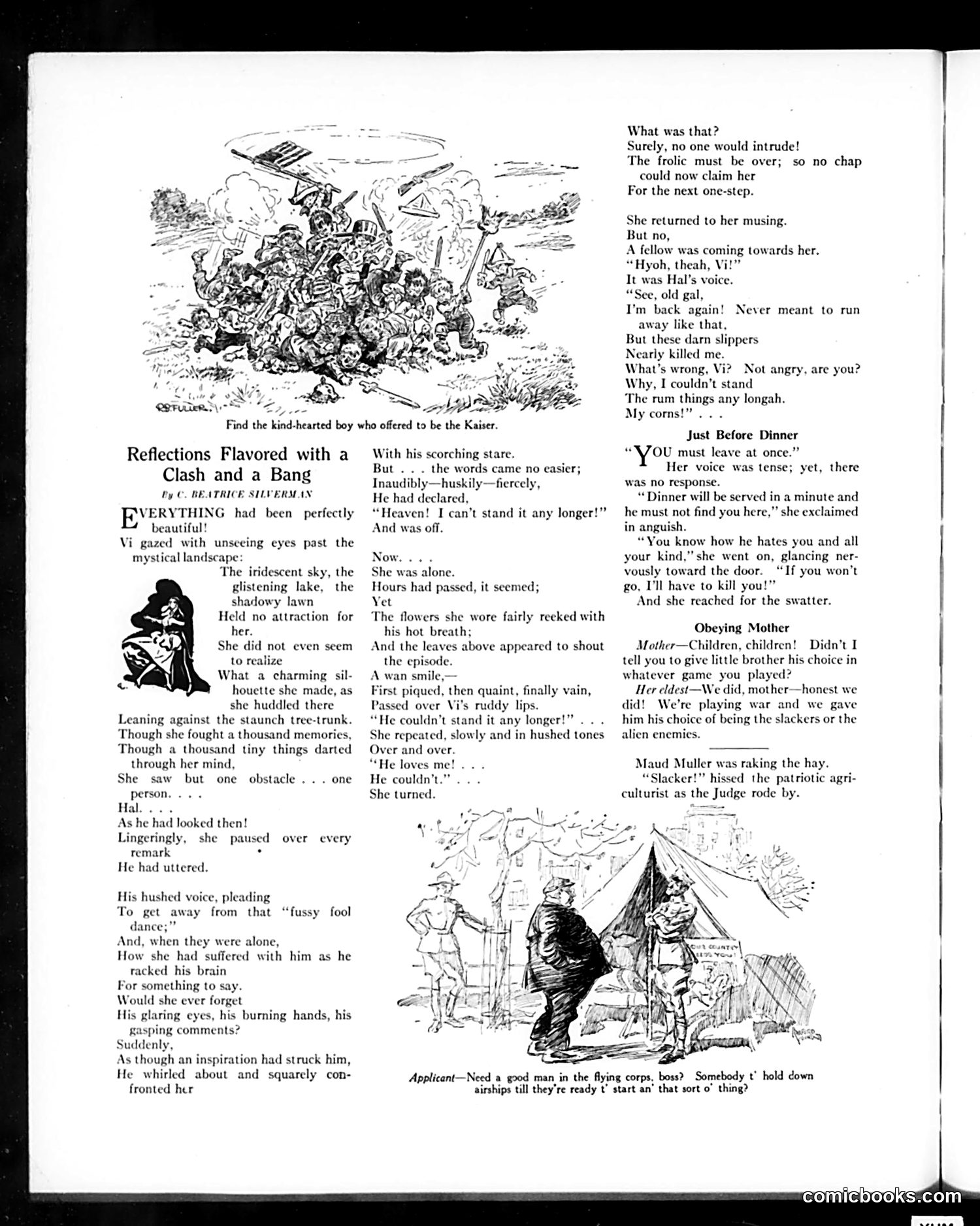
This page contains several satirical pieces reflecting American social life, likely from the World War I era based on references to "flying corps," "slackers," and "alien enemies." **"Reflections Flavored with a Clash and a Bang"**: A romantic story where Vi waits alone for her beau Hal, imagining his passionate declaration ("Heaven! I can't stand it any longer!"). The joke's punchline reveals his actual complaint: foot pain from his corns—deflating romantic expectations with mundane physical discomfort. **"Just Before Dinner"**: A woman urgently tries to remove a visitor before her husband arrives home, threatening violence. The final reveal: she's killing a fly with a swatter, not addressing an affair. **"Obeying Mother"**: Children claim they've given their brother "choice" in a war game—choosing between being "slackers or alien enemies," mocking both draft-dodging and anti-German sentiment. **"Applicant" cartoon**: A job seeker offers to hold down airships during takeoff—absurd wartime labor. The pieces use anticlimactic reveals and domestic humor to satirize romance, marriage dynamics, and wartime patriotism.
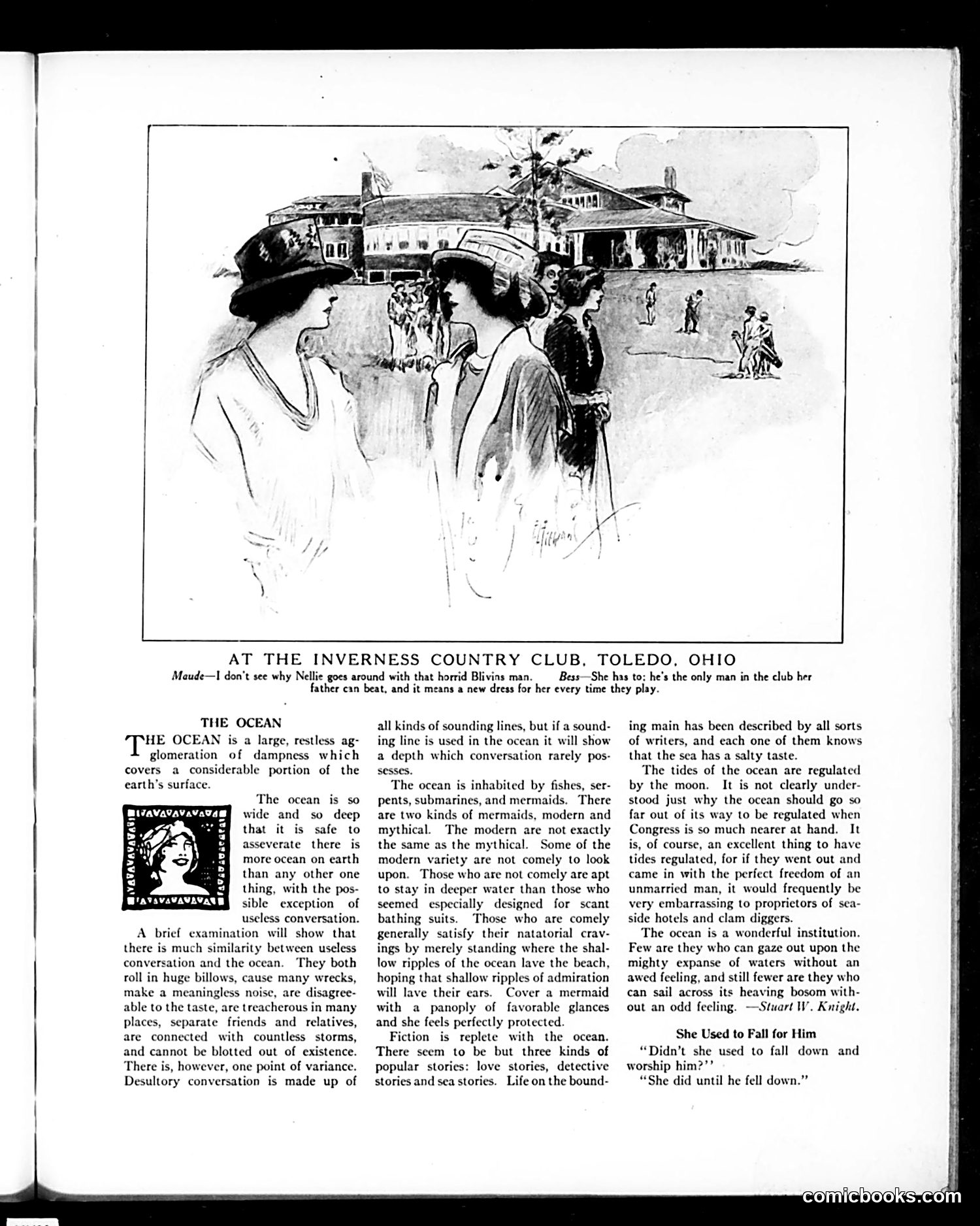
This page contains two distinct pieces of satirical content: **The Cartoon:** A sketch showing two women at the Inverness Country Club in Toledo, Ohio discussing a third woman named Nellie. The joke is that Nellie dates "that horrid Blivins man" solely because he's the only club member her father can reliably beat at golf—and she gets a new dress each time they play together. The satire mocks the transactional nature of wealthy social relationships and how women's romantic choices were sometimes economically motivated by their fathers' social standing. **"The Ocean" Essay:** A humorous mock-encyclopedic piece comparing the ocean to "useless conversation"—both cause wrecks, produce noise, taste bad, and are treacherous. The piece makes light observations about mermaids (contrasting mythical versus modern versions), ocean fiction formulas, and tidal regulation. It's gentle, whimsical satire without clear political targets, typical of Judge's lighter filler content.
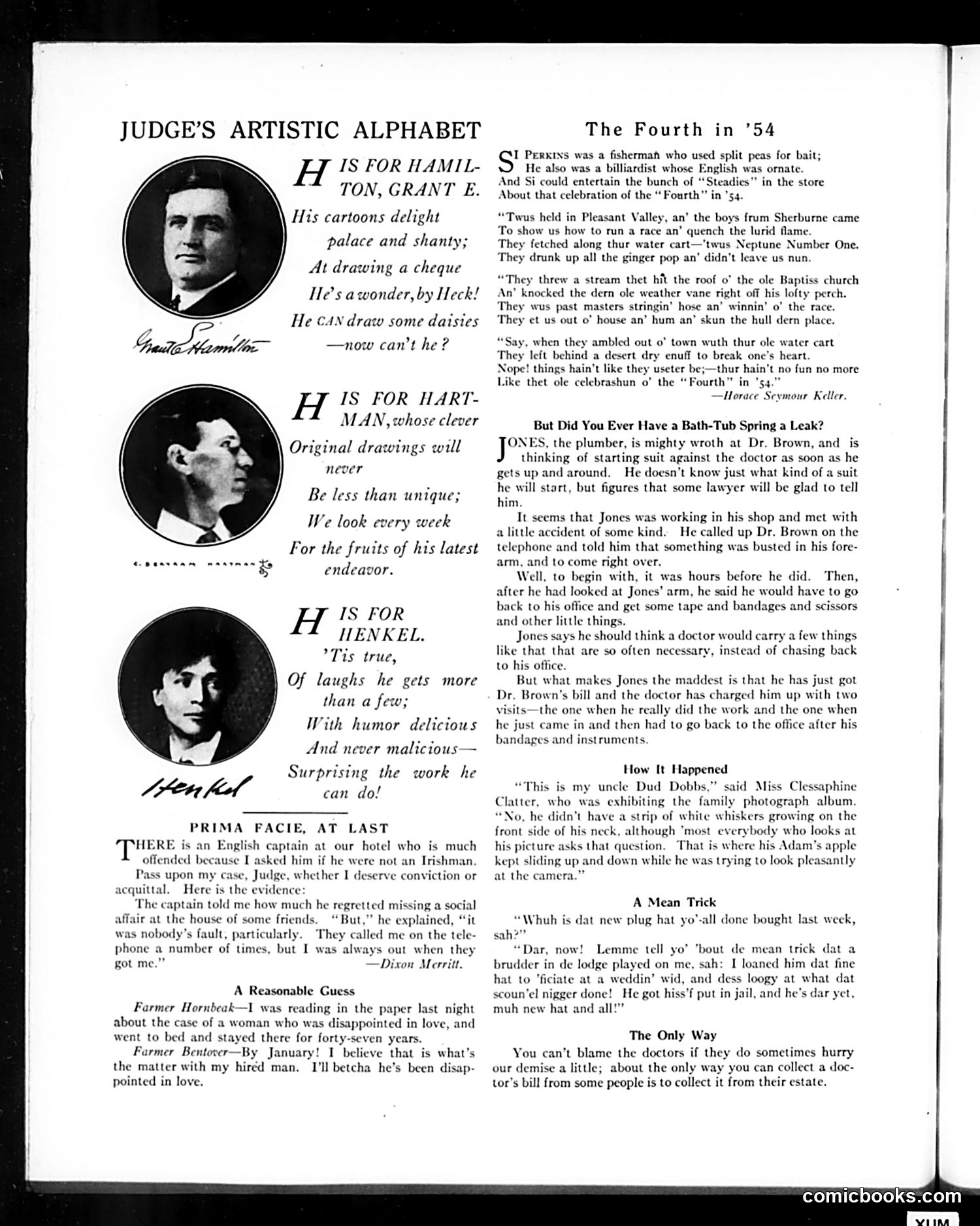
This page from Judge combines three elements: a humorous "artistic alphabet" featuring cartoonists Hamilton, Hartman, and Henkel; several comic anecdotes; and a nostalgic poem about a Fourth of July celebration. **The Alphabet Section** celebrates contemporary illustrators working for Judge itself—praising their cartoon skills and drawing abilities in affectionate, punning verse. **The Anecdotes** are light social satire: an Englishman's logistical mishap (repeatedly missing calls), a farmer's assumption about his hired man's lovesickness, and a plumber's legitimate grievance against a doctor who charges for two visits when performing one job—reflecting common professional frustrations of the era. **"The Fourth in '54"** nostalgically recounts a chaotic rural Fourth of July celebration where visiting firefighters with their water cart destroyed property and consumed all the town's provisions—a humorous commentary on small-town America and the costs of holiday festivities. The overall tone is gentle, middle-class humor aimed at contemporary readers familiar with Judge's regular contributors and everyday commercial frustrations.
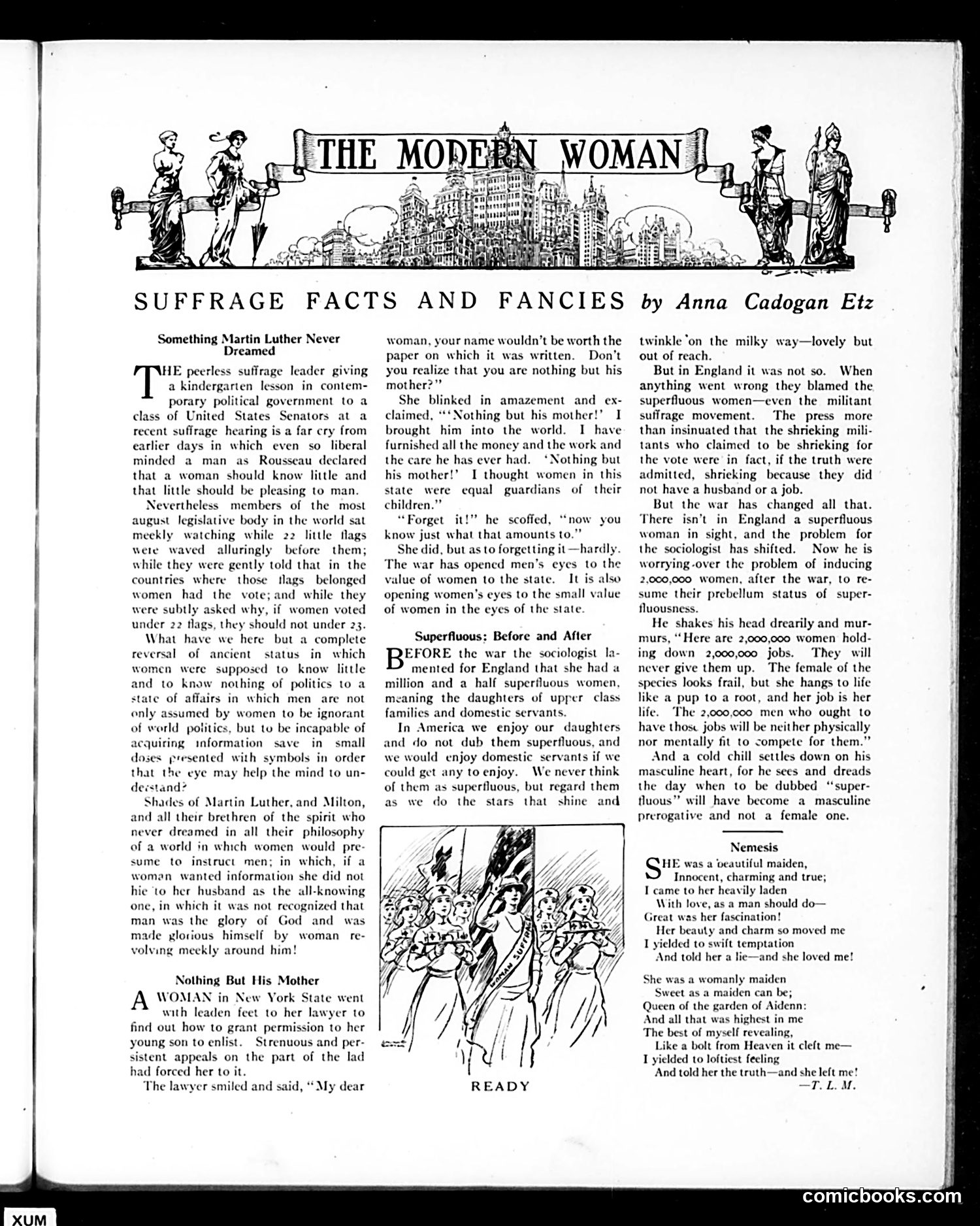
This page satirizes anti-suffrage arguments through three interconnected pieces by Anna Cadogan Etz, likely a suffragist writer. **The cartoon** (titled "READY") depicts women presenting flags to U.S. Senators during a suffrage hearing—a reversal of traditional power dynamics that the text mocks as absurd. The satire suggests suffragists are "instructing" supposedly superior male lawmakers using visual aids, as if teaching children. **The three articles** use irony to expose suffrage opponents' logical contradictions: 1. **"Something Martin Luther Never Dreamed"** ridicules the notion that women educating men violates natural order, invoking historical male philosophers. 2. **"Nothing But His Mother"** exposes legal absurdity: a woman cannot authorize her son's military enlistment despite providing all his material support—she's legally "nothing but his mother." 3. **"Superfluous: Before and After"** notes that pre-war England blamed unmarried women for social problems, yet wartime revealed women's essential value, contradicting claims they're unnecessary. The page's humor targets not suffragists but rather the illogical reasoning of those opposing women's equality and voting rights.
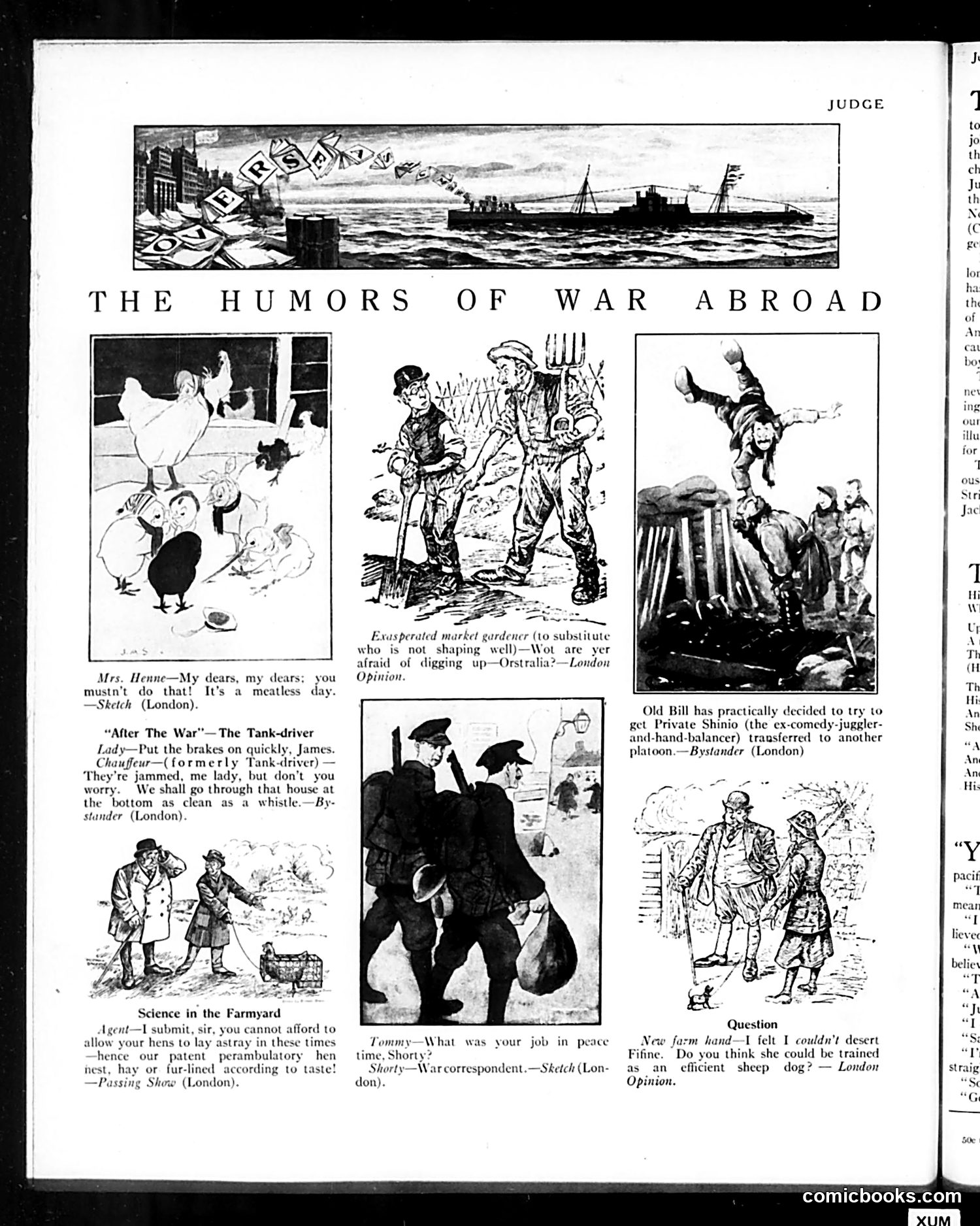
This page collects wartime satire from British publications, likely from WWI. The cartoons mock home-front absurdities and military life: **"Meatless day"**: Ridicules rationing compliance—a housewife forbids children from playing with toys during food shortages, treating recreation itself as wasteful. **"Tank-driver Lady"**: A post-war joke about a woman who learned to drive tanks and can't adjust to civilian cars, threatening to crash through a house. **"Patent perambulatory hen"**: Absurdist satire on wartime efficiency schemes—an agent pitches a ridiculous wheeled hen-cage as a patriotic farming innovation. **Market gardener/substitute worker**: Mocks incompetent farm labor during wartime (when able workers were conscripted), suggesting the substitute fears digging up Australia itself. **"War correspondent" joke**: Plays on the perception that war correspondents had cushy jobs compared to soldiers. The overall tone is affectionate mockery of British wartime inconveniences and the gap between civilian and military experience.
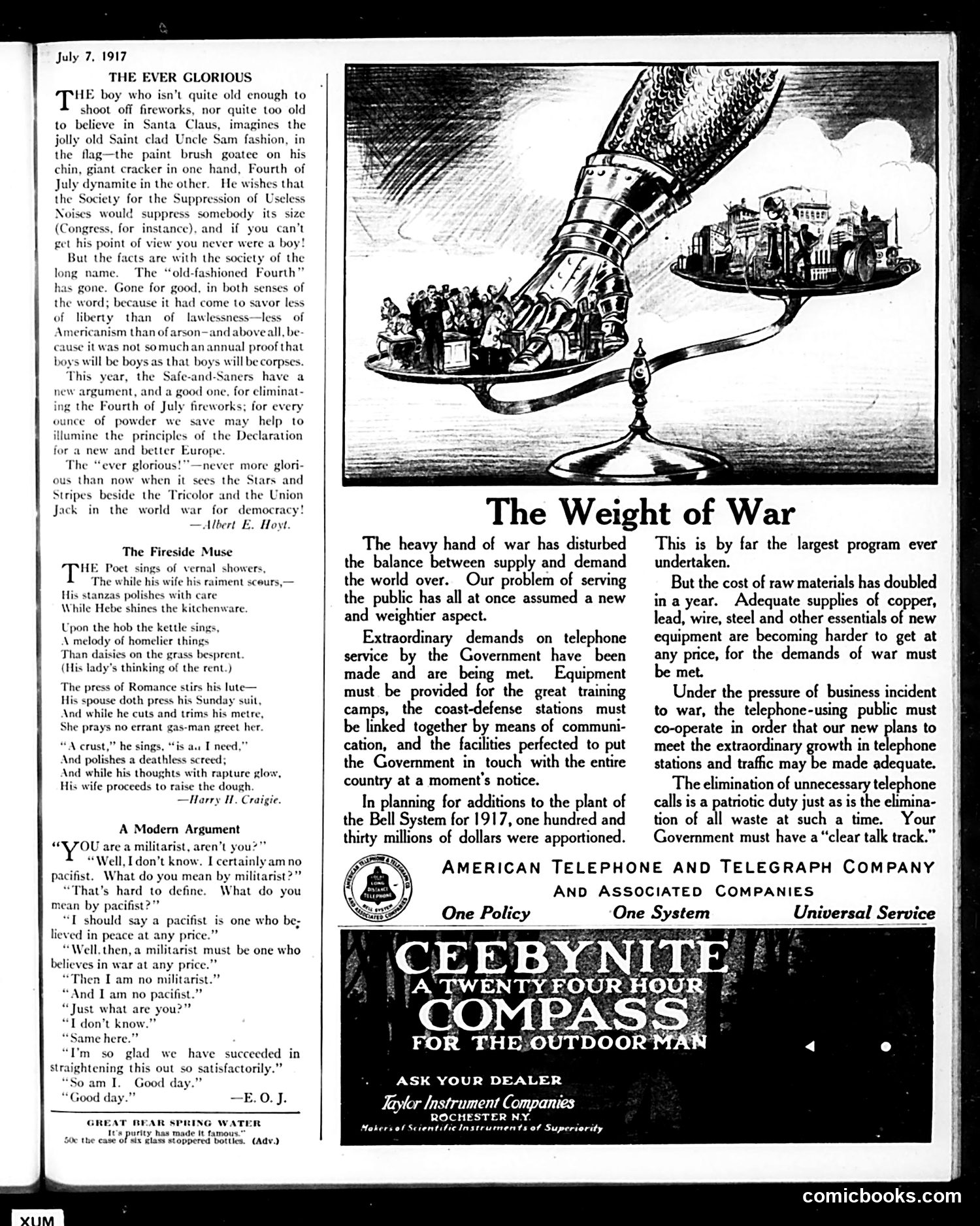
This page contains several pieces of WWI-era American commentary. The main cartoon, "The Weight of War," depicts Lady Liberty (or America) as a giant foot crushing a city, symbolizing how war's demands are overwhelming civilian infrastructure and resources. The editorial content argues for eliminating Fourth of July fireworks to conserve gunpowder for the war effort in Europe. The piece reframes patriotism: celebrating democracy now means supporting the Allies (noted by the Stars and Stripes beside the French Tricolor and British Union Jack) rather than traditional American independence celebrations. "A Modern Argument" is a satirical dialogue exposing how wartime rhetoric blurs definitions—the speakers can't clearly distinguish between "militarist" and "pacifist" positions, suggesting both sides claim the moral high ground. The Bell Telephone advertisement frames commercial wartime expansion as patriotic service, highlighting how private industry was mobilized for military communications needs. Overall, the page reflects America's 1917 entry into WWI and the cultural shift toward total war mobilization.
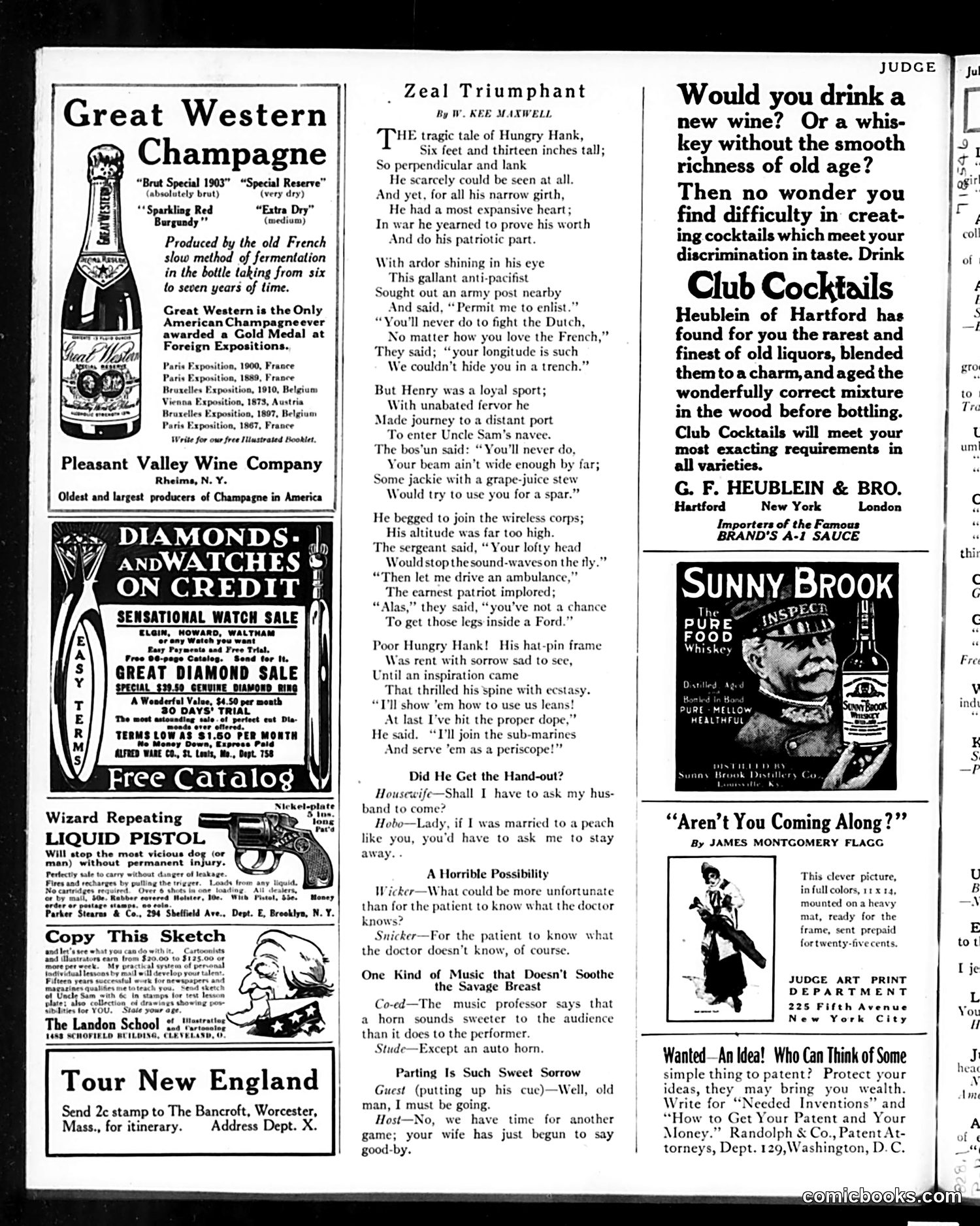
This page contains primarily **advertisements** with one substantial satirical poem/story titled "Zeal Triumphant" by W. Kee Maxwell. The poem mocks overzealous military recruitment during what appears to be the **World War I era**. It tells of "Hungry Hank," an extremely tall, thin man desperate to enlist for patriotic duty. However, every military branch rejects him for being unsuitably built: the Army can't hide him in a trench, the Navy finds his beam too narrow, the signal corps says his height blocks radio waves, and he's too long for an ambulance. **The satire targets:** military bureaucratic absurdity and the gap between patriotic enthusiasm and practical reality. Hank's final solution—volunteering as a submarine periscope—is absurd, suggesting the ridiculous lengths desperate volunteers go to serve, while mocking both military inflexibility and blind patriotic zeal. The page also includes brief joke sections ("Did He Get the Hand-out?") poking fun at social situations and professional incompetence.
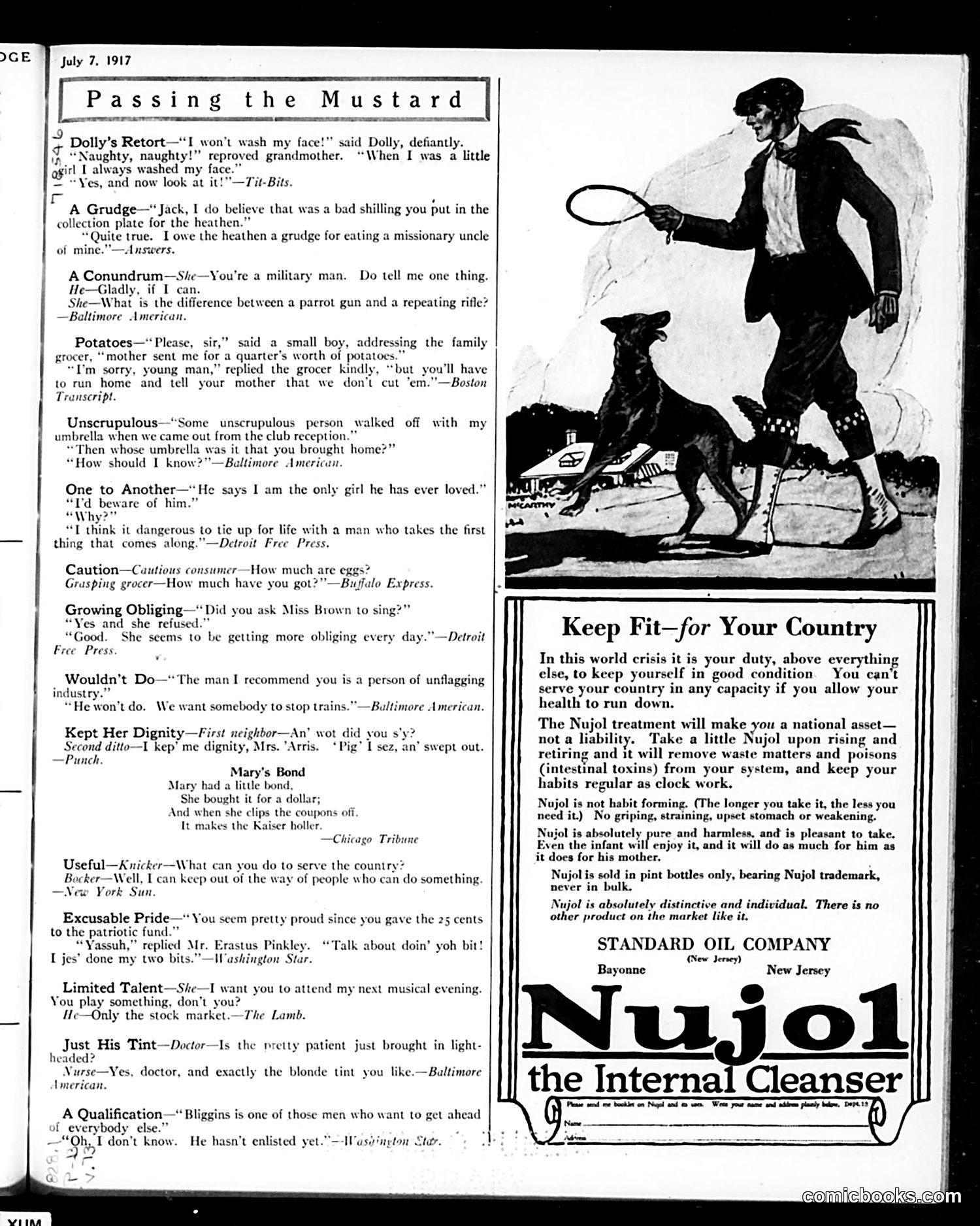
This page contains humorous short jokes and witticisms typical of Judge's satirical format, plus a prominent Nujol laxative advertisement. The main cartoon (top right) depicts a man with a tennis racket appearing to play with a dachshund dog as if it were a ball—a visual pun on "passing the mustard" (though the connection to the title remains unclear). The jokes themselves reflect 1917 wartime concerns: "Mary's Bond" celebrates war bonds as patriotic investments that hurt the Kaiser; "Useful" and "A Qualification" mock men avoiding military service; "Excusable Pride" gently ridicules small patriotic donations; and "Keep Fit for Your Country" emphasizes personal health as a patriotic duty. The Nujol ad reinforces this message, framing internal cleansing as national service—typical wartime rhetoric that privatized civic duty.
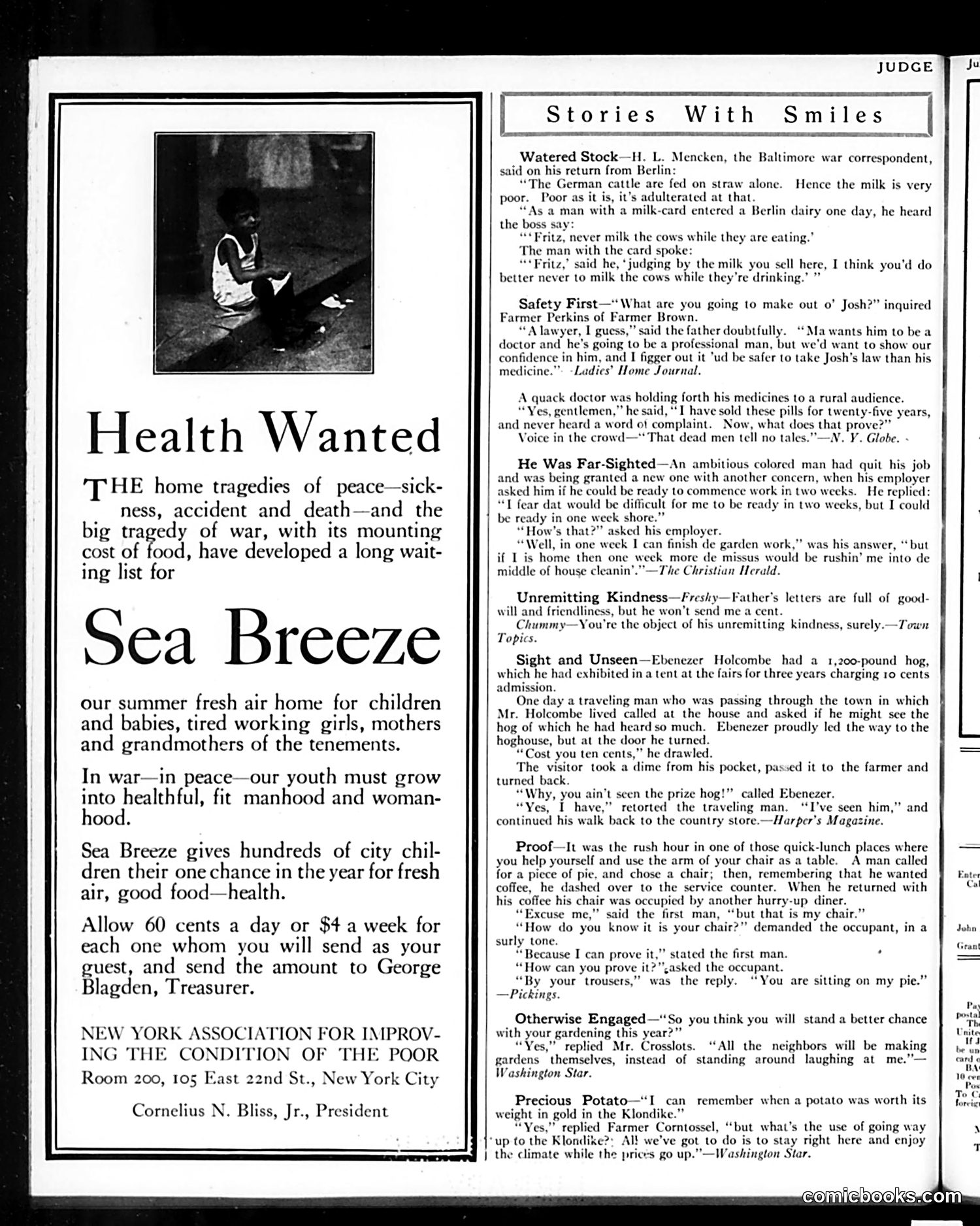
This page contains **two unrelated sections**: a charitable advertisement and a humor column. The left side is an **appeal for the Sea Breeze home**, a charitable organization providing fresh air and recuperation for impoverished urban children, working girls, and elderly women. It frames this as a patriotic duty ("In war—in peace"), emphasizing health as necessary for national strength. The photograph shows a child in what appears to be therapeutic conditions. The right side, "Stories With Smiles," collects brief humorous anecdotes. These include wartime satire (Germans adulterating milk), class comedy (a farmer's son becoming a lawyer), and period racial humor (a Black worker's malapropisms). The jokes rely on wordplay, practical deception, and social observation typical of early 20th-century American magazines. The page reflects both Progressive Era social reform concerns and the casual ethnic and racial stereotyping common to the era's popular humor.
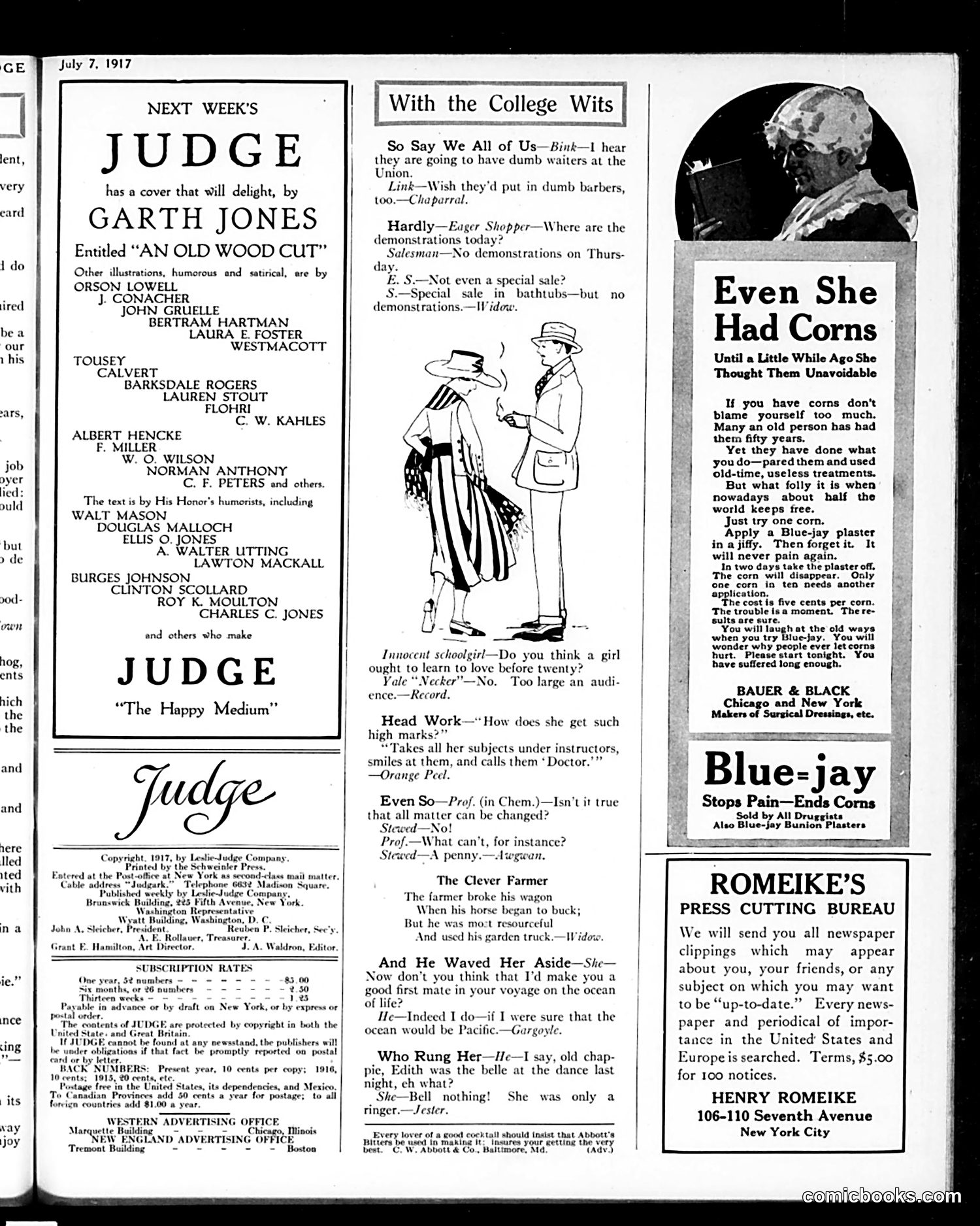
This page is primarily **advertising and announcements** rather than editorial content. The left side advertises next week's Judge cover by Garth Jones ("An Old Wood Cut") and lists contributing illustrators and writers. The center section titled "With the College Wits" contains brief humorous exchanges, likely student humor reflecting WWI-era college life—jokes about dumb waiters at the Union and demonstrations (possibly student activism related to the ongoing war). The right side features prominent **advertising**: a testimonial ad for Blue-jay corn plasters (a real product using before-and-after medical imagery), Bauer & Black surgical supplies, Romeike's Press Cutting Bureau (a clipping service), and Abbott's Bitters (an alcoholic product). The cartoon imagery is minimal and mostly decorative. The "Even She Had Corns" advertisement uses a stylized elderly woman's portrait as marketing. **Context**: This represents Judge's business model—combining satirical humor with lucrative advertising, particularly patent medicines and consumer products targeting common ailments.
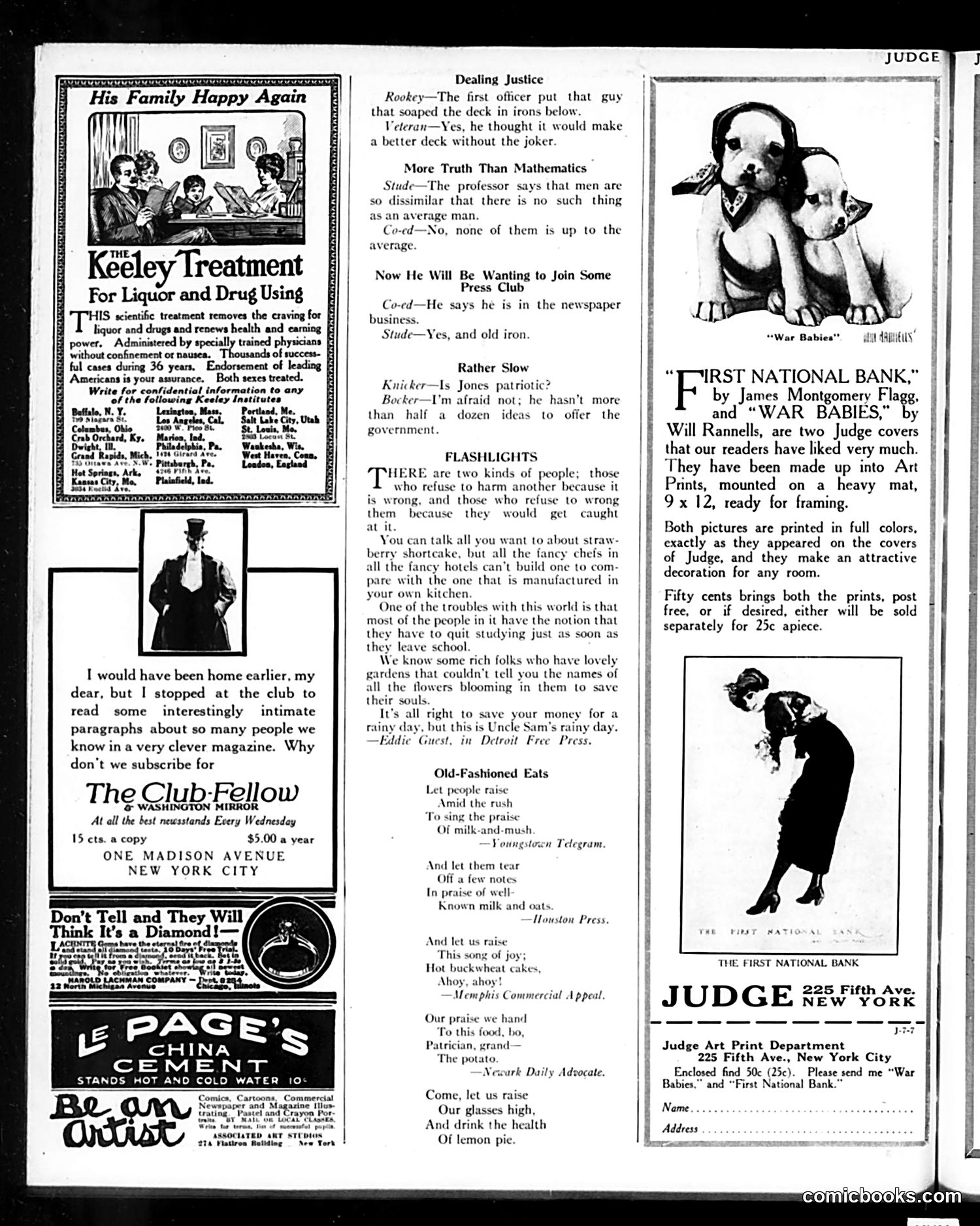
This page from *Judge* magazine combines satirical commentary with advertisements and illustrations typical of early 20th-century American humor. **Main Satirical Sections:** The "Dealing Justice" column presents brief comedic exchanges mocking pretension and hypocrisy. "Rather Slow" jokes that a patriotic man can't muster ideas for government. "More Truth Than Mathematics" ridicules academic types. A joke about an officer putting a troublemaker "in irons" suggests shipboard hierarchy and class distinctions. **"Flashlights"** offers cynical social observations—notably that people avoid wrongdoing from fear of consequences rather than morality, and that education stops after schooling ends. **"Old-Fashioned Eats"** nostalgically celebrates simple foods (buckwheat cakes, milk, oats, lemon pie) over modern trendy cuisine, reflecting period debates about changing American eating habits. The advertisements—particularly the Keeley Treatment for alcohol/drug addiction and *The Club Fellow* magazine—suggest this was aimed at educated, affluent readers dealing with substance abuse and social scandal.
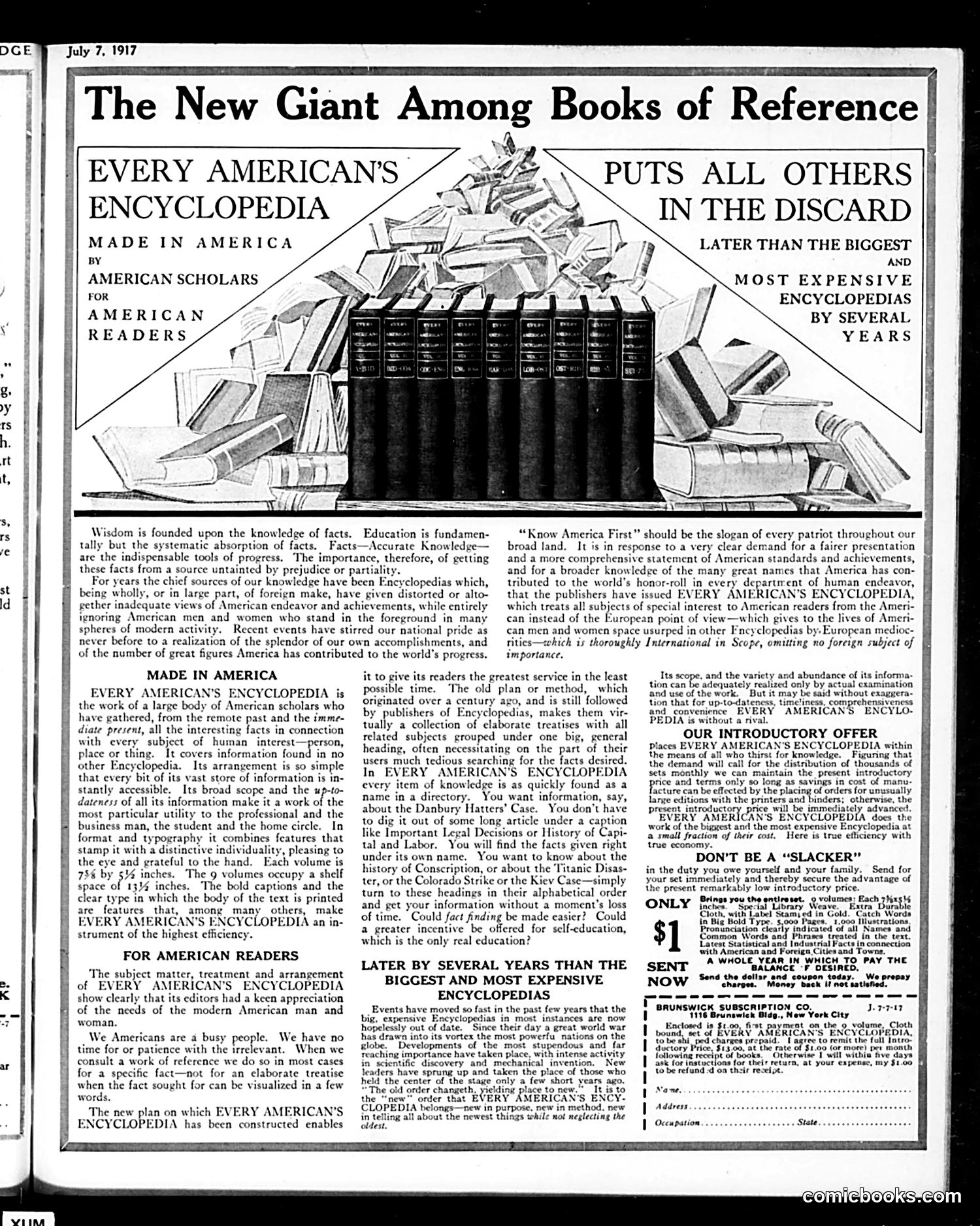
This is primarily a **product advertisement**, not political satire, though it contains nationalist messaging relevant to 1917. The page promotes "Every American's Encyclopedia"—a nine-volume reference work—by emphasizing its American authorship and contents. The central image shows these volumes towering over discarded foreign encyclopedias, visualizing the product's superiority. The nationalist appeal is significant for its **historical context**: published July 1917, just months after America entered World War I, the ad stresses that this encyclopedia is "Made in America by American Scholars for American Readers" and criticizes older encyclopedias of "foreign make" that gave "distorted" views of American achievement while "ignoring American men and women." The marketing targets busy Americans wanting quick fact-finding rather than lengthy articles. The satirical element is subtle—the towering stack of American volumes literally dwarfing competitors suggests almost comical superiority, appealing to patriotic pride during wartime while solving a practical reference problem.