
Judge, 1917-07-07 · page 14 of 27
Judge — July 7, 1917 — page 14: what you’re looking at
What you’re looking at
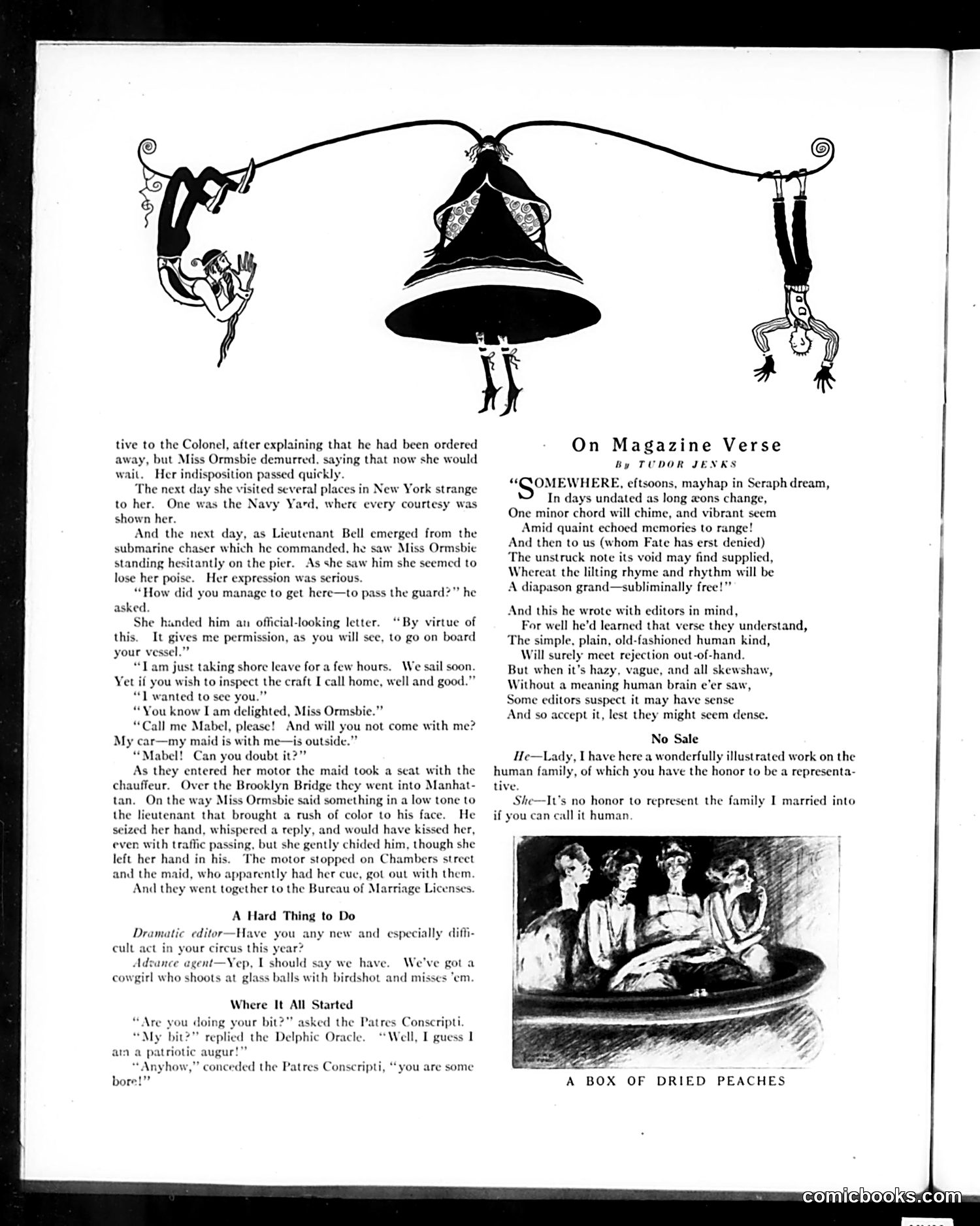
This page contains multiple satirical pieces typical of Judge's humor: **Main Story ("A Hard Thing to Do")**: A romantic narrative about a woman (Miss Ormsbie) and Lieutenant Bell who marry impulsively after visiting the Navy Yard during WWI. The satire appears to mock wartime romance and hasty military marriages—common social anxieties of the era. **"On Magazine Verse"**: Mocks pretentious, deliberately obscure poetry that editors accept out of fear of appearing unsophisticated. The joke: incomprehensible verse gets published while clear, human writing gets rejected. **"No Sale"**: A brief domestic joke where a woman sarcastically refuses to represent her husband's family as "human," satirizing marriage discord and in-law relationships. **The cartoons**: Three whimsical illustrations of figures suspended from ropes, likely accompanying the magazine verse section—decorative rather than political commentary. The page reflects Judge's focus on social satire over political content, targeting literary pretension, wartime romance, and domestic life.
📄 Transcribed text from this page (OCR, searchable)
Machine-transcribed from the original scan — historical spelling and the odd misread are preserved.
to the Colonel, after explaining that he had been ordered y, but Miss Ormsbie demurred. saying that now she would wait. Her indisposition passed quickly. The next day she visited several places in New York strange to her. One was the Navy Yard, where every courtesy was shown her. And the next day, as Lieutenant Bell emerged from the submarine chaser which he commanded, he saw Miss Ormsbie standing hesitantly on the pier. As she saw him she seemed to lose her poise. Her expression was serious. “How did you manage to get here—to pass the guard?” he asked. She handed him an official-looking letter. this. It gives me permission, as you will see, to go on board your vessel.” “Tam just taking shore leave for a few hours. We sail soon, Yet if you wish to inspect the craft I call home, well and gooc “1 wanted to see you.” “You know I am delighted, Miss Ormsbie. “Call me Mabel, please! And will you not come with me? My car—my maid is with me—is outside.” “Mabel! Can you doubt it?” As they entered her motor the maid took a seat with the chauffeur. Over the Brooklyn Bridge they went into Manhat- tan. On the way Miss Ormsbie said something in a low tone to the lieutenant that brought a rush of color to his face. He seized her hand, whispered a reply, and would have kissed her, even with traffic passing, but she gently chided him, though she left her hand in his. The motor stopped on Chambers street and the maid, who apparently had her cue, got out with them And they went together to the Bureau of Marriage Licenses. “By virtue of A Hard Thing to Do Dramatic editor—Have you any new and especially diffi- cult act in your circus this year? Advance agent—Yep, I should say we have. We've got a cowgirl who shoots at glass balls with birdshot and misses ‘em Where It All Started sked the Patres Conscripti. “Are you doing your bit?” “Well, I guess I “My bit?” replied the Delphic Oracle. ain a patriotic augur!” yhow,” conceded the Patres Conscripti, “you are some bore!” On Magazine Verse By TUDOR JENKS “QOMEWHERE, eftsoons, mayhap in Seraph dream, In days undated as long wons change, One minor chord will chime, and vibrant seem Amid quaint echoed memories to range! And then to us (whom Fate has erst denied) The unstruck note its void may find supplied, Whereat the lilting rhyme and rhythm will be A diapason grand—subliminally free!” And this he wrote with editors in mind, For well he'd learned that verse they understand, The simple, plain, old-fashioned human kind, Will surely meet rejection out-of-hand. But when it’s hazy, vague, and all skewshaw, Without a meaning human brain e’er saw, Some editors suspect it may have se And so accept it, lest they might seem dense. No Sale ve here a wonderfully illustrated work on the human family, of which you have the honor to be a representa- tive: She—It's no honor to represent the family I married into if you can call it human A BOX OF DRIED PEACHES