
Judge, 1917-07-07 · page 24 of 27
Judge — July 7, 1917 — page 24: what you’re looking at
What you’re looking at
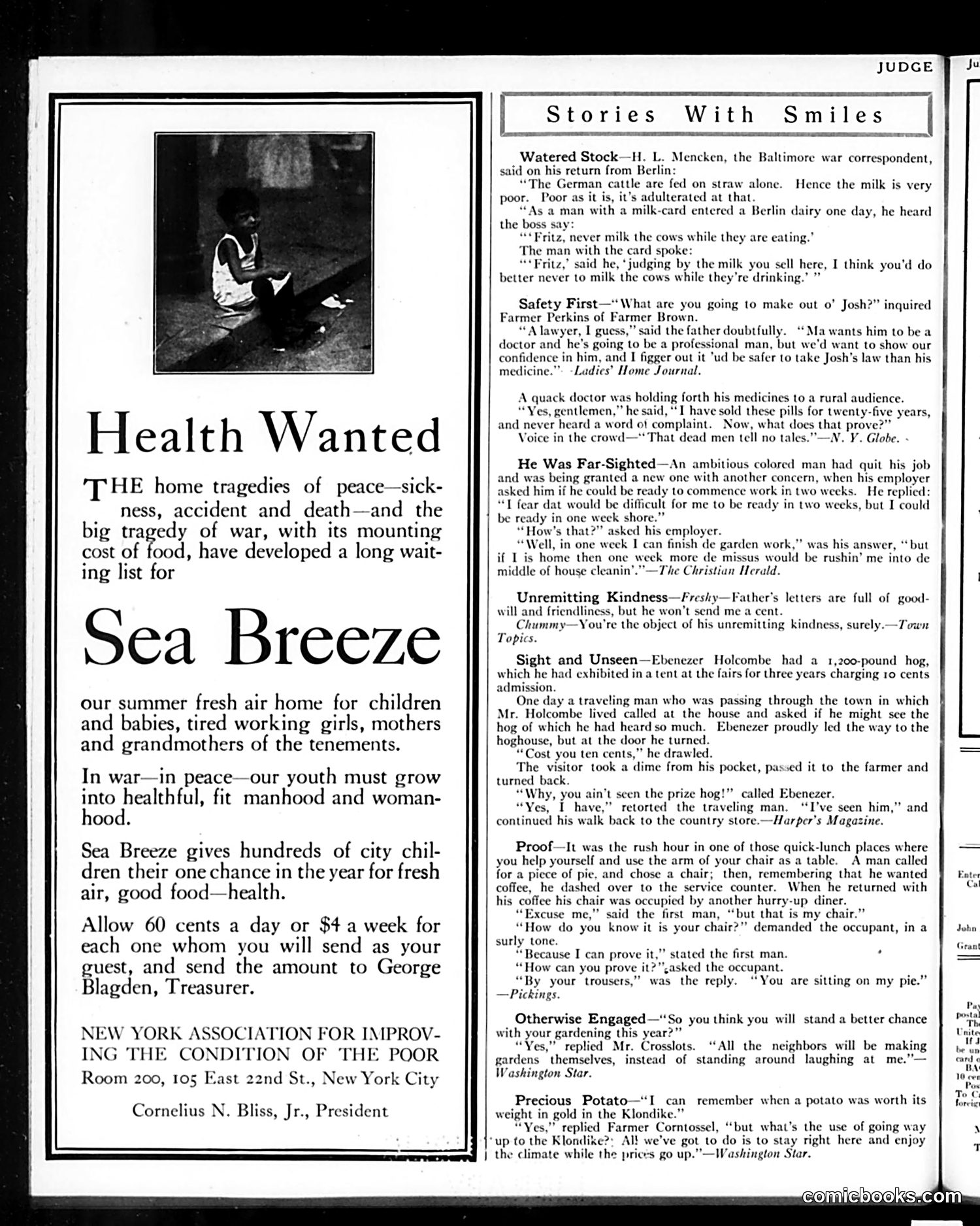
This page contains **two unrelated sections**: a charitable advertisement and a humor column. The left side is an **appeal for the Sea Breeze home**, a charitable organization providing fresh air and recuperation for impoverished urban children, working girls, and elderly women. It frames this as a patriotic duty ("In war—in peace"), emphasizing health as necessary for national strength. The photograph shows a child in what appears to be therapeutic conditions. The right side, "Stories With Smiles," collects brief humorous anecdotes. These include wartime satire (Germans adulterating milk), class comedy (a farmer's son becoming a lawyer), and period racial humor (a Black worker's malapropisms). The jokes rely on wordplay, practical deception, and social observation typical of early 20th-century American magazines. The page reflects both Progressive Era social reform concerns and the casual ethnic and racial stereotyping common to the era's popular humor.
📄 Transcribed text from this page (OCR, searchable)
Machine-transcribed from the original scan — historical spelling and the odd misread are preserved.
Health Wanted "THE home tragedies of peace—sick- ness, accident and death—and the big tragedy of war, with its mounting cost of food, have developed a long wait- ing list for Sea Breeze our summer fresh air home for children and babies, tired working girls, mothers and grandmothers of the tenements. In war—in peace—our youth must grow into healthful, fit manhood and woman- hood. Sea Breeze gives hundreds of city chil- dren their one chance in the year for fresh air, good food—health. Allow 60 cents a day or $4 a week for each one whom you will send as your guest, and send the amount to George Blagden, Treasurer. NEW YORK ASSOCIATION FOR IMPROV- ING THE CONDITION OF THE POOR Room 200, 105 East 22nd St., New York City Cornelius N. Bliss, Jr., President Stories With Sm Watered Stock—H. L. Mencken, the Baltimore war correspondent, said on his return from Berlin: “The German cattle are fed on straw alone. Hence the milk is very poor. Poor as it is, it’s adulterated at that. “As a man with a milk-card entered a Berlin dairy one day, he heard the boss sa: never milk the cows while they are eating.” n with the card spoke: ,” said he, ‘judging by the milk you sell here, I think you'd do better never to milk the cows while they're drinking.” Safety First—‘ What are you going to make out 0’ Josh?” inquired Farmer Perkins of Farmer Brown. “A lawyer, I guess, said the father doubtfully. ‘Ma wants him to be a doctor and he’ $ going to be a professions al man, but we'd want to show our fi , and I figger out it ‘ud be safer to take Josh’s law than his Ladies’ Home Journal. ints for twenty fi years, does that prove cad men tell no tales.” —N. Y. Globe. sai never ‘hes ind a ward | Voice in the crowd— He Was Far-Sighted—An ambitious colored man had quit his job and was being granted a new one with another concern, when his employer asked him if he could be ready to commence work in two weeks. He replied: ar dat would be difficult for me to be ready in two weeks, but I could dy in one week shore.’ How’s that?” a “Well, in one week I ca arden work,”’ was his answer, “but if 1 is home then one ‘k_ more de missus would be rushin’ me into de middle of house cleanin’. —The Christian Herald. Unremitting Kindness—Freshy—Father’s letters are full of good- will and friendliness, but he won't send me Chummy—You're the object of his unremitting kindness, surely.—Town Topics. Sight and Unseen—Ebenezer Holcombe had a 1,200-pound hog, which he had exhibited ina tent at the fairs for three years charging 10 cents admission. One day a traveling man who was passing through the town in which Mr. Holcombe lived called at the house and asked if he might sce the hog of which he had heard so much. Ebenezer proudly led the way to the hoghouse, but at the door he turned. . he drawled. vi a dime from his pocket, passed it to the farmer and turned back “Why, you ain't seen the prize hog!” called Ebenezer. “Yes, I retorted the traveling man. “‘I’ve seen him,” and continued his walk back to the country store.—Harper’s Magazine. Proof—It was the rush hour in one of those quick-lunch places where you help yourself and use the arm of your chair as a table. A man called for a piece of pie, and chose a chair; then, remembering that he wanted coffee, he dashed over to th vice counter. When he returned with his coffee his chair was occupied by another hurry-up diner. “Excuse me,” said the first man, “but that is my chair.” “How do you know it is your chair?”” demanded the occupant, in a surly tone. “Because I can prove i “How can you prov “By your trouser: was the reply. —Pickings. ated the first man. asked the occupant. “You are sitting on my pie.” Otherwise Engaged—"So you think you will stand a better chance with your gardening this year?” “Yes,” replied Mr. Crosslots. ‘All the neighbors will be making gardens themselves, instead of standing around laughing at me.”— Washington Star. Precious Potato—“I can remember when a potato was worth its weight i in gold in the Klondike. “Yes,” replied Farmer Corntossel, “but what's the use of going way up to the Klondike?: Al! we've got to do is to stay right here and enjoy the climate while the prices go up.” —Washington Star.