
Judge, 1917-07-07 · page 15 of 27
Judge — July 7, 1917 — page 15: what you’re looking at
What you’re looking at
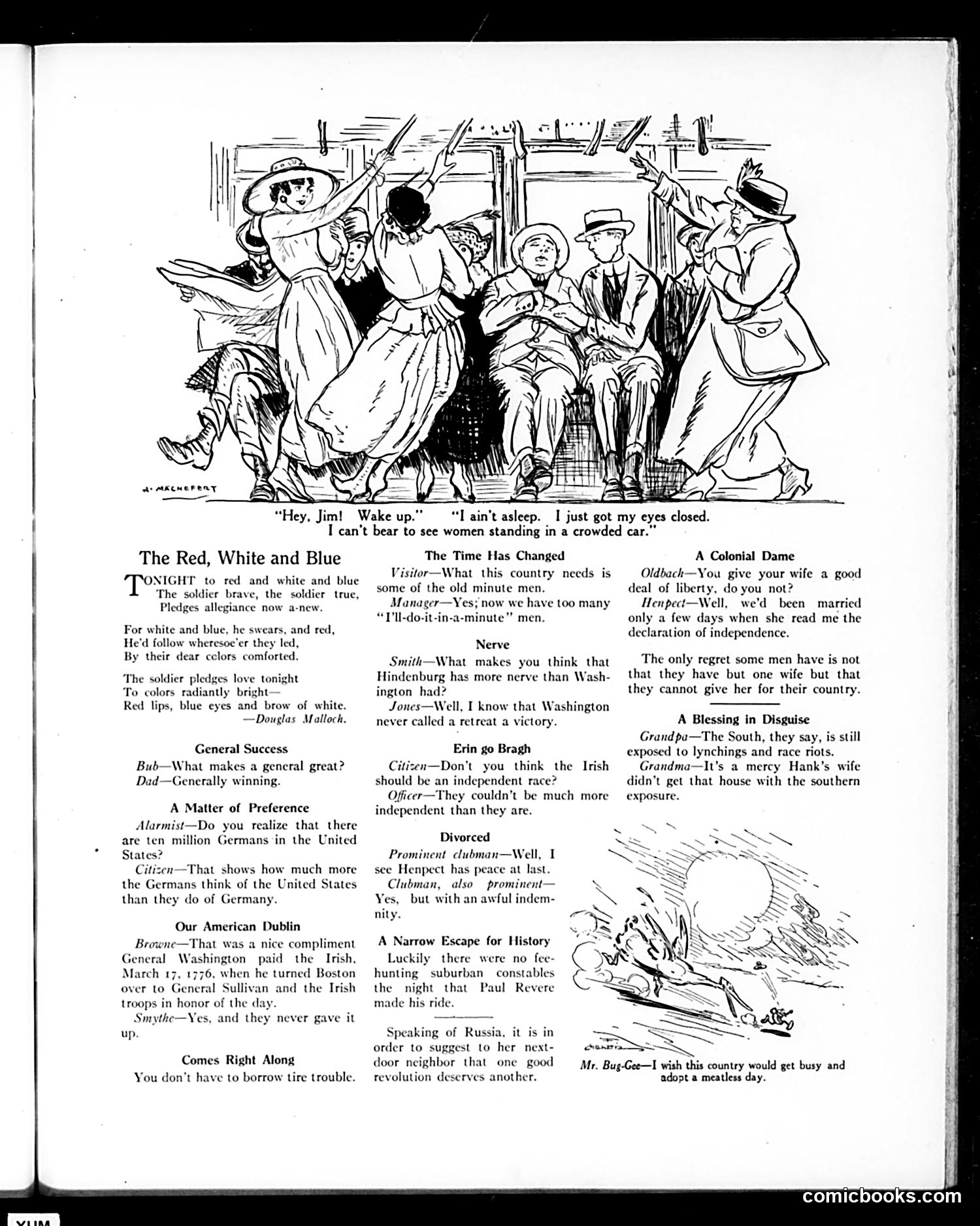
This page from Judge (likely WWI-era, based on references to Hindenburg and Washington comparisons) contains multiple brief satirical jokes rather than a single cartoon. The top illustration depicts a crowded streetcar with the caption about a man keeping his eyes closed rather than seeing "women standing in a crowded car"—satire of male discomfort with women's increasing public presence and mobility. The text pieces mock various contemporary issues: - **Military leadership**: A joke contrasting Washington's honesty (never calling retreats "victories") with Hindenburg's dishonesty - **Immigration anxiety**: A German-American population concern, deflated by noting Germans value America more than Germany itself - **Irish independence**: Play on Irish stubbornness and their dominant presence in Boston politics - **Women's liberation**: A wife citing the Declaration of Independence to her newly married husband, satirizing women's expanded demands for rights - **WWI references**: Comparisons to historical American figures, suggesting modern leaders lack their predecessors' character The humor relies on readers' familiarity with contemporary social anxieties: women's changing roles, ethnic politics, and wartime leadership debates.
📄 Transcribed text from this page (OCR, searchable)
Machine-transcribed from the original scan — historical spelling and the odd misread are preserved.
Ar akcuereny — “Hey, Jim! Wake up.” “T ain't asleep. I just got my eyes closed. I can’t bear to see women standing in a crowded car. The Red, White and Blue NIGHT to red and white and blue The soldier brave, the soldier true, Pledges allegiance now a-new. For white and blue, he swears, and red, He'd follow wheresoe’er they led, By their dear cclors comforted. The soldier pledges love tonight To colors radiantly bright Red lips, blue eyes and brow of white. —Douglas Malloch. General Success Bub—What makes a general great? Dad—Generally winning. A Matter of Preference Alarmist—Do you realize that there are ten million Germans in the United States? Citizen—That shows how much more the Germans think of the United States than they do of Germany. Our American Dublin Browne—That was a nice compliment General Washington paid the Irish, March 17, 1776, when he turned Boston over to General Sullivan and the Irish troops in honor of the day. Smythe—Yes, and they never gave it up. Comes Right Along You don’t have to borrow tire trouble. The Time Has Changed Visitor—What this country needs is some of the old minute men. Manager—Yes; now we have too many “T'll-do-it-in-a-minute” men. Nerve Smith—What makes you think that Hindenburg has more nerve than Wash- ington had? Jones—Well, I know that Washington never called a retreat a victory. Erin go Bragh Citien—Don't you think the Irish should be an independent race? Officer—They couldn’t be much more independent than they are. Divorced Prominent clubman—Well, 1 see Henpect has peace at last. Clubman, also prominent— Yes, but with an awful indem- nity. A Narrow Escape for History Luckily there were no fee- hunting suburban constables the night that Paul Revere made his ride. Speaking of Russia, it is in order to suggest to her next- door neighbor that one good revolution deserves another. A Colonial Dame Oldbach—You give your wife a good deal of liberty, do you not? Henpect—Well, we'd been married only a few days when she read me the declaration of independence. The only regret some men have is not that they have but one wife but that they cannot give her for their country. A Blessing in Disguise Grandpa—The South, they say, is still exposed to lynchings and race riots. Grandma—It's a mercy Hank’s wife didn’t get that house with the southern exposure. Mr, Bug-Gee—I wish this country would get busy and adopt a meatless day. comicbooks.com