
Judge, 1917-07-07 · page 2 of 27
Judge — July 7, 1917 — page 2: what you’re looking at
What you’re looking at
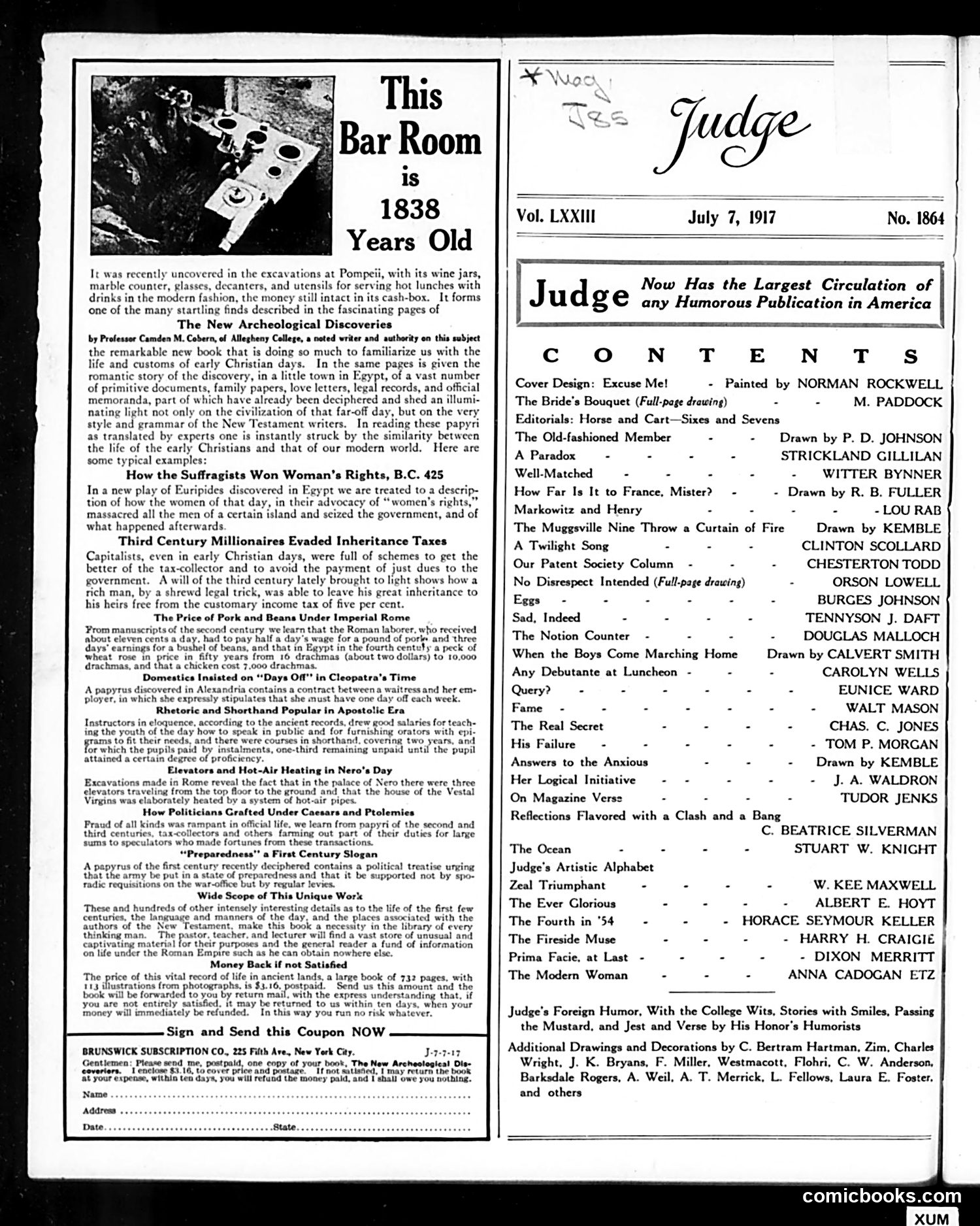
This page is primarily a **table of contents** for Judge's weekly issue, listing articles and illustrations by various contributors. The left side contains an advertisement for a book about a 1,838-year-old Roman bar room excavated at Pompeii, with historical commentary about early Christian customs and New Testament language. The cover design by **Norman Rockwell** is titled "Excuse Me!" The contents suggest typical Judge fare: political satire ("Horse and Cart—Sizes and Sevens"), social commentary, and humorous illustrations. Given the July 1917 date, this was published during American involvement in **World War I** — suggested by the article "When the Boys Come Marching Home." The page itself contains no visible political cartoons to analyze.
📄 Transcribed text from this page (OCR, searchable)
Machine-transcribed from the original scan — historical spelling and the odd misread are preserved.
is 1838 marble counter, glasses, decanters, and utensils for se ‘one of the many startling finds described in the fascinating pages of The New Archeological Discoveries of primitive documents, famil style and grammar of the Ne some typical examples: How the Suffragists Won Woman's Rights, B.C. 425 what happened afterwards. Third Century Millionaires Evaded Inheritance Taxes his heirs free from the customary’ income tax of five per cent. The Price of Pork and By Under Imperial Rome From manuscripts of the second century we drachmas, and that a chicken cost 7,000 drachmas. Domestics Insisted on “Days Off” in Cleopatra's Time A papyrus discovered in Alexandria contains a contract between a w: ployer, in which she expressly stipulates that she must have one day Rhetoric and Shorthand Popular in Apostolic Era ing the youth of the day how to speak in public and for furnishing ora: attained a certain degree of proficiency. Elevators and Hot-Air Heating in Nero's Day Excavations made in Rome reveal the fact that in the palace of } Virgins was elaborately heated by a system of hot-air pipes How Politicians Grafted Under Caesars and Ptolemies Praud of all kinds was rampant in offi third centuries, tax-collectors and others sums to speculators who made fortunes from these transactions. “Preparedness” a First Century Slogan A papyrus of the first century recently deciphered contains a polit that the army be put in a state of preparedness and that it be radic requisitions on the war-office but by regular levies. Wide Scope of This Unique Work These and hundreds of other intensely interesting ¢ thinking man. The on life under the Roman Empire such as he can obtain nowhere else. Money Back if not Satisfied 113 3 book will be forwarded to you by return mail, with the express unde you are not entirely satisfied. it may be returned to us within ten money will immediately be refunded. In this way you run no risk whatever. Sign and Send this Coupon NOW BRUNSWICK SUBSCRIPTION CO, 225 Fifth Ave, New York City. Gentlemen: Please send me, postpaid, one copy ot your book. The New Are T enclose $3.16, to cover price Name... Years Old It was recently uncovered in the excavations at Pompeii, with its wine jars, ing hot lunches with drinks in the modern fashion, the money still intact in its cash-box. It forms by Professor Camden M. Cobern, of Allegheny College, a noted writer and authority on this subject the remarkable new book that is doing so much to familiarize us with the life and customs of early Christian days. In the same pages is given the romantic story of the discovery, in a little town in Egypt, of a vast number y papers, love letters, legal records, and official memoranda, part of which have already been deciphered and shed an illumi- nating light not only on the civilization of that far-off day, but on the very festament writers. In reading these papyri as translated by experts one is instantly struck by the similarity between the life of the early Christians and that of our modern world. Here are In a new play of Euripides discovered in Egypt we are treated to a descrip- tion of how the women of that day, in their advocacy of “women’s rights,” massacred all the men of a certain island and seized the government, and of Capitalists, even in early Christian days, were full of schemes to get the better of the tax-collector and to avoid the payment of just dues to the government. A will of the third century lately brought to light shows how a rich man, by a shrewd legal trick, was able to leave his great inheritance to that the Roman laborer, who received about eleven cents a day, had to pay half a day’s wage for a pound of pork and three days’ earnings for a bushel of beans, and that in Egypt in the fourth centuly a peck of Wheat rose in price in fifty years from 16 drachmas (about two dollars) to 10,000 ssand her em- ff each week. Instructors in eloquence, according to the ancient records, drew good salaries for teach- rs with epi- rams to fit their needs, and there were courses in shorthand, covering two years, and for which the pupils paid by instalments, one-third remaining unpaid until the pupil ‘ero there were three elevators traveling from the top floor to the ground and that the house of the Vestal we learn from papyri of the second and larming out part of their duties for large urgi pported not oy spo- Is as to the life of the first few centuries, the language and manners of the day, and the places associated with the authors of the New Testament, make this book a necessity in the library of every pastor, teacher, and lecturer will find a vast store of unusual and captivating material for their purposes and the general reader a fund of information The price of this vital record of life in ancient lands. a large book of 732 pages. with lustrations from photographs. is $3.16. postpaid. Send us this amount and the lays, when your heotogical Dle- ‘and postage. If not satisfied, 1 may return the book At Your expense, within ten days, you will refund the money pald, and I'shall owe you nothing. Vol XX July 7, 1917 No. 1864 Now Has the Largest Circulation of | J udg e any Humorous Publication in America c O N T E N T S Cover Design: Excuse Me! - Painted by NORMAN ROCKWELL The Bride's Bouquet (Full-page drawing) - - M. PADDOCK Editorials: Horse and Cart—Sixes and Sevens The Old-fashioned Member - - Drawn by P. D. JOHNSON A Paradox - STRICKLAND GILLILAN ‘Well-Matched - - - - - WITTER BYNNER How Far Is It to France, Mister? - - Drawn by R. B. FULLER Markowitz and Henry - - - - - LOU RAB The Muggsville Nine Throw a Curtain of Fire Drawn by KEMBLE A Twilight Song - - - CLINTON SCOLLARD Our Patent Society Column = - - - CHESTERTON TODD No Disrespect Intended (Full-page drawing) - ORSON LOWELL Eggs - - - - - - BURGES JOHNSON Sad, Indeed - - - - TENNYSON J. DAFT The Notion Counter - - - - DOUGLAS MALLOCH When the Boys Come Marching Home Drawn by CALVERT SMITH Any Debutante at Luncheon - - - CAROLYN WELLS Query? - - - - - - EUNICE WARD Fame - - - - - - - WALT MASON The Real Secret - - - - CHAS. C. JONES His Failure - - - - - - TOM P. MORGAN Answers to the Anxious - - - Drawn by KEMBLE Her Logical I i 7: - - - J. A. WALDRON On Magazine Vers: - - - - TUDOR JENKS Reflections Flavored with a Clash and a Bang C. BEATRICE SILVERMAN The Ocean - - - STUART W. KNIGHT Judge's Artistic Alphabet Zeal Triumphant - - - . W. KEE MAXWELL The Ever Glorious - : - - ALBERT E. HOYT The Fourth in 54 - - HORACE SEYMOUR KELLER The Fireside Muse “ - : - HARRY H. CRAIGIE - - DIXON MERRITT ANNA CADOGAN ETZ Prima Facie, at Last - - - The Modern Woman - - “i Judge's Foreign Humor, With the College Wits, Stories with Smiles, Passing the Mustard, and Jest and Verse by His Honor's Humorists Additional Drawings and Decorations by C. Bertram Hartman, Zim, Charles Wright, J. K. Bryans, F. Miller, Westmacott, Flohri, C. W. Anderson, Barksdale Rogers, A. Weil, A. T. Merrick, L. Fellows, Laura E. Foster. and others comicbooks.com