
Judge, 1917-07-07 · page 12 of 27
Judge — July 7, 1917 — page 12: what you’re looking at
What you’re looking at
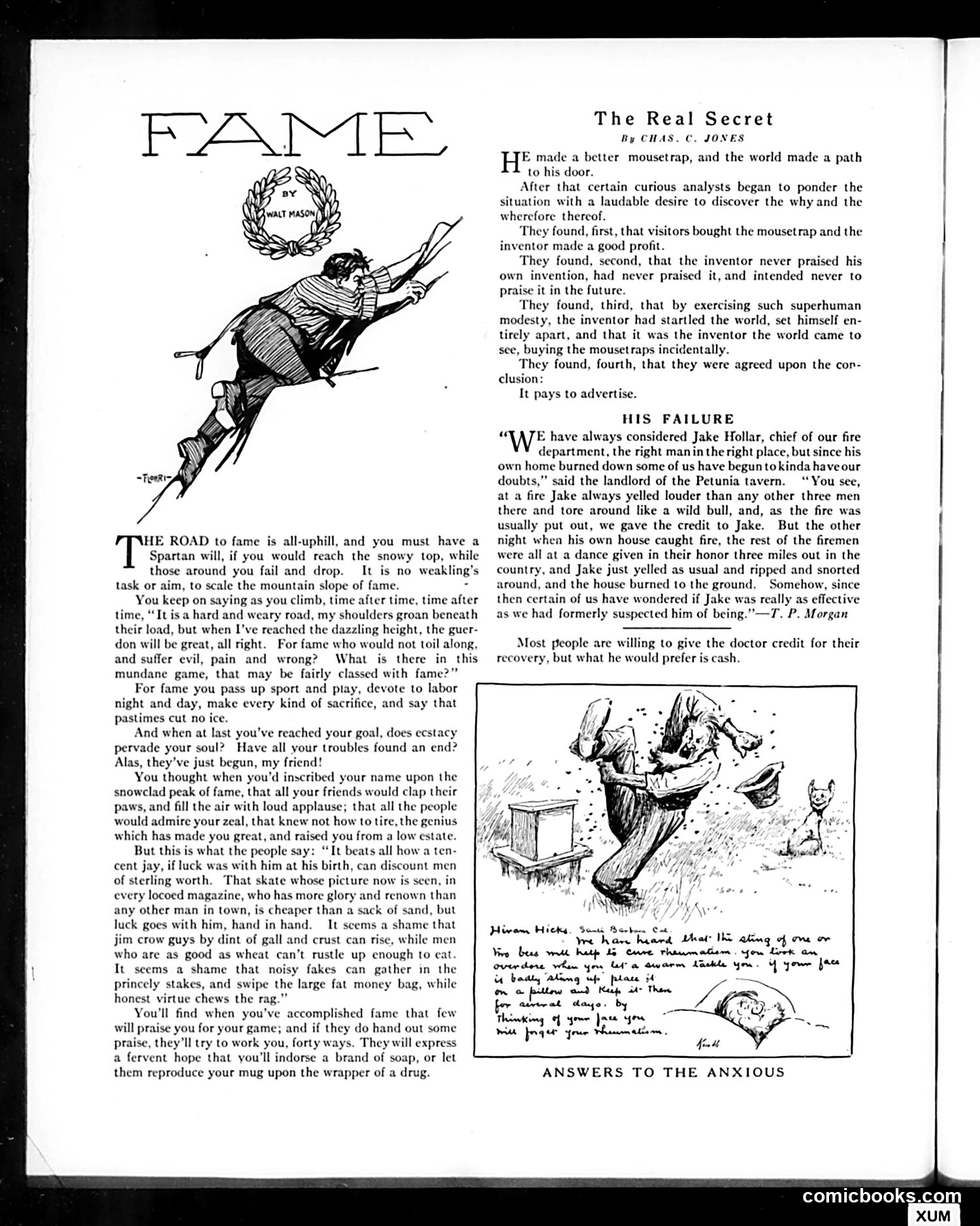
This page contains two distinct satirical pieces: **"FAME"** (left): A cynical poem mocking the pursuit of celebrity and public success. The accompanying illustration shows a figure ascending toward a wreath labeled "FAME." The satire argues that achieving renown requires relentless sacrifice, yet once attained, the public credits your success to luck rather than merit, dismisses you as cheap despite your accomplishments, and immediately tries to exploit you for commercial endorsements (soap wrappers, drug advertisements). The piece suggests fame brings envy and attempted exploitation rather than genuine admiration. **"The Real Secret"** and **"His Failure"** (right): Two brief anecdotes. The first notes that a mousetrap inventor succeeded through *not* self-promotion—his modesty attracted attention. The second mocks Fire Chief Jake Hollar, who performed spectacularly at others' fires (earning credit), but when his own house burned, his heroics couldn't save it, revealing his competence was circumstantial. Both mock the gap between public perception and actual ability.
📄 Transcribed text from this page (OCR, searchable)
Machine-transcribed from the original scan — historical spelling and the odd misread are preserved.
Spartan will, if you would reach the snowy top, while those around you fail and drop. It is no weakling’s T's ROAD to fame is all-uphill, and you must have a , to scale the mountain slope of fam You keep on saying as you climb, time after time, time after time, “It isa hard and weary road, my shoulders groan beneath their load, but when I've reached the dazzling height, the guer- don will be great, all right. For fame who would not toil along, and suffer evil, pain and wrong? What is there in this mundane game, that may be fairly classed with fame?” For fame you pass up sport and play, devote to labor night and day, make every kind of sacrifice, and say that pastimes cut no ice. And when at last you've reached your goal, does ecstacy pervade your soul? Have all your troubles found an end? Alas, they’ve just begun, my friend! You thought when you'd inscribed your name upon the snowclad peak of fame, that all your friends would clap their paws, and fill the air with loud applause; that all the people would admire your zeal, that knew not how to tire, the genius which has made you great, and raised you from a low estate. But this is what the people say: “It beats all how a ten- cent jay, if luck was with him at birth, can discount men of sterling worth. That skate whose picture now is seen, in every locoed magazine, who has more glory and renown than any other man in town, is cheaper than a sack of sand, but luck goes with him, hand in hand. It scems a shame that jim crow guys by dint of gall and crust can rise, while men who are as good as wheat can’t rustle up enough to eat. It seems a shame that noisy fakes can gather in the princely stakes, and swipe the large fat money bag, while honest virtue chews the rag.” You'll find when you've accomplished fame that few will praise you for your game; and if they do hand out some praise, they'll try to work you, forty ways. They will express a fervent hope that you'll indorse a brand of soap, or let them reproduce your mug upon the wrapper of a drug. task or ai The Real Secret By CHAS. ©. JONES E made a better mousetrap, and the world made a path to his door. After that certain curious analysts began to ponder the situation with a laudable desire to discover the why and the wherefore thercof. They found, first, that visitors bought the mousetrap and the inventor made a good profit. They found, second, that the inventor never praised his own invention, had never praised it, and intended never to prai: in the future. They found, third, that by exercising such superhuman modesty, the inventor had startled the world, set himself en- tirely apart, and that it was the inventor the world came to see, buying the mousetraps incidentally. They found, fourth, that they were agreed upon the con- clusion: It pays to advertise. HIS FAILURE have always considered Jake Hollar, chief of our fire department, the right manin the right place, but since his own home burned down some of us have begun tokinda have our doubts,” said the landlord of the Petunia tavern. “You see, at a fire Jake always yelled louder than any other three men there and tore around like a wild bull, and, as the fire was usually put out, we gave the credit to Jake. But the other night when his own house caught fire, the rest of the firemen were all at a dance given in their honor three miles out in the country, and Jake just yelled as usual and ripped and snorted around, and the house burned to the ground. Somehow, since then certain of us have wondered if Jake was really as effective as we had formerly suspected him of being.” —T. P. Morgan “ Most people are willing to give the doctor credit for their recovery, but what he would prefer is cash. u He Santi Barbon Hive Hie ean hiead thet WSaltng ef ow or Vivo bers wath Ruth 1a Corre Phimatiom you Lik au over dere whin you Lt a Swarm Laeble you. Y youn fact 4 badty Akon : il 2 A i: by = Thiwk: yome Jae ge ANSWERS TO THE ANXIOUS comicbooks.com