
Judge, 1917-07-07 · page 13 of 27
Judge — July 7, 1917 — page 13: what you’re looking at
What you’re looking at
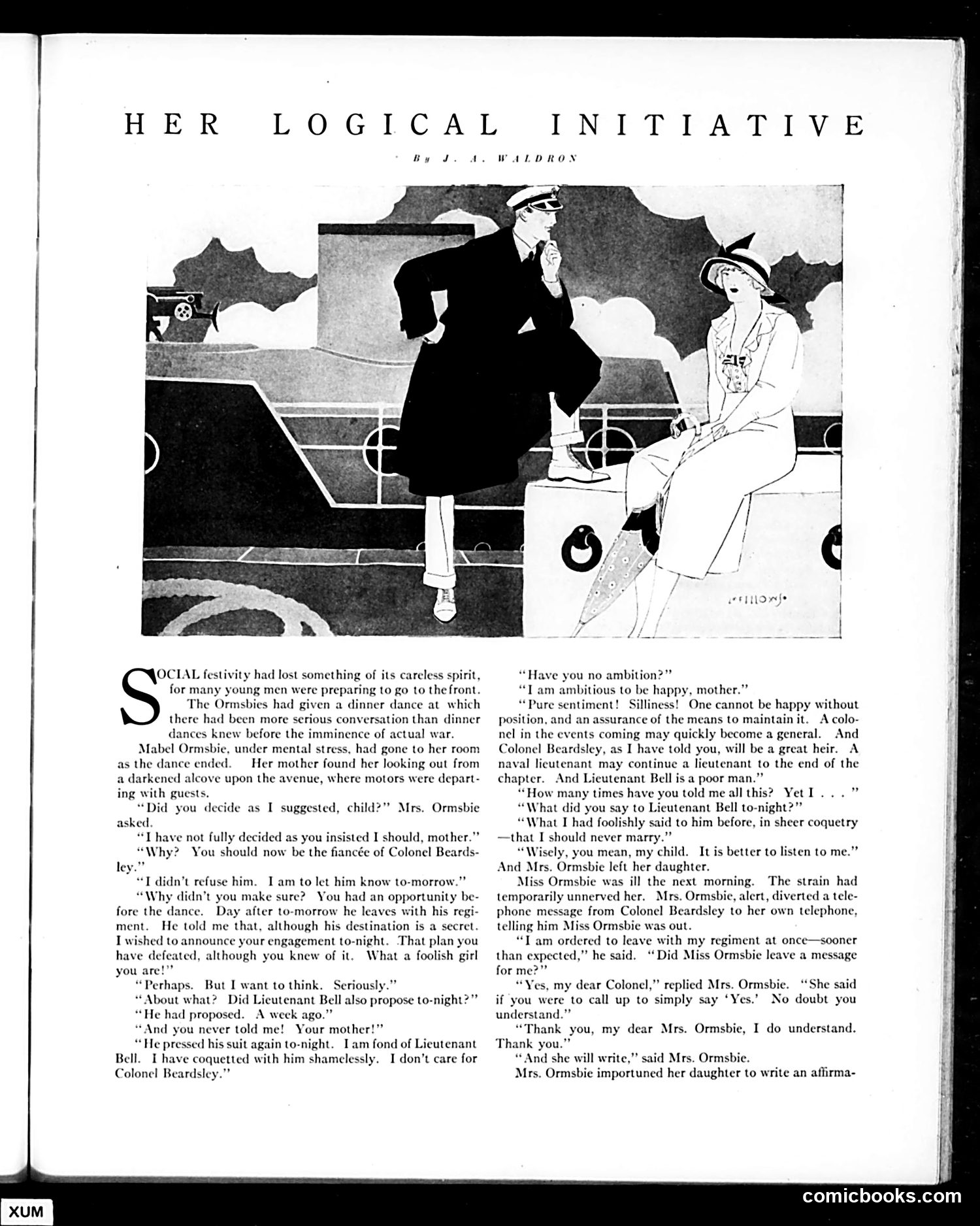
This story satirizes early-20th-century upper-class social pressures and maternal manipulation during wartime (likely WWI, given references to regiments deploying). **The setup:** Mabel Ormsbie, a young woman, has received proposals from two suitors—Colonel Beardsley (wealthy, likely to become a general) and Lieutenant Bell (poor but apparently genuinely loved). Her mother pressures her toward the Colonel for financial security and social advancement. **The satire:** The title "Her Logical Initiative" is ironic. Rather than Mabel making her own choice, her mother *intercepts* Colonel Beardsley's call, fabricates an affirmative answer ("Yes"), and manipulates her daughter into writing confirmation—all without Mabel's genuine consent. The "logic" is the mother's calculated social ambition, not Mabel's authentic preference. **The point:** This critiques how mothers and society coerced young women into marriages for status rather than love, overriding their agency even during serious circumstances like war. The irony exposes how patriarchal "logic" prioritizes wealth over happiness and female autonomy.
📄 Transcribed text from this page (OCR, searchable)
Machine-transcribed from the original scan — historical spelling and the odd misread are preserved.
HER f _N OCIAL festivity had lost something of its careless spirit, for many young men were preparing to go to the front. The Ormsbies had given a dinner dance at which there had been more serious conversation than dinner dances knew before the imminence of actual war. Mabel Ormsbie, under mental stress, had gone to her room as the dance ended Her mother found her looking out from a darkened alcove upon the avenue, where motors were depart- ing with guest “Did you decide as I suggested, child?” Mrs. Ormsbie asked. “Thave not fully decided as you insisted I should, mother.” “Why? You should now be the fiancée of Colonel Beards- ley. Tam to let him know to-morrow “Why didn’t you make sure? You had an opportunity be- fore the dance. I after to-morrow he leaves with his regi- ment. He told me that, although his destination is a secret. I wished to announce your engagement to-night. That plan you have defeated, although you knew of it. What a foolish girl you are!” “Perhaps. But I want to think. Seriously.” About what? Did Licutenant Bell also propose to-night?” “He had proposed. A week ago.” “And you never told me! Your mother!” “He pressed his suit again to-night. I am fond of Lieutenant Bell. I have coquetted with him shamelessly. I don’t care for Colonel Beardsley.” I didn’t refuse him. LOGICAL INITIATIVE WALDRON “Have you no ambition?” “T am ambitious to be happy, mother.” “Pure sentiment! Silliness! One cannot be happy without position, and an assurance of the means to maintain it. A colo- nel in the ev coming may quickly become a general. And Colonel Beardsley, as I have told you, will be a great heir. A naval lieutenant may continue a lieutenant to the end of the chapter. And Lieutenant Bell is a poor man.” “How many times have you told me all thi Yetl on. ? “What did you say to Lieutenant Bell to-night?” “What I had foolishly said to him before, in sheer coquetry —that I should never marry.” “Wisely, you mean, my child. It is better to listen to me. And Mrs. Ormsbie left her daughter. Miss Ormsbie was ill the next morning. The strain had temporarily unnerved her. Mrs. Ormsbie, alert, diverted a tele- phone message from Colonel Beardsley to her own telephone, telling him Miss Ormsbie was out. “Tam ordered to leave with my regiment at once—sooner than expected,” he said. “Did Miss Ormsbie leave a message for me?” “Yes, my dear Colonel,” replied Mrs. Ormsbie. ‘She said if you were to call up to simply say ‘Yes.’ No doubt you understand.” “Thank you, my dear Mrs. Ormsbie, I do understand. Thank you.” “And she will write,” said Mrs. Ormsbie. Mrs. Ormsbie importuned her daughter to write an affirma- comicbooks.com