
Judge, 1917-07-07 · page 7 of 27
Judge — July 7, 1917 — page 7: what you’re looking at
What you’re looking at
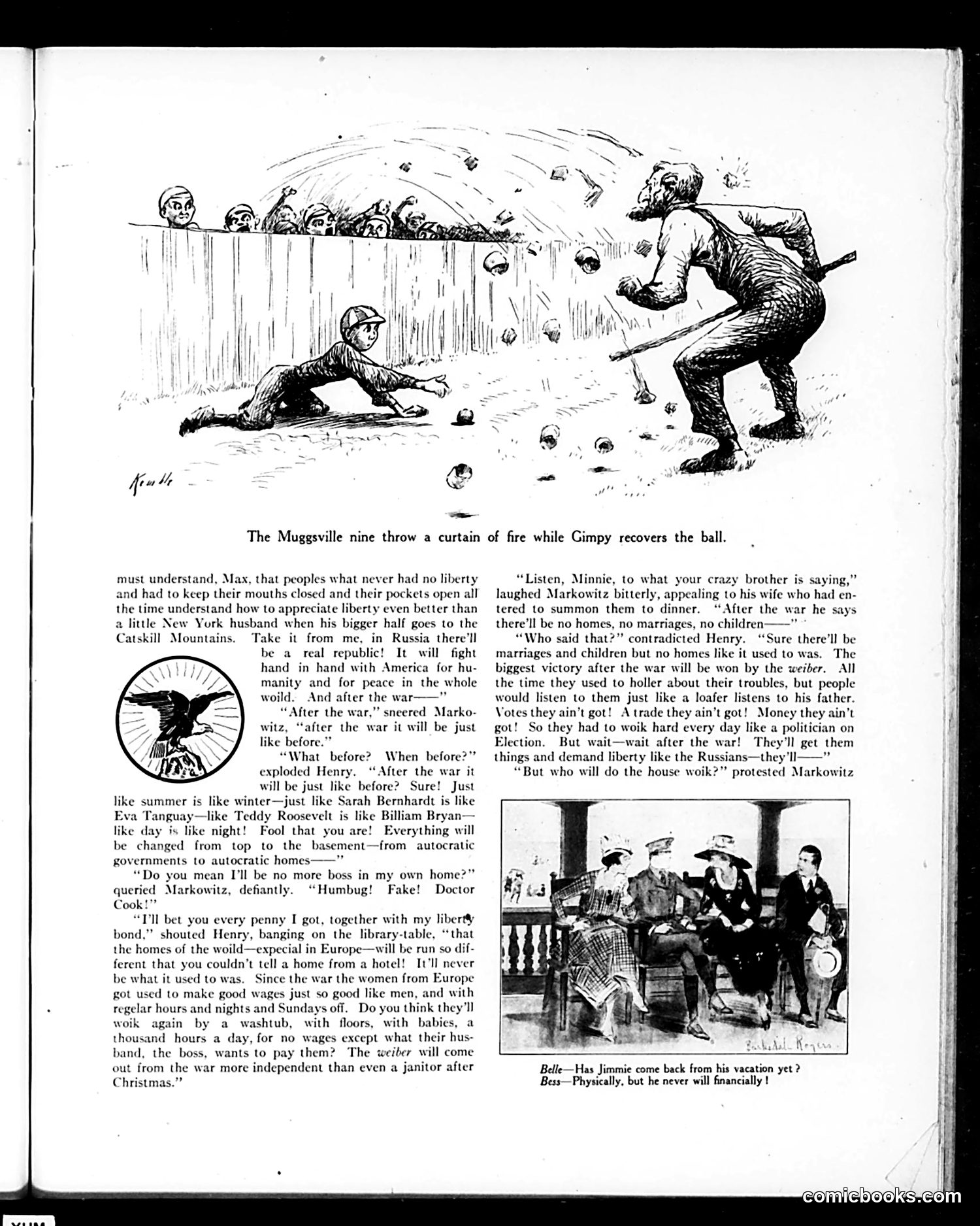
This page satirizes post-WWI optimism about social change, particularly regarding women's liberation and labor rights. The main text features a heated debate between Henry (an idealistic immigrant) and Markowitz (a skeptical traditionalist) about how war will transform society—especially European women's independence and domestic arrangements. Henry argues women will demand voting rights, trades, and freedom from unpaid housework, becoming as independent as "the Russians" (likely referencing Bolshevik revolution rhetoric). Markowitz dismissively counters: "who will do the house work?"—capturing male anxiety about losing domestic control. The top cartoon shows "Muggsville nine" (a baseball team) playing while "Gimpy recovers the ball," likely a mundane sports reference contrasting with the grandiose political debate below. The satire mocks both Henry's naive idealism and Markowitz's stubborn resistance to inevitable social change, while the small caption joke about Jimmie's vacation reinforces financial anxieties of the era.
📄 Transcribed text from this page (OCR, searchable)
Machine-transcribed from the original scan — historical spelling and the odd misread are preserved.
The Muggsville nine throw a curtain of fire while Gimpy recovers the ball. must understand, Max, that peoples what never had no liberty and had to keep their mouths closed and their pockets open a the time understand how to appreciate liberty even better than a little New York husband when his bigger half goes to the Catskill Mountains. Take it from me, in Russia there'll be a real republic! It will fight hand in hand with America for hu- manity and for peace in the whole woild. And after the war—" “After the war,” sneered Marko- i “after the war it will be just ¢ before.” “What before? When before?” exploded Henry. “After the war it will be just like before? Sure! Just ike winter—just like Sarah Bernhardt is like like Teddy Roosevelt is like Billiam Bryan- night! Fool that you are! Everything wil like summer is =va Tangua like day is I be changed from top to the basement—from autocratic governments to autocratic homes: “Do you mean I'll be no more boss in my own home?” queried Markowitz, defiantly. “Humbug! Fake! Doctor Cook “Tl bet you every penny I got, together with my liberty bond,”’ shouted Henry, banging on the library-table, “that the homes of the woild—expecial in Europe—will be run so dif- ferent that you couldn’t tell a home from a hotel! It'll never be what it used to was. Since the war the women from Europe got used to make good wages just so good like men, and with regelar hours and nights and Sundays off. Do you think they'll ain by a washtub, with floors, with babies, a thousand hours a day, for no wages except what their hus- band, the boss, wants to pay them? The weiber will come out from the war more independent than even a janitor after Christmas.”” “Listen, Minnie, to what your crazy brother is saying,” laughed Markowitz bitterly, appealing to his wife who had en- tered to summon them to dinner. “After the war he says there'll be no homes, no marriages, no children——” “Who said that?” contradicted Henry. ‘Sure there'll be marriages and children but no homes like it used to was. The biggest victory after the war will be won by the weiber. All the time they used to holler about their troubles, but people would listen to them just like a loafer listens to his father. Votes they ain’t got! A trade they ain’t got! Money they ain’t got! So they had to woik hard every day like a politician on Election. But wait—wait after the war! They'll get them things and demand liberty like the Ri ns—they’II——”" “But who will do the house woik?” protested Markowitz Belle—Has Jimmie come back from his vacation yet ? Bess—Physically, but he never will financially !