
Judge, 1917-07-07 · page 4 of 27
Judge — July 7, 1917 — page 4: what you’re looking at
What you’re looking at
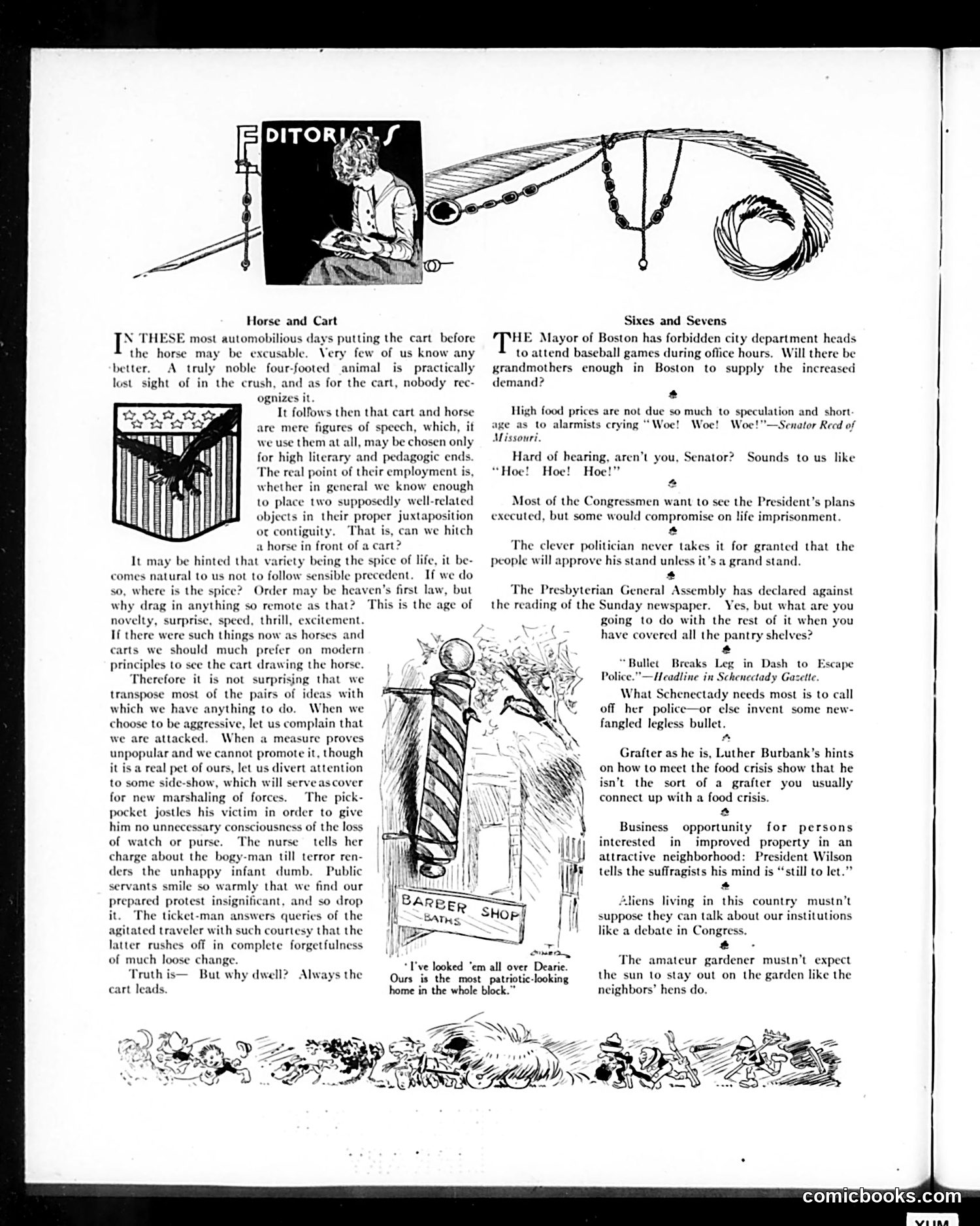
This page contains political commentary and social satire typical of early 20th-century Judge magazine. The left column's "Horse and Cart" essay argues for keeping traditional horse-drawn vehicles, framing modernization skeptically—a common theme as automobiles displaced horses. The right column, "Sizes and Sevens," collects brief satirical quips about contemporary issues: Senator Reed of Missouri's food price complaints, Congressional criticism of the President, the Presbyterian General Assembly's stance on Sunday newspapers, and workplace matters. The central cartoon depicts a bullet escaping a barber shop, illustrating a Schenectady Gazette headline about someone fleeing police—likely darkly humorous commentary on local crime or social disorder. The overall tone reflects Judge's typical approach: mocking politicians, social reformers, and modern anxieties through brief, pointed observations.
📄 Transcribed text from this page (OCR, searchable)
Machine-transcribed from the original scan — historical spelling and the odd misread are preserved.
Horse and Cart N THESE most automobilious days putting the cart before the horse may be excusable, Very few of us know any better. A truly noble four-footed animal is practically lost sight of in the crush, and as for the cart, nobody rec- ognizes it. It folfows then that cart and horse are mere figures of speech, which, it we use them at all, may be chosen only for high literary and pedagogic ends. The real point of their employment i whether in general we know enough to place two supposedly. well-related objects in their proper juxtaposition or contiguity. That is, can we hitch a horse in front of a cart? It may be hinted that variety being the spice of life, it be- comes natural to us not to follow sensible precedent. If we do Order may be heaven's first law, but This is the so, where is the spice? why drag in anything so remote as that? novelty, surprise, speed, thrill, excitement. If there were such things now as horses and carts we should much prefer on modern principles to sce the cart drawing the horse. Therefore it is not surprising that we transpose most of the pairs of ideas with which we have anything to do. When we aggressive, let us complain that ked. When a measure proves unpopular and we cannot promote it, though it is a real pet of ours, let us divert attention to some side-show, which will serve as cover for new marshaling of forces. ‘The pic pocket jostles his victim in order to give him no unnecessary consciousness of the loss of watch or purse. The nurse tells her charge about the bogy-man till terror ren- ders the unhappy infant dumb. Public servants smile so warmly that we find our prepared protest insignificant, and so drop it. The ticket-man answers queries of the agitated traveler with such courtesy that the latter rushes off in complete forgetfulness of much loose chang ruth is— But why dwell? Always the cart leads. Ours is the most home in the whole “I've looked ‘em all over Dearie. Sixes and Sevens HE Mayor of Boston has forbidden city department heads to attend baseball games during office hours. Will there be grandmothers enough in Boston to supply the increased demand? 2 High food prices are not due so much to speculation and short age as to alarmists crying “Woe! Woe! Woe!"—Senator Reed of Missouri Hard of hearing, Sounds to us like “Hoe! Hoe! Hoe ren’t you, Senator? 2 Most of the Congressmen want to see the President’s plans executed, but some would compromise on life imprisonment. s The clever politician never s it for granted that the people will approve his stand unless it’s a grand stand. 2 The Presbyterian General Assembly has declared against the reading of the Sunday newspaper. Yes, but what are you going to do with the rest of it when you have covered all the pantry shelves? e “Bullet Breaks Leg in Dash to E Police.” —Headline in Schenectady Gazette. What Schenectady needs most is to call off her police—or else invent some new- fangled legless bullet. 4s Grafter as he is, Luther Burbank’s hints on how to meet the food crisis show that he isn’t the sort of a grafter you usually connect up with a food crisis. 2 Business opportunity for persons interested in improved property in an attractive neighborhood: President Wilson tells the suffragists his mind is “still to let.” + Aliens living in this country mustn’t suppose they can talk about our institutions like a debate in Congress. & The amateur gardener mustn't expect the sun to stay out on the garden like the neighbors’ hens do. patriotic-looking block. comicbooks.com