
A complete issue · 32 pages · 1916
Judge — September 23, 1916
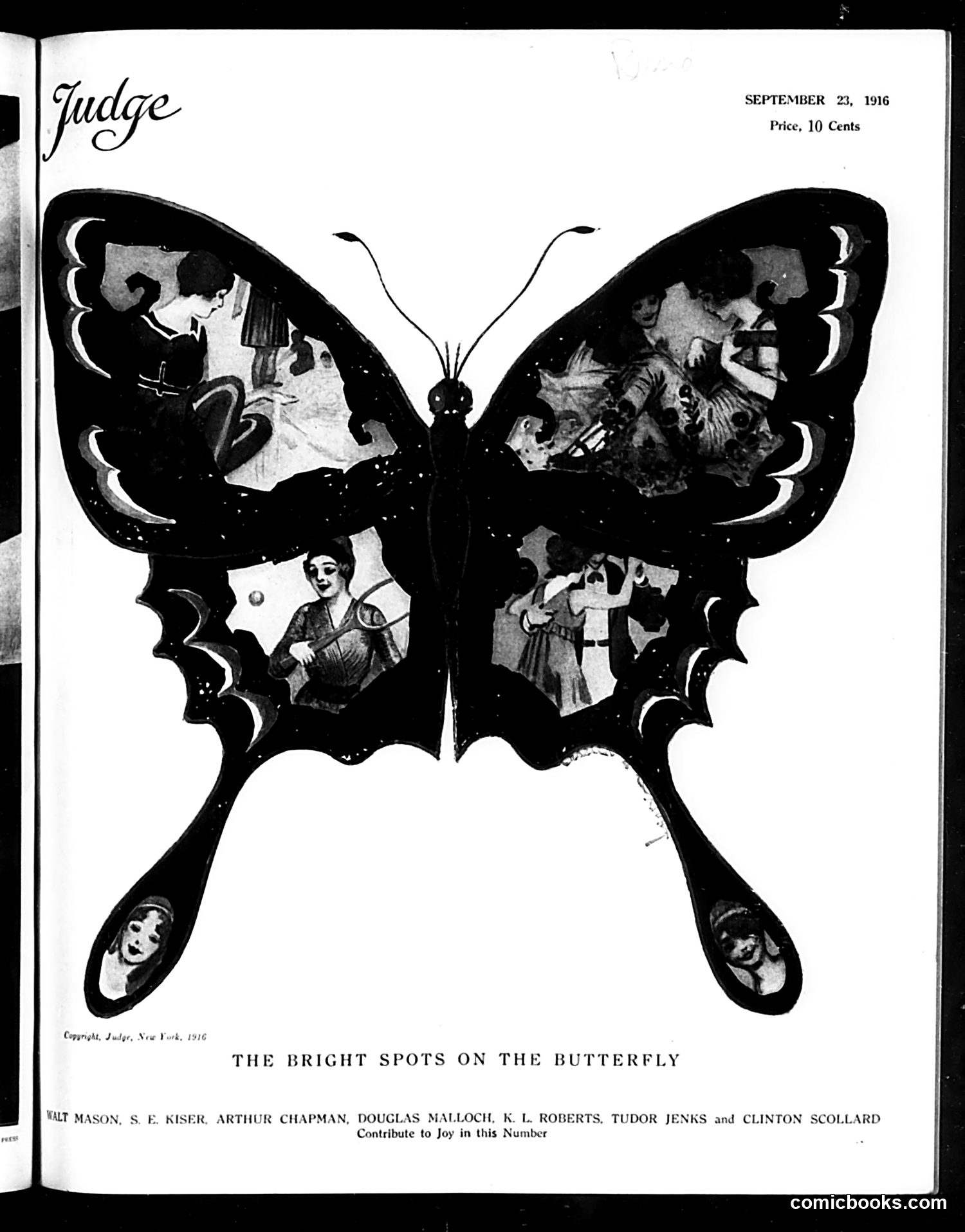
This is a **Judge magazine cover from September 23, 1916**, priced at 10 cents. The illustration uses a butterfly as a frame containing vignettes—small scenes depicting various entertainers or public figures of the era. The title "The Bright Spots on the Butterfly" appears to be a playful reference to entertainment and cultural luminaries. The butterfly's wings and body contain different photographic or illustrated scenes, likely representing popular actors, performers, or notable figures from 1916. The two oval spots at the bottom of the wings contain what appear to be portrait heads. The contributors listed (Walt Mason, S.E. Kiser, Arthur Chapman, Douglas Malloch, K.L. Roberts, Tudor Jenks, and Clinton Scollard) were prominent writers and humorists of the period. Without clearer image resolution, the specific identities of the figures remain unclear.
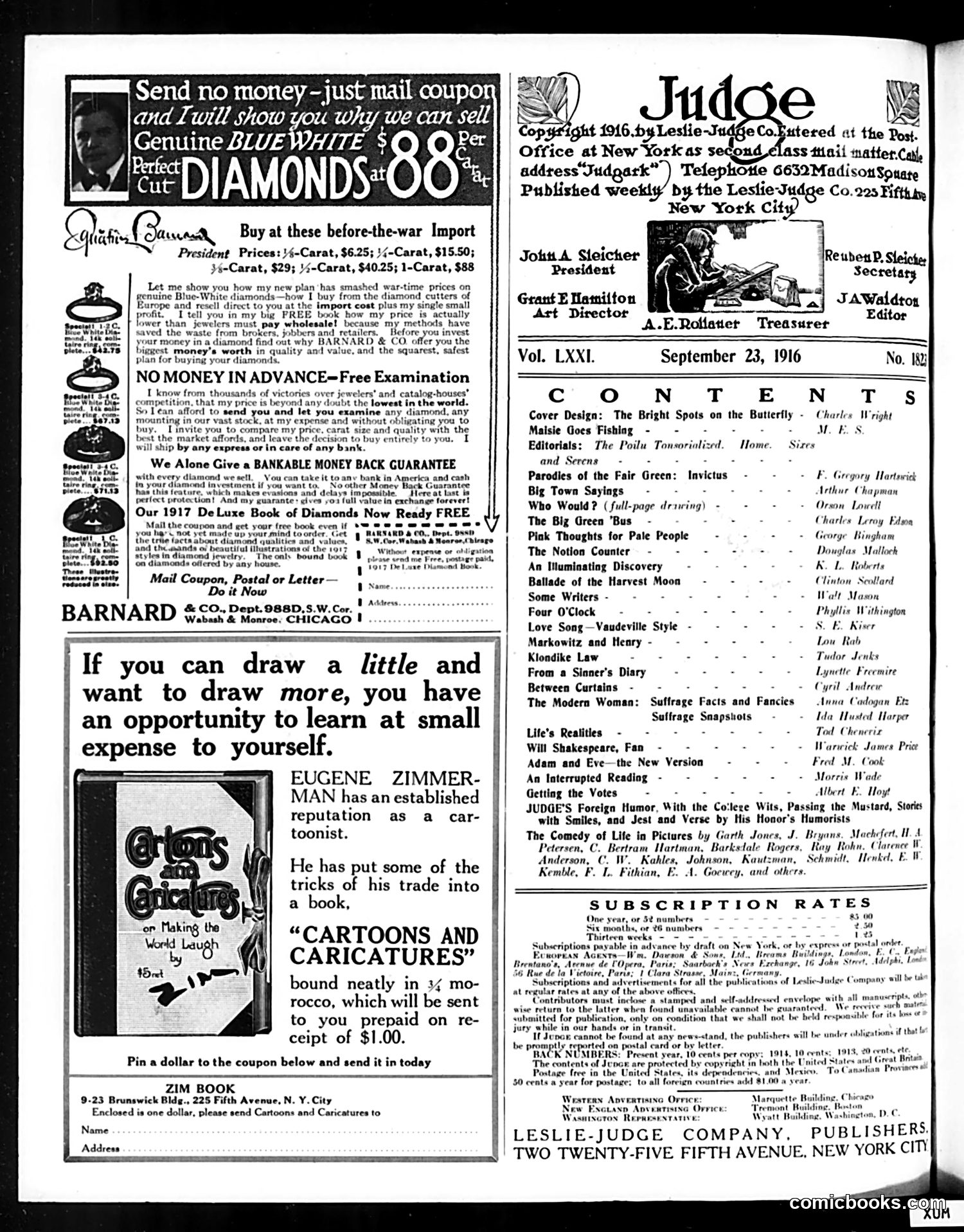
This page is primarily **advertising and masthead information** for Judge magazine rather than satirical content. The left side features diamond and jewelry advertisements typical of early 20th-century publications, plus an ad for "Cartoons and Caricatures," a instructional book by cartoonist Eugene Zimmerman. The right side shows the magazine's masthead and table of contents for this issue. The contents list various articles and illustrations—titles like "The Big Green Bus," "Pink Thoughts for Pale People," and "The Modern Woman"—suggesting typical satirical commentary on contemporary society and gender issues of 1916, though specific cartoons aren't visible in this reproduction.
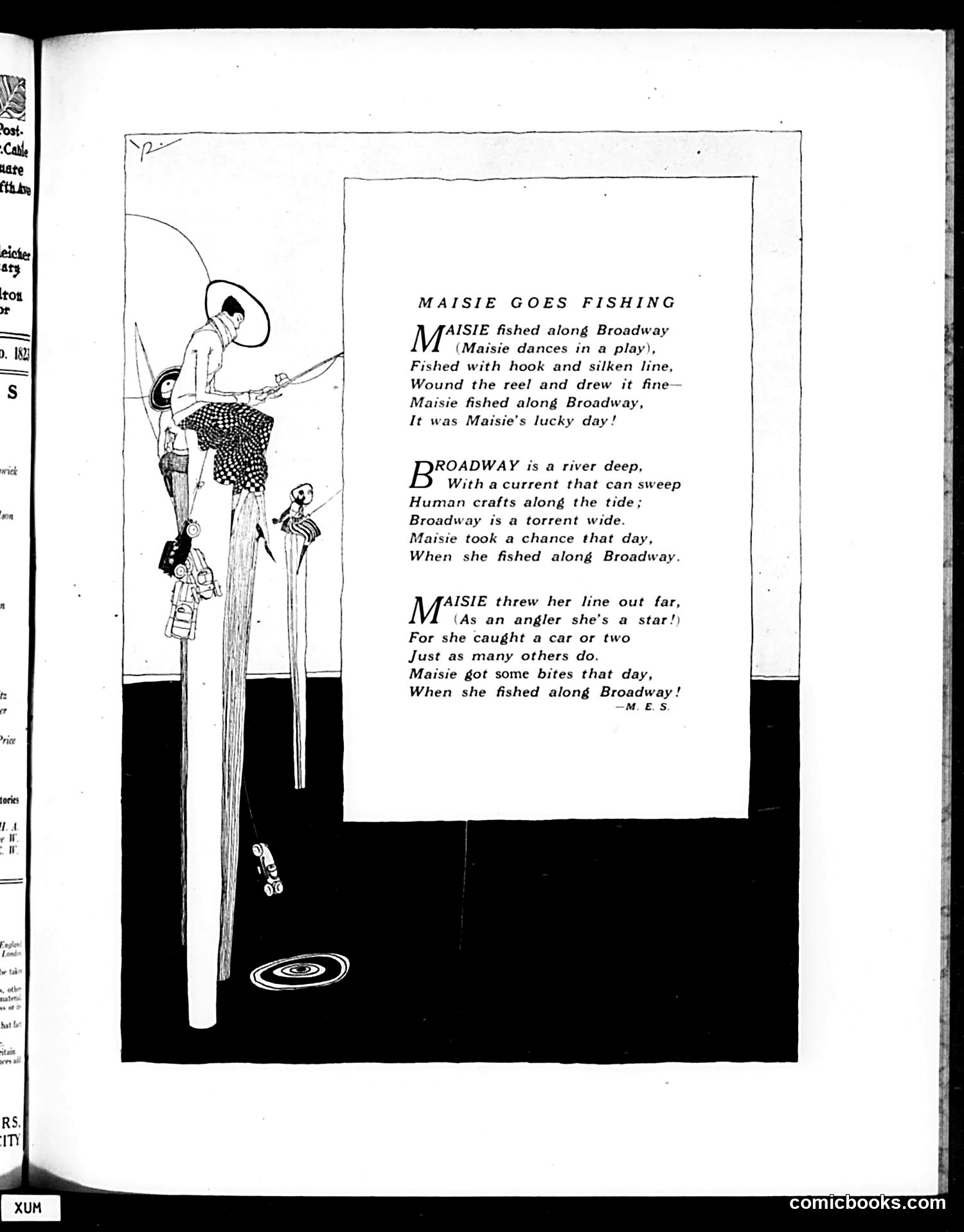
This page from *Judge* magazine contains a humorous poem and illustration about a character named Maisie fishing along Broadway (New York's main theater district). The joke plays on multiple meanings: "fishing" refers both to literal angling and to the slang practice of attempting to attract romantic attention ("casting a line"). The illustration shows Maisie fishing from a high perch above Broadway's street level, with her line extending downward. The poem suggests she's cleverly "catching" men—described as "a car or two"—much like an angler catches fish. The satire mocks both the boldness of young women of the era and the theatrical/romantic culture of Broadway, treating romantic pursuit as a sport. The author is credited as "M.E.S."
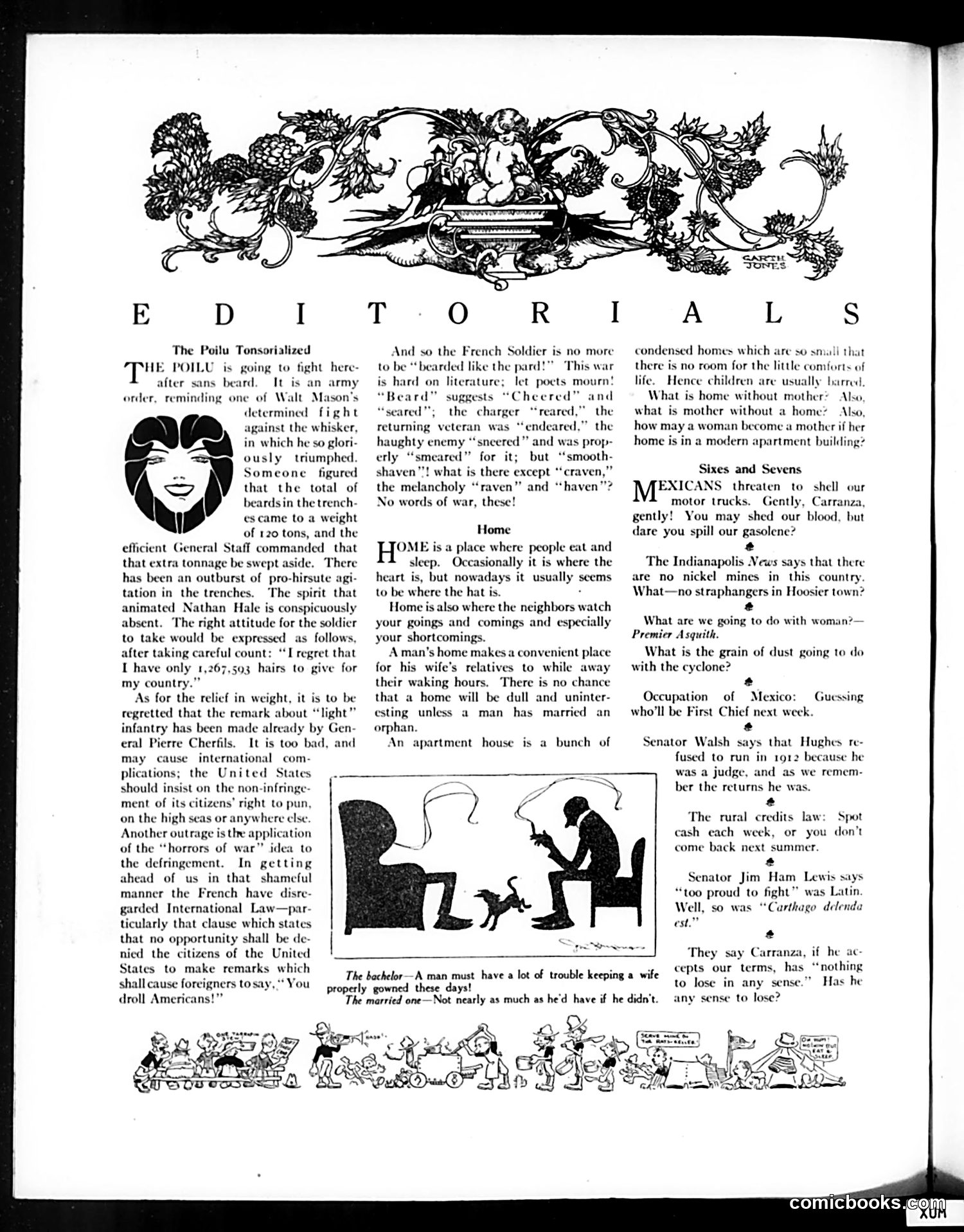
This page from *Judge* magazine contains satirical editorials addressing WWI-era American concerns. "The Poilu Tonsorialized" mocks French soldiers' beards and grooming standards, joking that General Pershing ordered beards shaved. The "Home" section satirizes domestic life and marriage, particularly apartment living's constraints on family comfort. "Sixes and Sevens" ridicules Mexican military threats against American motor vehicles and petroleum interests—likely referencing Mexican-American tensions during the Mexican Revolution period. References to "Carranza" (Mexican general/politician) and speculation about future Mexican leadership indicate anxieties about U.S. border security and resource protection. The small cartoon shows a domestic dispute, captioned about a husband's difficulty managing a wife—typical early-20th-century marital humor.
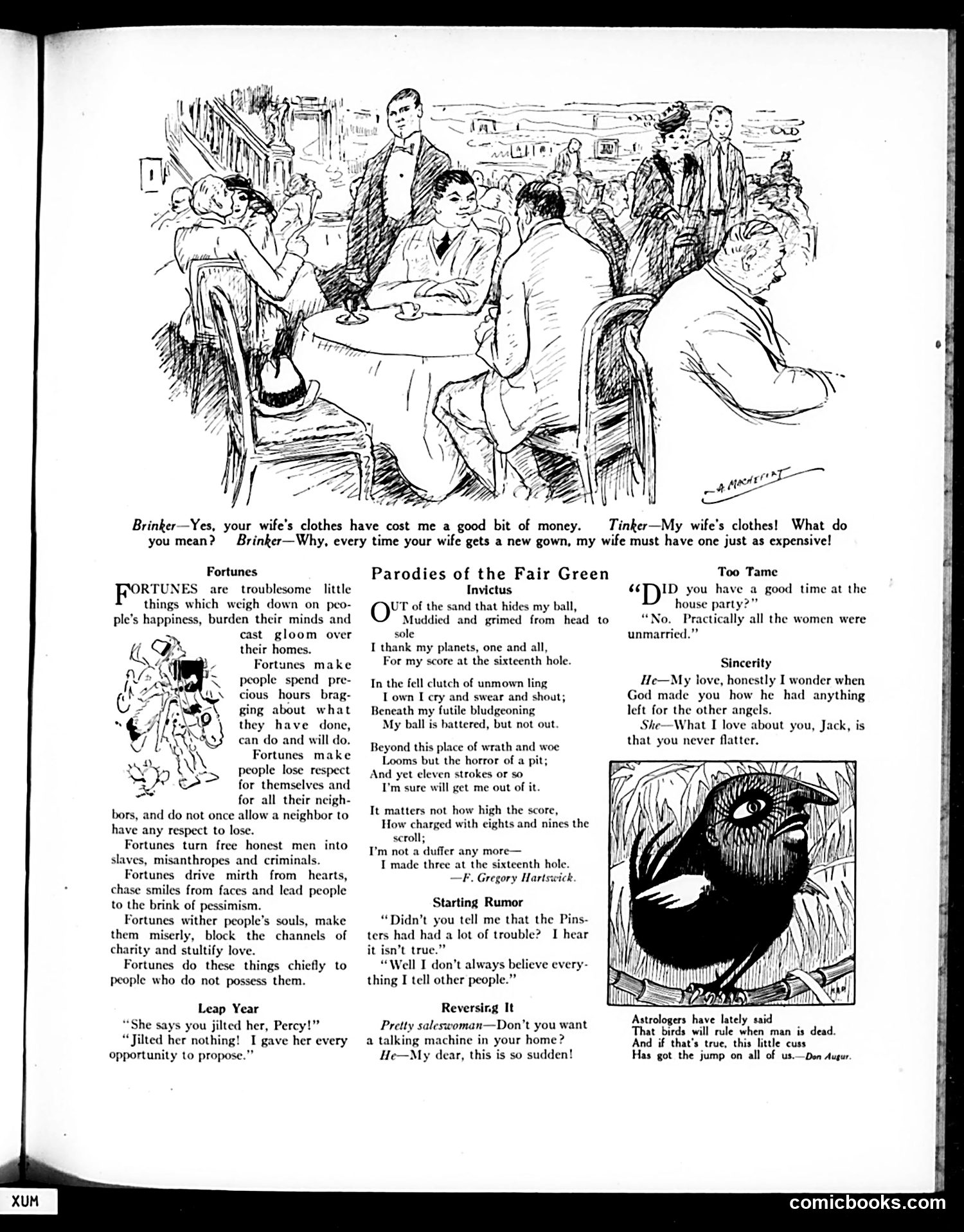
This page from *Judge* magazine contains several satirical pieces mocking social anxieties of the era: **Top cartoon**: Depicts men complaining about wives' clothing expenses—a recurring theme about consumer culture and domestic tension. "Tinker" responds that his wife must match others' fashions, reflecting anxieties about competitive status-signaling through clothing. **"Fortunes"**: Satirizes how financial troubles corrupt character and damage social relationships, suggesting wealth inequality creates moral problems. **"Parodies of the Fair Green"**: Golf-themed parody poems mocking competitive golfing culture and male vanity. **Other pieces**: Mock romantic clichés ("Sincerity"), gossip ("Starting Rumor"), gender role reversal ("Leap Year"), and emerging technology ("Reversing It"—about talking machines/phonographs). The overall tone critiques materialism, social competition, and marital discord among the middle/upper classes.
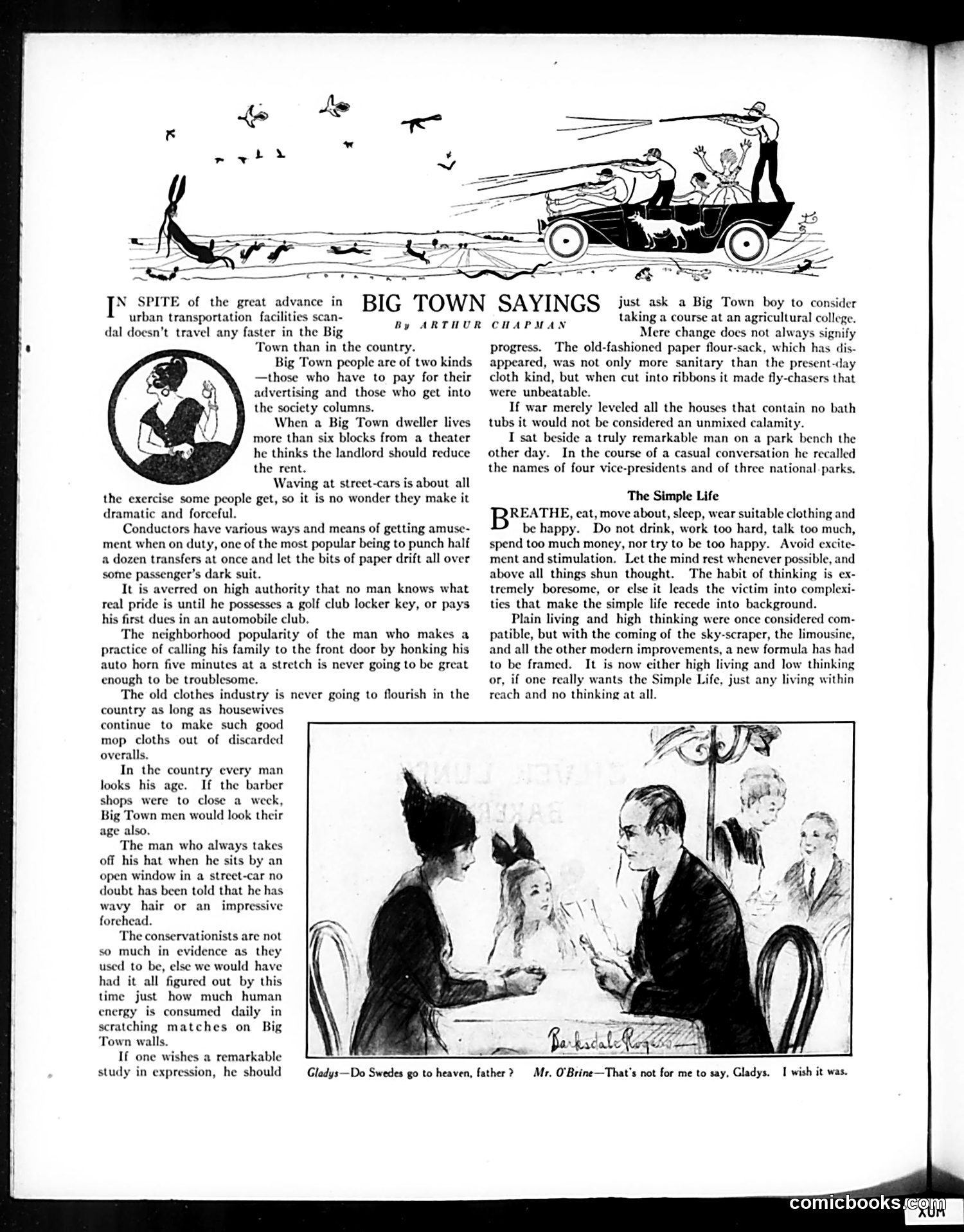
This page satirizes contrasts between urban and rural American life through social commentary and a cartoon joke. **Main Article Content:** Arthur Chapman's "Big Town Sayings" mocks city dwellers' pretensions and behaviors—their vanity (needing regular haircuts to look young), status-seeking (golf club memberships), and petty grievances (complaining about rent if theaters aren't within six blocks). The section "The Simple Life" ironically critiques the modern impossibility of simple living: whereas "plain living and high thinking" were once compatible, contemporary urban life (skyscrapers, limousines) now forces a choice between "high living and low thinking" or actual simplicity without intellectual engagement. **The Cartoon Joke:** The small illustration depicts a father-daughter exchange. Gladys asks if Swedes go to heaven; her father (Mr. O'Brine) responds it's not his place to say, but wishes it were—likely a period ethnic joke suggesting skepticism about Swedish virtue or heavenly worthiness. This reflects common early-20th-century ethnic stereotyping in American humor. The overall tone satirizes urban sophistication as shallow and exhausting compared to rural authenticity.
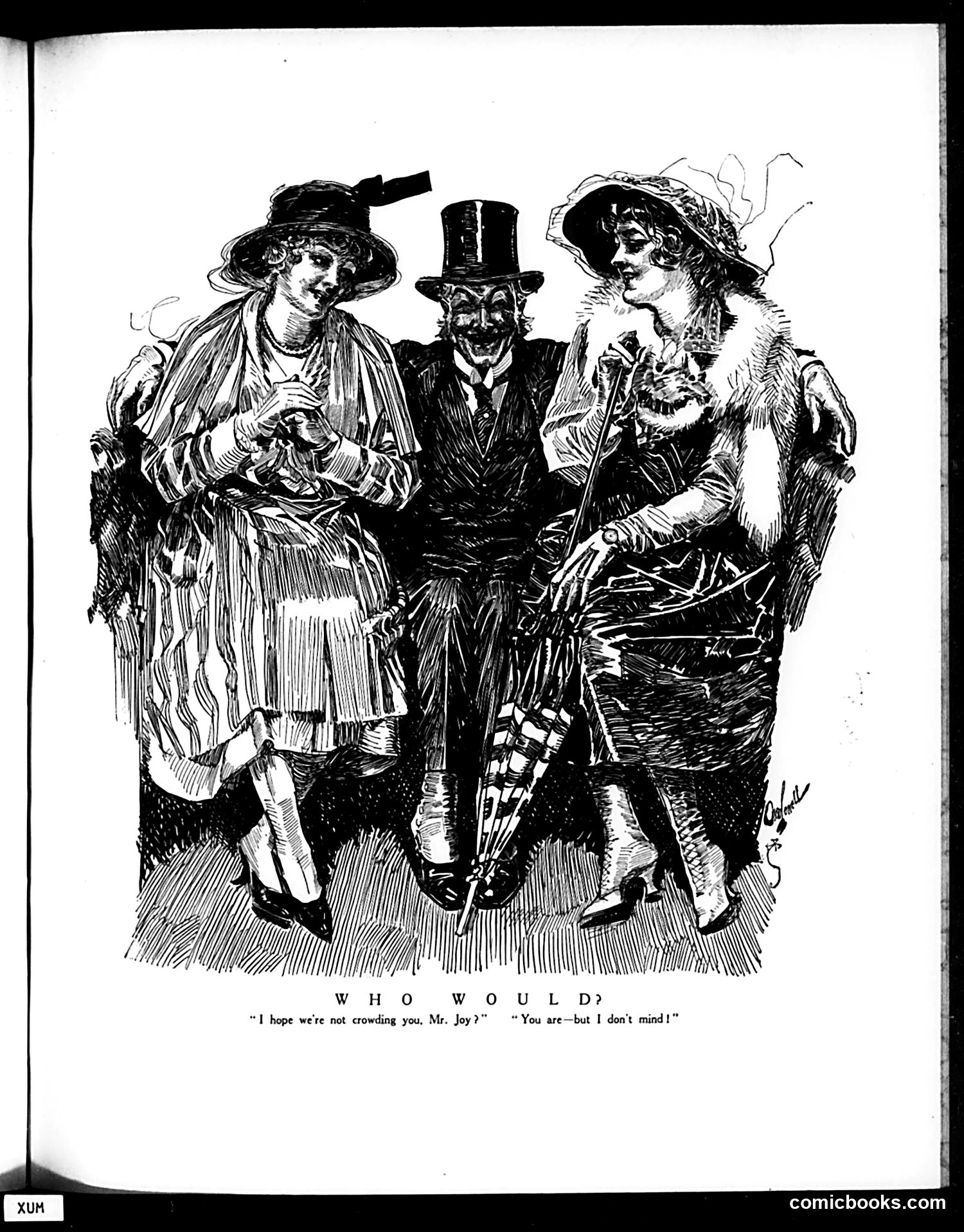
This cartoon depicts three figures in early 20th-century dress. The central figure wears a top hat and formal attire, while two women flank him—one in a striped dress on the left, another in a fur-trimmed outfit on the right. The caption reads: "I hope we're not crowding you, Mr. Joy" / "You are—but I don't mind!" The satire appears to mock social overcrowding or an awkward social situation, likely referencing a specific public figure or celebrity named "Mr. Joy." The women's familiar, forward behavior suggests commentary on social propriety or changing gender dynamics of the era. The cartoon's humor relies on contemporary recognition of who "Mr. Joy" was—context now unclear without additional historical documentation.
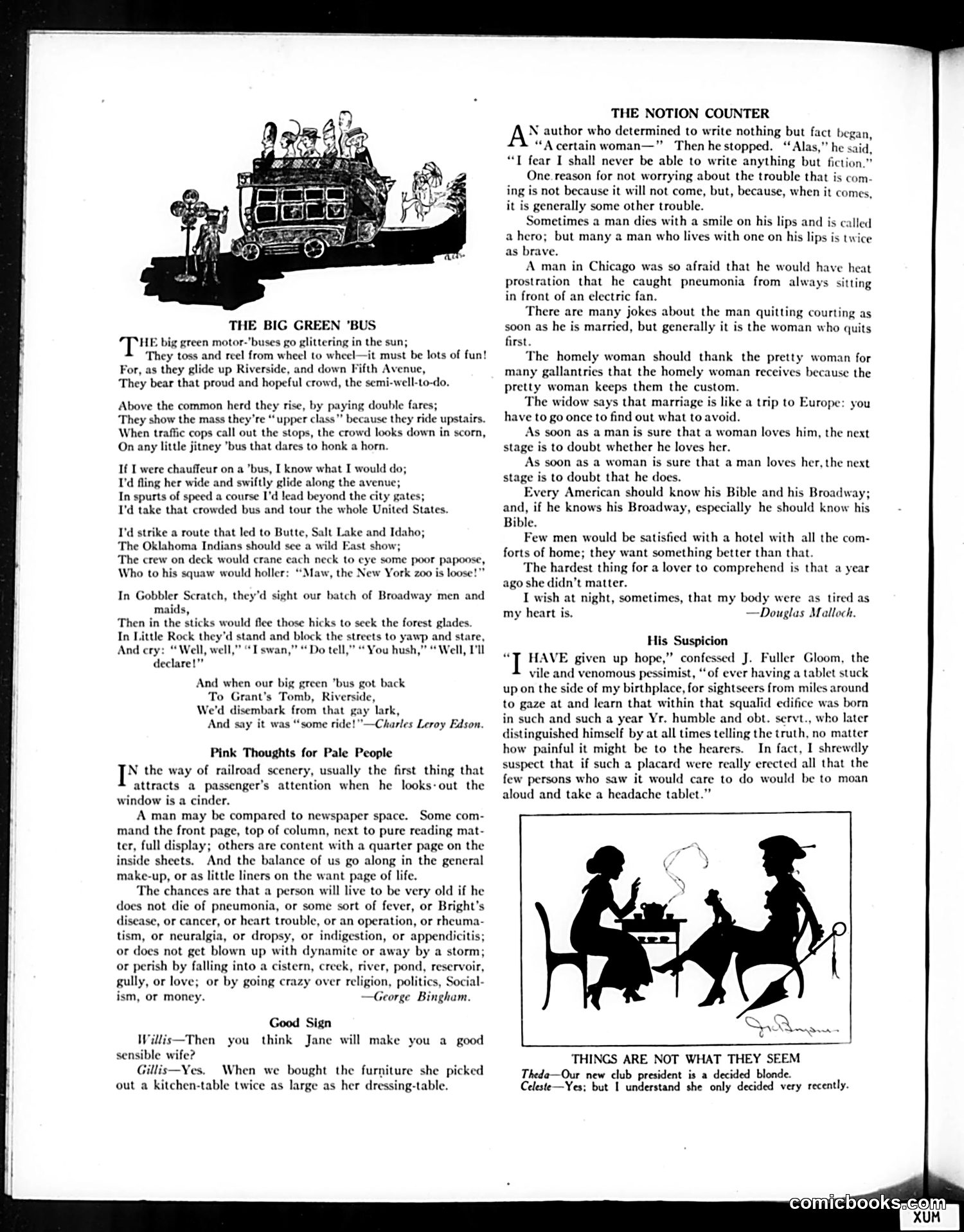
This page contains three satirical pieces typical of early 20th-century American humor: **"The Big Green 'Bus"** is a poem mocking the pretensions of urban middle-class riders of new motor-buses. The satire targets people who pay extra to sit upstairs, viewing themselves as "upper class" and looking down on cheaper transportation like jitneys. The poem humorously imagines a bus driver taking passengers on a cross-country tour, with rural Americans gawking at New York sophisticates—reversing the expected hierarchy and suggesting that city dwellers' snobbery is unfounded. **"Pink Thoughts for Pale People"** offers cynical one-liners about life's absurdities and mortality, in the tradition of turn-of-the-century newspaper wit. **The illustration** titled "Things Are Not What They Seem" shows a silhouetted domestic scene, likely satirizing appearances versus reality in relationships or social situations. The overall tone reflects Judge's characteristic blend of class commentary and gentle social criticism aimed at American urban readers.
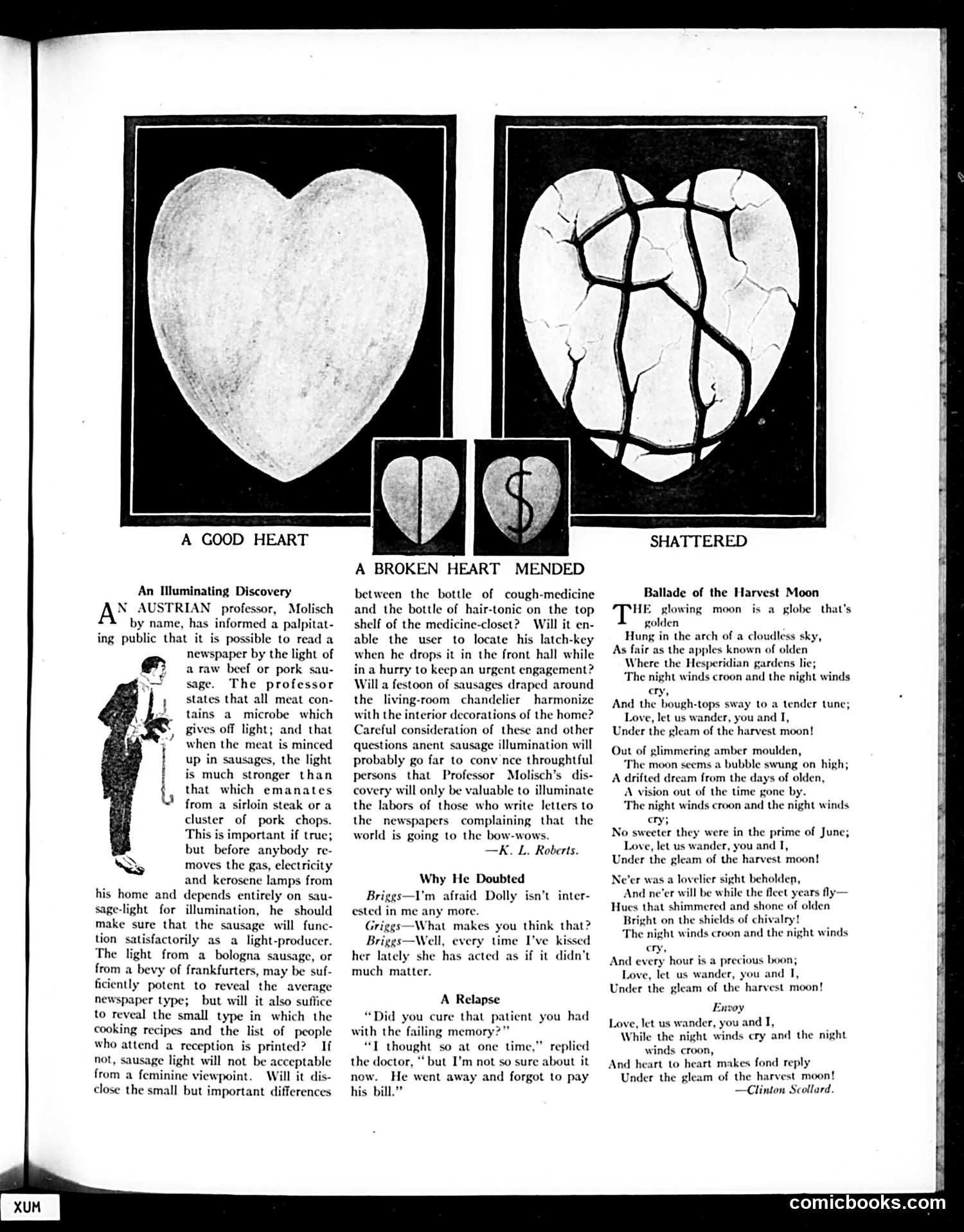
**Top Section: The Heart Illustrations** The three heart images illustrate a satirical article about an Austrian Professor Molisch's claim that raw meat glows faintly due to microbes, allowing one to read by sausage-light. The "Good Heart," "Broken Heart," and "Mended Heart" serve as decorative headers, but the satire mocks the impracticality of using sausage illumination—the author humorously questions whether it could reveal small cooking recipes, locate lost keys, or harmonize with living room décor. The joke targets both the professor's dubious discovery and contemporary newspaper readers who enjoy doom-saying letters about societal decline. **Bottom Section: Short Humorous Pieces** Two brief comedic dialogues follow: "Why He Doubted" presents a boyfriend doubting his girlfriend's interest when she seems indifferent to his kisses, and "A Relapse" features a doctor whose patient "forgot" to pay his bill, suggesting the cure was ineffective. **Right Column: Sentimental Poetry** A romantic poem about moonlit wandering provides tonal contrast to the page's humor.
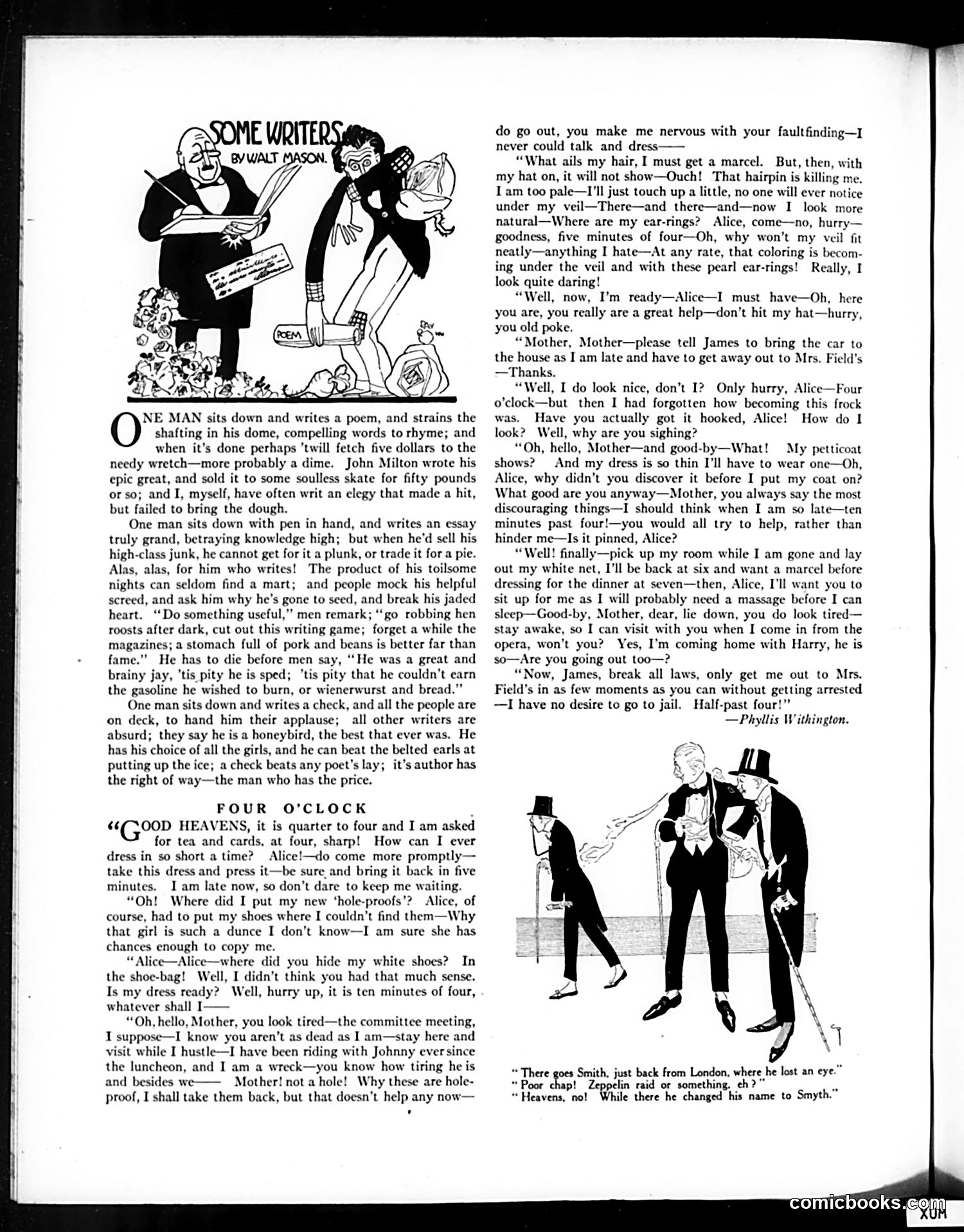
This page contains two satirical pieces about writers and women's vanity. **"Some Writers" (left):** A poem mocking the financial struggles of serious writers. It contrasts the poverty of poets and essayists—even citing John Milton's meager payment—with the undeserved success of men who "write a check." The satire suggests that wealth, not talent, determines social status and respect. Writers are told to abandon their craft for practical work ("robbing hen roosts"), yet only after death do people appreciate them. **"Four O'Clock" (right):** A monologue depicting an upper-class woman frantically preparing for a 4 p.m. social engagement. She constantly badgers her maid Alice about clothing, accessories, and appearance while simultaneously complaining about being rushed. The satire targets wealthy women's superficiality—obsessing over hair, makeup, shoes, and dress while remaining completely self-absorbed and demanding. Her daughter appears equally vain and inconsiderate. The piece mocks the frivolous priorities and poor treatment of servants among society women. Both pieces use exaggeration to critique American class anxieties: artistic merit versus commercial success, and women's materialism.
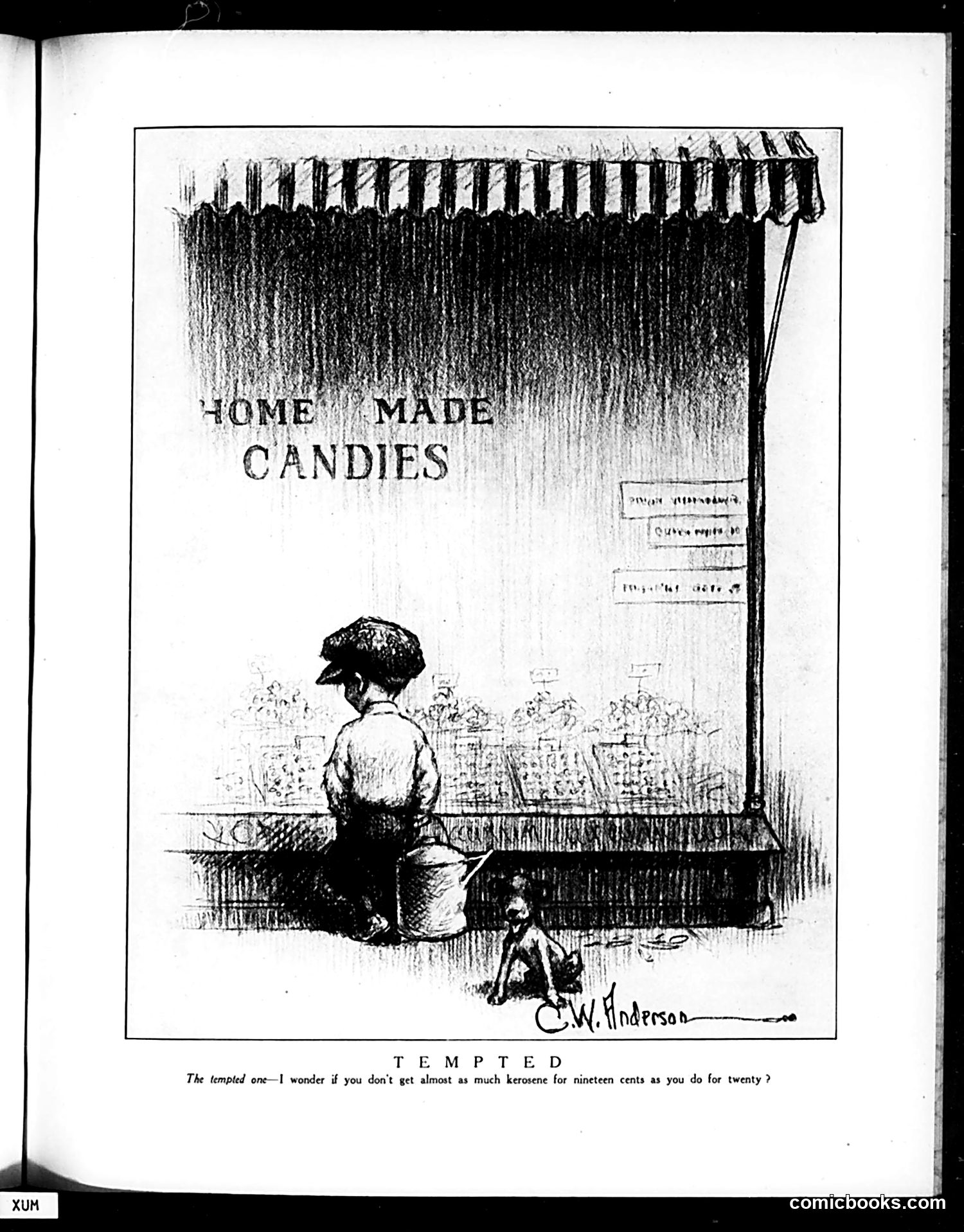
This cartoon satirizes wartime or post-war profiteering. A vendor sells "Home Made Candies" from a street stand while a child and adult window-shop. The caption's "tempted one" refers to the vendor, suggesting they're tempted to cheat customers. The joke criticizes price inflation: the vendor charges twenty cents for candies that contain nearly as much kerosene (cheap filler) as kerosene that costs nineteen cents—implying the candies are mostly worthless adulterant, sold at inflated prices. The cartoon mocks merchants who exploit consumers through adulteration and overpricing, likely during a period of supply scarcity when such practices were common. It's social commentary on commercial dishonesty masked as humor.
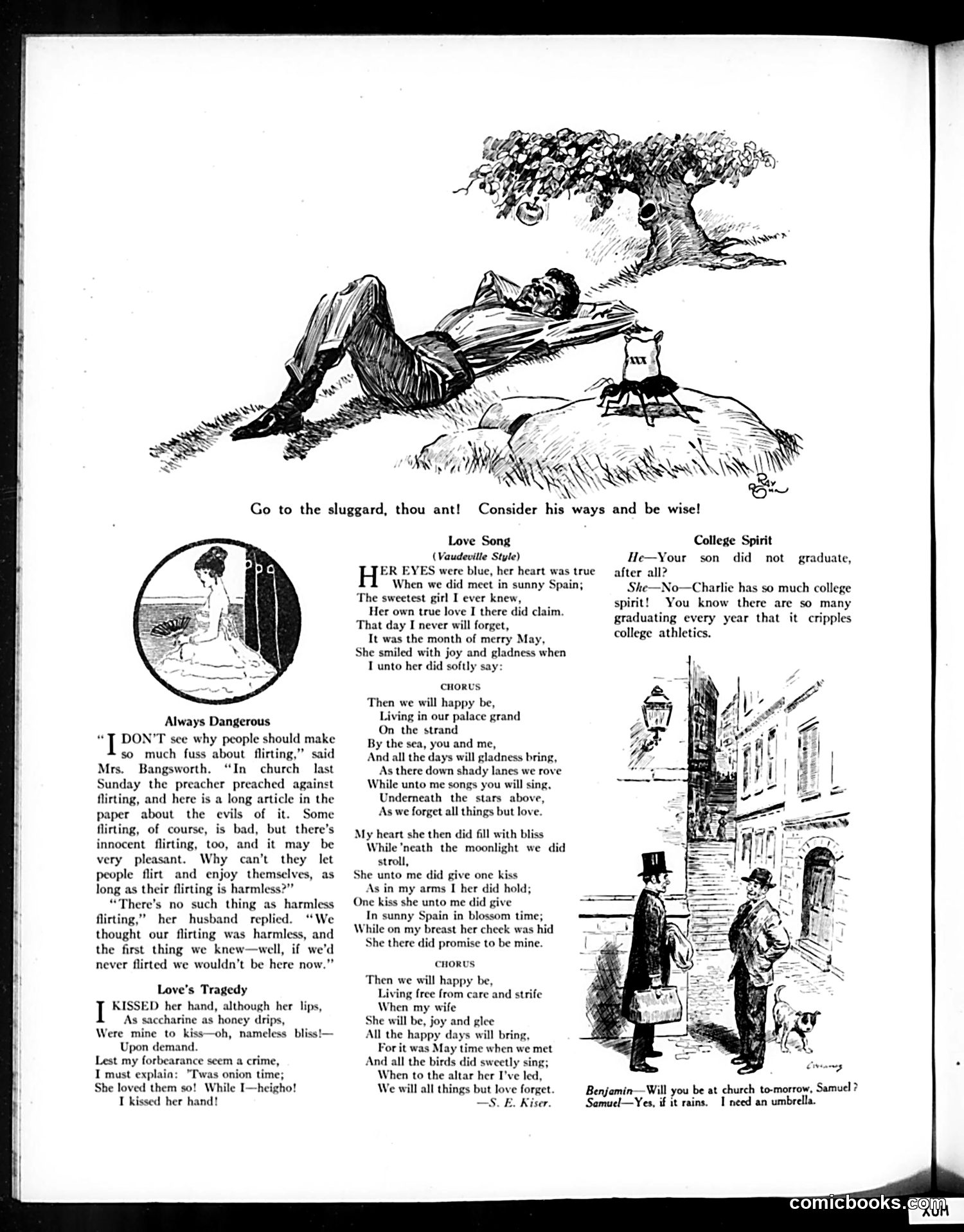
This page contains three unrelated pieces typical of early 20th-century humor magazines: **Top cartoon**: A man lounges beneath a tree while an ant labors nearby—an illustration of the Biblical proverb "Go to the sluggard, thou ant," mocking idleness. **Three humorous pieces**: - "Always Dangerous": Mrs. Bangsworth defends innocent flirting, but her husband notes their own "harmless" flirting led directly to marriage—suggesting flirtation inevitably leads to unwanted consequences. - "Love Song" and "Love's Tragedy": Sentimental vaudeville-style poems about romantic encounters in Spain, played for melodramatic effect. - "College Spirit": A joke where a father learns his son didn't graduate due to "college spirit" crippling athletics—satirizing how athletic commitments compromise academics. **Bottom cartoon**: Two well-dressed men discuss church attendance; Samuel will only attend "if it rains" since he needs an umbrella—absurdist humor about making excuses. The page exemplifies Judge's mix of social satire, sentimental parody, and gentle domestic comedy.
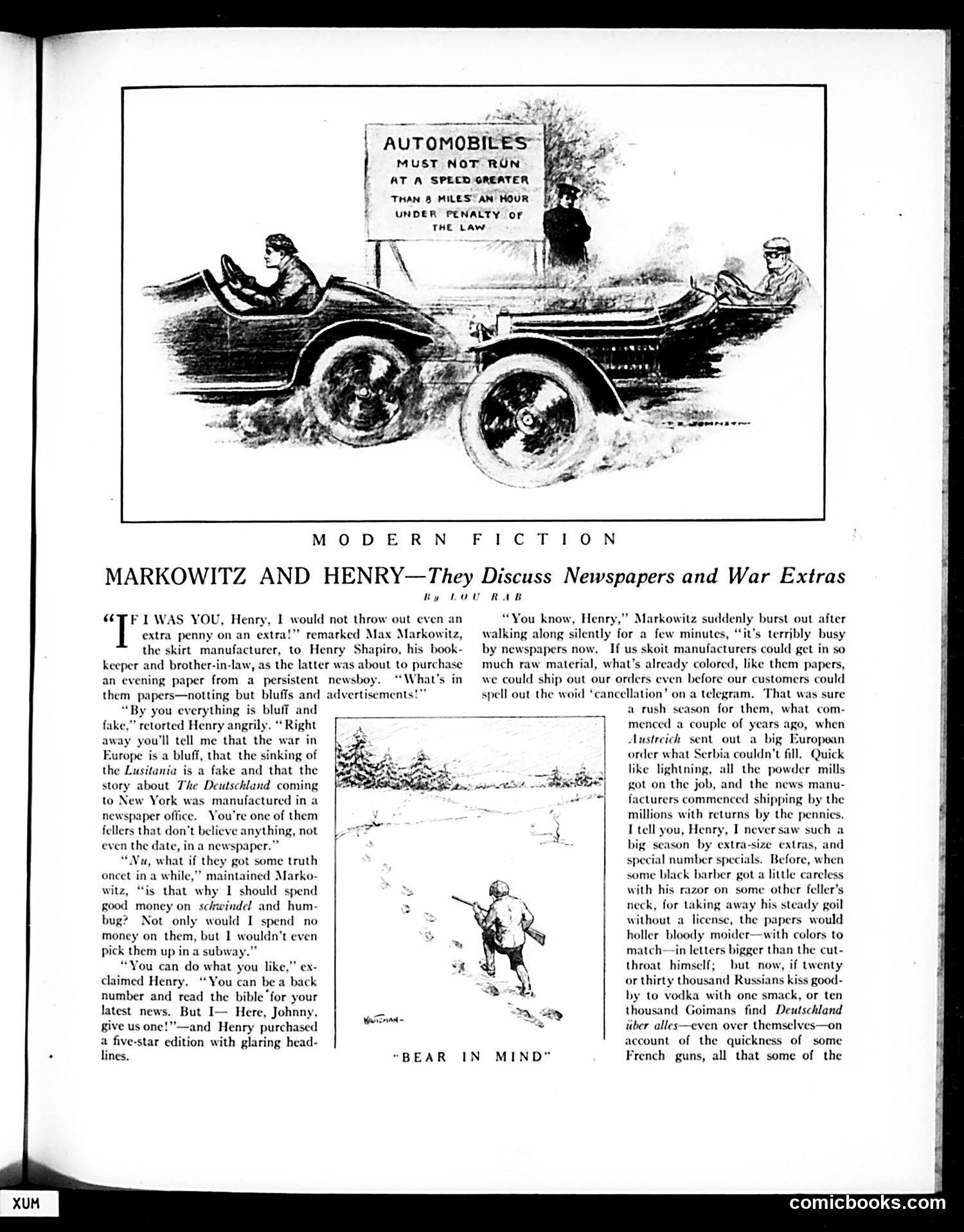
This is a satirical dialogue between two Jewish immigrant characters (identifiable by their accented English and names) debating newspaper credibility during World War I. **The satire targets:** 1. **Yellow journalism**: Henry defends sensational newspaper reporting; Markowitz accuses papers of "bluff and fake." The joke is that wartime "extras" (special editions) sold by exaggerating minor incidents (a barber's razor incident) into massive headlines. 2. **War profiteering**: Markowitz observes that newspapers—like powder mills and munitions manufacturers—experienced boom profits from the war, treating serious events (Russian deaths, German nationalism) as mere commercial opportunities for circulation. 3. **The top cartoon** satirizes early automobile speed laws (8 mph limit), labeling them "modern fiction"—implying such regulations are as unbelievable as the exaggerated newspaper accounts discussed below. The piece mocks both sensationalist media and wartime commercialism, using working-class immigrant characters to voice skepticism about official narratives.
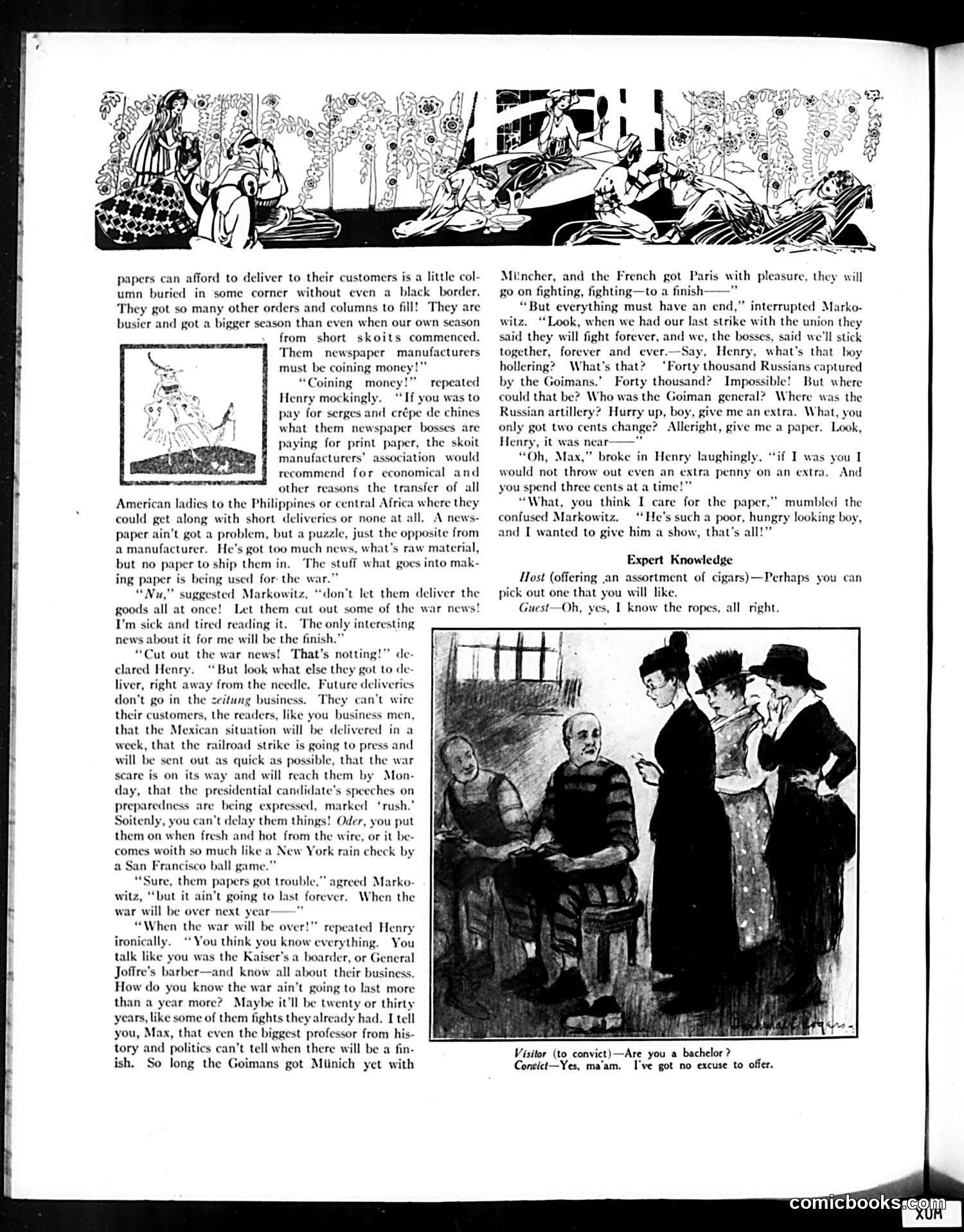
This page depicts a conversation between two Jewish characters—Henry and Markowitz (identifiable by Yiddish-inflected English dialogue)—discussing wartime newspaper shortages during World War I. **The satire's point:** Newspapers face an acute paradox: they have enormous quantities of urgent war news to publish but insufficient paper stock because paper supplies are diverted to the war effort. Markowitz, a garment manufacturer, complains that newspapers can't deliver promised orders; Henry responds that newspapers themselves can't control their output—they must print fresh war news immediately as it arrives, unable to schedule deliveries like ordinary businesses. The exchange mocks both newspaper publishers' predicament and the broader absurdity of wartime shortages. Henry's cynical conclusion—that the war may last decades, not ending soon—undercuts Markowitz's optimistic faith in resolution. A secondary cartoon below shows a visitor making a joke about bachelor excuses. The dialogue captures authentic immigrant voice and contemporary economic chaos of 1914-1917.
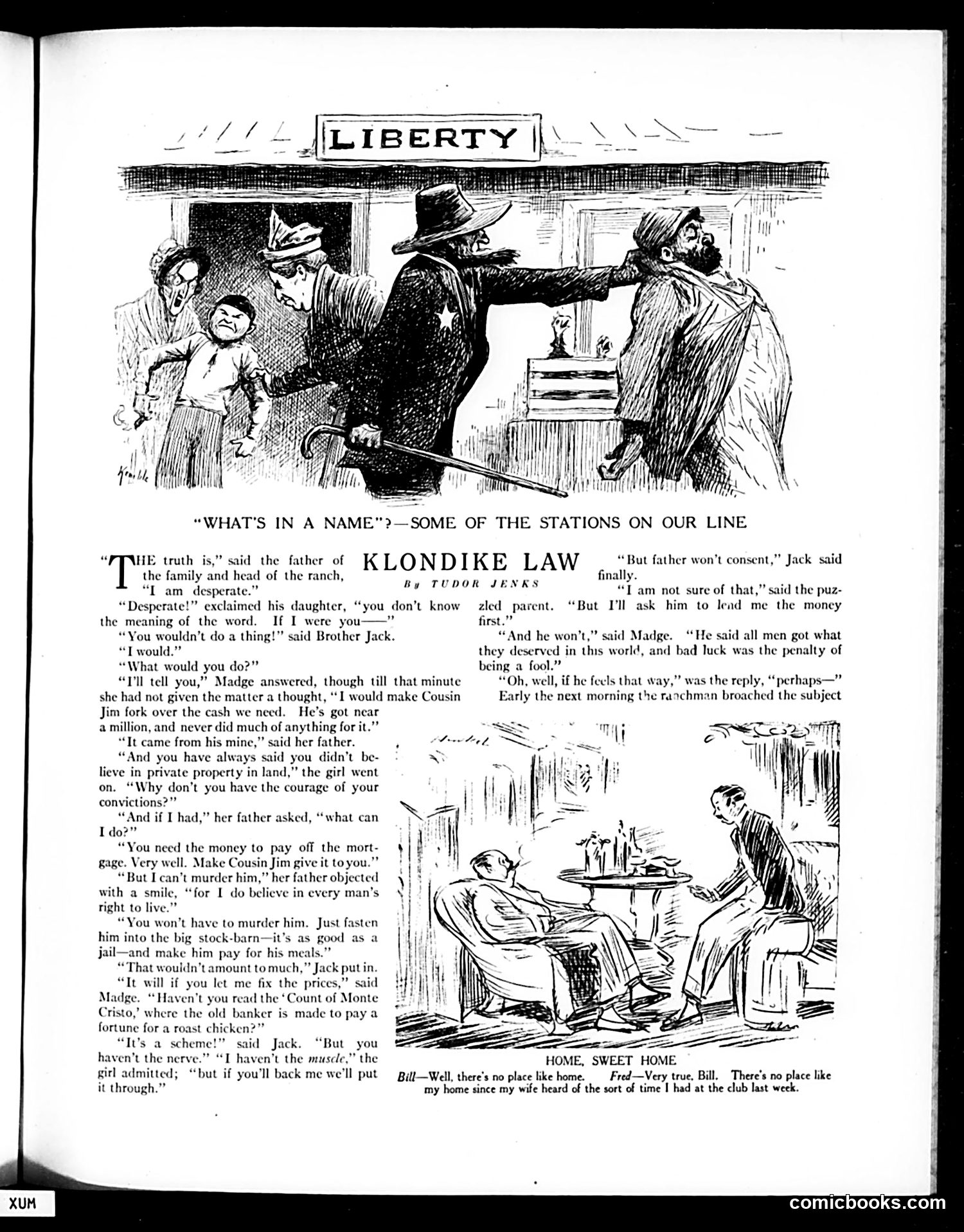
This page contains two distinct pieces from Judge magazine's satirical commentary on American life. **Top cartoon ("What's in a Name?"):** A family discusses financial desperation. The daughter Madge proposes an unethical scheme: lock their wealthy Cousin Jim in a barn and charge him exorbitant prices for food—referencing *The Count of Monte Cristo*—to extort money for the mortgage. The satire targets the hypocrisy of those who claim socialist ideals ("private property in land" is wrong) while proposing ruthless capitalist exploitation. The cartoon mocks both radical rhetoric divorced from principle and the desperation of rural economic hardship. **Bottom cartoon ("Home, Sweet Home"):** Two men (Bill and Fred) exchange a hackneyed saying about home being best. Bill reveals his wife discovered he spent time at a club, implying infidelity or impropriety. The "station on our line" suggests these are observations at different life stages—satirizing domestic discord and the gap between nostalgic sentimentality and actual marital reality. Both pieces use ironic juxtaposition: stated ideals versus actual behavior, and romantic notions versus harsh truth.
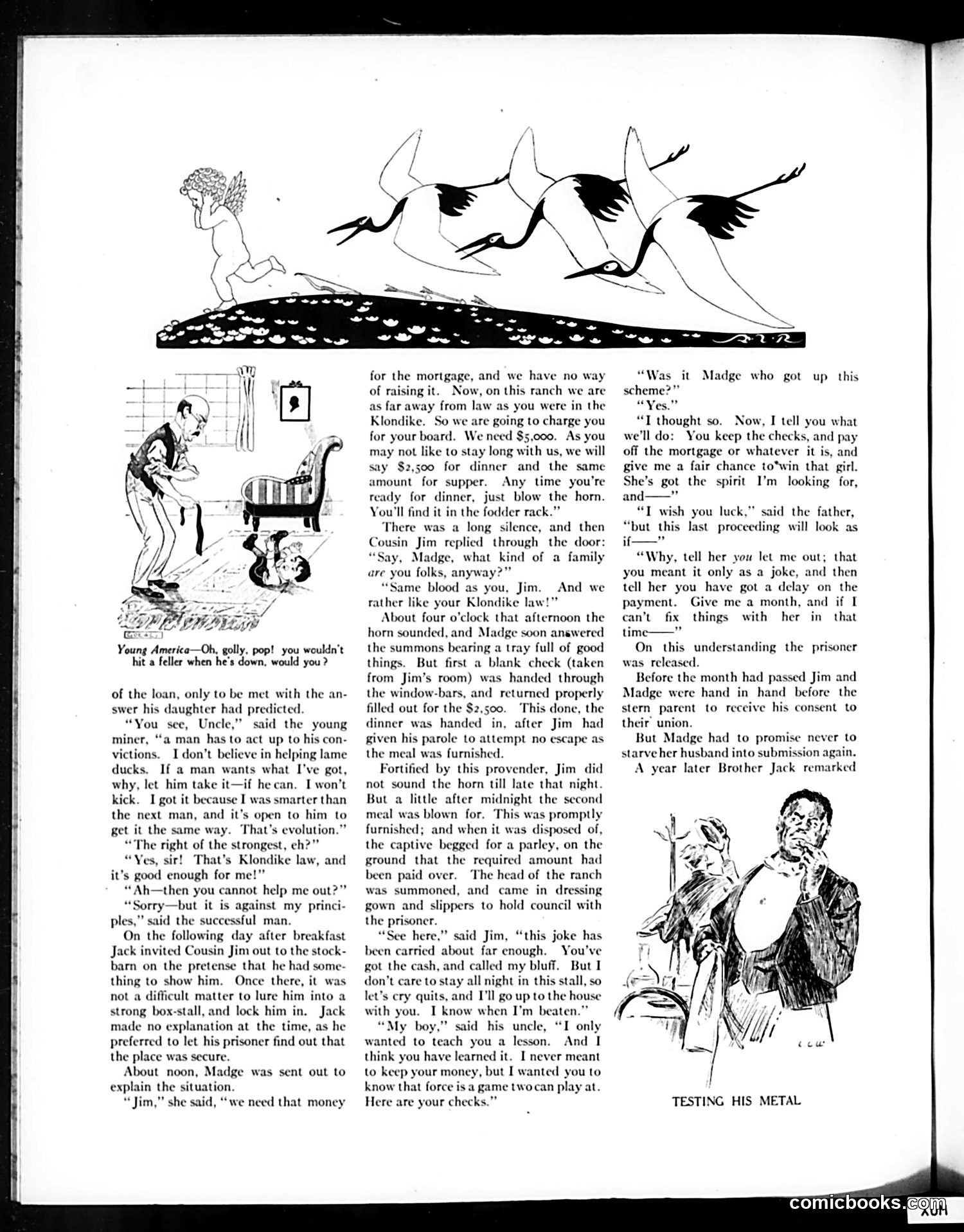
This story satirizes **Social Darwinism** and the ruthless individualism of the Klondike Gold Rush era (1890s). A young miner from the Klondike visits his uncle, invoking "survival of the fittest" philosophy to refuse helping family pay a mortgage. He claims "force is a game" and won't help "lame ducks." His uncle and cousin Madge teach him a lesson by **imprisoning him and demanding $5,000 ransom** ($2,500 per meal), using his own "Klondike law" against him. The captive quickly surrenders and signs a blank check. The satire works on two levels: it mocks both the young man's callous Social Darwinism *and* suggests frontier morality has no place in civilized society. By story's end, he learns compassion—and wins Madge's hand. The cartoon at top (three mythological figures) reinforces themes of strength and natural law ironically undermined by domestic restraint.
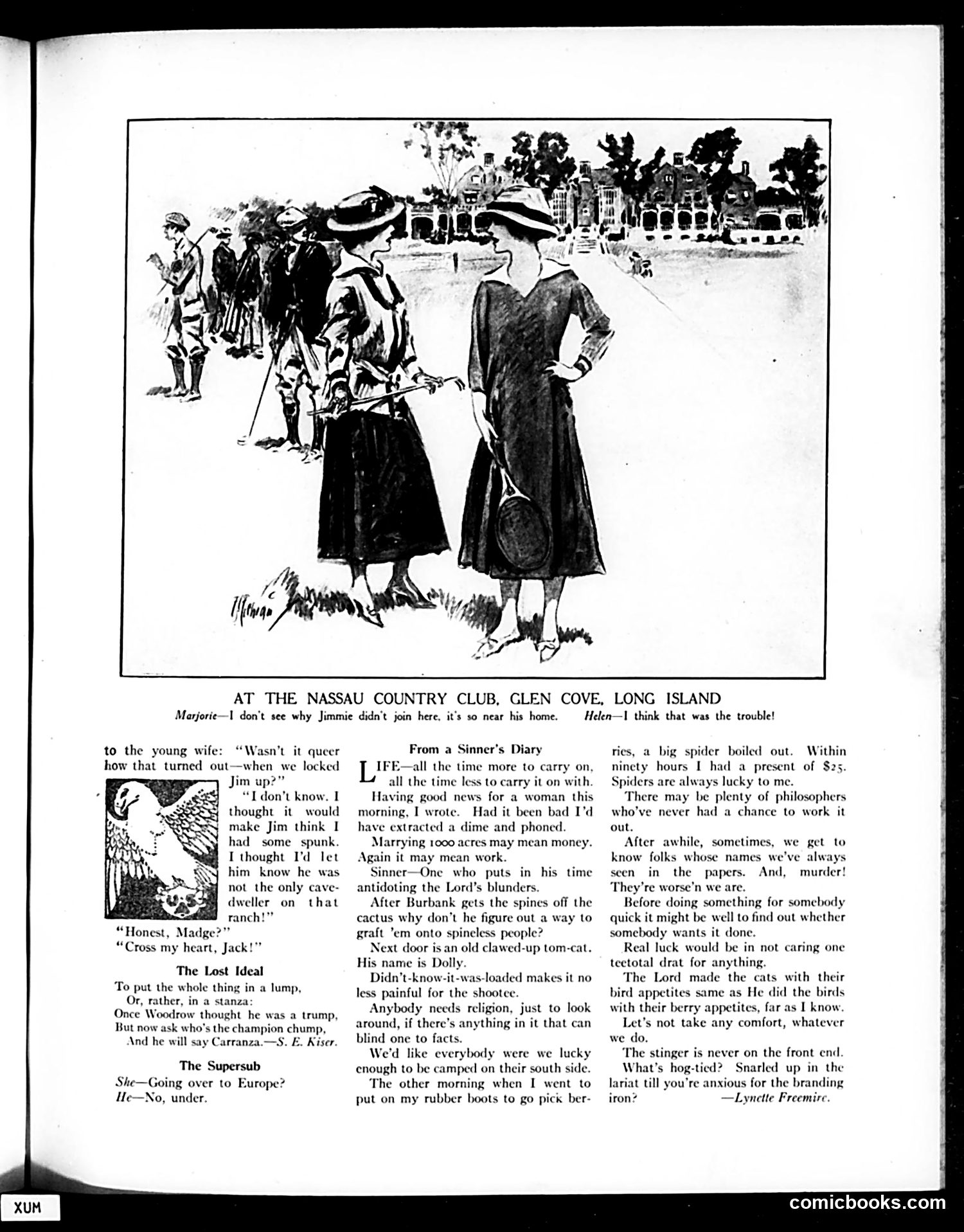
This page contains satirical humor and social commentary typical of Judge magazine's content. The main illustrated cartoon depicts women at an exclusive country club (Nassau Country Club, Glen Cove, Long Island), showing the leisure activities of wealthy women. The dialogue jokes about a wife deliberately "locking Jim up" (jailing her husband) to assert independence and prove she has "spunk"—satirizing both marital dynamics and women's limited agency in the era. Below are several brief humorous items: "The Lost Ideal" mocks President Woodrow Wilson and Mexican revolutionary Venustiano Carranza; "The Supersub" contains unclear context; and "From a Sinner's Diary" offers cynical observations on marriage, religion, wealth, and human nature. The overall tone reflects early 20th-century upper-class American attitudes—poking fun at gender relations, politics, and social hypocrisy while assuming readers shared the magazine's elite perspective.
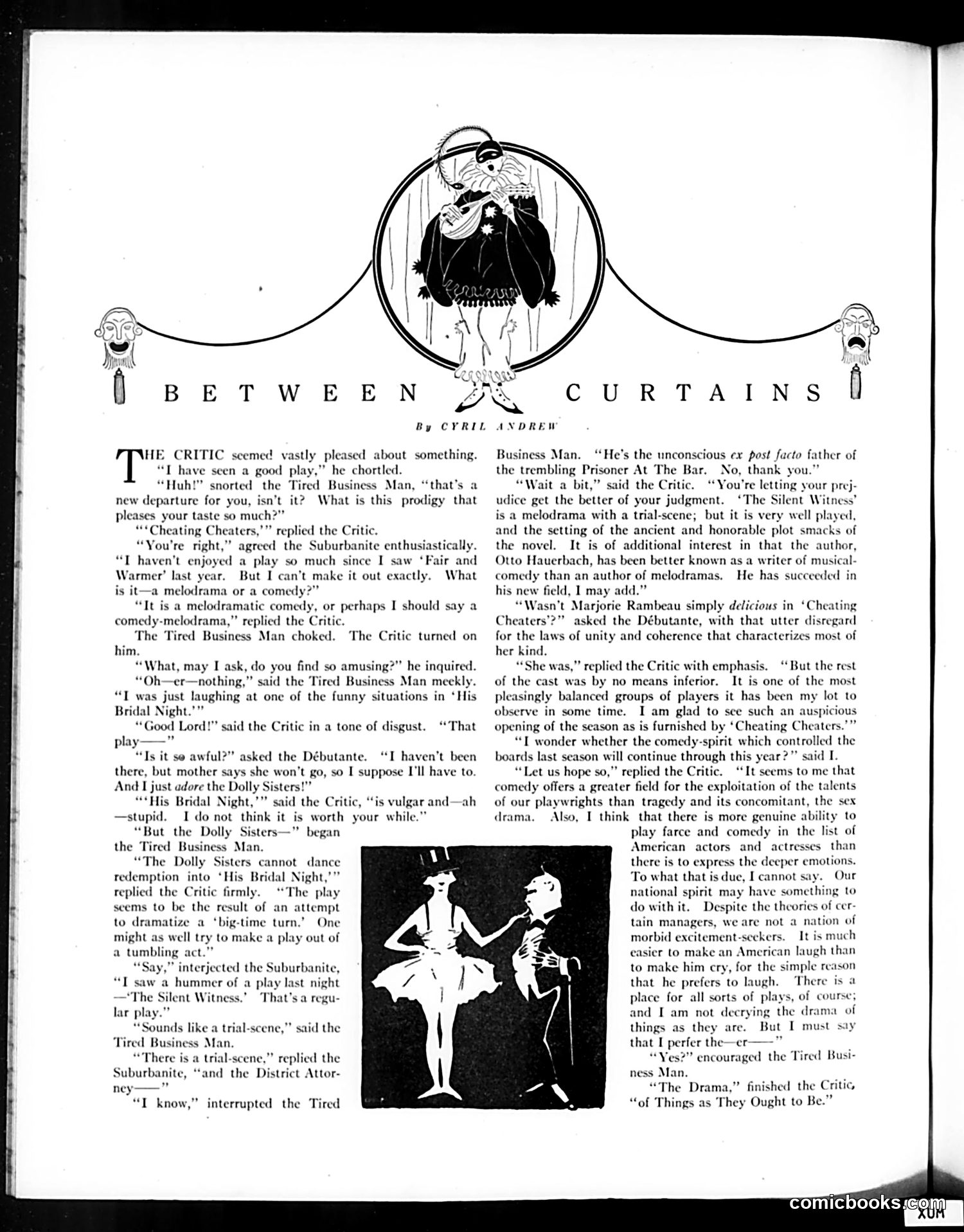
This is a theater criticism dialogue from Judge magazine featuring a "Critic" character debating Broadway plays with a "Tired Business Man" and other theatergoers. The satire targets both pretentious theater critics and general audiences' tastes. The cartoon illustrates the central tension: the Critic dismisses "His Bridal Night" as vulgar and unworthy despite featuring the Dolly Sisters (a famous vaudeville dance act), while others enjoy it. The Critic praises "Cheating Cheaters" and "The Silent Witness" for their artistic merit, yet acknowledges American audiences prefer comedy to serious drama. The joke is that the Critic represents snobbish, intellectual theater reviewing that contradicts popular entertainment preferences. The piece satirizes the gap between what critics deem worthy and what audiences actually find amusing—a timeless tension in entertainment criticism.
This Judge magazine page satirizes anti-suffrage arguments while ironically endorsing women's equality. The main article by Anna Cadogan Etz uses sarcasm to defend women's suffrage and property rights in marriage. It mocks the "contented wife" stereotype (legally the property of her husband, beaten with impunity) as obsolete, then presents a case study: a woman who invested equally in building a butcher business now demands equal ownership rather than mere alimony in divorce. The author celebrates that judges and law journals increasingly support this justice claim. The "Suffrage Snapshots" section by Ida Husted Harper adds state-level examples mocking anti-suffrage positions: Indiana should give mothers voting rights rather than monuments; Kansas shows women's civilizing influence; Georgia's "chivalry" actually prevents women from practicing law. The implicit point throughout: denying women voting and property rights is not protection but injustice dressed in paternalism. The page supports suffrage through sharp, satirical critique of the status quo.
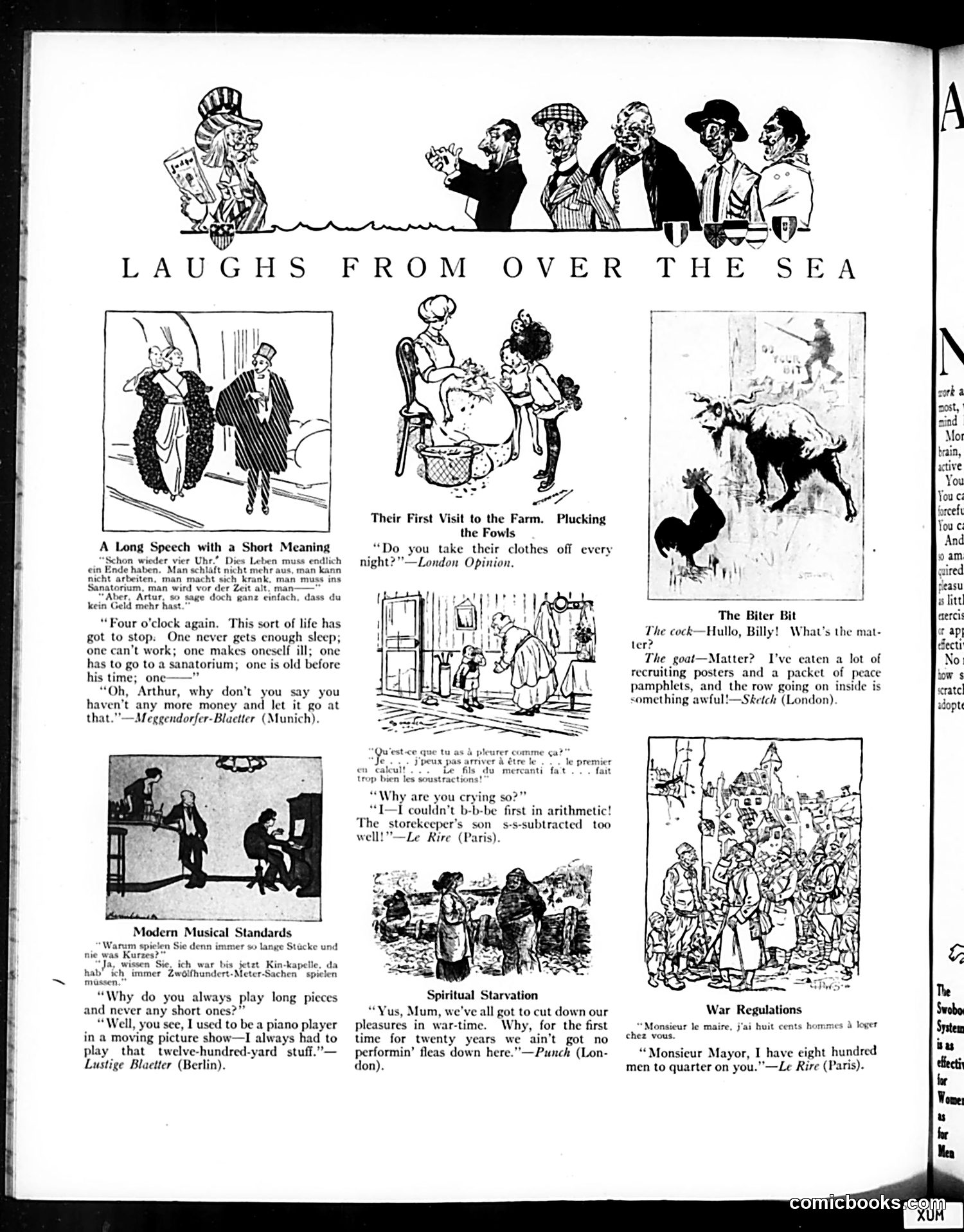
This page collects satirical comics from European magazines (German, French, British), all addressing **World War I-era anxieties**. The jokes target: 1. **Wartime hardship**: A man complains endlessly about exhaustion before admitting he's simply broke—mocking verbose excuses for economic collapse. 2. **Cultural displacement**: A cinema pianist plays unnecessarily long pieces because that's what moving pictures required—satirizing how war disrupts normal professions. 3. **Rural ignorance**: City visitors naively ask if farmers undress chickens nightly—poking fun at urban-rural disconnect. 4. **Arithmetic anxiety**: A child cries over not ranking first, reflecting wartime stress on families. 5. **Military burden**: A mayor receives billeting orders for 800 soldiers—showing the civilian cost of war occupation. 6. **Animal commentary**: A rooster and goat suffer from recruiting propaganda and peace pamphlets—dark humor about conflicting wartime messaging. The page's structure—reprinting foreign cartoons—suggests *Judge* was showcasing how other nations processed shared wartime experiences through humor.
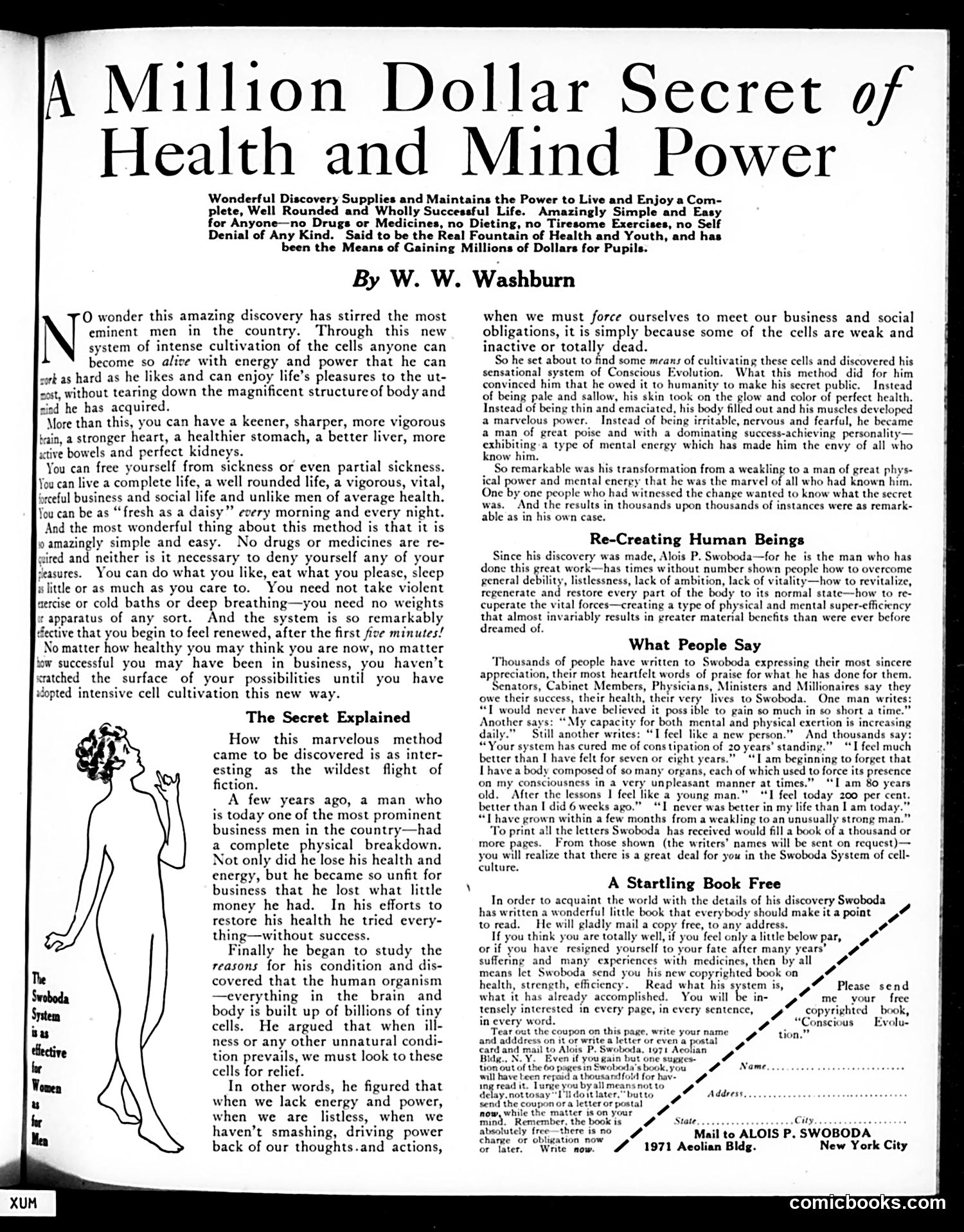
This page is **vintage pseudoscientific health advertising**, not satire. It promotes "Swoboda's System of cell-culture" — a dubious wellness scheme claiming to cure all ailments through undefined "cell cultivation," requiring no medicine, diet, or exercise. The pitch targets vulnerable people: a businessman suffered "complete physical breakdown," tried everything, then discovered billions of tiny cells need "cultivating." The vague promise—become energetic, healthy, successful, "fresh as a daisy"—required only following Swoboda's method. The crude illustration of a thin male figure represents the "before" state needing transformation. This reflects early-20th-century **health-fraud culture** before FDA regulation. The claims are laughably broad and unfalsifiable. While this appears in *Judge* (a satirical magazine), there's **no indication this is satire itself**—it's likely paid advertising the magazine ran, alongside actual humor. Modern readers would recognize this as a con targeting desperation.
This page contains two distinct elements: **LEFT SIDE:** An advertisement for Collier's magazine promoting a golf story called "Adolphus Kitts" by Charles E. Van Loan. The ad uses humor by asking if readers have such a character in their golf club, promising entertainment value. **RIGHT SIDE:** Two satirical essays: 1. **"Life's Realities"** critiques pacifist psychology—specifically a psychologist's advice to "make the best of existing circumstances." The author argues this is passive defeatism. Instead, people should actively *change* troublesome circumstances rather than merely accept them. This appears to be commentary on early 20th-century debates about pacifism vs. active engagement with life's challenges. 2. **"Will Shakespeare, Fan"** humorously argues that Shakespeare was a baseball fan, citing baseball-related phrases from his plays (hitting, stealing bases, etc.). This is playful wordplay celebrating both Shakespeare's 300th-anniversary year and baseball's perceived antiquity, framing the Bard as an American sports enthusiast. Both pieces exemplify Judge's satirical approach to social commentary.
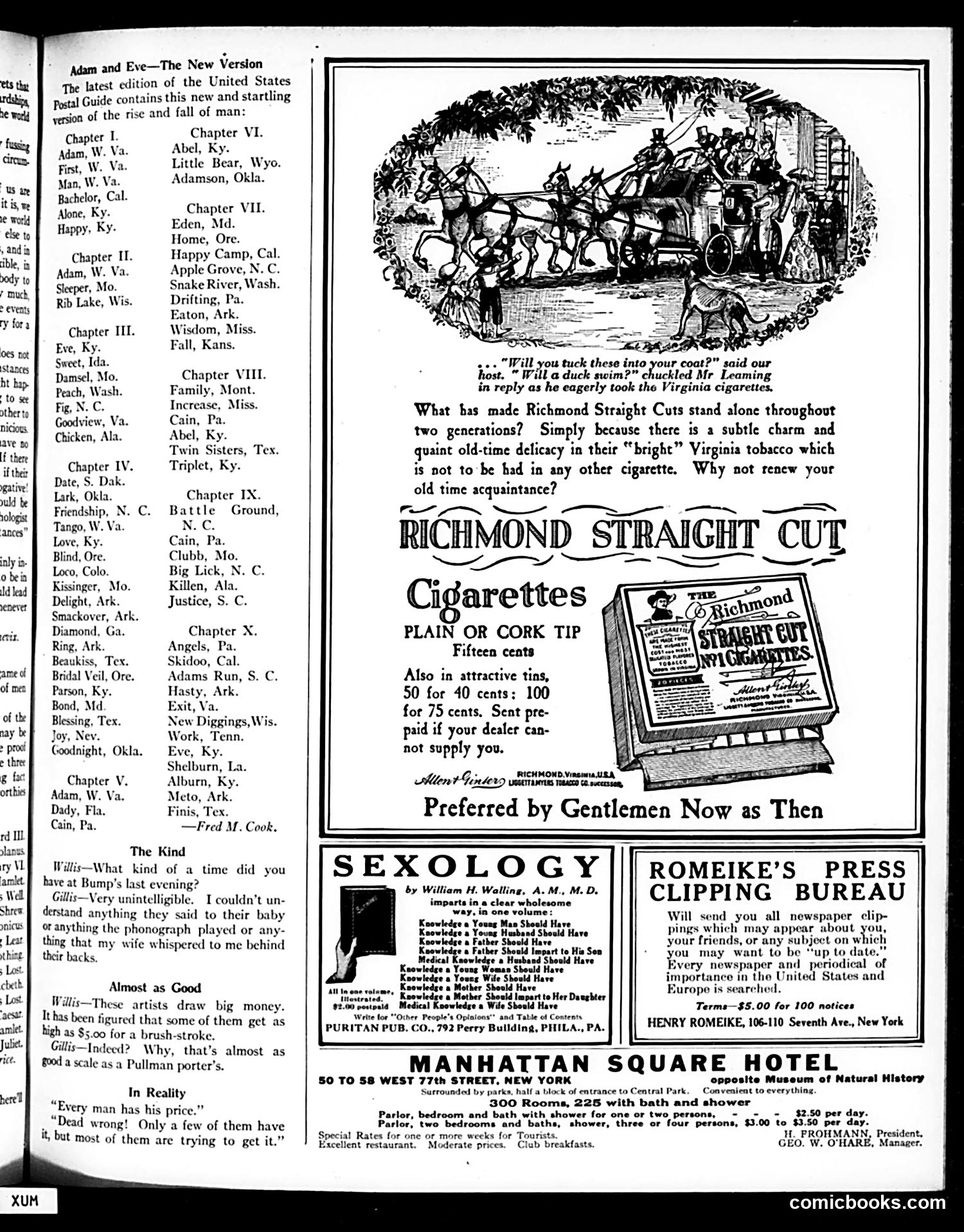
This page's main cartoon is a clever satire on the U.S. Postal Guide. The joke lists American town names that trace the Biblical narrative of Adam and Eve: beginning with "Adam, W. Va." and "Eve, Ky.," progressing through "Love, Ky." and "Marriage" (implied), then "Cain, Pa." and "Abel, Ky." (the first brothers), and concluding with "Finis, Tex." and "Death" (implied). The satire ridicules how America's geography—with its abundance of oddly-named settlements—accidentally mirrors humanity's entire moral arc from creation to fall to damnation. It's a jab at both the absurdity of place-naming conventions and, implicitly, at American civilization's decline mirrored in these settlements' fates. The page also contains unrelated advertisements and brief humor pieces about artists' pay and marital communication.
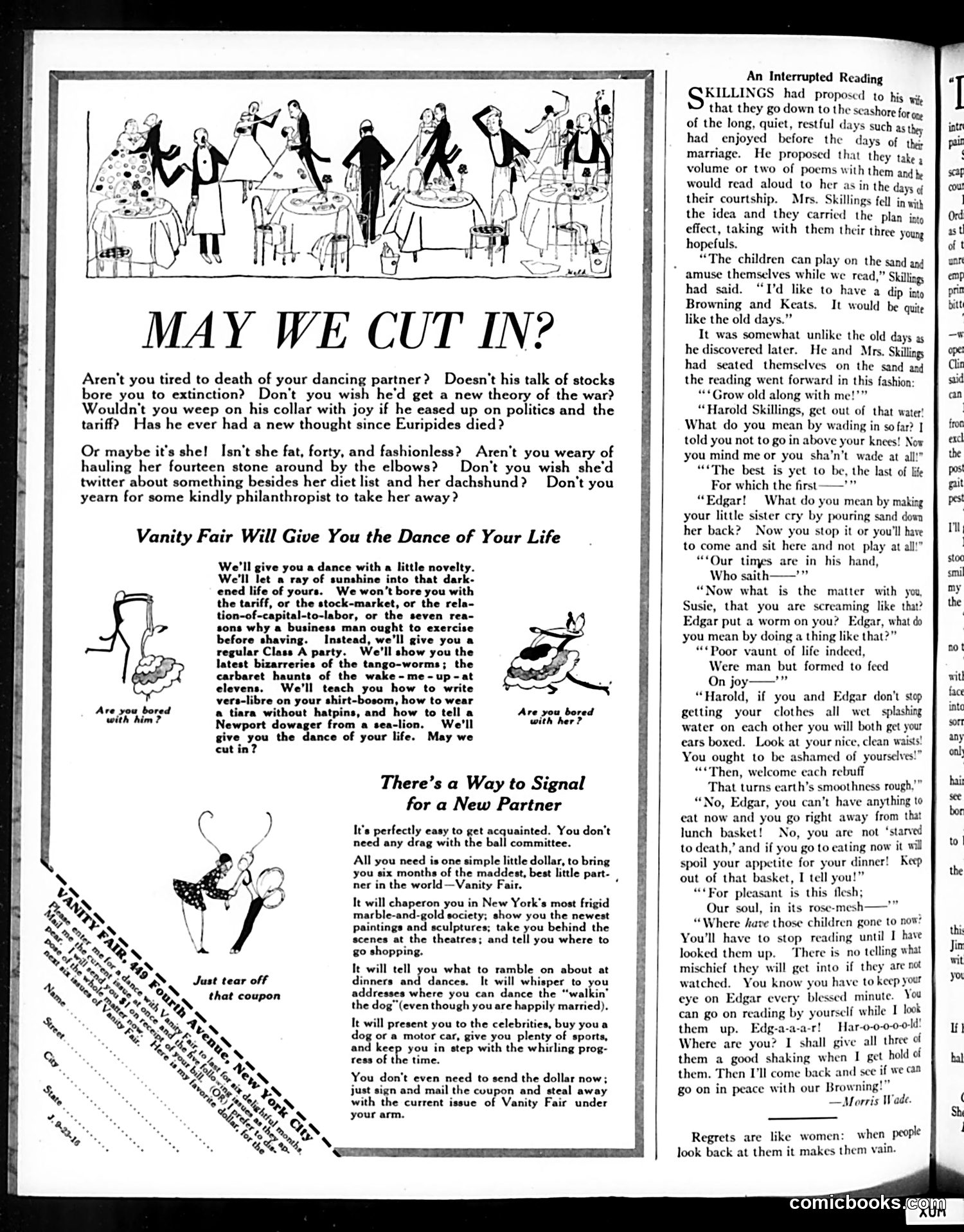
This page features two distinct pieces: a **Vanity Fair magazine advertisement** and a **humorous domestic sketch**. The main advertisement mocks the tedium of 1920s social life by satirizing boring dinner companions—men who drone on about stocks, war theories, politics, and tariffs; women preoccupied with diets and their dachshunds. It positions Vanity Fair as an escape, promising readers relief through coverage of fashionable nightlife, dance trends (the "tango"), Broadway gossip, and New York high society. The subscription pitch uses self-deprecating humor: for one dollar, readers gain a "partner" more entertaining than their actual spouses. The right column's sketch, "An Interrupted Reading," offers ironic domestic commentary. Mr. Skillings attempts to recapture courtship romance by reading Browning and Keats aloud to his wife at the seaside, but their three children constantly interrupt with minor crises—wading too far, pouring sand, releasing worms. The satire targets the impossibility of recapturing pre-marriage tranquility once children arrive, contrasting literary ideals with domestic chaos. Both pieces reflect 1920s anxieties about marriage's monotony and modern social obligations.
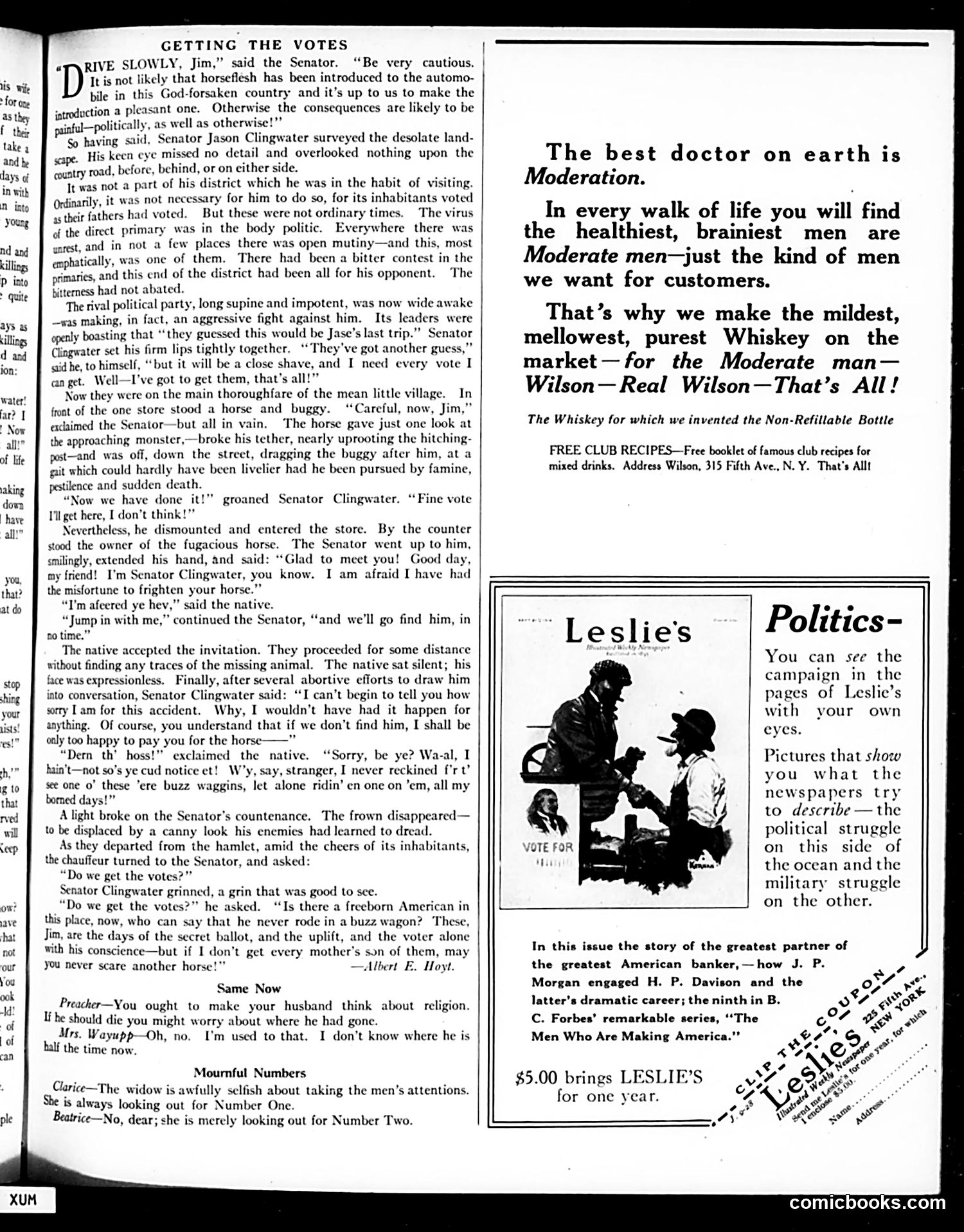
This story-cartoon satirizes rural campaigning and vote-buying in early 20th-century American politics. Senator Jason Clingwater, a city politician, ventures into a remote village during a heated primary election where his opponent is unexpectedly competitive—the "direct primary" has disrupted traditional voting patterns. The satire hinges on Clingwater's patronizing approach to rural voters. He cautiously introduces the automobile to supposedly unsophisticated country folk, treating them as ignorant. His plan backfires when he frightens a farmer's horse with his car, then attempts clumsy damage control by offering a ride to find the animal. The joke is that despite Clingwater's calculated politeness and schmoozing, the silent, unimpressed farmer—the very voter he needs—remains unmoved. The rural voter's passive resistance to political manipulation represents honest indifference to urban politicians' condescending tactics. The piece critiques both rural stereotyping and urban politicians' cynical vote-chasing methods during the era of democratizing primary elections.
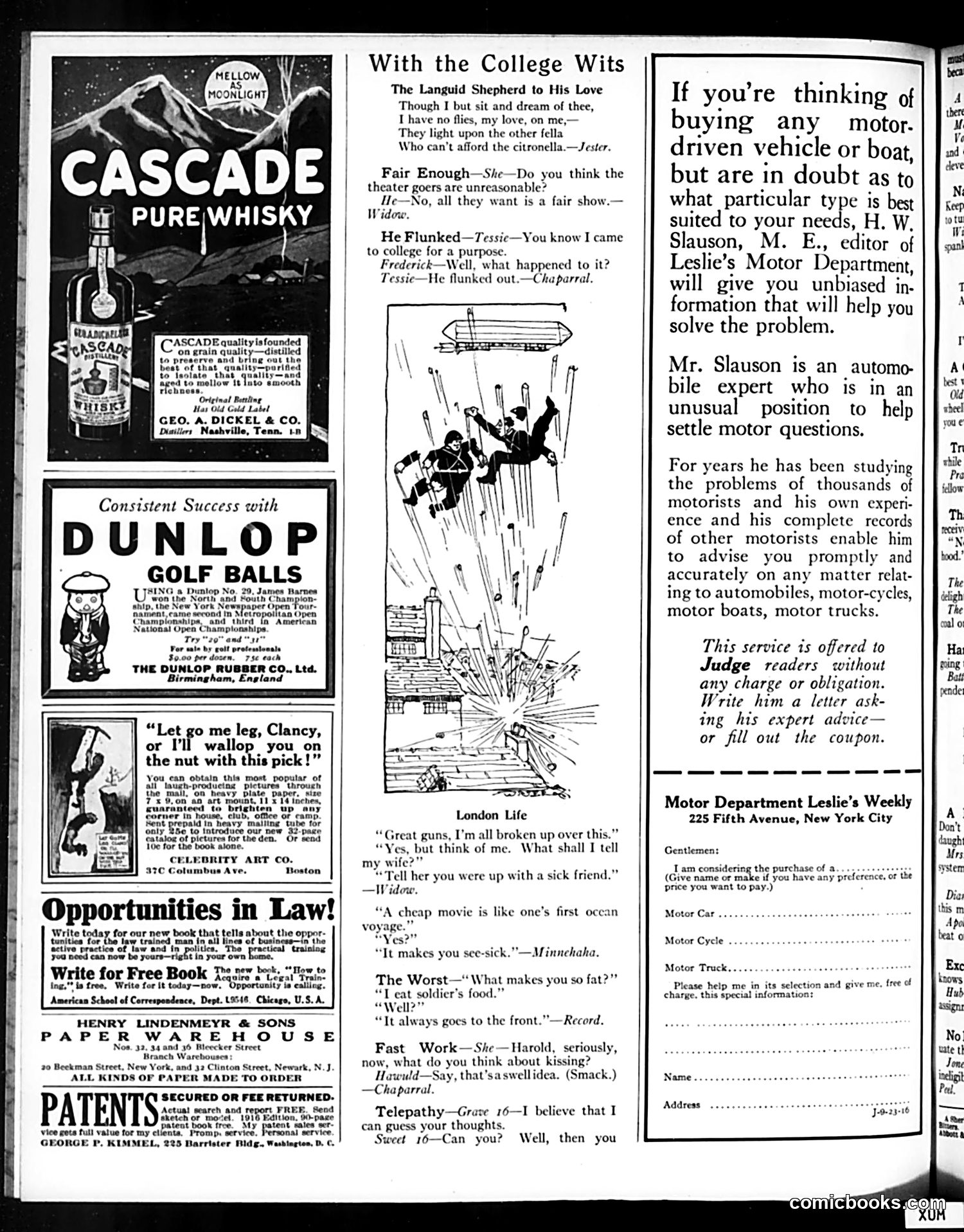
This page is primarily **advertising and advice columns** from Judge magazine, with minimal satirical cartooning. The "With the College Wits" section contains brief humorous quotes from college publications—jokes about romance, academic failure, and social situations typical of early 20th-century college life. These are mild, genteel humor rather than sharp satire: a shepherd's complaint about flies and citronella, a woman who came to college "for a purpose" (implied: marriage, not education), and various quips about movies and kissing. The page is dominated by **commercial advertisements**—Cascade whisky, Dunlop golf balls, legal correspondence courses, and notably a "Motor Department" advice service from Leslie's Weekly offering free guidance on purchasing automobiles, motorcycles, or boats. The single cartoon depicts people falling from a zeppelin or airship during what appears to be a disaster, captioned "Great guns, I'm all broken up over this." This references **early aviation accidents**, a contemporary source of dark humor. The overall content reflects 1910s-era concerns: courtship rituals, new automotive technology, and early aviation novelties.
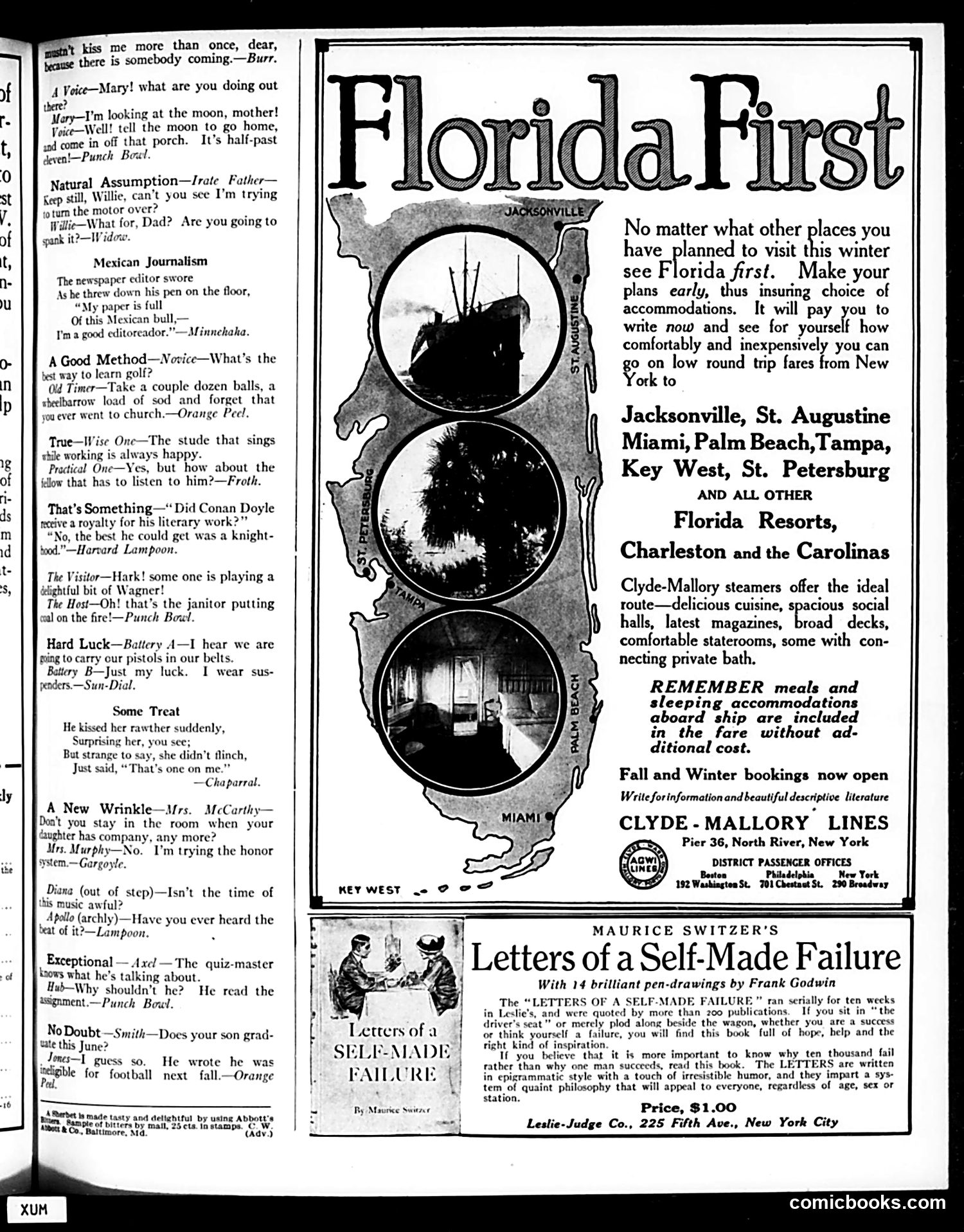
This page is primarily **advertising and comic shorts**, not a political cartoon. The main content includes: **Comic Shorts**: Brief humorous exchanges from various college humor magazines (Punch Bowl, Harvard Lampoon, etc.), covering domestic situations, romantic encounters, and light satire. These lack specific political targets—they're general observational humor about courtship, golf, and military service. **Main Advertisement**: The "Florida First" travel ad for Clyde-Mallory steamship lines dominates the right side, promoting winter tourism to Florida destinations via steamship from New York, emphasizing affordable fares and included meals/accommodations. **Book Advertisement**: Maurice Switzer's "Letters of a Self-Made Failure" is promoted at bottom—a serialized work that apparently offered inspirational/self-help commentary on success and failure, illustrated by Frank Godwin. The page reflects early 20th-century Judge content: light collegiate humor, commercial tourism advertising, and self-improvement literature. No specific political figures or events are referenced.
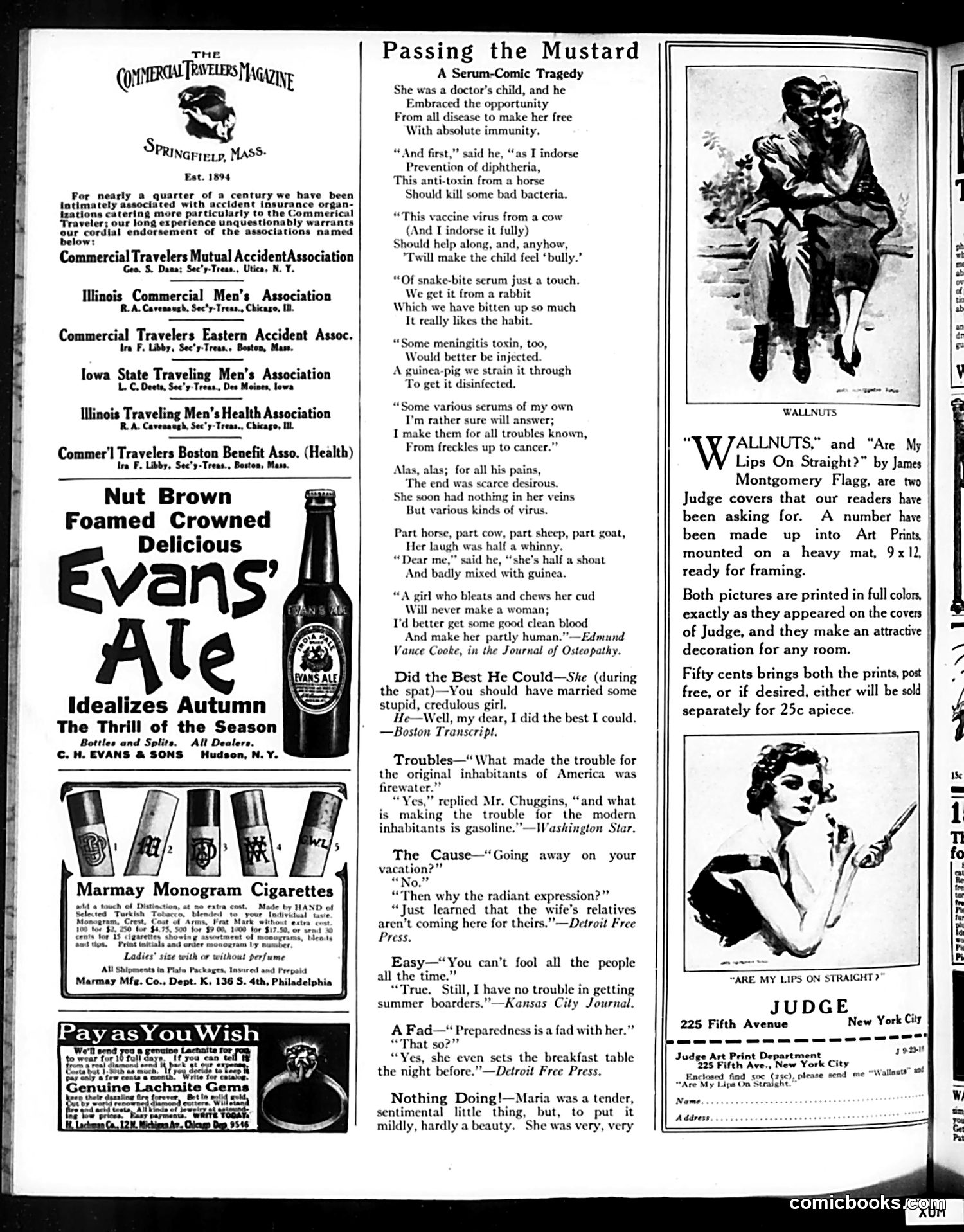
This page is primarily **advertisements and humorous short anecdotes** rather than political cartoons. The main content is "Passing the Mustard: A Serum-Comic Tragedy," a satirical poem mocking medical over-treatment. ## The Satire The poem ridicules a doctor who indiscriminately injects his patient (a young girl) with various animal-derived serums and vaccines—from horse anti-toxin to guinea-pig extracts—claiming each prevents different diseases. The joke culminates when she becomes a hybrid creature, literally transforming into part horse, cow, sheep, and goat ("her laugh was half a whinny"). ## The Point This appears to target **medical fads and unproven treatments** of the era. Early 20th-century medicine featured experimental serums of questionable efficacy. The cartoon exaggerates this tendency absurdly—suggesting doctors blindly administered multiple treatments without understanding consequences. The remainder of the page contains **vintage ads** (Evans' Ale, Marmay Cigarettes) and short comic anecdotes unrelated to the main satire. A small section promotes Judge magazine covers by artist James Montgomery Flagg.
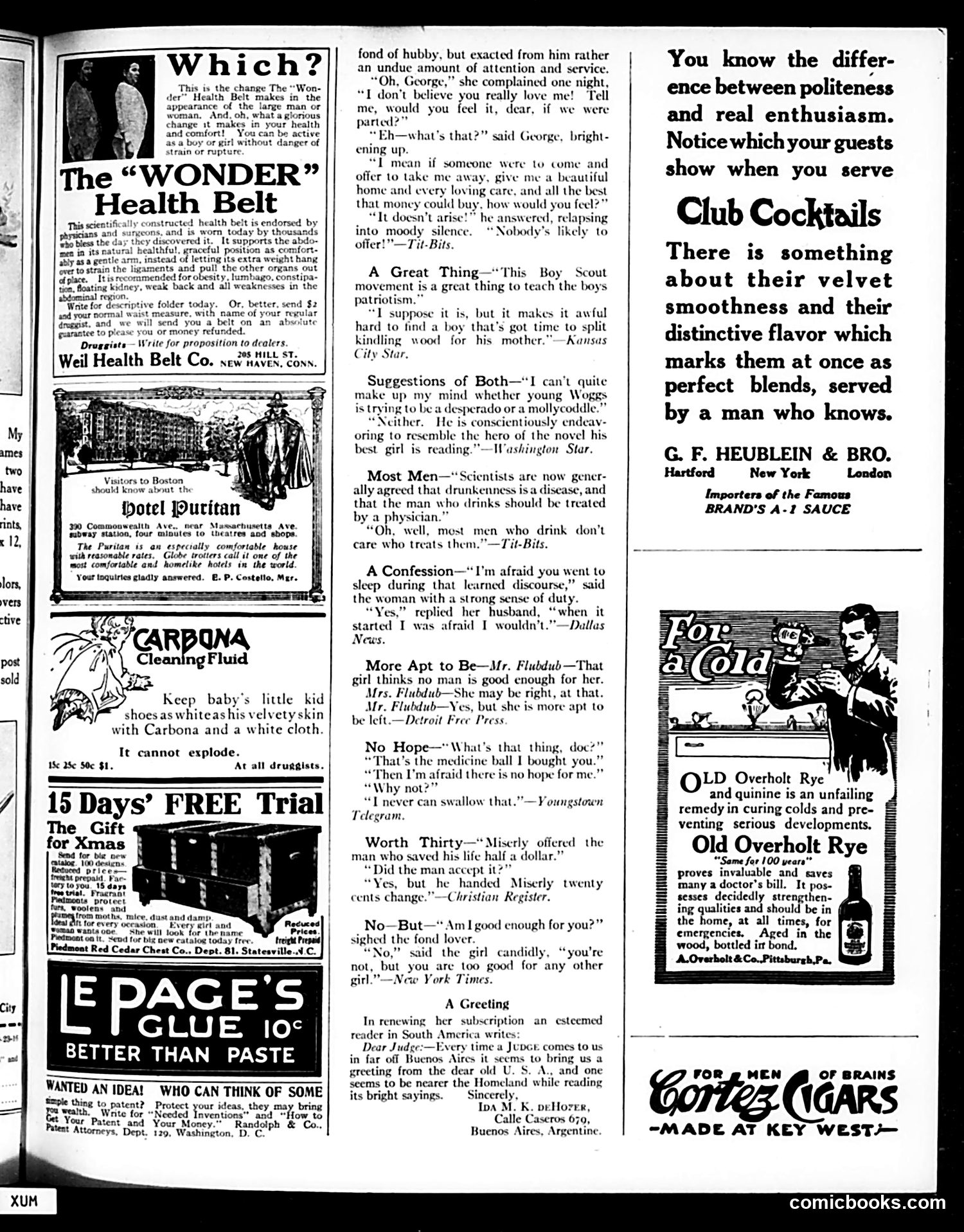
This page from *Judge* (a satirical magazine) is primarily **advertising**, with a small cartoon strip titled "Which?" at the top. **The "Which?" Cartoon:** The strip depicts a husband-and-wife domestic dispute. The wife complains that her husband doesn't love her, then asks if he'd care if someone took her away with a comfortable home. The husband perks up at this prospect—revealing that he'd actually welcome her departure. The satire mocks the disconnect between romantic pretense and marital reality: the wife expects emotional reassurance, while the husband's true (selfish) feelings are exposed. **Surrounding Content:** The page is dominated by period advertisements for products like the "Wonder" Health Belt (a pseudo-medical device), hotels, cleaning fluid, and patent medicines. Notable is an ad for **Old Overholt Rye whiskey with quinine**, marketed as medicinal for colds—reflecting the pre-Prohibition era when alcohol was promoted as a cure-all. The page reflects early 20th-century advertising culture and marital humor typical of *Judge*'s irreverent tone.
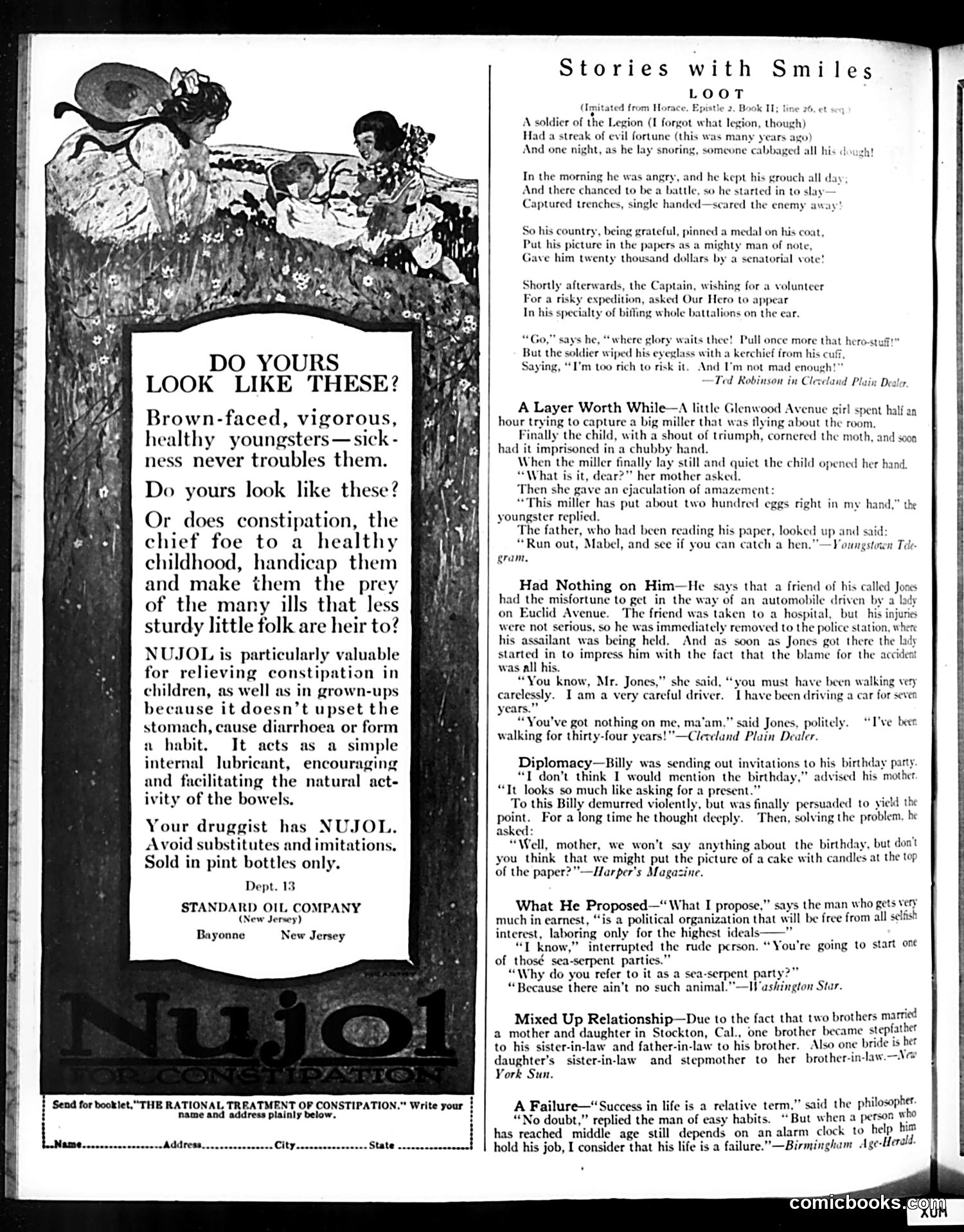
This page contains **primarily advertising and short humorous anecdotes**, not political satire. **The Advertisement:** The large left panel promotes NUJOL, a mineral oil laxative by Standard Oil (New Jersey). It uses before/after imagery contrasting healthy, robust children with sickly ones, claiming constipation is "the chief foe to healthy childhood." This reflects early-20th-century patent medicine marketing that treated minor digestive issues as serious medical problems requiring commercial solutions. **The "Stories with Smiles" Section:** The right side contains brief comic anecdotes: - "Loot": A soldier's stolen belongings lead to military heroism and medals—satirizing how fortune and publicity can reward someone for accidental circumstances - "A Layer Worth While" and other short jokes about everyday situations (catching a moth, car accidents, birthday party etiquette) These are gentle, domestic humor pieces with no apparent political content—typical filler for magazines of this era. The page reflects early-20th-century American consumer culture and family-oriented comedy.
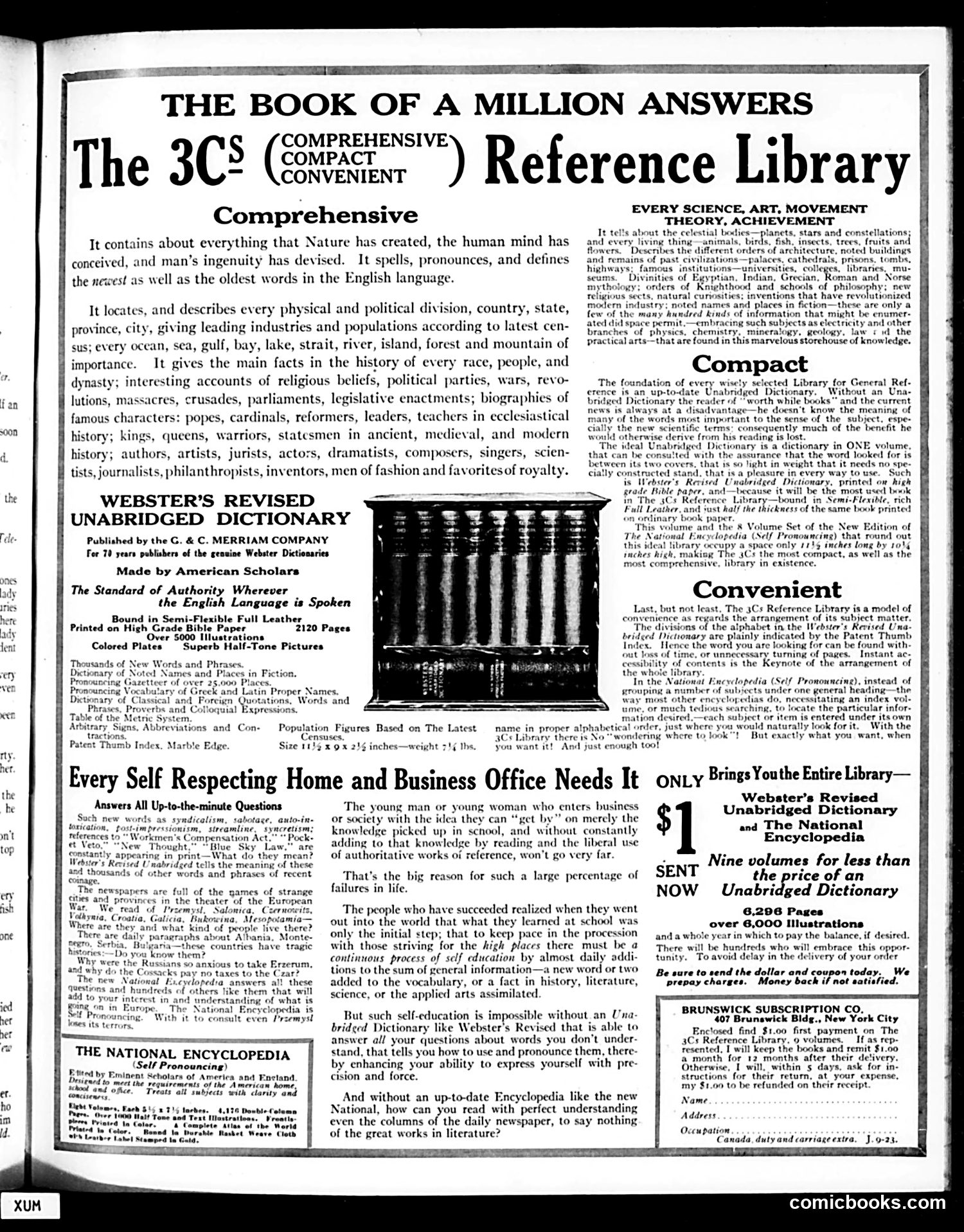
This is primarily **advertising**, not a cartoon. The page promotes "The 3Cs Reference Library"—a combined package of Webster's Revised Unabridged Dictionary and the National Encyclopedia—positioned as an essential home reference set. The sales pitch targets middle-class anxiety about knowledge and self-improvement. The text argues that without an unabridged dictionary, readers cannot fully understand newspapers, literature, or other important texts. It emphasizes that the 3Cs set is "compact" and "convenient"—fitting on modest bookshelves—while still being comprehensive. The advertisement reflects early 20th-century beliefs that owning reference books signified respectability and education. The rhetorical claim that "every self-respecting home and business office needs it" suggests that lacking such volumes was socially embarrassing. The image shows the encyclopedia volumes side-by-side, visually demonstrating the product's compactness compared to larger competing sets.
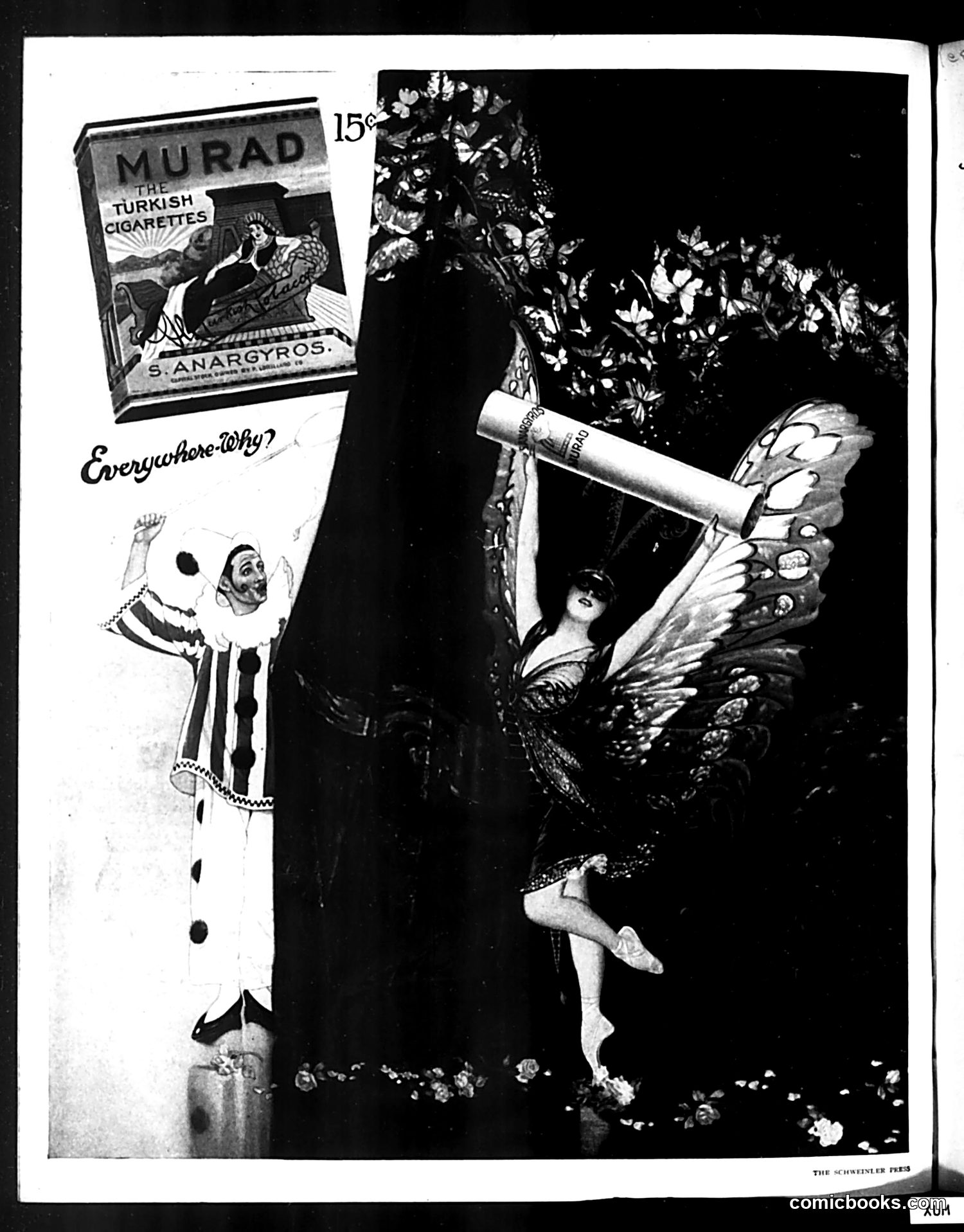
This page contains a cigarette advertisement for "Murad Turkish Cigarettes" by S. Anargyros, priced at 15¢. The ad features two illustrated scenes: **Left side:** A figure in striped clothing (possibly representing a Pierrot or commedia dell'arte character) with text reading "Everywhere-Why?" **Right side:** An Art Deco-style illustration of a woman in an ornate dress with butterfly wings, holding what appears to be a cigarette, in an enchanted garden setting. The advertisement uses fantasy and theatrical imagery to market the product. The "Everywhere-Why?" slogan suggests the cigarettes' widespread popularity. The fairy/butterfly motif and exotic Turkish branding appealed to early 20th-century consumers' desires for sophistication and glamour. This represents typical Judge magazine advertising rather than political satire.