
Judge, 1916-09-23 · page 6 of 32
Judge — September 23, 1916 — page 6: what you’re looking at
What you’re looking at
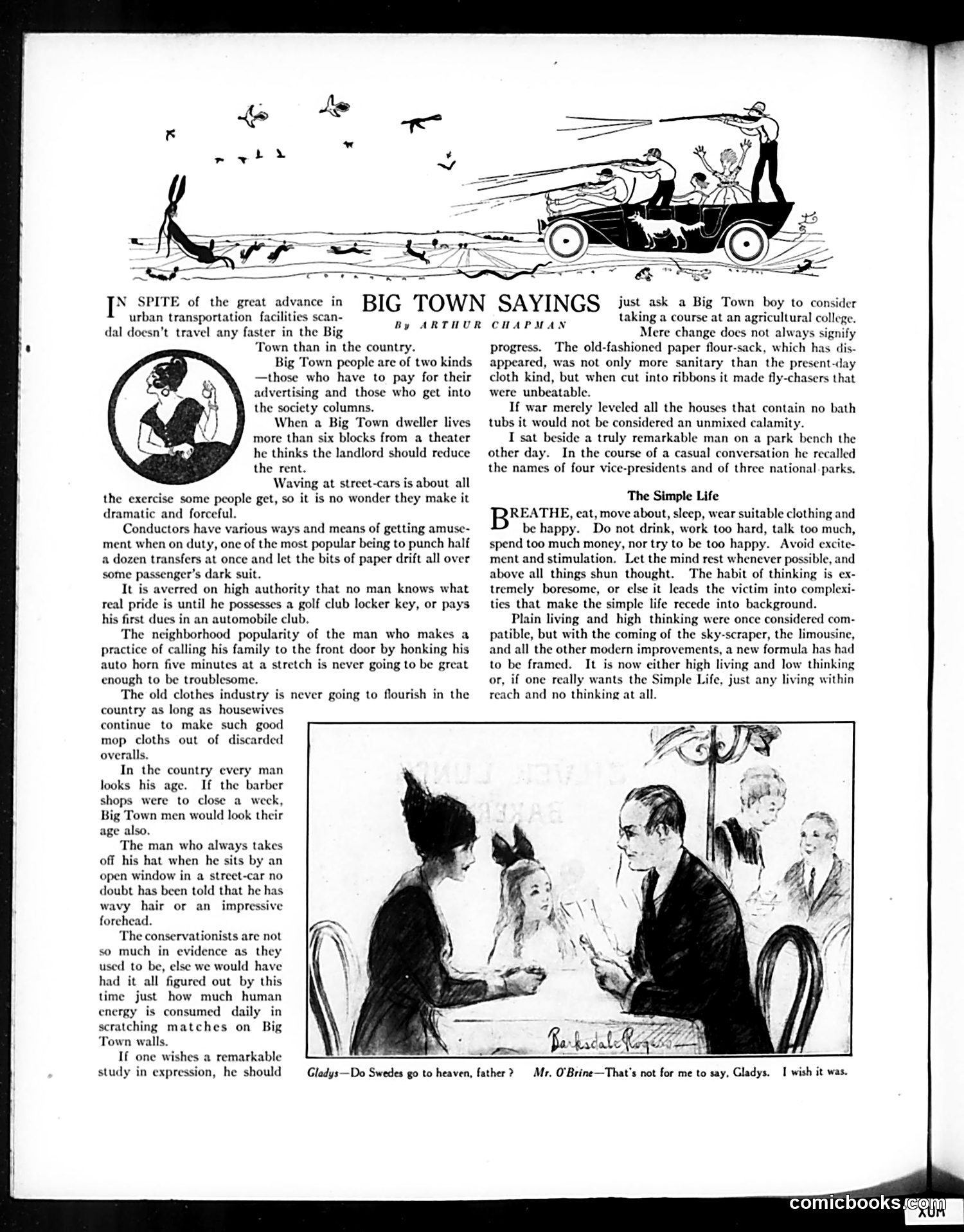
This page satirizes contrasts between urban and rural American life through social commentary and a cartoon joke. **Main Article Content:** Arthur Chapman's "Big Town Sayings" mocks city dwellers' pretensions and behaviors—their vanity (needing regular haircuts to look young), status-seeking (golf club memberships), and petty grievances (complaining about rent if theaters aren't within six blocks). The section "The Simple Life" ironically critiques the modern impossibility of simple living: whereas "plain living and high thinking" were once compatible, contemporary urban life (skyscrapers, limousines) now forces a choice between "high living and low thinking" or actual simplicity without intellectual engagement. **The Cartoon Joke:** The small illustration depicts a father-daughter exchange. Gladys asks if Swedes go to heaven; her father (Mr. O'Brine) responds it's not his place to say, but wishes it were—likely a period ethnic joke suggesting skepticism about Swedish virtue or heavenly worthiness. This reflects common early-20th-century ethnic stereotyping in American humor. The overall tone satirizes urban sophistication as shallow and exhausting compared to rural authenticity.
📄 Transcribed text from this page (OCR, searchable)
Machine-transcribed from the original scan — historical spelling and the odd misread are preserved.
[s SPITE of the great advance in urban transportation facilities scan. dal doesn’t travel any faster in the Big Town than in the country. Big Town people are of two kinds —those who have to pay for their advertising and those who get into the society columns. When a Big Town dweller lives more than six blocks from a theater he thinks the landlord should reduce the rent. Waving at street-cars is about all the exercise some people get, so it is no wonder they make it dramatic and forceful. Conductors have various ways and means of getting amuse- ment when on duty, one of the most popular being to punch half a dozen transfers at once and let the bits of paper drift all over some passenger’s dark suit. It is rred on high authority that no man knows what real pride is until he possesses a golf club locker key, or pays his first dues in an automobile club. The neighborhood popularity of the man who makes a practice of calling his family to the front door by honking his auto horn five minutes at a stretch is never going to be great enough to be troublesome. The old clothes industry is never going to flourish in the country as long as housewives continue to make such good mop cloths out of discarded overalls. In the country every man looks his age. If the barber shops were to close a weck, Big Town men would look their age also, The man who always takes off his hat when he sits by an open window in a street-car no doubt has been told that he wavy hair or an impressive forehead. The conservationists are not so much in evidence as they used to be, else we would have had it all figured out by this time just how much human energy is consumed daily in scratching matches on Big Town walls. If one wishes a remarkable BIG TOWN SAYINGS By ARTHUR CHAPMAN just ask a Big Town boy to consider taking a course at an agricultural college. Mere change does not always signify progress. The old-fashioned paper flour-sack, which has dis- appeared, was not only more sanitary than the present-day cloth kind, but when cut into ribbons it made fly-chasers that were unbeatable. If war merely leveled all the houses that contain no bath tubs it would not be considered an unmixed calamity. I sat beside a truly remarkable man on a park bench the other day. In the course of a casual conversation he recalled the names of four vice-presidents and of three national. parks, The Simple Life REATHE, eat, move about, sleep, wear suitable clothing and be happy. Do not drink, work too hard, talk too much, spend too much money, nor try to be too happy. Avoid excite- ment and stimulation. Let the mind rest whenever possible, and above all things shun thought. The habit of thinking is ex- tremely boresome, or else it leads the victim into complexi- tics that make the simple life recede into background. Plain living and high thinking were once considered com- patible, but with the coming of the sky-scraper, the limousine, and all the other modern improvemen new formula has had to be framed. It is now either high living and low thinking or, if one really wants the Simple Life, just any living within reach and no thinking at all. study in expression, he should Gladys—Do Swedes go to heaven, father ? Mr. O'Brine—That's not for me to say, Gladys. I wish it was. comicbookss@