
Judge, 1916-09-23 · page 8 of 32
Judge — September 23, 1916 — page 8: what you’re looking at
What you’re looking at
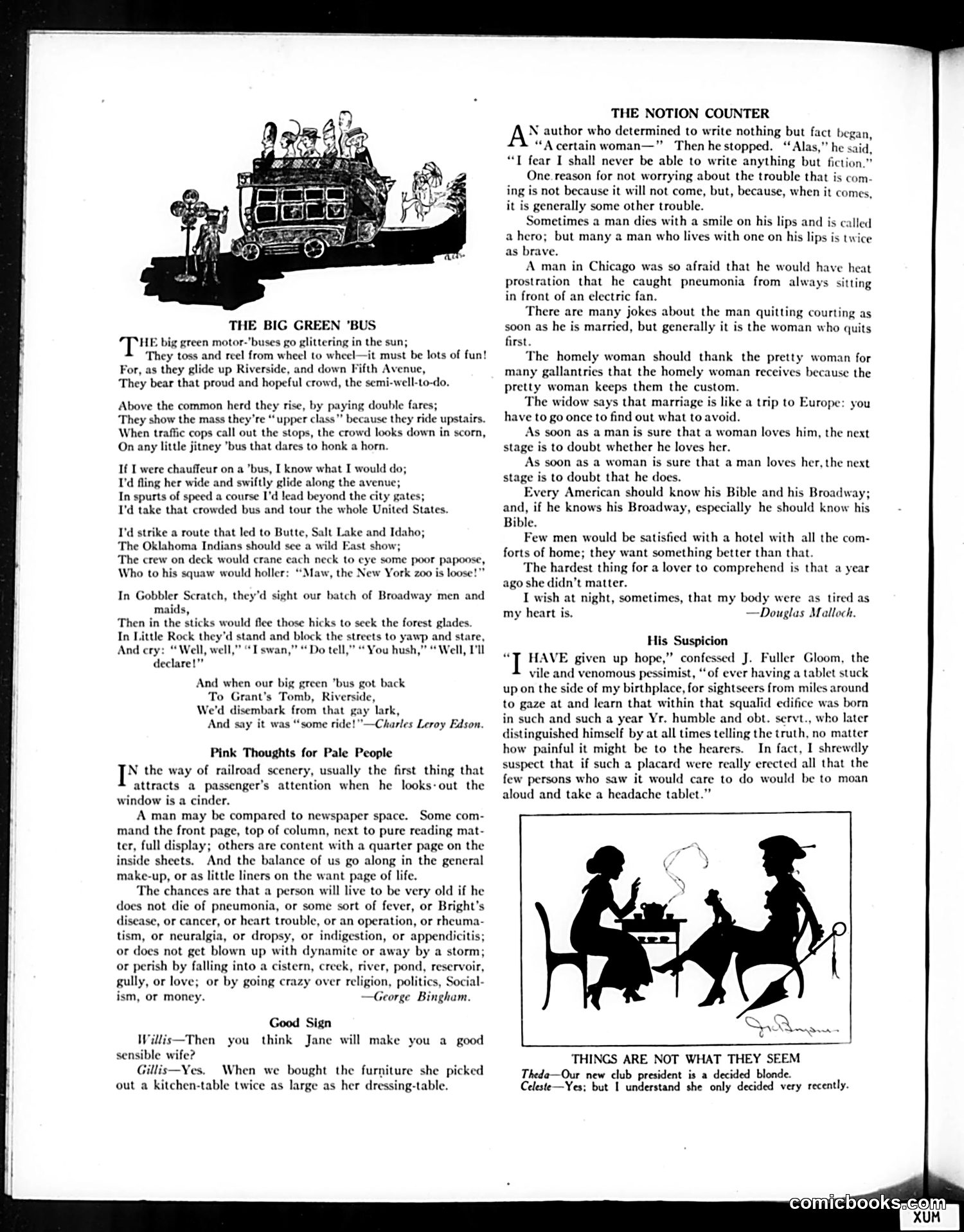
This page contains three satirical pieces typical of early 20th-century American humor: **"The Big Green 'Bus"** is a poem mocking the pretensions of urban middle-class riders of new motor-buses. The satire targets people who pay extra to sit upstairs, viewing themselves as "upper class" and looking down on cheaper transportation like jitneys. The poem humorously imagines a bus driver taking passengers on a cross-country tour, with rural Americans gawking at New York sophisticates—reversing the expected hierarchy and suggesting that city dwellers' snobbery is unfounded. **"Pink Thoughts for Pale People"** offers cynical one-liners about life's absurdities and mortality, in the tradition of turn-of-the-century newspaper wit. **The illustration** titled "Things Are Not What They Seem" shows a silhouetted domestic scene, likely satirizing appearances versus reality in relationships or social situations. The overall tone reflects Judge's characteristic blend of class commentary and gentle social criticism aimed at American urban readers.
📄 Transcribed text from this page (OCR, searchable)
Machine-transcribed from the original scan — historical spelling and the odd misread are preserved.
THE BIG GRE "BUS HE big green motor-'buses go glittering in the sun; They toss and reel from wheel to wheel—it must be lots of fun! For, as they glide up Riverside, and down Fifth Avenue, They bear that proud and hopeful crowd, the semi-well-to-do. Above the common herd they rise, by paying double far They show the mass they’re “upper class”’ because they ride upstairs. When traffic cops call out the stops, the crowd looks down in scorn, On any little jitney "bus that dares to honk a horn. If I were chauffeur on a "bus, I know what I would do; I'd fling her wide and swiftly glide along the avenue; In spurts of speed a course I'd lead beyond the city gates; I'd take that crowded bus and tour the whole United States. I'd strike a route that led to Butte, Salt Lake and Idaho; The Oklahoma Indians should see a wild East show; ‘The crew on deck would crane each neck to eye some poor papoose, Who to his squaw would holler: “Maw, the New York zoo is loose! In Gobbler Scratch, they'd sight our batch of Broadway men and maids, Then in the sticks would flee those hicks to seck the forest glades. In Little Rock they'd stand and block the streets to yawp and stare, And cry: “Well, well,” “I swan,” “Do tell,” “You hush,” “Well, Pll declare!” And when our big green 'bus got back To Grant’s Tomb, Riverside, We'd disembark from that go And say it was “some ride lark, Charles Leroy Edson. Pink Thoughts for Pale People I‘ the way of railroad scenery, usually the first thing that attracts a passenger's attention when he looks-out the window is a cinder. A man may be compared to newspaper space. Some com- mand the front page, top of column, next to pure reading mat- ter, full display; others are content with a quarter page on the inside sheets. And the balance of us go along in the gencral make-up, or as little liners on the want page of life. The chances are that a person will live to be very old if he does not die of pneumonia, or some sort of fever, or Bright’s disease, or cancer, or heart trouble, or an operation, or rheum: tism, or neuralgia, or dropsy, or indigestion, or appendiciti: or does not get blown up with dynamite or away by a storm; or perish by falling into a cistern, creek, river, pond, reservoir, gully, or love; or by going crazy over religion, politics, Social- i —George Bingham. Good Sign Willis—Then think Jane will make you a good sensible wi Gillis—Yes. When we bought the furniture she picked out a kitchen-table twice as large as her dressing-table. you THE NOTION COUNTER AX author who determined to write nothing but fac “A certain woman—" Then he stopped. “Ala: . “I fear I shall never be able to write anything but fiction.” One. reason for not worrying about the trouble that is com- ing is not because it will not come, but, because, when it comes, it is generally some other trouble. Sometimes a man dies with a smile on his lips and is called a hero; but many a man who lives with one on his lips is twice as brave. A man in Chicago was so afraid that he would h: prostration that he caught pneumonia from alway: in front of an electric fan. There are many jokes about the man quitting courting as soon as he is married, but generally it is the woman who quits first. The homely woman should thank the pretty woman for many gallantries that the homely woman receives because the pretty woman keeps them the custom. The widow says that marriage is like a trip to Europe: you have to go once to find out what to avoid. $ soon as a man is sure that a woman loves him, the next stage is to doubt whether he loves her. As soon as a woman is sure that a man loves her, the next stage is to doubt that he does. Every American should know his Bible and his Broadway. and, if he knows his Broadway, especially he should know his Bible. Few men would be satisfied with a hotel with all the com- forts of home; they want something better than that. The hardest thing for a lover to comprehend is that a year ago she didn’t matter. I wish at night, sometimes, that my body were as tired as my heart is. —Douglas Malloch. heat sitting His Suspicion “J HAVE given up hope,” confessed J. Fuller Gloom, the vile and venomous pessimist, “of ever having a tablet stuck up on the side of my birthplace, for sightscers from miles around to gaze at and learn that within that squalid e was born in such and such a year Yr. humble and obt. servt., who later distinguished himself by at all times telling the truth, no matter how painful it might be to the hearers. In fact, I shrewdly suspect that if such a placard were really erected all that the few persons who saw it would care to do would be to moan aloud and take a headache tablet.” THINGS ARE NOT WHAT THEY SEEM Theda—Our new club president is a decided blonde. Celeste—Yes; but I understand she only decided very recently. micbooks cay