
Judge, 1916-09-23 · page 18 of 32
Judge — September 23, 1916 — page 18: what you’re looking at
What you’re looking at
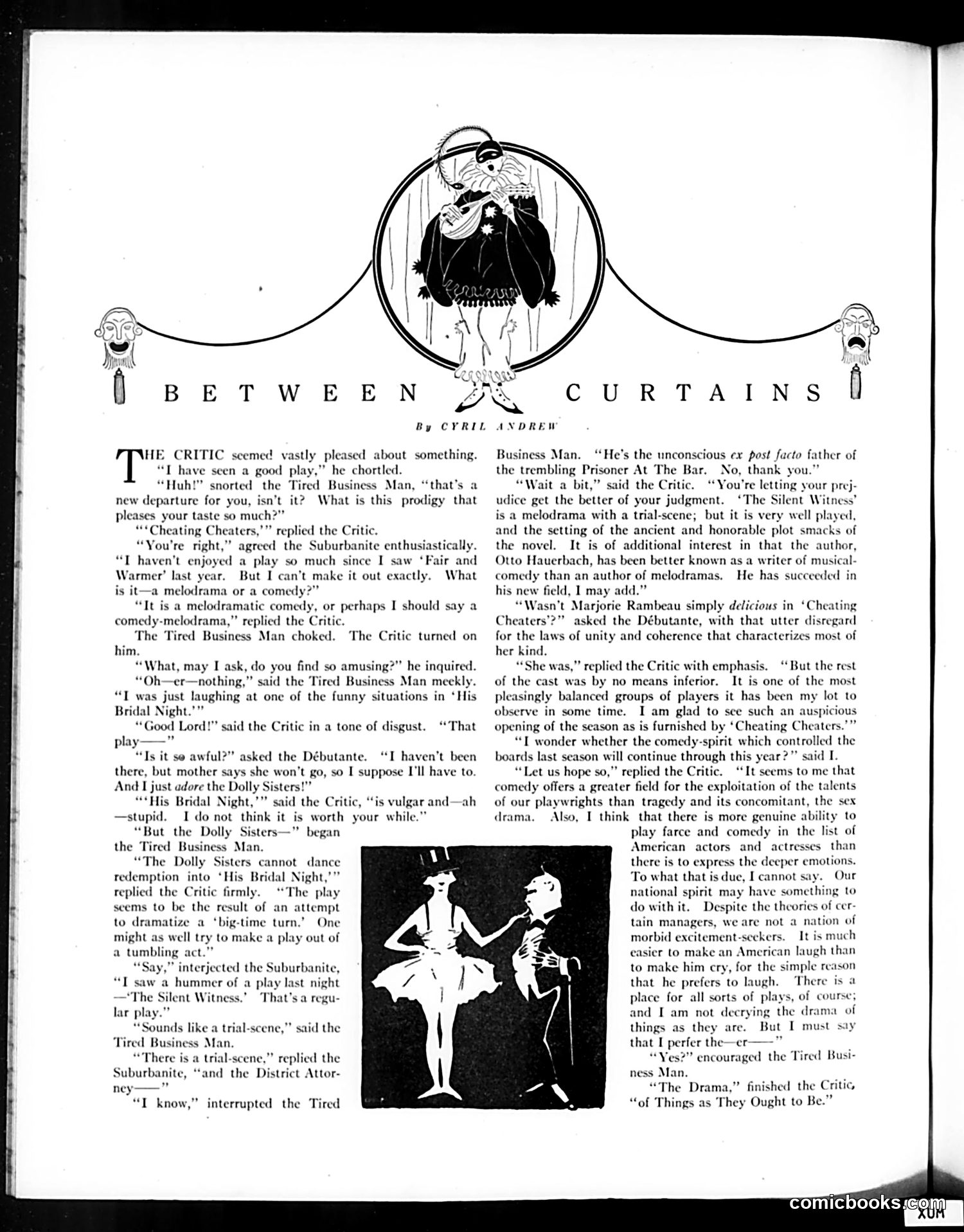
This is a theater criticism dialogue from Judge magazine featuring a "Critic" character debating Broadway plays with a "Tired Business Man" and other theatergoers. The satire targets both pretentious theater critics and general audiences' tastes. The cartoon illustrates the central tension: the Critic dismisses "His Bridal Night" as vulgar and unworthy despite featuring the Dolly Sisters (a famous vaudeville dance act), while others enjoy it. The Critic praises "Cheating Cheaters" and "The Silent Witness" for their artistic merit, yet acknowledges American audiences prefer comedy to serious drama. The joke is that the Critic represents snobbish, intellectual theater reviewing that contradicts popular entertainment preferences. The piece satirizes the gap between what critics deem worthy and what audiences actually find amusing—a timeless tension in entertainment criticism.
📄 Transcribed text from this page (OCR, searchable)
Machine-transcribed from the original scan — historical spelling and the odd misread are preserved.
BETWEEN 3 By CYRIL CRITIC pleased about something. he chortled. ired Business Man, “that’s a new departure for you, isn’t it? What is this prodigy that pl your taste so much?” Cheating Cheaters,’” replied the Critic. “You're right,” agreed the Suburbanite enthusiastically. “T haven't enjoyed a play so much since I saw ‘Fair and Warmer’ last year. But I can’t make it out exactly. What is it—a melodrama or a comed, “It is a melodramatic comedy, or perhaps I should say a comedy-melodrama,” replied the Critic. The Tired Business Man choked. him. “What, may I ask, do you find so amusing?” he inquired. “Oh—er—nothing,” said the Tired Business Man meckly. “T was just laughing at one of the funny situations in ‘His Bridal Night.’” ood Lord!” said the C The Critic turned on tic in a tone of disgust. “That Is it se awful?” asked the Débutante. “I haven't been there, but mother says she won't go, so I suppose I'll have to And I just adore the Dolly Sisters!” “*His Bridal Night,’” said the Critic, “is vulgar and —stupid. I do not think it is worth your while.” “But the Dolly Sisters—” began the Tired Business Man, “The Dolly Sisters cannot dance redemption into ‘His Bridal Night,’” replied the Critic firmly. “The play seems to be the result of an attempt to dramatize a ‘big-time turn.’ One might as well try to make a play out of a tumbling act. y,” interjected the Suburbanite, hummer of a play last night lent Witness.” That's a regu- ah “T saw ~The lar play “Sounds like a trial-scene,” said the Tired Business Man. “There is a trial-scene,” replied the Suburbanite, “and the District Attor- “I know,” interrupted the Tired ANDREW “He's the unconscious ex post facto father of the trembling Prisoner At The Bar. No, thank you.” “Wait a bit,” said the € “You're letting your prej- udice get the better of your judgment. ‘The Silent Witness’ is a melodrama with a trial-scene; but it is very well played, and the setting of the ancient and honorable plot smacks of the novel. It is of additional interest in that the author, Otto Hauerbach, has been better known as a writer of musical- comedy than an author of melodramas. He has succeeded in his new field, I may add.” “Wasn't Marjorie Rambeau simply delicious in ‘Cheating Cheaters’?” asked the Débutante, with that utter disregard for the laws of unity and coherence that characterizes most of her kind. “She was,” replied the Critic with emphasis.“ But the rest of the cast was by no means inferior. It is one of the most pleasingly balanced groups of players it has been my lot to observe in some time. I am glad to see such an auspicious opening of the season as is furnished by ‘Cheating Cheaters. “T wonder whether the comedy-spirit which controlled the boards last season will continue through this year?” said I. Let us hope so,” replied the Critic. “It seems to me that comedy offers a greater field for the exploitation of the talents of our playwrights than tragedy and its concomitant, the sex drama. Also, I think that there is more genuine ability to play farce and comedy in the list of American actors and actresses than there is to express the deeper emotions. To what that is due, I cannot say. Our national spirit y have something to do with it. Despite the theories of cer- tain managers, we are not a nation of morbid excitement-seckers. It is much easier to make an American laugh than to make him cry, for the simple reason that he prefers to laugh. There is @ place for all sorts of plays, of course; and [I am not decrying the drama of things as they are. But I must sty that I perfer the—er—" “Yes?” encouraged the Tired Busi- Business Man. ness Man. . “The Drama,” finished the Critic “of Things as They Ought to Be.” comicbooks: |