
Judge, 1916-09-23 · page 19 of 32
Judge — September 23, 1916 — page 19: what you’re looking at
What you’re looking at
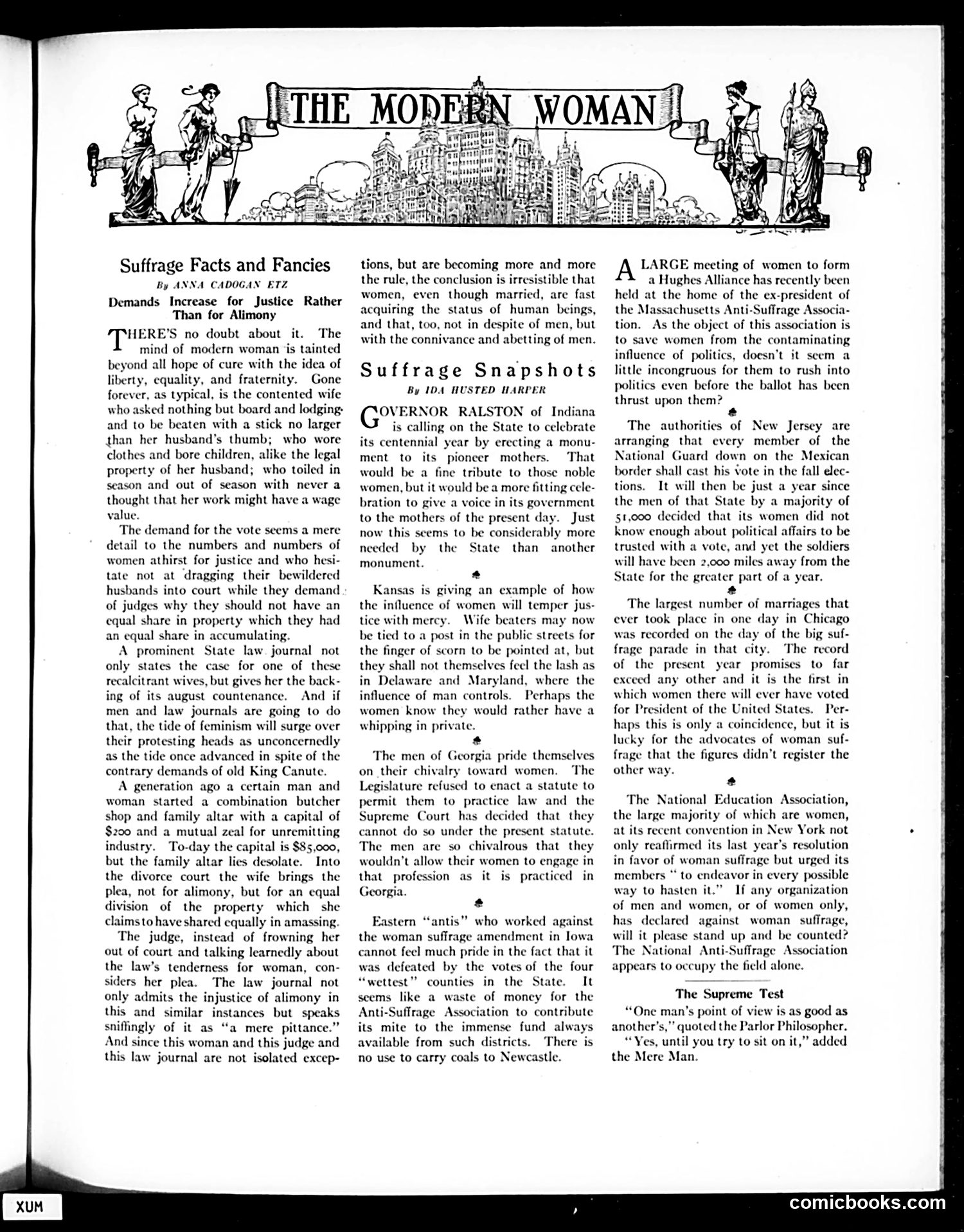
This Judge magazine page satirizes anti-suffrage arguments while ironically endorsing women's equality. The main article by Anna Cadogan Etz uses sarcasm to defend women's suffrage and property rights in marriage. It mocks the "contented wife" stereotype (legally the property of her husband, beaten with impunity) as obsolete, then presents a case study: a woman who invested equally in building a butcher business now demands equal ownership rather than mere alimony in divorce. The author celebrates that judges and law journals increasingly support this justice claim. The "Suffrage Snapshots" section by Ida Husted Harper adds state-level examples mocking anti-suffrage positions: Indiana should give mothers voting rights rather than monuments; Kansas shows women's civilizing influence; Georgia's "chivalry" actually prevents women from practicing law. The implicit point throughout: denying women voting and property rights is not protection but injustice dressed in paternalism. The page supports suffrage through sharp, satirical critique of the status quo.
📄 Transcribed text from this page (OCR, searchable)
Machine-transcribed from the original scan — historical spelling and the odd misread are preserved.
Suffrage Facts and Fancies by ‘A CADOGAN ETZ Demands Increase for Justice Rather Than for Alimony HERE’S no doubt about it. The mind of modern woman ‘is tainted beyond all hope of cure with the idea of liberty, equality, and fraternity. Gone forever, as typical, is the contented wife who asked nothing but board and lodging: and to be beaten with a stick no larger than her husband’s thumb; who wore clothes and bore children, alike the legal property of her husband; who toiled in season and out of season with never a thought that her work might have a wage value. The demand for the vote seems a mere detail to the numbers and numbers of women athirst for justice and who hesi tate not at dragging their bewildered husbands into court while they demand of judges why they should not have an equal share in property which they had an equal share in accumulating. A prominent State law journal not only states the case for one of these recalcitrant wives, but gives her the back- ing of its august countenance. And if men and law journals are going to do that, the tide of feminism will surge over their protesting heads as unconcernedly as the tide once advanced in spite of the contrary demands of old King Canute. A generation ago a certain man and woman started a combination butcher shop and family altar with a capital of $200 and a mutual zeal for unremitting industry. To-day the capital is $85,000, but the family altar lies desolate. Into the divorce court the wife brings the plea, not for alimony, but for an equal division of the property which she ims to have shared equally in amassing, The judge, instead of frowning her out of court and talking learnedly about the law’s tenderness for woman, con- siders her plea. The law journal not only admits the injustice of alimony in this and similar instances but speaks sniffingly of it as “a mere pittance.” And since this woman and this judge and this law journal are not isolated excep- tions, but are becoming more and more the rule, the conclusion is irresistible that women, even though married, are fast acquiring the status of human beings, and that, too, not in despite of men, but with the connivance and abetting of men. Suffrage Snapshots By IDA HUSTED HARPER OVERNOR RALSTON of Indiana is calling on the State to celebrate its centennial year by erecting a monu- ment to its pioneer mothers. That would be a fine tribute to those noble women, but it would be a more fitting cele- bration to give a voice in its government to the mothers of the present day. Just now this scems to be considerably more needed by the State than another monument. 2 Kansas is giving an example of how the influence of women will temper jus- tice with mercy. Wife beaters may now be tied to a post in the public streets for the finger of scorn to be pointed at, but they shall not themselves feel the lash as in Delaware and Maryland, where the influence of man controls. Perhaps the women know they would rather have a whipping in private. * The men of Georgia pride themselves on their chivalry toward women. The Legislature refused to enact a statute to permit them to practice law and the Supreme Court has decided that they cannot do so under the present statute. The men are so chivalrous that they wouldn’t allow their women to eng: ii that profession as it is practiced in Georgia. 2 Eastern “‘antis” who worked against the woman suffrage amendment in Iowa cannot feel much pride in the fact that it was defeated by the votes of the four “wettest” counties in the State. It seems like a waste of money for the Anti-Suffrage Association to contribute its mite to the imme fund always available from such districts. There is no use to carry coals to Newcastle. LARGE meeting of women to form a Hughes Alliance has recently been at the home of the ex-president of the Massachusetts Anti- tion. As the object of this association is to save women from the contaminating influence of politics, doesn’t it seem a little incongruous for them to rush into politics even before the ballot has been thrust upon them? hele The authorities of w Jersey are arranging that every member of the National Guard down on the Mexican border shall cast his vote in the fall elec- tions. It will then be just a year since the men of that State by a majority of 51,000 decided that its women did not know enough about political affairs to be trusted with a vote, and yet the soldiers will have been 2,000 miles away from the State for the greater part of a year. * The largest number of marriages that ever took place in one day in Chicago was recorded on the day of the big suf- frage parade in that city. The record of the present year promises to far exceed any other and it is the first in which women there will ever have voted for President of the United States. Per- haps this is only a coincidence, but it is lucky for the advocates of woman suf- frage that the figures didn’t register the other way. ¢ The National Education Association, the large majority of which are women, at its recent convention in New York not only reaffirmed its last year’s resolution in favor of woman suffrage but urged its members * to endeavor in every possible way to hasten it.” If any organization of men and women, or of women only, has declared against woman suffrage, will it please stand up and be counted? The National Anti-Suffrage Association appears to occupy the field alone. The Supreme Test “One man’s point of view is another's,” quoted the Parlor Philosopher. “Yes, until you try to sit on it,” added the Mere Man. comicbooks.com