
Judge, 1916-09-23 · page 20 of 32
Judge — September 23, 1916 — page 20: what you’re looking at
What you’re looking at
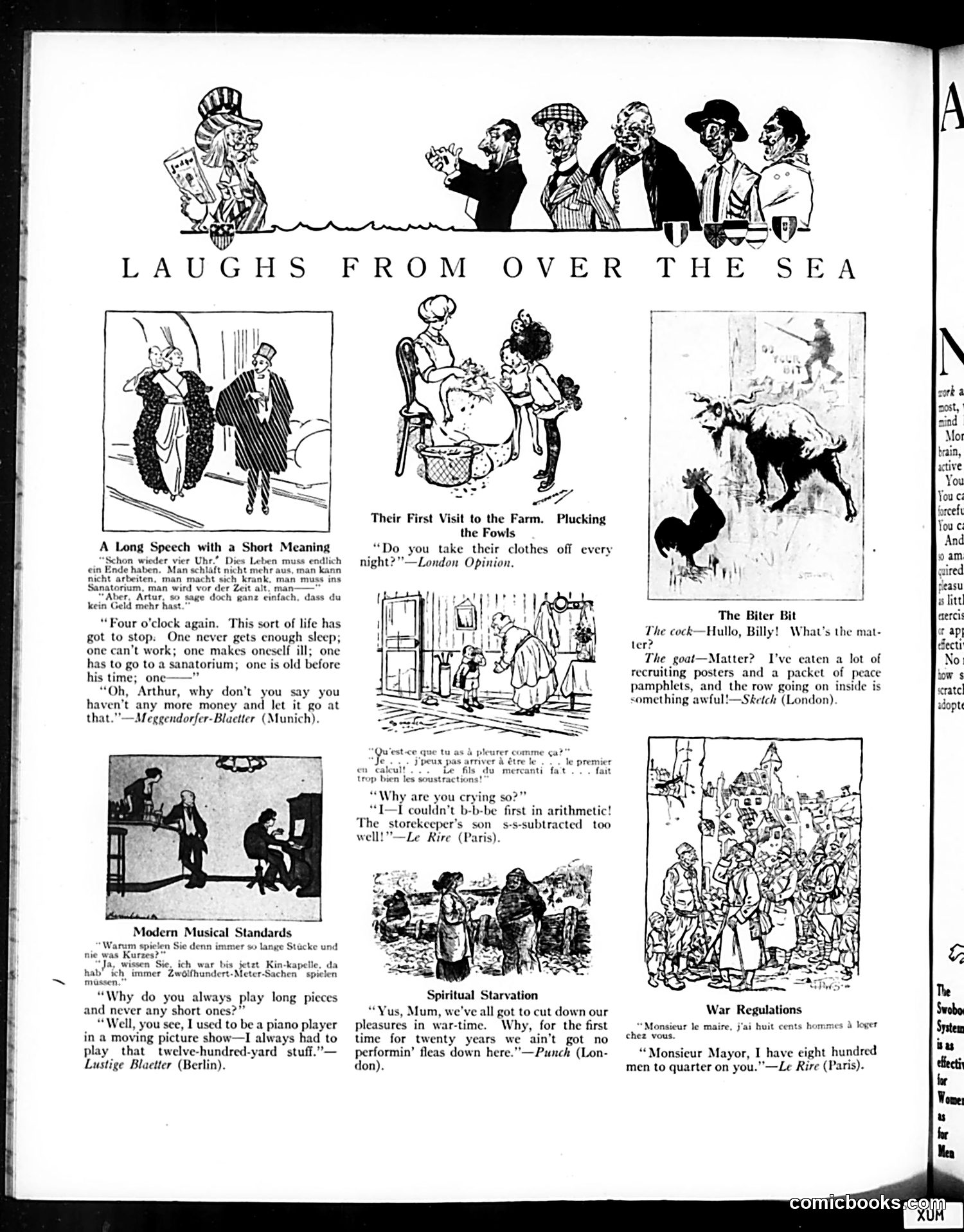
This page collects satirical comics from European magazines (German, French, British), all addressing **World War I-era anxieties**. The jokes target: 1. **Wartime hardship**: A man complains endlessly about exhaustion before admitting he's simply broke—mocking verbose excuses for economic collapse. 2. **Cultural displacement**: A cinema pianist plays unnecessarily long pieces because that's what moving pictures required—satirizing how war disrupts normal professions. 3. **Rural ignorance**: City visitors naively ask if farmers undress chickens nightly—poking fun at urban-rural disconnect. 4. **Arithmetic anxiety**: A child cries over not ranking first, reflecting wartime stress on families. 5. **Military burden**: A mayor receives billeting orders for 800 soldiers—showing the civilian cost of war occupation. 6. **Animal commentary**: A rooster and goat suffer from recruiting propaganda and peace pamphlets—dark humor about conflicting wartime messaging. The page's structure—reprinting foreign cartoons—suggests *Judge* was showcasing how other nations processed shared wartime experiences through humor.
📄 Transcribed text from this page (OCR, searchable)
Machine-transcribed from the original scan — historical spelling and the odd misread are preserved.
LAUGHS FROM A Long Speech with a Short Meaning “Schon wieder vier Uhr.” Dies Leben muss endlich de haben. Man schlaft nicht mehr aus, man kann nicht arbeiten, man macht sich krank, man muss ins Sanatorium, man wird vor der Zeit alt, man—" “Aber, Artur, so sage doch ganz einfach, dass du kein Geld mehr hast.” “Four o'clock again. 1 sort of life has got to stop: One never gets cnough sleep; one can’t work; one makes oneself ill; one has to go to a sanatorium; one is old before n't any more money and let it go at —Meggendorfer-Blaetter (Munich). ae . Modern Musical Standards “Warum spielen Sie denn immer so lange Stucke und nie was Kurze “Ja, wissen Sie, ich war bis jetzt Kin-kapelle, da hab" ich immer Zwoifhundert-Meter-Sachen spiclen mussen. “Why do you always play long pieces and never any short ones?” “Well, you see, I used to be a piano player in a moving picture show—I always had to play that twelve-hundred-yard stuff.” — Lustige Blaetter (Berlin). OVER Their First Visit to the Farm. Plucking the Fowls “Do you take their clothes off every night?""—London Opinion. “Why are you crying so?” “y I couldn't b-b-be first in arithmetic! torekeeper’s son s-s-subtracted too —Le Rire (Paris). Spiritual Starvation “Yus, Mum, we've all got to cut down our pleasures in war-time. Why, for the first time for twenty years we ain’t got no esformin’ fleas down here.” —Punch (Lon- don). The Biter Bit The cock—Hullo, Billy!) What's the mat- ter? The goat—Matter? I’ve eaten a lot of recruiting posters and a packet of peace pamphlets, and the row going on inside is something awful!—Sketch (London) War Regulations “Monsieur le maire, j'ai huit cents hommes 4 loger chez vous. “Monsieur Mayor, I have eight hundred men to quarter on you.” —Le Rire (Paris). Bee Re TTY comicbooks sera