
Judge, 1916-09-23 · page 14 of 32
Judge — September 23, 1916 — page 14: what you’re looking at
What you’re looking at
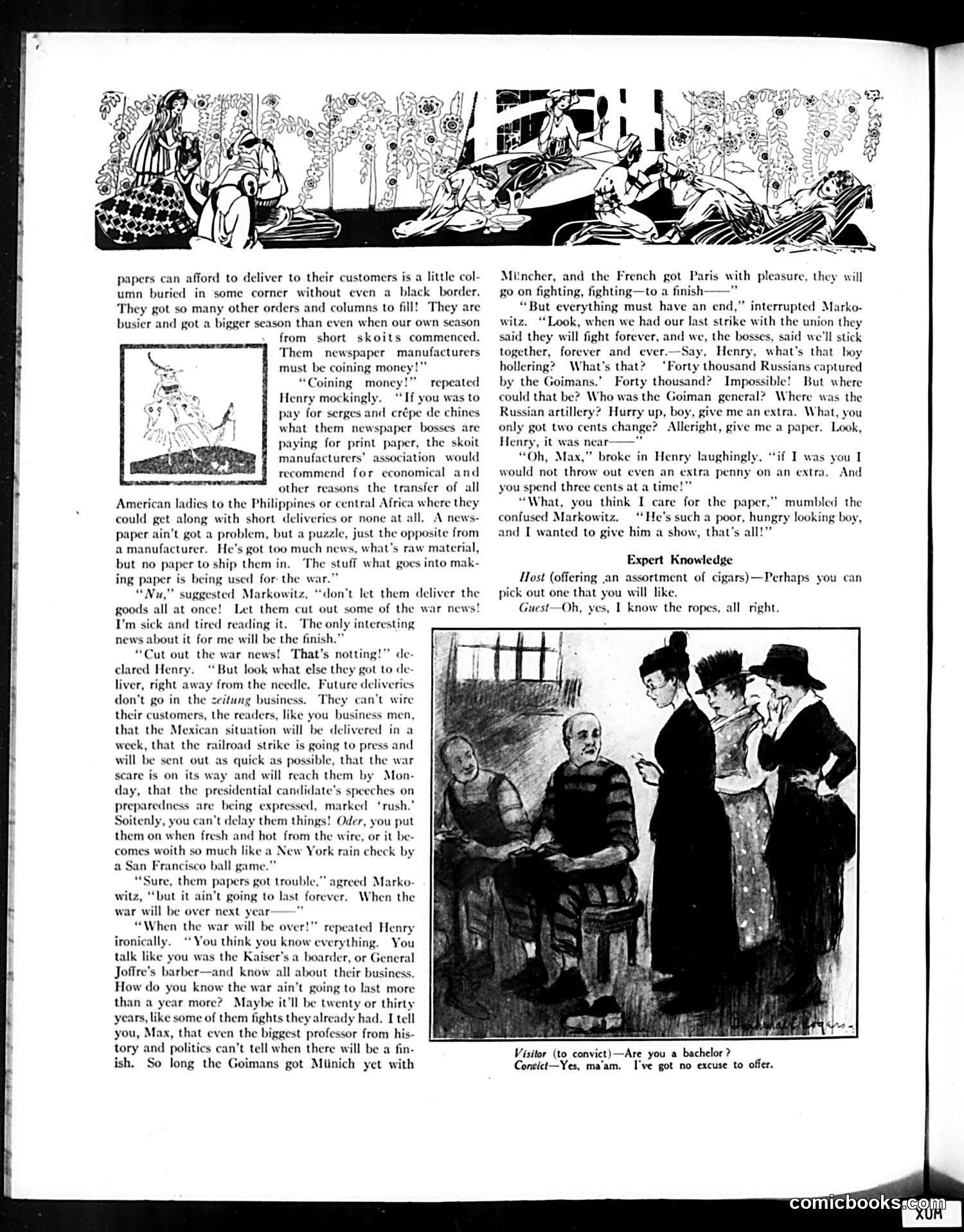
This page depicts a conversation between two Jewish characters—Henry and Markowitz (identifiable by Yiddish-inflected English dialogue)—discussing wartime newspaper shortages during World War I. **The satire's point:** Newspapers face an acute paradox: they have enormous quantities of urgent war news to publish but insufficient paper stock because paper supplies are diverted to the war effort. Markowitz, a garment manufacturer, complains that newspapers can't deliver promised orders; Henry responds that newspapers themselves can't control their output—they must print fresh war news immediately as it arrives, unable to schedule deliveries like ordinary businesses. The exchange mocks both newspaper publishers' predicament and the broader absurdity of wartime shortages. Henry's cynical conclusion—that the war may last decades, not ending soon—undercuts Markowitz's optimistic faith in resolution. A secondary cartoon below shows a visitor making a joke about bachelor excuses. The dialogue captures authentic immigrant voice and contemporary economic chaos of 1914-1917.
📄 Transcribed text from this page (OCR, searchable)
Machine-transcribed from the original scan — historical spelling and the odd misread are preserved.
papers can afford to deliver to their customers is a little col- umn buried in some corner without even a black border. They got so many other orders and columns to fill! They are busier and got a bigger season than even when our own season from short skoits commenced. Them newspaper manufacturers must be coining money!” “Coining money!” repeated Henry mockingly. ‘If you was to pay for serges and crépe de chines what them newspaper bosses are paying for print paper, the skoit manufacturers’ association would recommend for economical and other reasons the transfer of all American ladies to the Philippines or central Africa where they et along with short deliveries or none at all. A news- just the opposite from could paper ain't got a problem, but a puzzl a manufacturer. He's got too much news, what's raw material, but no paper to ship them in. The stuff what goes into mak- ing paper is being used for the war.” “Nu,” suggested Markowitz, “don’t let them deliver the js all at once! Let them cut out some of the war news! and tired reading it. The only interesting news about it for me will be the finish.” “Cut out the war news! That’s notting!”’ de- clared Henry. ‘* But look what else they got to de- liver, right away from the needle. Future deliveries don’t go in the ceitung business. They can't wire their customers, the readers, like you business men, that the Mexican situation will be delivered in a week, that the railroad strike is going to press and will be sent out as quick as possible, that the war re is on its way and will reach them by Mon- day, that the presidential candidate’s speeches on preparedness are being expressed, ‘rush.’ Soitenly, you can’t delay them things! Oder, you put them on when fresh and hot from the wire, or it be- comes woith so much like a New York rain check by a San Francisco ball game.” “Sure, them papers got troubl greed Marko- witz, “but it ain’t going to last forever. When the war will be over next year-—” “When the war will be ove repeated Henry lly. “You think you know everything. You talk like you was the Kaiser’s a boarder, or General Joffre’s barber—and know all about their business. How do you know the war ain’t going to last more than ur more? Maybe it'll be twenty or thirty years, like some of them fights they already had. I tell you, Max, that even the biggest professor from his- tory and politics can’t tell when there will be a fin- ish. So long the Goimans got Munich yet with Métncher, and the French got Paris with pleasure, they will go on fighting, fighting—to a finish——” “But everything must have an end,” interrupted Marko- witz. “Look, when we had our last strike with the union they said they will fight forever, and we, the bosses, said we'll stick together, forever and ever.—Say, Henry, what’s that boy hollering? What's that? ‘Forty thousand Russians captured by the Goimans.’ Forty thousand? Impossible! But where could that be? Who was the Goiman general? Where was the Russian artillery? Hurry up, boy, give me an extra. What, you only got two cents change? Alleright, give me a paper. Look, :ar—— .” broke in Henry laughing] would not throw out even an extra penny on an extra. you spend three cents at a time! Jhat, you think I care for the paper,” mumbled the confused Markowitz. ‘He's such a poor, hungry looking boy, and I wanted to give him a show, that’ { I was you I And Expert Knowledge Host (offering an assortment of ci; pick out one that you will like. Guest—Oh, yes, I know the ropes rs)—Perhaps you can all right. Visitor (to convict)—Are you a bachelor ? Concict—Yes, ma'am. I've got no excuse to offer. nIEcoonria |