
Judge, 1916-09-23 · page 22 of 32
Judge — September 23, 1916 — page 22: what you’re looking at
What you’re looking at
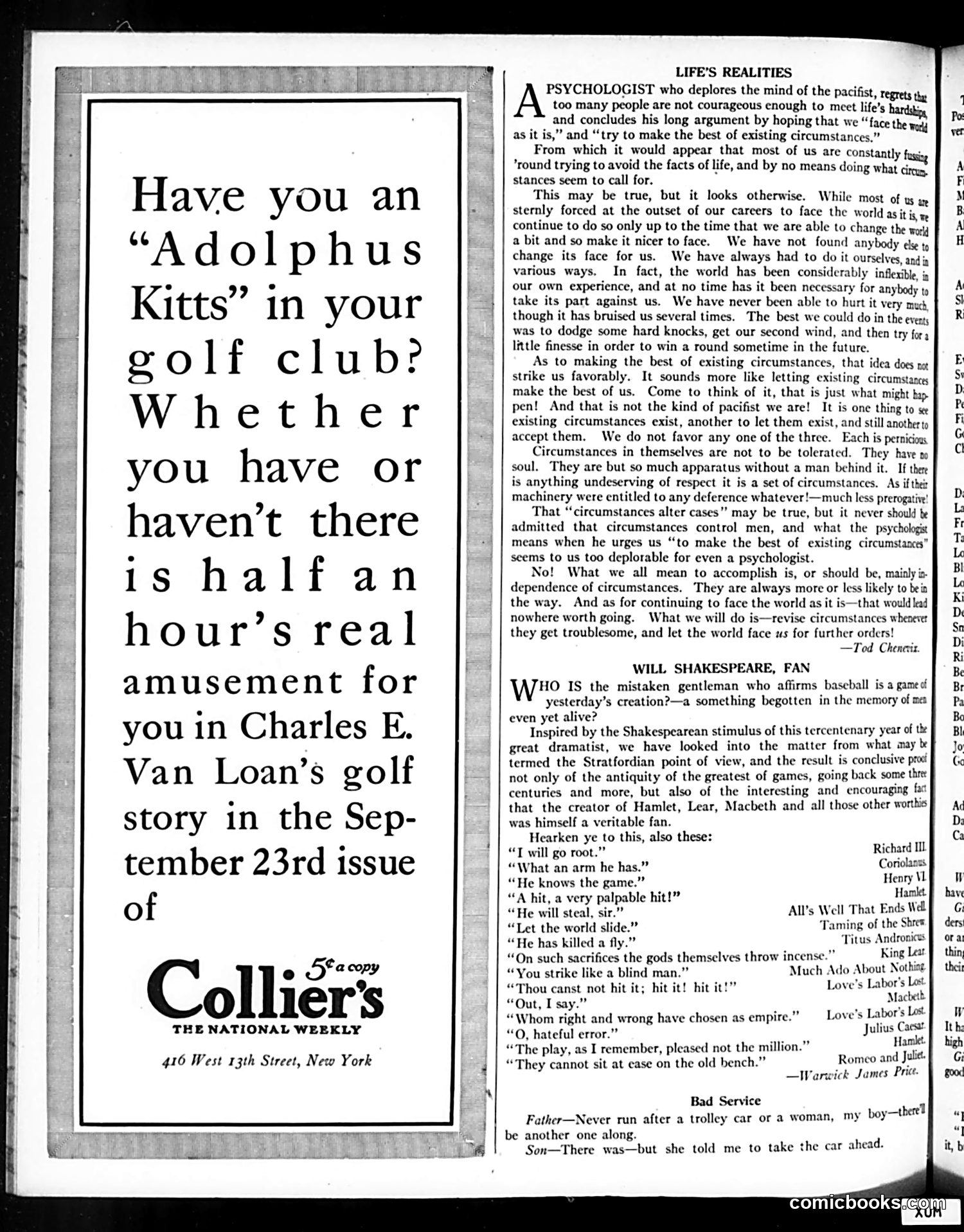
This page contains two distinct elements: **LEFT SIDE:** An advertisement for Collier's magazine promoting a golf story called "Adolphus Kitts" by Charles E. Van Loan. The ad uses humor by asking if readers have such a character in their golf club, promising entertainment value. **RIGHT SIDE:** Two satirical essays: 1. **"Life's Realities"** critiques pacifist psychology—specifically a psychologist's advice to "make the best of existing circumstances." The author argues this is passive defeatism. Instead, people should actively *change* troublesome circumstances rather than merely accept them. This appears to be commentary on early 20th-century debates about pacifism vs. active engagement with life's challenges. 2. **"Will Shakespeare, Fan"** humorously argues that Shakespeare was a baseball fan, citing baseball-related phrases from his plays (hitting, stealing bases, etc.). This is playful wordplay celebrating both Shakespeare's 300th-anniversary year and baseball's perceived antiquity, framing the Bard as an American sports enthusiast. Both pieces exemplify Judge's satirical approach to social commentary.
📄 Transcribed text from this page (OCR, searchable)
Machine-transcribed from the original scan — historical spelling and the odd misread are preserved.
Have you an “Adolphus Kitts” in your golf club? Whether you have or haven’t there is half an hour’s real amusement for you in Charles E. Van Loan’s golf story in the Sep- tember 23rd issue of 416 West 13th Street, New York LIFE’S REALITIES [ey who deplores the mind of the pacifist, regrets too many people are not courageous enough to meet life’s a and concludes his long argument by hoping that we “face the wg as it is,” and “try to make the best of existing circumstances,” From which it would appear that most of us are constantly fuss ‘round trying to avoid the facts of life, and by no means doing what circus, stances seem to call for. This may be true, but it looks otherwise. While most of US an sternly forced at the outset of our careers to face the world as it is, wr continue to do so only up to the time that we are able to change the world a bit and so make it nicer to face. We have not found anybody else to change its face for us. We have always had to do it ourselves, andia various ways. In fact, the world has been considerably inflexible, ip our own experience, and at no time has it been necessary for anybody to take its part against us. We have never been able to hurt it very much, though it has bruised us several times. The best we could do in the events was to dodge some hard knocks, get our second wind, and then try for 2 Intle finesse in order to win a round sometime in the future. As to making the best of existing circumstances, that idea does net strike us favorably. It sounds more like letting existing circumstances make the best of us. Come to think of it, that is just what might bap pen! And that is not the kind of pacifist we are! It is one thing to xe existing circumstances exist, another to let them exist, and still anotherto accept them. We do not favor any one of the three. Each is pernicious Circumstances in themselves are not to be tolerated. They have to soul. They are but so much apparatus without a man behind it. If there is anything undeserving of respect it is a set of circumstances. As if ther machinery were entitled to any deference whatever!—much less prerogative! That “circumstances alter cases” may be true, but it never should be admitted that circumstances control men, and what the psychologist means when he urges us “to make the best of existing circumstances” seems to us too deplorable for even a psychologist. No! What we all mean to accomplish is, or should be, mainly dependence of circumstances. They are always more or less likely to bein the way. And as for continuing to face the world as it is—that would lad nowhere worth going. What we will do is—revise circumstances whenever they get troublesome, and let the world face us for further orders! —Tod Chenevis. WILL SHAKESPEARE, FAN Wo IS the mistaken gentleman who affirms baseball is a gamed yesterday’s creation?—a something begotten in the memory of ma even yet alive? Inspired by the Shakespearean stimulus of this tercentenary year of the great dramatist, we have looked into the matter from what may be termed the Stratfordian point of view, and the result is conclusive proc not only of the antiquity of the greatest of games, going back some three centuries and more, but also of the interesting and encouraging fac that the creator of Hamlet, Lear, Macbeth and all those other worthies was himself a veritable fan. Hearken ye to this, also these: “T will go root.” “What an arm he has.” “He knows the game.” “A hit, a very palpable hit!” “He will steal, sir.” “Let the world slide.” nin “He has killed a fly.” Titus Andronice “On such sacrifices the gods themselves throw incense.”” King Last “You strike like a blind man.” Much Ado About No int “Thou canst not hit it; hit it! hit it!” Love's Labor's Lot “Out, I say.” Mactett “Whom right and wrong have chosen as empire.”” Love's Labor $ Las. “O, hateful error.” june “The play, as I remember, pleased not the million.” ane “They cannot sit at case on the old bench.” Romeo and Jt —Warwick James Pre. Richard IL All’s Well That Ends Wel ‘Taming of the $ Bad Service Father—Never run after a trolley car or a woman, be another one along. Son—There was—but she told me to take my boy—therel the car ahead. “] ps it, b COMED CON mm a)